Manjasetty, Babu wrote:
Hi there,
1. See attached for life-time of crystals ("How long will my crystal lost?") at various beamlines in the world.
2. The citations for the beauty and quality of the datasets from bending magnet beamlines. Please read most of the papers from Dauter group.
Cheers,
-Babu
Well, it's certainly interesting to see how far my little document has
gone! As one might infer from the URL in the header of the PDF Babu has
just posted, I made this document for the radiation damage session at
ACA this year. So, I thought I should take this moment to claim
responsibility for it. If anyone out there feels like this document has
errors or omissions, please do not flame Babu about it. Send all
complaints and corrections to [EMAIL PROTECTED] Send them quickly too,
I'm getting the impression that I should publish this document properly.
As for the original question that launched this thread: I generally
advise my users to use a beam that is the same size as their crystal.
Bathing is important, but after you are clean, it is a waste.
IMHO, The only time you want to use a beam smaller than your crystal is
if there are parts of your crystal you want to avoid. An example given
already is a needle crystal that has been bent. It is not hard to
imagine a bent needle crystal as a pile of plate crystals stacked along
a curved path. Thus the bend results in a wider "mosaic spread". Using
a smaller beam will make the "mosaic spread" smaller because "plates"
nearer each other in the bent needle have more similar orientations.
The only time you want to use a beam larger than your crystal is if you
think you can live with the extra background. An over-sized beam
obviously simplifies the "crystal-centering problem" as well as the
"flicker noise" induced if the crystal is vibrating. However, in a
"properly done experiment" (a centered crystal that doesn't shake),
there is no real advantage to using an over-sized beam. Since the
strength of diffraction spots is proportional to the crystal volume
(roughly the third power of the linear "size") as your shoot smaller and
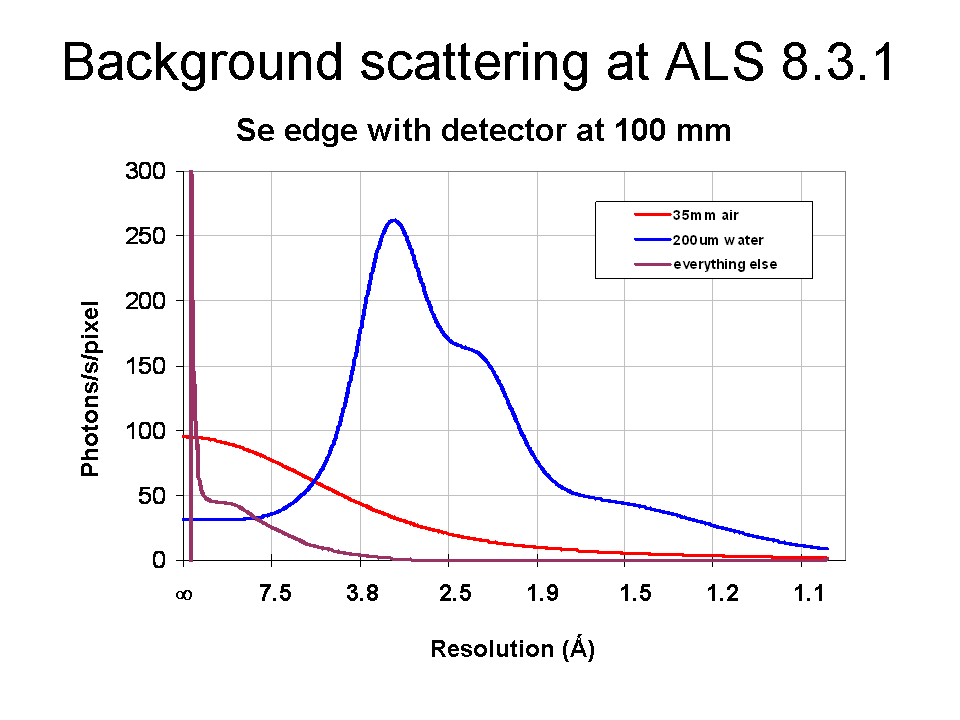
smaller crystals, the background will eventually kill you. I measured
the background on ALS 8.3.1 on an absolute scale here:
http://bl831.als.lbl.gov/~jamesh/pickup/background_scatter.png
The rule of thumb (as Colin pointed out) is that 1 mm of air is about
equal to 1 micron of sample. This is because the air and the sample are
basically made of the same stuff (nitrogen) and air is ~1/1000 the
density of a protein crystal. As you go to higher and higher angles,
the "form factor" of water, protein or most any substance will approach
that of a "single atom" of that substance. Hence, the rule of thumb
applies in the domain of "high-res" spots.
WRT helium paths:
Scattering is proportional to the square of the number of electrons, so
(at high res) He will produce (7/2)^2 ~1/12 the background from nitrogen
(air). When it comes to forward scattering, N2 has 14 electrons in it,
not 7. So, the difference in "low-res" scattering from N2 vs He is a
factor of 49. My colleague Scott Classen has verified this experimentally:
http://bl1231.als.lbl.gov/2006/05/helium_box.php
So I would say a He box is certainly worth it, as long as your sample
(crystal and surrounding material) is on the order of ~1/1000th the air
path (or smaller).
It is also important to bear in mind that not all of the background you
see on a "no-sample" image is "air scatter". A significant contribution
to background can come from the pinhole/slits, or even from stuff
upstream of them. The "everything else" line in the
background_scatter.png graph above is generated by subtracting the
calibrated air scatter from a "no sample" image. Note the sharp spike
near the beamstop. I'm not sure what this is, but it is NOT air
scatter. It is also not x-ray fluorescence from the pinhole or
beamstop. I am still trying to figure out exactly what kind of physics
produces these photons, but diffuse scatter from the pinhole (if there
is such a thing) or SAXS from the mirrors may be culprits. If anyone
has any ideas about what could give you a sharp spike just around the
beamstop, I'd like to hear it.
-James Holton
MAD Scientist