Hello Dale,

Thank you for the correction/ clarification.
I think this is still a tricky question, as in solution, this is an average
state and one doesn't have a stable hydrogen (or two) sitting discretely on the
phosphate. More specifically, the hydrogens are coming off and popping back on
constantly (just the ratios change depending on the pH). It is likely that the
phosphate is also moving in and out of the binding site of a protein in
solution. What state is captured in a crystal structure and is that consistent
across all of the proteins in that crystal?
As you say, one needs very high resolution to determine the bond length
difference between those oxygens with and without a potential hydrogen attached
to orient a phosphate correctly in a structure, assuming that there is only a
single preferred orientation to start with.
I believe the original question was whether in fact the density supported a
phosphate ion, and I still believe that looking for some anomalous signal may
be a good way to approach that question.
Nonetheless, I stand corrected and there is likely to be some hydrogen on
phosphate ions found in crystal structures.
Happy holidays to all, tom
________________________________
From: Dale Tronrud <[email protected]>
Sent: Monday, December 25, 2023 8:52 PM
To: Tom Peat <[email protected]>; [email protected] <[email protected]>
Subject: Re: [ccp4bb] Query on density fitting to phosphate
[You don't often get email from [email protected]. Learn why this is
important at https://aka.ms/LearnAboutSenderIdentification ]

Hi,

    I wanted to correct a statement by Prof. Peat about the ionic state
of phosphate in solution.  Phosphate has four states differing by the
number of attached hydrogen atoms.  The number of hydrogen atoms depends
on the pH, or maybe it is the other way around since phosphate is used
as a buffer.  I've attached a plot of the fraction of each species as a
function of pH (Citation: "By Clarolux - Own work, CC BY-SA 4.0,
https://commons.wikimedia.org/w/index.php?curid=90586171";).  There you
can see that for all pH's usually seen in mother liquors the solution is
almost completely either HPO4(-2) and H2PO4(-1).  A binding site may, of
course, prefer a species that is present in low concentration but such a
protein will be fighting entropy to fill its pocket.

    Unless your mother liquor has an extreme pH you should expect that
the phosphate species you are seeing in your crystal has either one or
two hydrogen atoms attached.  Their presence will affect both the nature
of the hydrogen bonding of the protein to the phosphate and will change
the length of the P-O bonds (with the P-O-H bond being about 0.05 A
longer than the P=O bond).  The two lengths will only be distinguishable
given very high resolution diffraction data but there are examples in
the PDB where the differences are clear.  You can determine the presence
of an hydrogen atom at much lower resolution if the hydrogen bond is
made with an obligate hydrogen bond acceptor.

    The inappropriate identification of an ion as PO4(-3) will
significantly degrade the quality of any electrostatic potential one
calculates from the model.

    I did a quick-and-dirty search of the PDB for the various species of
phosphates in PDB entries.  While I found 5979 models with PO4(-3) (ID:
PO4) I only found 42 with HPO4(-2) (ID: PI) and 27 with H2PO4(-1) (ID:
2HP).  I didn't find any H3PO4 and could not find an ID code for that
molecule.  (This search was done quite a while ago.)   I believe
depositors are mostly assuming the ID PO4 indicates any protonation of a
phosphate ion but that is not correct.  I am unaware of any ID that is
defined as a phosphate ion with unknown protonation state.  To conform
to the wwPDB standards a depositor must do their best, using the limited
data available to them, to choose one species of phosphate when they
identify the presence of one, but almost certainly that choice should
not be PO4.

As usual, just causing trouble,
Dale E. Tronrud

On 12/17/2023 1:05 PM, Tom Peat wrote:
> Dear Arpita,
>
> The hydrogens on phosphate, just like sodium and potassium, will come
> off the oxygens in water.
> To be more explicit, you don't have mono- or di-hydrogen phosphate in
> water (except transiently), you just have phosphate, depending somewhat
> on the pH of course. At 2.5 Angstrom resolution, there is no way to
> 'see' hydrogens with X-rays.
> Depending on the wavelength you used for your data collection, you could
> try doing an anomalous map and see if you have any anomalous signal at
> this position, which may help in identifying what the density is.
> Best of luck, tom
>
> ------------------------------------------------------------------------
> *From:* CCP4 bulletin board <[email protected]> on behalf of Arpita
> Goswami <[email protected]>
> *Sent:* Sunday, December 17, 2023 9:46 PM
> *To:* [email protected] <[email protected]>
> *Subject:* [ccp4bb] Query on density fitting to phosphate
>
> You don't often get email from [email protected]. Learn why this is
> important <https://aka.ms/LearnAboutSenderIdentification>
>
>
> Dear All,
>
> Hope you all are doing well.
>
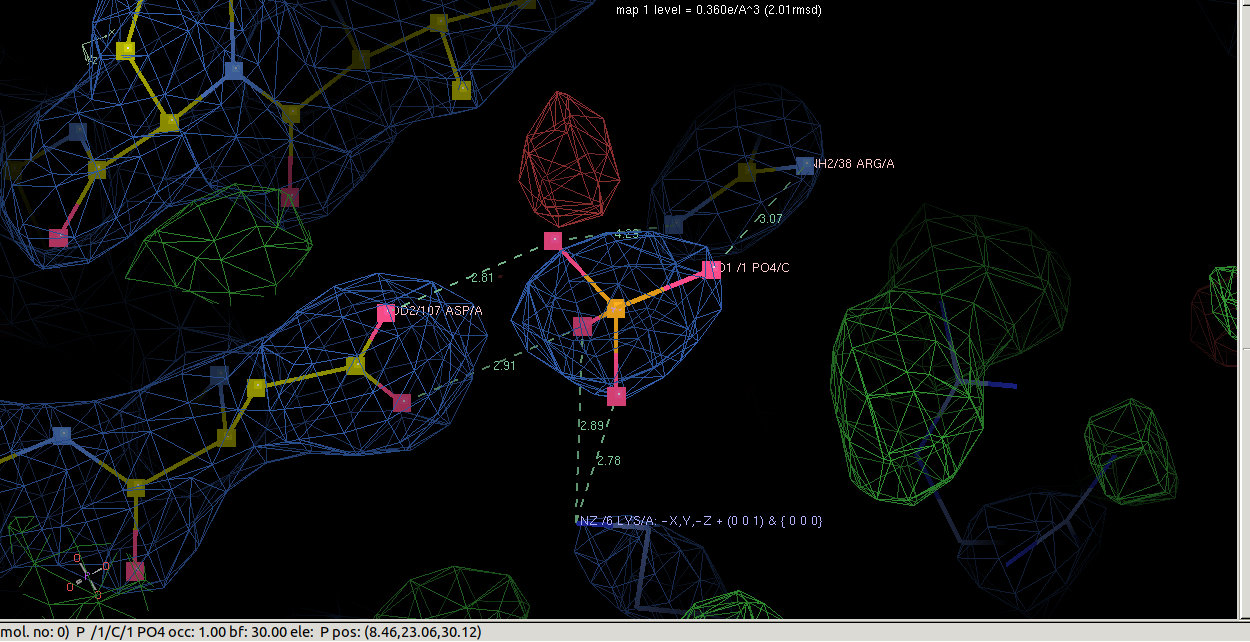
> The density in the image (in link below)  is fitted with PO4 ion,
> although the crystallization condition has both mono and dihydrogen
> phosphate which is not fitting without hydrogen. But the resolution is
> 2.5 A, so hydrogen may not be put in, or is there any way to do so?
> Otherwise placing water is the final option.
>
> https://i.postimg.cc/4N7q2K0p/Screenshot-from-2023-12-17-16-07-07.png
> <https://i.postimg.cc/4N7q2K0p/Screenshot-from-2023-12-17-16-07-07.png>
>
> Also the density is quite close to Aspartate, so PO4 may not be right.
> Can it be dihydrogen phosphate as two positively charged residues
> (Specially the lysine) are also nearby to neutralize positive charge?
> Other ions in the crystallization condition are Cl-, K+ and Na+. These
> are not put as both aspartate and lysine are at comparable distances
> from the density. The pH is 6.2 in which dihydrogen phosphate is
> reported to interact with aspartate
> (https://www.ncbi.nlm.nih.gov/pmc/articles/PMC5855859/
> <https://www.ncbi.nlm.nih.gov/pmc/articles/PMC5855859/>).
>
> Waiting eagerly for your reply.
> --
> Thanks and Merry Christmas in advance.
> Best Regards,
> Arpita
>
> ------------------------------------------------------------------------
>
> To unsubscribe from the CCP4BB list, click the following link:
> https://www.jiscmail.ac.uk/cgi-bin/WA-JISC.exe?SUBED1=CCP4BB&A=1
> <https://www.jiscmail.ac.uk/cgi-bin/WA-JISC.exe?SUBED1=CCP4BB&A=1>
>
>
> ------------------------------------------------------------------------
>
> To unsubscribe from the CCP4BB list, click the following link:
> https://www.jiscmail.ac.uk/cgi-bin/WA-JISC.exe?SUBED1=CCP4BB&A=1
> <https://www.jiscmail.ac.uk/cgi-bin/WA-JISC.exe?SUBED1=CCP4BB&A=1>
>

########################################################################

To unsubscribe from the CCP4BB list, click the following link:
https://www.jiscmail.ac.uk/cgi-bin/WA-JISC.exe?SUBED1=CCP4BB&A=1

This message was issued to members of www.jiscmail.ac.uk/CCP4BB, a mailing list
hosted by www.jiscmail.ac.uk, terms & conditions are available at
https://www.jiscmail.ac.uk/policyandsecurity/