Lunderberg commented on code in PR #100:
URL: https://github.com/apache/tvm-rfcs/pull/100#discussion_r1160804586
########## rfcs/0100-sparestir-dialect.md: ########## @@ -0,0 +1,658 @@ +- Feature Name: SparseTIR Dialect +- Start Date: 2023-03-31 +- RFC PR: [apache/tvm-rfcs#0100](https://github.com/apache/tvm-rfcs/pull/0100) +- Discussion forum: [#14645](https://discuss.tvm.apache.org/t/rfc-sparsetir-as-a-new-dialect-in-tvm/14645) + +# Summary +[summary]: #summary + +This RFC proposes a plan for integrating SparseTIR as a new dialect into TVM. + +# Motivation +[motivation]: #motivation + +## N0: No Sparse Support in TVM +Many Deep Learning workloads involve sparse/variable components, e.g. Mixture of Experts, Network Pruning, GNNs, and Sparse Conv. Currently, if users want to write these operators in TVM, they need to compose them with IRBuilder, which is not scalable and cannot be specified schedules. + +[SparseTIR](https://dl.acm.org/doi/10.1145/3582016.3582047) is our attempt at bringing sparsity to TVM, the basic idea is to build a dialect on top of TVM's TensorIR, and adding sparse annotations (inspired by TACO and other pioneering works in sparse compilers) as first-class members to describe formats for sparse tensors and sparse iterations. SparseTIR designs a multi-stage compilation process whose frontend IR is TACO-like sparse computation description and target IR is TensorIR: + +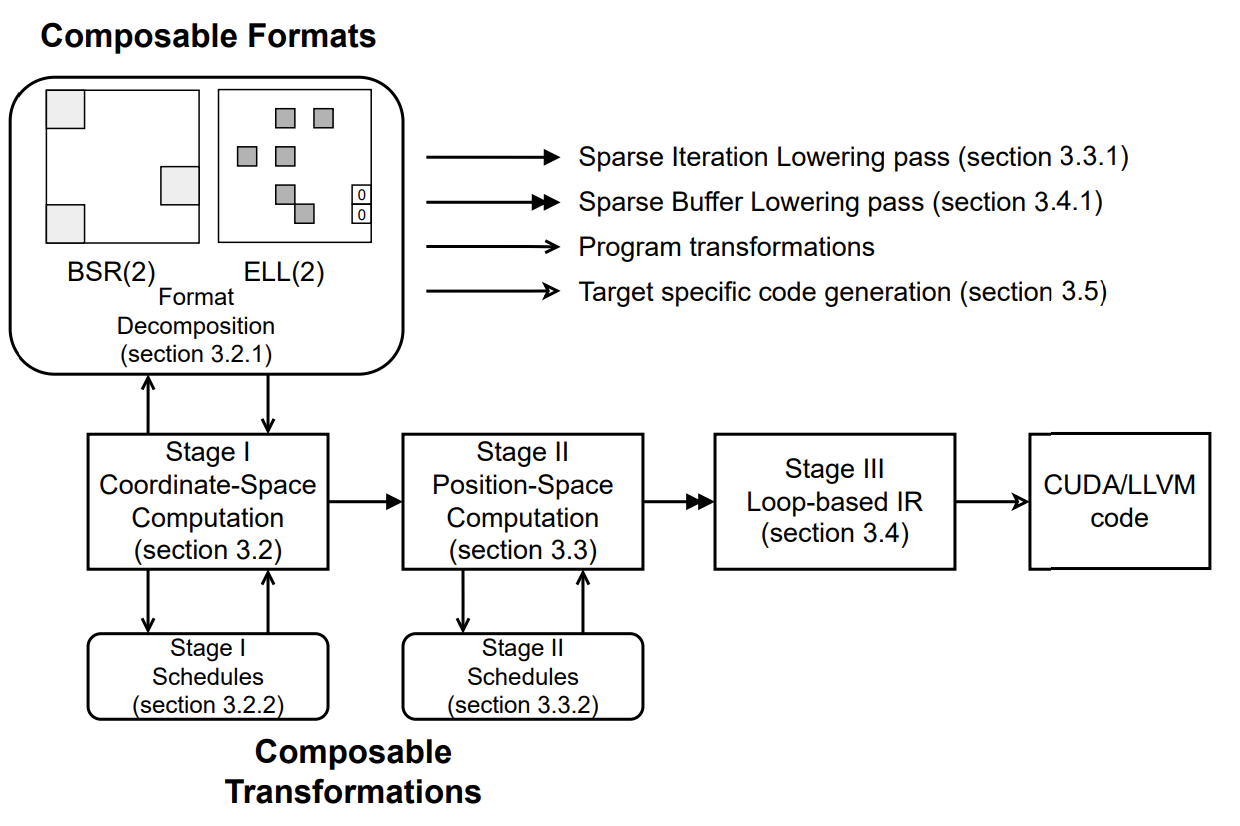 + +## N1: Sparsity-Aware Optimizations and Hardware-Aware Optimizations for Sparse Operators +A lot of optimizations and generalizations can be done under this framework. Notably composable formats and composable transformations: we can decompose the computation into several different formats where each one of them in different formats (usually more hardware friendly), and optimize computation on each one of these formats. The multi-stage design enables us to apply schedule primitives in different stages, at both high-level (stage-I) for sparsity-aware transformations and lower-level (stage-II) to reuse TVM's schedule primitives. + +# Guide-level Explanation +[guide-level-explaination]: #guide-level-explaination + +We have the following design goals of SparseTIR: + +- G0: SparseTIR is consistent with TVM's ecosystem, which means other components of TVM stack (Relax/Relay/TOPI) +can interact with SparseTIR smoothly, and enjoy of the benefits of SparseTIR. +- G1: SparseTIR is expressive, which means we can express most sparse operators in Deep Learning with SparseTIR. +- G2: SparseTIR is performant, which means we can cover optimizations used in Sparse CPU/GPU libraries. + +We will outline the detailed design in the next section. + +# Reference-level explanation +[reference-level-explanation]: #reference-level-explanation + +This section outlines the design of SparseTIR, and its interaction with existing components in TVM. + +## D0: Programming Interface + +A generic SparseTIR program looks like the following, the workload is Sampled-Dense-Dense-Matrix-Multiplication (SDDMM): + +```python [email protected]_func +def sddmm( + a: T.handle, + b: T.handle, + x: T.handle, + y: T.handle, + indptr: T.handle, + indices: T.handle, + m: T.int32, + n: T.int32, + feat_size: T.int32, + nnz: T.int32, +) -> None: + T.func_attr({"global_symbol": "main", "tir.noalias": True, "sparse_tir_level": 2}) + # sparse axes + I = T.dense_fixed(m) + J = T.sparse_variable(I, (n, nnz), (indptr, indices), "int32") + J_detach = T.dense_fixed(n) + K = T.dense_fixed(feat_size) + # sparse buffers + A = T.match_sparse_buffer(a, (I, K), "float32") + B = T.match_sparse_buffer(b, (J_detach, K), "float32") + X = T.match_sparse_buffer(x, (I, J), "float32") + Y = T.match_sparse_buffer(y, (I, J), "float32") + # sparse iterations + with T.sp_iter([I, J, K], "SSR", "sddmm") as [i, j, k]: + with T.init(): + Y[i, j] = 0.0 + Y[i, j] = Y[i, j] + A[i, k] * B[j, k] * X[i, j] +``` + +where we have constructs like **sparse axes**, **sparse buffers** and **sparse iterations**. + +### Sparse Axis +Sparse axis is a generation of per-dimensional level formats in TACO where we annotate each dimension of a format as **dense**/**sparse** (this dimension is stored in dense or compressed storage) and **fixed**/**variable** (this dimension's extent is fixed or variable). For **sparse**/**variable** axes, we need to specify its dependent axis. + +- For axes that are **sparse**, we need to specify a `indices` array to store the column indices. +- For axes that are **variable**, we need to specify an `indptr` (short for indices pointer) array to store the start offset of each row because the row length is variable and we cannot simply compute element offset with an affine map of indices. +- An axes that is both **sparse** and **variable** need to be specified with both **indices** and **indptr** array. + +```python Review Comment: Nit: Can the different sparse axis definitions be moved under the `T.axis` namespace, similar to `T.axis.spatial`? ########## rfcs/0100-sparestir-dialect.md: ########## @@ -0,0 +1,658 @@ +- Feature Name: SparseTIR Dialect +- Start Date: 2023-03-31 +- RFC PR: [apache/tvm-rfcs#0100](https://github.com/apache/tvm-rfcs/pull/0100) +- Discussion forum: [#14645](https://discuss.tvm.apache.org/t/rfc-sparsetir-as-a-new-dialect-in-tvm/14645) + +# Summary +[summary]: #summary + +This RFC proposes a plan for integrating SparseTIR as a new dialect into TVM. + +# Motivation +[motivation]: #motivation + +## N0: No Sparse Support in TVM +Many Deep Learning workloads involve sparse/variable components, e.g. Mixture of Experts, Network Pruning, GNNs, and Sparse Conv. Currently, if users want to write these operators in TVM, they need to compose them with IRBuilder, which is not scalable and cannot be specified schedules. + +[SparseTIR](https://dl.acm.org/doi/10.1145/3582016.3582047) is our attempt at bringing sparsity to TVM, the basic idea is to build a dialect on top of TVM's TensorIR, and adding sparse annotations (inspired by TACO and other pioneering works in sparse compilers) as first-class members to describe formats for sparse tensors and sparse iterations. SparseTIR designs a multi-stage compilation process whose frontend IR is TACO-like sparse computation description and target IR is TensorIR: + + + +## N1: Sparsity-Aware Optimizations and Hardware-Aware Optimizations for Sparse Operators +A lot of optimizations and generalizations can be done under this framework. Notably composable formats and composable transformations: we can decompose the computation into several different formats where each one of them in different formats (usually more hardware friendly), and optimize computation on each one of these formats. The multi-stage design enables us to apply schedule primitives in different stages, at both high-level (stage-I) for sparsity-aware transformations and lower-level (stage-II) to reuse TVM's schedule primitives. + +# Guide-level Explanation +[guide-level-explaination]: #guide-level-explaination + +We have the following design goals of SparseTIR: + +- G0: SparseTIR is consistent with TVM's ecosystem, which means other components of TVM stack (Relax/Relay/TOPI) +can interact with SparseTIR smoothly, and enjoy of the benefits of SparseTIR. +- G1: SparseTIR is expressive, which means we can express most sparse operators in Deep Learning with SparseTIR. +- G2: SparseTIR is performant, which means we can cover optimizations used in Sparse CPU/GPU libraries. + +We will outline the detailed design in the next section. + +# Reference-level explanation +[reference-level-explanation]: #reference-level-explanation + +This section outlines the design of SparseTIR, and its interaction with existing components in TVM. + +## D0: Programming Interface + +A generic SparseTIR program looks like the following, the workload is Sampled-Dense-Dense-Matrix-Multiplication (SDDMM): + +```python [email protected]_func +def sddmm( + a: T.handle, + b: T.handle, + x: T.handle, + y: T.handle, + indptr: T.handle, + indices: T.handle, + m: T.int32, + n: T.int32, + feat_size: T.int32, + nnz: T.int32, +) -> None: + T.func_attr({"global_symbol": "main", "tir.noalias": True, "sparse_tir_level": 2}) + # sparse axes + I = T.dense_fixed(m) + J = T.sparse_variable(I, (n, nnz), (indptr, indices), "int32") + J_detach = T.dense_fixed(n) + K = T.dense_fixed(feat_size) + # sparse buffers + A = T.match_sparse_buffer(a, (I, K), "float32") + B = T.match_sparse_buffer(b, (J_detach, K), "float32") + X = T.match_sparse_buffer(x, (I, J), "float32") + Y = T.match_sparse_buffer(y, (I, J), "float32") + # sparse iterations + with T.sp_iter([I, J, K], "SSR", "sddmm") as [i, j, k]: + with T.init(): + Y[i, j] = 0.0 + Y[i, j] = Y[i, j] + A[i, k] * B[j, k] * X[i, j] +``` + +where we have constructs like **sparse axes**, **sparse buffers** and **sparse iterations**. + +### Sparse Axis +Sparse axis is a generation of per-dimensional level formats in TACO where we annotate each dimension of a format as **dense**/**sparse** (this dimension is stored in dense or compressed storage) and **fixed**/**variable** (this dimension's extent is fixed or variable). For **sparse**/**variable** axes, we need to specify its dependent axis. + +- For axes that are **sparse**, we need to specify a `indices` array to store the column indices. +- For axes that are **variable**, we need to specify an `indptr` (short for indices pointer) array to store the start offset of each row because the row length is variable and we cannot simply compute element offset with an affine map of indices. +- An axes that is both **sparse** and **variable** need to be specified with both **indices** and **indptr** array. + +```python +I = T.dense_fixed(m) +# J1 is a sparse fixed axis, whose dependent axis is I +# it has maximum length n and number of non-zero elements per row: c, Review Comment: Why does this function need the number of non-zero elements per row `c`? That should be inferrable from the shape of the `indices_1` buffer without requiring it to be explicitly specified separately. ########## rfcs/0100-sparestir-dialect.md: ########## @@ -0,0 +1,658 @@ +- Feature Name: SparseTIR Dialect +- Start Date: 2023-03-31 +- RFC PR: [apache/tvm-rfcs#0100](https://github.com/apache/tvm-rfcs/pull/0100) +- Discussion forum: [#14645](https://discuss.tvm.apache.org/t/rfc-sparsetir-as-a-new-dialect-in-tvm/14645) + +# Summary +[summary]: #summary + +This RFC proposes a plan for integrating SparseTIR as a new dialect into TVM. + +# Motivation +[motivation]: #motivation + +## N0: No Sparse Support in TVM +Many Deep Learning workloads involve sparse/variable components, e.g. Mixture of Experts, Network Pruning, GNNs, and Sparse Conv. Currently, if users want to write these operators in TVM, they need to compose them with IRBuilder, which is not scalable and cannot be specified schedules. + +[SparseTIR](https://dl.acm.org/doi/10.1145/3582016.3582047) is our attempt at bringing sparsity to TVM, the basic idea is to build a dialect on top of TVM's TensorIR, and adding sparse annotations (inspired by TACO and other pioneering works in sparse compilers) as first-class members to describe formats for sparse tensors and sparse iterations. SparseTIR designs a multi-stage compilation process whose frontend IR is TACO-like sparse computation description and target IR is TensorIR: + + + +## N1: Sparsity-Aware Optimizations and Hardware-Aware Optimizations for Sparse Operators +A lot of optimizations and generalizations can be done under this framework. Notably composable formats and composable transformations: we can decompose the computation into several different formats where each one of them in different formats (usually more hardware friendly), and optimize computation on each one of these formats. The multi-stage design enables us to apply schedule primitives in different stages, at both high-level (stage-I) for sparsity-aware transformations and lower-level (stage-II) to reuse TVM's schedule primitives. + +# Guide-level Explanation +[guide-level-explaination]: #guide-level-explaination + +We have the following design goals of SparseTIR: + +- G0: SparseTIR is consistent with TVM's ecosystem, which means other components of TVM stack (Relax/Relay/TOPI) +can interact with SparseTIR smoothly, and enjoy of the benefits of SparseTIR. +- G1: SparseTIR is expressive, which means we can express most sparse operators in Deep Learning with SparseTIR. +- G2: SparseTIR is performant, which means we can cover optimizations used in Sparse CPU/GPU libraries. + +We will outline the detailed design in the next section. + +# Reference-level explanation +[reference-level-explanation]: #reference-level-explanation + +This section outlines the design of SparseTIR, and its interaction with existing components in TVM. + +## D0: Programming Interface + +A generic SparseTIR program looks like the following, the workload is Sampled-Dense-Dense-Matrix-Multiplication (SDDMM): + +```python [email protected]_func +def sddmm( + a: T.handle, + b: T.handle, + x: T.handle, + y: T.handle, + indptr: T.handle, + indices: T.handle, + m: T.int32, + n: T.int32, + feat_size: T.int32, + nnz: T.int32, +) -> None: + T.func_attr({"global_symbol": "main", "tir.noalias": True, "sparse_tir_level": 2}) + # sparse axes + I = T.dense_fixed(m) + J = T.sparse_variable(I, (n, nnz), (indptr, indices), "int32") + J_detach = T.dense_fixed(n) + K = T.dense_fixed(feat_size) + # sparse buffers + A = T.match_sparse_buffer(a, (I, K), "float32") + B = T.match_sparse_buffer(b, (J_detach, K), "float32") + X = T.match_sparse_buffer(x, (I, J), "float32") + Y = T.match_sparse_buffer(y, (I, J), "float32") + # sparse iterations + with T.sp_iter([I, J, K], "SSR", "sddmm") as [i, j, k]: + with T.init(): + Y[i, j] = 0.0 + Y[i, j] = Y[i, j] + A[i, k] * B[j, k] * X[i, j] +``` + +where we have constructs like **sparse axes**, **sparse buffers** and **sparse iterations**. + +### Sparse Axis +Sparse axis is a generation of per-dimensional level formats in TACO where we annotate each dimension of a format as **dense**/**sparse** (this dimension is stored in dense or compressed storage) and **fixed**/**variable** (this dimension's extent is fixed or variable). For **sparse**/**variable** axes, we need to specify its dependent axis. + +- For axes that are **sparse**, we need to specify a `indices` array to store the column indices. +- For axes that are **variable**, we need to specify an `indptr` (short for indices pointer) array to store the start offset of each row because the row length is variable and we cannot simply compute element offset with an affine map of indices. +- An axes that is both **sparse** and **variable** need to be specified with both **indices** and **indptr** array. + +```python +I = T.dense_fixed(m) +# J1 is a sparse fixed axis, whose dependent axis is I +# it has maximum length n and number of non-zero elements per row: c, +# the column indices data are stored in the region started from indices_1 handle, +# and the index data type (in indices array) is int32. +J1 = T.sparse_fixed(I, (n, c), indices_1, idtype="int32") +# J2 is a dense variable axis, whose dependent axis is I, +# it has a maximum length of n, +# the indptr data are stored in the region started from indptr_2 handle, +# and the index data type (in indptr array) is int32. +J2 = T.dense_variable(I, n, indptr_2, idtype="int32") +# J3 is a sparse variable axis, whose dependent axis is J1, +# it has maximum length of n1, number of elements nnz in the space composed of (I, J1, J3), +# the indptr data are stored in the region started from indptr_3 handle, +# and the indices data are stored in the region started from indices_3 handle, +# the index data type (of indptr and indices array) is "int64") +J3 = T.sparse_variable(J1, (n1, nnz), (indptr_3, indices_3), idtype="int34") +``` + +### Sparse Buffer + +User can create sparse buffers with following APIs in SparseTIR: +``` +A = T.match_sparse_buffer(a, (I, J1), dtype="float32", scope="global") +B = T.alloc_sparse_buffer((I, j2), dtype="float32", scope="shared") +``` +Their semantics are very similar to the existing `match_buffer` and `alloc_buffer` constructs in TensorIR, with the exception that we accept an array of sparse axes as shape. +- The `match_sparse_buffer` binds a sparse format with a handle(pointer) `a` to the start of a user-specified input/output array that stores the value inside the sparse buffer. +- The `alloc_sparse_buffer` create a sparse buffer without binding to input or output and always acts as an intermediate buffer. + +The storage of sparse tensors in SparseTIR follows the design of [Compressed Sparse Fiber](http://shaden.io/pub-files/smith2017knl.pdf) which is a natural extension of CSR format to high dimensional. Note that SparseTIR decouples the storage of `value` with auxiliary structure information such as `indptr` and `indices`: the `value` array is bonded with sparse buffers and the `indptr` and `indices` array is bonded to axes. Such design enables us to share structure information for different buffers (e.g. in the SDDMM example shown above, the `X` and `Y` sparse buffers share structure and we don't need duplicate storage for their `indptr` and `indices`). + +We can express sparse tensors stored in various formats using the *sparse axis* and *sparse buffer* construct: +```python +# ELLPack format, with number of columns per row 4 +I = T.dense_fixed(m) +J = T.sparse_fixed(I, (n, 4), indices, idtype="int32") +A = T.match_sparse_buffer(a, (I, J), dtype="float32") +``` +```python +# 2D Ragged Tensor +I = T.dense_fixed(m) +J = T.dense_variable(I, n, indptr, idtype="int32") +A = T.match_sparse_buffer(a, (I, J), dtype="float32") +``` +```python +# Doubly Compressed Sparse Row (DCSR) +O = T.dense_fixed(1) # A placeholder axis to create axis I. +I = T.sparse_variable(O, (m, nnz1), (indptr_i, indices_i), idtype="int32") +J = T.sparse_variable(I, (n, nnz2), (indptr_j, indices_j), idtype="int32") +A = T.match_sparse_buffer(a, (O, I, J), dtype="float32") +``` +```python +# Block Compressed Sparse Row (BCSR) +IO = T.dense_fixed(mb) +JO = T.sparse_variable(IO, (nb, nnzb), (indptr, indices), idtype="int32") +II = T.dense_fixed(block_size) +JI = T.dense_fixed(block_size) +A = T.match_sparse_buffer(a, (IO, JO, II, JI), dtype="float32") +``` + +### Sparse Iteration + +To create an iteration space, SparseTIR provides a structure called **sparse iteration**, which accepts an array of sparse axes as input and emits correspondingly iterators on these axes, user can write computations inside the body of sparse iterations: +```python +with T.sp_iter([I, J, K], "SSR", "sddmm") as [i, j, k]: + with T.init(): + Y[i, j] = 0.0 + Y[i, j] = Y[i, j] + A[i, k] * B[j, k] * X[i, j] +``` +here the `SSR` means the three iterators are `spatial` or `reduction`, which follows the design of TensorIR. `sddmm` is the name of the sparse iteration for reference when applying schedule primitives. Review Comment: Why does the sparse iteration require an explicit name? As a user, I'd expect `sch.get_loop("block_name")` to return all iterators known by the block, regardless of whether they are sparse iterators or not. ########## rfcs/0100-sparestir-dialect.md: ########## @@ -0,0 +1,658 @@ +- Feature Name: SparseTIR Dialect +- Start Date: 2023-03-31 +- RFC PR: [apache/tvm-rfcs#0100](https://github.com/apache/tvm-rfcs/pull/0100) +- Discussion forum: [#14645](https://discuss.tvm.apache.org/t/rfc-sparsetir-as-a-new-dialect-in-tvm/14645) + +# Summary +[summary]: #summary + +This RFC proposes a plan for integrating SparseTIR as a new dialect into TVM. + +# Motivation +[motivation]: #motivation + +## N0: No Sparse Support in TVM +Many Deep Learning workloads involve sparse/variable components, e.g. Mixture of Experts, Network Pruning, GNNs, and Sparse Conv. Currently, if users want to write these operators in TVM, they need to compose them with IRBuilder, which is not scalable and cannot be specified schedules. + +[SparseTIR](https://dl.acm.org/doi/10.1145/3582016.3582047) is our attempt at bringing sparsity to TVM, the basic idea is to build a dialect on top of TVM's TensorIR, and adding sparse annotations (inspired by TACO and other pioneering works in sparse compilers) as first-class members to describe formats for sparse tensors and sparse iterations. SparseTIR designs a multi-stage compilation process whose frontend IR is TACO-like sparse computation description and target IR is TensorIR: + + + +## N1: Sparsity-Aware Optimizations and Hardware-Aware Optimizations for Sparse Operators +A lot of optimizations and generalizations can be done under this framework. Notably composable formats and composable transformations: we can decompose the computation into several different formats where each one of them in different formats (usually more hardware friendly), and optimize computation on each one of these formats. The multi-stage design enables us to apply schedule primitives in different stages, at both high-level (stage-I) for sparsity-aware transformations and lower-level (stage-II) to reuse TVM's schedule primitives. + +# Guide-level Explanation +[guide-level-explaination]: #guide-level-explaination + +We have the following design goals of SparseTIR: + +- G0: SparseTIR is consistent with TVM's ecosystem, which means other components of TVM stack (Relax/Relay/TOPI) +can interact with SparseTIR smoothly, and enjoy of the benefits of SparseTIR. +- G1: SparseTIR is expressive, which means we can express most sparse operators in Deep Learning with SparseTIR. +- G2: SparseTIR is performant, which means we can cover optimizations used in Sparse CPU/GPU libraries. + +We will outline the detailed design in the next section. + +# Reference-level explanation +[reference-level-explanation]: #reference-level-explanation + +This section outlines the design of SparseTIR, and its interaction with existing components in TVM. + +## D0: Programming Interface + +A generic SparseTIR program looks like the following, the workload is Sampled-Dense-Dense-Matrix-Multiplication (SDDMM): + +```python [email protected]_func +def sddmm( + a: T.handle, + b: T.handle, + x: T.handle, + y: T.handle, + indptr: T.handle, + indices: T.handle, + m: T.int32, + n: T.int32, + feat_size: T.int32, + nnz: T.int32, +) -> None: + T.func_attr({"global_symbol": "main", "tir.noalias": True, "sparse_tir_level": 2}) + # sparse axes + I = T.dense_fixed(m) + J = T.sparse_variable(I, (n, nnz), (indptr, indices), "int32") + J_detach = T.dense_fixed(n) + K = T.dense_fixed(feat_size) + # sparse buffers + A = T.match_sparse_buffer(a, (I, K), "float32") + B = T.match_sparse_buffer(b, (J_detach, K), "float32") + X = T.match_sparse_buffer(x, (I, J), "float32") + Y = T.match_sparse_buffer(y, (I, J), "float32") + # sparse iterations + with T.sp_iter([I, J, K], "SSR", "sddmm") as [i, j, k]: + with T.init(): + Y[i, j] = 0.0 + Y[i, j] = Y[i, j] + A[i, k] * B[j, k] * X[i, j] +``` + +where we have constructs like **sparse axes**, **sparse buffers** and **sparse iterations**. + +### Sparse Axis +Sparse axis is a generation of per-dimensional level formats in TACO where we annotate each dimension of a format as **dense**/**sparse** (this dimension is stored in dense or compressed storage) and **fixed**/**variable** (this dimension's extent is fixed or variable). For **sparse**/**variable** axes, we need to specify its dependent axis. Review Comment: Because a **sparse** axis must specify a dependent axis, does this mean that we cannot make a 1-d sparse buffer? ########## rfcs/0100-sparestir-dialect.md: ########## @@ -0,0 +1,658 @@ +- Feature Name: SparseTIR Dialect +- Start Date: 2023-03-31 +- RFC PR: [apache/tvm-rfcs#0100](https://github.com/apache/tvm-rfcs/pull/0100) +- Discussion forum: [#14645](https://discuss.tvm.apache.org/t/rfc-sparsetir-as-a-new-dialect-in-tvm/14645) + +# Summary +[summary]: #summary + +This RFC proposes a plan for integrating SparseTIR as a new dialect into TVM. + +# Motivation +[motivation]: #motivation + +## N0: No Sparse Support in TVM +Many Deep Learning workloads involve sparse/variable components, e.g. Mixture of Experts, Network Pruning, GNNs, and Sparse Conv. Currently, if users want to write these operators in TVM, they need to compose them with IRBuilder, which is not scalable and cannot be specified schedules. + +[SparseTIR](https://dl.acm.org/doi/10.1145/3582016.3582047) is our attempt at bringing sparsity to TVM, the basic idea is to build a dialect on top of TVM's TensorIR, and adding sparse annotations (inspired by TACO and other pioneering works in sparse compilers) as first-class members to describe formats for sparse tensors and sparse iterations. SparseTIR designs a multi-stage compilation process whose frontend IR is TACO-like sparse computation description and target IR is TensorIR: + + + +## N1: Sparsity-Aware Optimizations and Hardware-Aware Optimizations for Sparse Operators +A lot of optimizations and generalizations can be done under this framework. Notably composable formats and composable transformations: we can decompose the computation into several different formats where each one of them in different formats (usually more hardware friendly), and optimize computation on each one of these formats. The multi-stage design enables us to apply schedule primitives in different stages, at both high-level (stage-I) for sparsity-aware transformations and lower-level (stage-II) to reuse TVM's schedule primitives. + +# Guide-level Explanation +[guide-level-explaination]: #guide-level-explaination + +We have the following design goals of SparseTIR: + +- G0: SparseTIR is consistent with TVM's ecosystem, which means other components of TVM stack (Relax/Relay/TOPI) +can interact with SparseTIR smoothly, and enjoy of the benefits of SparseTIR. +- G1: SparseTIR is expressive, which means we can express most sparse operators in Deep Learning with SparseTIR. +- G2: SparseTIR is performant, which means we can cover optimizations used in Sparse CPU/GPU libraries. + +We will outline the detailed design in the next section. + +# Reference-level explanation +[reference-level-explanation]: #reference-level-explanation + +This section outlines the design of SparseTIR, and its interaction with existing components in TVM. + +## D0: Programming Interface + +A generic SparseTIR program looks like the following, the workload is Sampled-Dense-Dense-Matrix-Multiplication (SDDMM): + +```python [email protected]_func +def sddmm( + a: T.handle, + b: T.handle, + x: T.handle, + y: T.handle, + indptr: T.handle, + indices: T.handle, + m: T.int32, + n: T.int32, + feat_size: T.int32, + nnz: T.int32, +) -> None: + T.func_attr({"global_symbol": "main", "tir.noalias": True, "sparse_tir_level": 2}) + # sparse axes + I = T.dense_fixed(m) + J = T.sparse_variable(I, (n, nnz), (indptr, indices), "int32") + J_detach = T.dense_fixed(n) + K = T.dense_fixed(feat_size) + # sparse buffers + A = T.match_sparse_buffer(a, (I, K), "float32") + B = T.match_sparse_buffer(b, (J_detach, K), "float32") + X = T.match_sparse_buffer(x, (I, J), "float32") + Y = T.match_sparse_buffer(y, (I, J), "float32") + # sparse iterations + with T.sp_iter([I, J, K], "SSR", "sddmm") as [i, j, k]: + with T.init(): + Y[i, j] = 0.0 + Y[i, j] = Y[i, j] + A[i, k] * B[j, k] * X[i, j] +``` + +where we have constructs like **sparse axes**, **sparse buffers** and **sparse iterations**. + +### Sparse Axis Review Comment: This section refers to 2-d concepts of "row" and "column". How do these extend to n-dimensional buffers? ########## rfcs/0100-sparestir-dialect.md: ########## @@ -0,0 +1,658 @@ +- Feature Name: SparseTIR Dialect +- Start Date: 2023-03-31 +- RFC PR: [apache/tvm-rfcs#0100](https://github.com/apache/tvm-rfcs/pull/0100) +- Discussion forum: [#14645](https://discuss.tvm.apache.org/t/rfc-sparsetir-as-a-new-dialect-in-tvm/14645) + +# Summary +[summary]: #summary + +This RFC proposes a plan for integrating SparseTIR as a new dialect into TVM. + +# Motivation +[motivation]: #motivation + +## N0: No Sparse Support in TVM +Many Deep Learning workloads involve sparse/variable components, e.g. Mixture of Experts, Network Pruning, GNNs, and Sparse Conv. Currently, if users want to write these operators in TVM, they need to compose them with IRBuilder, which is not scalable and cannot be specified schedules. + +[SparseTIR](https://dl.acm.org/doi/10.1145/3582016.3582047) is our attempt at bringing sparsity to TVM, the basic idea is to build a dialect on top of TVM's TensorIR, and adding sparse annotations (inspired by TACO and other pioneering works in sparse compilers) as first-class members to describe formats for sparse tensors and sparse iterations. SparseTIR designs a multi-stage compilation process whose frontend IR is TACO-like sparse computation description and target IR is TensorIR: + + + +## N1: Sparsity-Aware Optimizations and Hardware-Aware Optimizations for Sparse Operators +A lot of optimizations and generalizations can be done under this framework. Notably composable formats and composable transformations: we can decompose the computation into several different formats where each one of them in different formats (usually more hardware friendly), and optimize computation on each one of these formats. The multi-stage design enables us to apply schedule primitives in different stages, at both high-level (stage-I) for sparsity-aware transformations and lower-level (stage-II) to reuse TVM's schedule primitives. + +# Guide-level Explanation +[guide-level-explaination]: #guide-level-explaination + +We have the following design goals of SparseTIR: + +- G0: SparseTIR is consistent with TVM's ecosystem, which means other components of TVM stack (Relax/Relay/TOPI) +can interact with SparseTIR smoothly, and enjoy of the benefits of SparseTIR. +- G1: SparseTIR is expressive, which means we can express most sparse operators in Deep Learning with SparseTIR. +- G2: SparseTIR is performant, which means we can cover optimizations used in Sparse CPU/GPU libraries. + +We will outline the detailed design in the next section. + +# Reference-level explanation +[reference-level-explanation]: #reference-level-explanation + +This section outlines the design of SparseTIR, and its interaction with existing components in TVM. + +## D0: Programming Interface + +A generic SparseTIR program looks like the following, the workload is Sampled-Dense-Dense-Matrix-Multiplication (SDDMM): + +```python [email protected]_func +def sddmm( + a: T.handle, + b: T.handle, + x: T.handle, + y: T.handle, + indptr: T.handle, + indices: T.handle, + m: T.int32, + n: T.int32, + feat_size: T.int32, + nnz: T.int32, +) -> None: + T.func_attr({"global_symbol": "main", "tir.noalias": True, "sparse_tir_level": 2}) + # sparse axes + I = T.dense_fixed(m) + J = T.sparse_variable(I, (n, nnz), (indptr, indices), "int32") + J_detach = T.dense_fixed(n) + K = T.dense_fixed(feat_size) + # sparse buffers + A = T.match_sparse_buffer(a, (I, K), "float32") + B = T.match_sparse_buffer(b, (J_detach, K), "float32") + X = T.match_sparse_buffer(x, (I, J), "float32") + Y = T.match_sparse_buffer(y, (I, J), "float32") + # sparse iterations + with T.sp_iter([I, J, K], "SSR", "sddmm") as [i, j, k]: + with T.init(): + Y[i, j] = 0.0 + Y[i, j] = Y[i, j] + A[i, k] * B[j, k] * X[i, j] +``` + +where we have constructs like **sparse axes**, **sparse buffers** and **sparse iterations**. + +### Sparse Axis +Sparse axis is a generation of per-dimensional level formats in TACO where we annotate each dimension of a format as **dense**/**sparse** (this dimension is stored in dense or compressed storage) and **fixed**/**variable** (this dimension's extent is fixed or variable). For **sparse**/**variable** axes, we need to specify its dependent axis. + +- For axes that are **sparse**, we need to specify a `indices` array to store the column indices. +- For axes that are **variable**, we need to specify an `indptr` (short for indices pointer) array to store the start offset of each row because the row length is variable and we cannot simply compute element offset with an affine map of indices. +- An axes that is both **sparse** and **variable** need to be specified with both **indices** and **indptr** array. + +```python +I = T.dense_fixed(m) +# J1 is a sparse fixed axis, whose dependent axis is I +# it has maximum length n and number of non-zero elements per row: c, +# the column indices data are stored in the region started from indices_1 handle, +# and the index data type (in indices array) is int32. +J1 = T.sparse_fixed(I, (n, c), indices_1, idtype="int32") Review Comment: Instead of passing the dependent axes and the indices as separate arguments, could they be passed as a single argument `indices_1[I]`? If I understand correctly, that should generalize better to N-d buffers, since they could express multiple dependent axes as `index_lookup_3d[I1, I2, I3]`. ########## rfcs/0100-sparestir-dialect.md: ########## @@ -0,0 +1,658 @@ +- Feature Name: SparseTIR Dialect +- Start Date: 2023-03-31 +- RFC PR: [apache/tvm-rfcs#0100](https://github.com/apache/tvm-rfcs/pull/0100) +- Discussion forum: [#14645](https://discuss.tvm.apache.org/t/rfc-sparsetir-as-a-new-dialect-in-tvm/14645) + +# Summary +[summary]: #summary + +This RFC proposes a plan for integrating SparseTIR as a new dialect into TVM. + +# Motivation +[motivation]: #motivation + +## N0: No Sparse Support in TVM +Many Deep Learning workloads involve sparse/variable components, e.g. Mixture of Experts, Network Pruning, GNNs, and Sparse Conv. Currently, if users want to write these operators in TVM, they need to compose them with IRBuilder, which is not scalable and cannot be specified schedules. + +[SparseTIR](https://dl.acm.org/doi/10.1145/3582016.3582047) is our attempt at bringing sparsity to TVM, the basic idea is to build a dialect on top of TVM's TensorIR, and adding sparse annotations (inspired by TACO and other pioneering works in sparse compilers) as first-class members to describe formats for sparse tensors and sparse iterations. SparseTIR designs a multi-stage compilation process whose frontend IR is TACO-like sparse computation description and target IR is TensorIR: + + + +## N1: Sparsity-Aware Optimizations and Hardware-Aware Optimizations for Sparse Operators +A lot of optimizations and generalizations can be done under this framework. Notably composable formats and composable transformations: we can decompose the computation into several different formats where each one of them in different formats (usually more hardware friendly), and optimize computation on each one of these formats. The multi-stage design enables us to apply schedule primitives in different stages, at both high-level (stage-I) for sparsity-aware transformations and lower-level (stage-II) to reuse TVM's schedule primitives. + +# Guide-level Explanation +[guide-level-explaination]: #guide-level-explaination + +We have the following design goals of SparseTIR: + +- G0: SparseTIR is consistent with TVM's ecosystem, which means other components of TVM stack (Relax/Relay/TOPI) +can interact with SparseTIR smoothly, and enjoy of the benefits of SparseTIR. +- G1: SparseTIR is expressive, which means we can express most sparse operators in Deep Learning with SparseTIR. +- G2: SparseTIR is performant, which means we can cover optimizations used in Sparse CPU/GPU libraries. + +We will outline the detailed design in the next section. + +# Reference-level explanation +[reference-level-explanation]: #reference-level-explanation + +This section outlines the design of SparseTIR, and its interaction with existing components in TVM. + +## D0: Programming Interface + +A generic SparseTIR program looks like the following, the workload is Sampled-Dense-Dense-Matrix-Multiplication (SDDMM): + +```python [email protected]_func +def sddmm( + a: T.handle, + b: T.handle, + x: T.handle, + y: T.handle, + indptr: T.handle, + indices: T.handle, + m: T.int32, + n: T.int32, + feat_size: T.int32, + nnz: T.int32, +) -> None: + T.func_attr({"global_symbol": "main", "tir.noalias": True, "sparse_tir_level": 2}) + # sparse axes + I = T.dense_fixed(m) + J = T.sparse_variable(I, (n, nnz), (indptr, indices), "int32") + J_detach = T.dense_fixed(n) + K = T.dense_fixed(feat_size) + # sparse buffers + A = T.match_sparse_buffer(a, (I, K), "float32") + B = T.match_sparse_buffer(b, (J_detach, K), "float32") + X = T.match_sparse_buffer(x, (I, J), "float32") + Y = T.match_sparse_buffer(y, (I, J), "float32") + # sparse iterations + with T.sp_iter([I, J, K], "SSR", "sddmm") as [i, j, k]: + with T.init(): + Y[i, j] = 0.0 + Y[i, j] = Y[i, j] + A[i, k] * B[j, k] * X[i, j] +``` + +where we have constructs like **sparse axes**, **sparse buffers** and **sparse iterations**. + +### Sparse Axis +Sparse axis is a generation of per-dimensional level formats in TACO where we annotate each dimension of a format as **dense**/**sparse** (this dimension is stored in dense or compressed storage) and **fixed**/**variable** (this dimension's extent is fixed or variable). For **sparse**/**variable** axes, we need to specify its dependent axis. + Review Comment: For axes that are **dense** and **fixed**, is this equivalent to a normal axis? If so, do we need to `T.dense_fixed` instead of using the existing `T.iter_var`? ########## rfcs/0100-sparestir-dialect.md: ########## @@ -0,0 +1,658 @@ +- Feature Name: SparseTIR Dialect +- Start Date: 2023-03-31 +- RFC PR: [apache/tvm-rfcs#0100](https://github.com/apache/tvm-rfcs/pull/0100) +- Discussion forum: [#14645](https://discuss.tvm.apache.org/t/rfc-sparsetir-as-a-new-dialect-in-tvm/14645) + +# Summary +[summary]: #summary + +This RFC proposes a plan for integrating SparseTIR as a new dialect into TVM. + +# Motivation +[motivation]: #motivation + +## N0: No Sparse Support in TVM +Many Deep Learning workloads involve sparse/variable components, e.g. Mixture of Experts, Network Pruning, GNNs, and Sparse Conv. Currently, if users want to write these operators in TVM, they need to compose them with IRBuilder, which is not scalable and cannot be specified schedules. + +[SparseTIR](https://dl.acm.org/doi/10.1145/3582016.3582047) is our attempt at bringing sparsity to TVM, the basic idea is to build a dialect on top of TVM's TensorIR, and adding sparse annotations (inspired by TACO and other pioneering works in sparse compilers) as first-class members to describe formats for sparse tensors and sparse iterations. SparseTIR designs a multi-stage compilation process whose frontend IR is TACO-like sparse computation description and target IR is TensorIR: + + + +## N1: Sparsity-Aware Optimizations and Hardware-Aware Optimizations for Sparse Operators +A lot of optimizations and generalizations can be done under this framework. Notably composable formats and composable transformations: we can decompose the computation into several different formats where each one of them in different formats (usually more hardware friendly), and optimize computation on each one of these formats. The multi-stage design enables us to apply schedule primitives in different stages, at both high-level (stage-I) for sparsity-aware transformations and lower-level (stage-II) to reuse TVM's schedule primitives. + +# Guide-level Explanation +[guide-level-explaination]: #guide-level-explaination + +We have the following design goals of SparseTIR: + +- G0: SparseTIR is consistent with TVM's ecosystem, which means other components of TVM stack (Relax/Relay/TOPI) +can interact with SparseTIR smoothly, and enjoy of the benefits of SparseTIR. +- G1: SparseTIR is expressive, which means we can express most sparse operators in Deep Learning with SparseTIR. +- G2: SparseTIR is performant, which means we can cover optimizations used in Sparse CPU/GPU libraries. + +We will outline the detailed design in the next section. + +# Reference-level explanation +[reference-level-explanation]: #reference-level-explanation + +This section outlines the design of SparseTIR, and its interaction with existing components in TVM. + +## D0: Programming Interface + +A generic SparseTIR program looks like the following, the workload is Sampled-Dense-Dense-Matrix-Multiplication (SDDMM): + +```python [email protected]_func +def sddmm( + a: T.handle, + b: T.handle, + x: T.handle, + y: T.handle, + indptr: T.handle, + indices: T.handle, + m: T.int32, + n: T.int32, + feat_size: T.int32, + nnz: T.int32, +) -> None: + T.func_attr({"global_symbol": "main", "tir.noalias": True, "sparse_tir_level": 2}) + # sparse axes + I = T.dense_fixed(m) + J = T.sparse_variable(I, (n, nnz), (indptr, indices), "int32") + J_detach = T.dense_fixed(n) + K = T.dense_fixed(feat_size) + # sparse buffers + A = T.match_sparse_buffer(a, (I, K), "float32") + B = T.match_sparse_buffer(b, (J_detach, K), "float32") + X = T.match_sparse_buffer(x, (I, J), "float32") + Y = T.match_sparse_buffer(y, (I, J), "float32") + # sparse iterations + with T.sp_iter([I, J, K], "SSR", "sddmm") as [i, j, k]: + with T.init(): + Y[i, j] = 0.0 + Y[i, j] = Y[i, j] + A[i, k] * B[j, k] * X[i, j] +``` + +where we have constructs like **sparse axes**, **sparse buffers** and **sparse iterations**. + +### Sparse Axis +Sparse axis is a generation of per-dimensional level formats in TACO where we annotate each dimension of a format as **dense**/**sparse** (this dimension is stored in dense or compressed storage) and **fixed**/**variable** (this dimension's extent is fixed or variable). For **sparse**/**variable** axes, we need to specify its dependent axis. + +- For axes that are **sparse**, we need to specify a `indices` array to store the column indices. +- For axes that are **variable**, we need to specify an `indptr` (short for indices pointer) array to store the start offset of each row because the row length is variable and we cannot simply compute element offset with an affine map of indices. +- An axes that is both **sparse** and **variable** need to be specified with both **indices** and **indptr** array. + +```python +I = T.dense_fixed(m) +# J1 is a sparse fixed axis, whose dependent axis is I +# it has maximum length n and number of non-zero elements per row: c, +# the column indices data are stored in the region started from indices_1 handle, +# and the index data type (in indices array) is int32. +J1 = T.sparse_fixed(I, (n, c), indices_1, idtype="int32") +# J2 is a dense variable axis, whose dependent axis is I, +# it has a maximum length of n, +# the indptr data are stored in the region started from indptr_2 handle, +# and the index data type (in indptr array) is int32. +J2 = T.dense_variable(I, n, indptr_2, idtype="int32") +# J3 is a sparse variable axis, whose dependent axis is J1, +# it has maximum length of n1, number of elements nnz in the space composed of (I, J1, J3), +# the indptr data are stored in the region started from indptr_3 handle, +# and the indices data are stored in the region started from indices_3 handle, +# the index data type (of indptr and indices array) is "int64") +J3 = T.sparse_variable(J1, (n1, nnz), (indptr_3, indices_3), idtype="int34") Review Comment: Typo: "int34" ########## rfcs/0100-sparestir-dialect.md: ########## @@ -0,0 +1,658 @@ +- Feature Name: SparseTIR Dialect +- Start Date: 2023-03-31 +- RFC PR: [apache/tvm-rfcs#0100](https://github.com/apache/tvm-rfcs/pull/0100) +- Discussion forum: [#14645](https://discuss.tvm.apache.org/t/rfc-sparsetir-as-a-new-dialect-in-tvm/14645) + +# Summary +[summary]: #summary + +This RFC proposes a plan for integrating SparseTIR as a new dialect into TVM. + +# Motivation +[motivation]: #motivation + +## N0: No Sparse Support in TVM +Many Deep Learning workloads involve sparse/variable components, e.g. Mixture of Experts, Network Pruning, GNNs, and Sparse Conv. Currently, if users want to write these operators in TVM, they need to compose them with IRBuilder, which is not scalable and cannot be specified schedules. + +[SparseTIR](https://dl.acm.org/doi/10.1145/3582016.3582047) is our attempt at bringing sparsity to TVM, the basic idea is to build a dialect on top of TVM's TensorIR, and adding sparse annotations (inspired by TACO and other pioneering works in sparse compilers) as first-class members to describe formats for sparse tensors and sparse iterations. SparseTIR designs a multi-stage compilation process whose frontend IR is TACO-like sparse computation description and target IR is TensorIR: + + + +## N1: Sparsity-Aware Optimizations and Hardware-Aware Optimizations for Sparse Operators +A lot of optimizations and generalizations can be done under this framework. Notably composable formats and composable transformations: we can decompose the computation into several different formats where each one of them in different formats (usually more hardware friendly), and optimize computation on each one of these formats. The multi-stage design enables us to apply schedule primitives in different stages, at both high-level (stage-I) for sparsity-aware transformations and lower-level (stage-II) to reuse TVM's schedule primitives. + +# Guide-level Explanation +[guide-level-explaination]: #guide-level-explaination + +We have the following design goals of SparseTIR: + +- G0: SparseTIR is consistent with TVM's ecosystem, which means other components of TVM stack (Relax/Relay/TOPI) +can interact with SparseTIR smoothly, and enjoy of the benefits of SparseTIR. +- G1: SparseTIR is expressive, which means we can express most sparse operators in Deep Learning with SparseTIR. +- G2: SparseTIR is performant, which means we can cover optimizations used in Sparse CPU/GPU libraries. + +We will outline the detailed design in the next section. + +# Reference-level explanation +[reference-level-explanation]: #reference-level-explanation + +This section outlines the design of SparseTIR, and its interaction with existing components in TVM. + +## D0: Programming Interface + +A generic SparseTIR program looks like the following, the workload is Sampled-Dense-Dense-Matrix-Multiplication (SDDMM): + +```python [email protected]_func +def sddmm( + a: T.handle, + b: T.handle, + x: T.handle, + y: T.handle, + indptr: T.handle, + indices: T.handle, + m: T.int32, + n: T.int32, + feat_size: T.int32, + nnz: T.int32, +) -> None: + T.func_attr({"global_symbol": "main", "tir.noalias": True, "sparse_tir_level": 2}) + # sparse axes + I = T.dense_fixed(m) + J = T.sparse_variable(I, (n, nnz), (indptr, indices), "int32") + J_detach = T.dense_fixed(n) + K = T.dense_fixed(feat_size) + # sparse buffers + A = T.match_sparse_buffer(a, (I, K), "float32") + B = T.match_sparse_buffer(b, (J_detach, K), "float32") + X = T.match_sparse_buffer(x, (I, J), "float32") + Y = T.match_sparse_buffer(y, (I, J), "float32") + # sparse iterations + with T.sp_iter([I, J, K], "SSR", "sddmm") as [i, j, k]: + with T.init(): + Y[i, j] = 0.0 + Y[i, j] = Y[i, j] + A[i, k] * B[j, k] * X[i, j] +``` + +where we have constructs like **sparse axes**, **sparse buffers** and **sparse iterations**. + +### Sparse Axis +Sparse axis is a generation of per-dimensional level formats in TACO where we annotate each dimension of a format as **dense**/**sparse** (this dimension is stored in dense or compressed storage) and **fixed**/**variable** (this dimension's extent is fixed or variable). For **sparse**/**variable** axes, we need to specify its dependent axis. + +- For axes that are **sparse**, we need to specify a `indices` array to store the column indices. +- For axes that are **variable**, we need to specify an `indptr` (short for indices pointer) array to store the start offset of each row because the row length is variable and we cannot simply compute element offset with an affine map of indices. +- An axes that is both **sparse** and **variable** need to be specified with both **indices** and **indptr** array. + +```python +I = T.dense_fixed(m) +# J1 is a sparse fixed axis, whose dependent axis is I +# it has maximum length n and number of non-zero elements per row: c, +# the column indices data are stored in the region started from indices_1 handle, +# and the index data type (in indices array) is int32. +J1 = T.sparse_fixed(I, (n, c), indices_1, idtype="int32") +# J2 is a dense variable axis, whose dependent axis is I, +# it has a maximum length of n, +# the indptr data are stored in the region started from indptr_2 handle, +# and the index data type (in indptr array) is int32. +J2 = T.dense_variable(I, n, indptr_2, idtype="int32") +# J3 is a sparse variable axis, whose dependent axis is J1, +# it has maximum length of n1, number of elements nnz in the space composed of (I, J1, J3), +# the indptr data are stored in the region started from indptr_3 handle, +# and the indices data are stored in the region started from indices_3 handle, +# the index data type (of indptr and indices array) is "int64") +J3 = T.sparse_variable(J1, (n1, nnz), (indptr_3, indices_3), idtype="int34") +``` + +### Sparse Buffer + +User can create sparse buffers with following APIs in SparseTIR: +``` +A = T.match_sparse_buffer(a, (I, J1), dtype="float32", scope="global") +B = T.alloc_sparse_buffer((I, j2), dtype="float32", scope="shared") +``` +Their semantics are very similar to the existing `match_buffer` and `alloc_buffer` constructs in TensorIR, with the exception that we accept an array of sparse axes as shape. +- The `match_sparse_buffer` binds a sparse format with a handle(pointer) `a` to the start of a user-specified input/output array that stores the value inside the sparse buffer. +- The `alloc_sparse_buffer` create a sparse buffer without binding to input or output and always acts as an intermediate buffer. + +The storage of sparse tensors in SparseTIR follows the design of [Compressed Sparse Fiber](http://shaden.io/pub-files/smith2017knl.pdf) which is a natural extension of CSR format to high dimensional. Note that SparseTIR decouples the storage of `value` with auxiliary structure information such as `indptr` and `indices`: the `value` array is bonded with sparse buffers and the `indptr` and `indices` array is bonded to axes. Such design enables us to share structure information for different buffers (e.g. in the SDDMM example shown above, the `X` and `Y` sparse buffers share structure and we don't need duplicate storage for their `indptr` and `indices`). + +We can express sparse tensors stored in various formats using the *sparse axis* and *sparse buffer* construct: +```python +# ELLPack format, with number of columns per row 4 +I = T.dense_fixed(m) +J = T.sparse_fixed(I, (n, 4), indices, idtype="int32") +A = T.match_sparse_buffer(a, (I, J), dtype="float32") +``` +```python Review Comment: Can we explicitly call out that the variable introduces ragged buffers in TIR, where they didn't exist before? While the buffer extent's in TVM main can currently be expressions rather than constants, those expressions cannot be in terms of dependent axes, and so the N-d buffer cannot be ragged. I think it's a useful abstraction to add, but we should call out that this is changing an existing assumption that may be made about buffers. ########## rfcs/0100-sparestir-dialect.md: ########## @@ -0,0 +1,658 @@ +- Feature Name: SparseTIR Dialect +- Start Date: 2023-03-31 +- RFC PR: [apache/tvm-rfcs#0100](https://github.com/apache/tvm-rfcs/pull/0100) +- Discussion forum: [#14645](https://discuss.tvm.apache.org/t/rfc-sparsetir-as-a-new-dialect-in-tvm/14645) + +# Summary +[summary]: #summary + +This RFC proposes a plan for integrating SparseTIR as a new dialect into TVM. + +# Motivation +[motivation]: #motivation + +## N0: No Sparse Support in TVM +Many Deep Learning workloads involve sparse/variable components, e.g. Mixture of Experts, Network Pruning, GNNs, and Sparse Conv. Currently, if users want to write these operators in TVM, they need to compose them with IRBuilder, which is not scalable and cannot be specified schedules. + +[SparseTIR](https://dl.acm.org/doi/10.1145/3582016.3582047) is our attempt at bringing sparsity to TVM, the basic idea is to build a dialect on top of TVM's TensorIR, and adding sparse annotations (inspired by TACO and other pioneering works in sparse compilers) as first-class members to describe formats for sparse tensors and sparse iterations. SparseTIR designs a multi-stage compilation process whose frontend IR is TACO-like sparse computation description and target IR is TensorIR: + + + +## N1: Sparsity-Aware Optimizations and Hardware-Aware Optimizations for Sparse Operators +A lot of optimizations and generalizations can be done under this framework. Notably composable formats and composable transformations: we can decompose the computation into several different formats where each one of them in different formats (usually more hardware friendly), and optimize computation on each one of these formats. The multi-stage design enables us to apply schedule primitives in different stages, at both high-level (stage-I) for sparsity-aware transformations and lower-level (stage-II) to reuse TVM's schedule primitives. + +# Guide-level Explanation +[guide-level-explaination]: #guide-level-explaination + +We have the following design goals of SparseTIR: + +- G0: SparseTIR is consistent with TVM's ecosystem, which means other components of TVM stack (Relax/Relay/TOPI) +can interact with SparseTIR smoothly, and enjoy of the benefits of SparseTIR. +- G1: SparseTIR is expressive, which means we can express most sparse operators in Deep Learning with SparseTIR. +- G2: SparseTIR is performant, which means we can cover optimizations used in Sparse CPU/GPU libraries. + +We will outline the detailed design in the next section. + +# Reference-level explanation +[reference-level-explanation]: #reference-level-explanation + +This section outlines the design of SparseTIR, and its interaction with existing components in TVM. + +## D0: Programming Interface + +A generic SparseTIR program looks like the following, the workload is Sampled-Dense-Dense-Matrix-Multiplication (SDDMM): + +```python [email protected]_func +def sddmm( + a: T.handle, + b: T.handle, + x: T.handle, + y: T.handle, + indptr: T.handle, + indices: T.handle, + m: T.int32, + n: T.int32, + feat_size: T.int32, + nnz: T.int32, +) -> None: + T.func_attr({"global_symbol": "main", "tir.noalias": True, "sparse_tir_level": 2}) + # sparse axes + I = T.dense_fixed(m) + J = T.sparse_variable(I, (n, nnz), (indptr, indices), "int32") + J_detach = T.dense_fixed(n) + K = T.dense_fixed(feat_size) + # sparse buffers + A = T.match_sparse_buffer(a, (I, K), "float32") + B = T.match_sparse_buffer(b, (J_detach, K), "float32") + X = T.match_sparse_buffer(x, (I, J), "float32") + Y = T.match_sparse_buffer(y, (I, J), "float32") + # sparse iterations + with T.sp_iter([I, J, K], "SSR", "sddmm") as [i, j, k]: + with T.init(): + Y[i, j] = 0.0 + Y[i, j] = Y[i, j] + A[i, k] * B[j, k] * X[i, j] +``` + +where we have constructs like **sparse axes**, **sparse buffers** and **sparse iterations**. + +### Sparse Axis +Sparse axis is a generation of per-dimensional level formats in TACO where we annotate each dimension of a format as **dense**/**sparse** (this dimension is stored in dense or compressed storage) and **fixed**/**variable** (this dimension's extent is fixed or variable). For **sparse**/**variable** axes, we need to specify its dependent axis. + +- For axes that are **sparse**, we need to specify a `indices` array to store the column indices. +- For axes that are **variable**, we need to specify an `indptr` (short for indices pointer) array to store the start offset of each row because the row length is variable and we cannot simply compute element offset with an affine map of indices. +- An axes that is both **sparse** and **variable** need to be specified with both **indices** and **indptr** array. + +```python +I = T.dense_fixed(m) +# J1 is a sparse fixed axis, whose dependent axis is I +# it has maximum length n and number of non-zero elements per row: c, +# the column indices data are stored in the region started from indices_1 handle, +# and the index data type (in indices array) is int32. +J1 = T.sparse_fixed(I, (n, c), indices_1, idtype="int32") +# J2 is a dense variable axis, whose dependent axis is I, +# it has a maximum length of n, +# the indptr data are stored in the region started from indptr_2 handle, +# and the index data type (in indptr array) is int32. +J2 = T.dense_variable(I, n, indptr_2, idtype="int32") +# J3 is a sparse variable axis, whose dependent axis is J1, +# it has maximum length of n1, number of elements nnz in the space composed of (I, J1, J3), +# the indptr data are stored in the region started from indptr_3 handle, +# and the indices data are stored in the region started from indices_3 handle, +# the index data type (of indptr and indices array) is "int64") +J3 = T.sparse_variable(J1, (n1, nnz), (indptr_3, indices_3), idtype="int34") +``` + +### Sparse Buffer + +User can create sparse buffers with following APIs in SparseTIR: +``` +A = T.match_sparse_buffer(a, (I, J1), dtype="float32", scope="global") +B = T.alloc_sparse_buffer((I, j2), dtype="float32", scope="shared") +``` +Their semantics are very similar to the existing `match_buffer` and `alloc_buffer` constructs in TensorIR, with the exception that we accept an array of sparse axes as shape. Review Comment: Since the sparse/variable axes have new and explicitly listed data types, do we need the introduce the new `alloc_sparse_buffer` and `match_sparse_buffer` methods? That is, if we change from `T.alloc_buffer([n,m])` to `T.alloc_buffer([n, J1])`, the argument type changing from `m: PrimExpr` to `J1: SparseFixed` would be sufficient to know that we are making a sparse buffer. ########## rfcs/0100-sparestir-dialect.md: ########## @@ -0,0 +1,658 @@ +- Feature Name: SparseTIR Dialect +- Start Date: 2023-03-31 +- RFC PR: [apache/tvm-rfcs#0100](https://github.com/apache/tvm-rfcs/pull/0100) +- Discussion forum: [#14645](https://discuss.tvm.apache.org/t/rfc-sparsetir-as-a-new-dialect-in-tvm/14645) + +# Summary +[summary]: #summary + +This RFC proposes a plan for integrating SparseTIR as a new dialect into TVM. + +# Motivation +[motivation]: #motivation + +## N0: No Sparse Support in TVM +Many Deep Learning workloads involve sparse/variable components, e.g. Mixture of Experts, Network Pruning, GNNs, and Sparse Conv. Currently, if users want to write these operators in TVM, they need to compose them with IRBuilder, which is not scalable and cannot be specified schedules. + +[SparseTIR](https://dl.acm.org/doi/10.1145/3582016.3582047) is our attempt at bringing sparsity to TVM, the basic idea is to build a dialect on top of TVM's TensorIR, and adding sparse annotations (inspired by TACO and other pioneering works in sparse compilers) as first-class members to describe formats for sparse tensors and sparse iterations. SparseTIR designs a multi-stage compilation process whose frontend IR is TACO-like sparse computation description and target IR is TensorIR: + + + +## N1: Sparsity-Aware Optimizations and Hardware-Aware Optimizations for Sparse Operators +A lot of optimizations and generalizations can be done under this framework. Notably composable formats and composable transformations: we can decompose the computation into several different formats where each one of them in different formats (usually more hardware friendly), and optimize computation on each one of these formats. The multi-stage design enables us to apply schedule primitives in different stages, at both high-level (stage-I) for sparsity-aware transformations and lower-level (stage-II) to reuse TVM's schedule primitives. + +# Guide-level Explanation +[guide-level-explaination]: #guide-level-explaination + +We have the following design goals of SparseTIR: + +- G0: SparseTIR is consistent with TVM's ecosystem, which means other components of TVM stack (Relax/Relay/TOPI) +can interact with SparseTIR smoothly, and enjoy of the benefits of SparseTIR. +- G1: SparseTIR is expressive, which means we can express most sparse operators in Deep Learning with SparseTIR. +- G2: SparseTIR is performant, which means we can cover optimizations used in Sparse CPU/GPU libraries. + +We will outline the detailed design in the next section. + +# Reference-level explanation +[reference-level-explanation]: #reference-level-explanation + +This section outlines the design of SparseTIR, and its interaction with existing components in TVM. + +## D0: Programming Interface + +A generic SparseTIR program looks like the following, the workload is Sampled-Dense-Dense-Matrix-Multiplication (SDDMM): + +```python [email protected]_func +def sddmm( + a: T.handle, + b: T.handle, + x: T.handle, + y: T.handle, + indptr: T.handle, + indices: T.handle, + m: T.int32, + n: T.int32, + feat_size: T.int32, + nnz: T.int32, +) -> None: + T.func_attr({"global_symbol": "main", "tir.noalias": True, "sparse_tir_level": 2}) + # sparse axes + I = T.dense_fixed(m) + J = T.sparse_variable(I, (n, nnz), (indptr, indices), "int32") + J_detach = T.dense_fixed(n) + K = T.dense_fixed(feat_size) + # sparse buffers + A = T.match_sparse_buffer(a, (I, K), "float32") + B = T.match_sparse_buffer(b, (J_detach, K), "float32") + X = T.match_sparse_buffer(x, (I, J), "float32") + Y = T.match_sparse_buffer(y, (I, J), "float32") + # sparse iterations + with T.sp_iter([I, J, K], "SSR", "sddmm") as [i, j, k]: + with T.init(): + Y[i, j] = 0.0 + Y[i, j] = Y[i, j] + A[i, k] * B[j, k] * X[i, j] +``` + +where we have constructs like **sparse axes**, **sparse buffers** and **sparse iterations**. + +### Sparse Axis +Sparse axis is a generation of per-dimensional level formats in TACO where we annotate each dimension of a format as **dense**/**sparse** (this dimension is stored in dense or compressed storage) and **fixed**/**variable** (this dimension's extent is fixed or variable). For **sparse**/**variable** axes, we need to specify its dependent axis. Review Comment: Is "variable" the standard terminology for a dimension whose extent depends the value of an iterator along another dimension? If not, this might cause some confusion between variable-sized buffers, where a buffer dimension is unknown at compile-time, but does not depend on the value of iterators along any other dimension. If there isn't a standard definition being used, I'd propose using "ragged" instead of "variable" for extents that depends on other iterators, and "dynamic" for extents that depend on runtime parameters. That way, neither use case uses the ambiguous term "variable". ########## rfcs/0100-sparestir-dialect.md: ########## @@ -0,0 +1,658 @@ +- Feature Name: SparseTIR Dialect +- Start Date: 2023-03-31 +- RFC PR: [apache/tvm-rfcs#0100](https://github.com/apache/tvm-rfcs/pull/0100) +- Discussion forum: [#14645](https://discuss.tvm.apache.org/t/rfc-sparsetir-as-a-new-dialect-in-tvm/14645) + +# Summary +[summary]: #summary + +This RFC proposes a plan for integrating SparseTIR as a new dialect into TVM. + +# Motivation +[motivation]: #motivation + +## N0: No Sparse Support in TVM +Many Deep Learning workloads involve sparse/variable components, e.g. Mixture of Experts, Network Pruning, GNNs, and Sparse Conv. Currently, if users want to write these operators in TVM, they need to compose them with IRBuilder, which is not scalable and cannot be specified schedules. + +[SparseTIR](https://dl.acm.org/doi/10.1145/3582016.3582047) is our attempt at bringing sparsity to TVM, the basic idea is to build a dialect on top of TVM's TensorIR, and adding sparse annotations (inspired by TACO and other pioneering works in sparse compilers) as first-class members to describe formats for sparse tensors and sparse iterations. SparseTIR designs a multi-stage compilation process whose frontend IR is TACO-like sparse computation description and target IR is TensorIR: + + + +## N1: Sparsity-Aware Optimizations and Hardware-Aware Optimizations for Sparse Operators +A lot of optimizations and generalizations can be done under this framework. Notably composable formats and composable transformations: we can decompose the computation into several different formats where each one of them in different formats (usually more hardware friendly), and optimize computation on each one of these formats. The multi-stage design enables us to apply schedule primitives in different stages, at both high-level (stage-I) for sparsity-aware transformations and lower-level (stage-II) to reuse TVM's schedule primitives. + +# Guide-level Explanation +[guide-level-explaination]: #guide-level-explaination + +We have the following design goals of SparseTIR: + +- G0: SparseTIR is consistent with TVM's ecosystem, which means other components of TVM stack (Relax/Relay/TOPI) +can interact with SparseTIR smoothly, and enjoy of the benefits of SparseTIR. +- G1: SparseTIR is expressive, which means we can express most sparse operators in Deep Learning with SparseTIR. +- G2: SparseTIR is performant, which means we can cover optimizations used in Sparse CPU/GPU libraries. + +We will outline the detailed design in the next section. + +# Reference-level explanation +[reference-level-explanation]: #reference-level-explanation + +This section outlines the design of SparseTIR, and its interaction with existing components in TVM. + +## D0: Programming Interface + +A generic SparseTIR program looks like the following, the workload is Sampled-Dense-Dense-Matrix-Multiplication (SDDMM): + +```python [email protected]_func +def sddmm( + a: T.handle, + b: T.handle, + x: T.handle, + y: T.handle, + indptr: T.handle, + indices: T.handle, + m: T.int32, + n: T.int32, + feat_size: T.int32, + nnz: T.int32, +) -> None: + T.func_attr({"global_symbol": "main", "tir.noalias": True, "sparse_tir_level": 2}) + # sparse axes + I = T.dense_fixed(m) + J = T.sparse_variable(I, (n, nnz), (indptr, indices), "int32") + J_detach = T.dense_fixed(n) + K = T.dense_fixed(feat_size) + # sparse buffers + A = T.match_sparse_buffer(a, (I, K), "float32") + B = T.match_sparse_buffer(b, (J_detach, K), "float32") + X = T.match_sparse_buffer(x, (I, J), "float32") + Y = T.match_sparse_buffer(y, (I, J), "float32") + # sparse iterations + with T.sp_iter([I, J, K], "SSR", "sddmm") as [i, j, k]: + with T.init(): + Y[i, j] = 0.0 + Y[i, j] = Y[i, j] + A[i, k] * B[j, k] * X[i, j] +``` + +where we have constructs like **sparse axes**, **sparse buffers** and **sparse iterations**. + +### Sparse Axis +Sparse axis is a generation of per-dimensional level formats in TACO where we annotate each dimension of a format as **dense**/**sparse** (this dimension is stored in dense or compressed storage) and **fixed**/**variable** (this dimension's extent is fixed or variable). For **sparse**/**variable** axes, we need to specify its dependent axis. + +- For axes that are **sparse**, we need to specify a `indices` array to store the column indices. +- For axes that are **variable**, we need to specify an `indptr` (short for indices pointer) array to store the start offset of each row because the row length is variable and we cannot simply compute element offset with an affine map of indices. +- An axes that is both **sparse** and **variable** need to be specified with both **indices** and **indptr** array. + +```python +I = T.dense_fixed(m) +# J1 is a sparse fixed axis, whose dependent axis is I +# it has maximum length n and number of non-zero elements per row: c, Review Comment: Similarly, the `indices_1` buffer's dtype should avoid the need to specify the `idtype = "int32"` separately. ########## rfcs/0100-sparestir-dialect.md: ########## @@ -0,0 +1,658 @@ +- Feature Name: SparseTIR Dialect +- Start Date: 2023-03-31 +- RFC PR: [apache/tvm-rfcs#0100](https://github.com/apache/tvm-rfcs/pull/0100) +- Discussion forum: [#14645](https://discuss.tvm.apache.org/t/rfc-sparsetir-as-a-new-dialect-in-tvm/14645) + +# Summary +[summary]: #summary + +This RFC proposes a plan for integrating SparseTIR as a new dialect into TVM. + +# Motivation +[motivation]: #motivation + +## N0: No Sparse Support in TVM +Many Deep Learning workloads involve sparse/variable components, e.g. Mixture of Experts, Network Pruning, GNNs, and Sparse Conv. Currently, if users want to write these operators in TVM, they need to compose them with IRBuilder, which is not scalable and cannot be specified schedules. + +[SparseTIR](https://dl.acm.org/doi/10.1145/3582016.3582047) is our attempt at bringing sparsity to TVM, the basic idea is to build a dialect on top of TVM's TensorIR, and adding sparse annotations (inspired by TACO and other pioneering works in sparse compilers) as first-class members to describe formats for sparse tensors and sparse iterations. SparseTIR designs a multi-stage compilation process whose frontend IR is TACO-like sparse computation description and target IR is TensorIR: + + + +## N1: Sparsity-Aware Optimizations and Hardware-Aware Optimizations for Sparse Operators +A lot of optimizations and generalizations can be done under this framework. Notably composable formats and composable transformations: we can decompose the computation into several different formats where each one of them in different formats (usually more hardware friendly), and optimize computation on each one of these formats. The multi-stage design enables us to apply schedule primitives in different stages, at both high-level (stage-I) for sparsity-aware transformations and lower-level (stage-II) to reuse TVM's schedule primitives. + +# Guide-level Explanation +[guide-level-explaination]: #guide-level-explaination + +We have the following design goals of SparseTIR: + +- G0: SparseTIR is consistent with TVM's ecosystem, which means other components of TVM stack (Relax/Relay/TOPI) +can interact with SparseTIR smoothly, and enjoy of the benefits of SparseTIR. +- G1: SparseTIR is expressive, which means we can express most sparse operators in Deep Learning with SparseTIR. +- G2: SparseTIR is performant, which means we can cover optimizations used in Sparse CPU/GPU libraries. + +We will outline the detailed design in the next section. + +# Reference-level explanation +[reference-level-explanation]: #reference-level-explanation + +This section outlines the design of SparseTIR, and its interaction with existing components in TVM. + +## D0: Programming Interface + +A generic SparseTIR program looks like the following, the workload is Sampled-Dense-Dense-Matrix-Multiplication (SDDMM): + +```python [email protected]_func +def sddmm( + a: T.handle, + b: T.handle, + x: T.handle, + y: T.handle, + indptr: T.handle, + indices: T.handle, + m: T.int32, + n: T.int32, + feat_size: T.int32, + nnz: T.int32, +) -> None: + T.func_attr({"global_symbol": "main", "tir.noalias": True, "sparse_tir_level": 2}) + # sparse axes + I = T.dense_fixed(m) + J = T.sparse_variable(I, (n, nnz), (indptr, indices), "int32") + J_detach = T.dense_fixed(n) + K = T.dense_fixed(feat_size) + # sparse buffers + A = T.match_sparse_buffer(a, (I, K), "float32") + B = T.match_sparse_buffer(b, (J_detach, K), "float32") + X = T.match_sparse_buffer(x, (I, J), "float32") + Y = T.match_sparse_buffer(y, (I, J), "float32") + # sparse iterations + with T.sp_iter([I, J, K], "SSR", "sddmm") as [i, j, k]: + with T.init(): + Y[i, j] = 0.0 + Y[i, j] = Y[i, j] + A[i, k] * B[j, k] * X[i, j] +``` + +where we have constructs like **sparse axes**, **sparse buffers** and **sparse iterations**. + +### Sparse Axis +Sparse axis is a generation of per-dimensional level formats in TACO where we annotate each dimension of a format as **dense**/**sparse** (this dimension is stored in dense or compressed storage) and **fixed**/**variable** (this dimension's extent is fixed or variable). For **sparse**/**variable** axes, we need to specify its dependent axis. + +- For axes that are **sparse**, we need to specify a `indices` array to store the column indices. +- For axes that are **variable**, we need to specify an `indptr` (short for indices pointer) array to store the start offset of each row because the row length is variable and we cannot simply compute element offset with an affine map of indices. +- An axes that is both **sparse** and **variable** need to be specified with both **indices** and **indptr** array. + +```python +I = T.dense_fixed(m) +# J1 is a sparse fixed axis, whose dependent axis is I +# it has maximum length n and number of non-zero elements per row: c, +# the column indices data are stored in the region started from indices_1 handle, +# and the index data type (in indices array) is int32. +J1 = T.sparse_fixed(I, (n, c), indices_1, idtype="int32") +# J2 is a dense variable axis, whose dependent axis is I, +# it has a maximum length of n, +# the indptr data are stored in the region started from indptr_2 handle, +# and the index data type (in indptr array) is int32. +J2 = T.dense_variable(I, n, indptr_2, idtype="int32") Review Comment: Similarly here, would it be accurate to say that extent of the `J2` axis is `indptr_2[I+1] - indptr_2[I]`? If so, that might be a more convenient way to write it, and would allow us to express ragged arrays either as a sequence of `N+1` elements `(row_1_start, row_2_start, ..., row_N_start, row_N_end)`, or as a sequence of `N` elements `(row_1_extent, row_2_extent, ..., row_N_extent)` by change the argument to `extent_arr[I]`. ########## rfcs/0100-sparestir-dialect.md: ########## @@ -0,0 +1,658 @@ +- Feature Name: SparseTIR Dialect +- Start Date: 2023-03-31 +- RFC PR: [apache/tvm-rfcs#0100](https://github.com/apache/tvm-rfcs/pull/0100) +- Discussion forum: [#14645](https://discuss.tvm.apache.org/t/rfc-sparsetir-as-a-new-dialect-in-tvm/14645) + +# Summary +[summary]: #summary + +This RFC proposes a plan for integrating SparseTIR as a new dialect into TVM. + +# Motivation +[motivation]: #motivation + +## N0: No Sparse Support in TVM +Many Deep Learning workloads involve sparse/variable components, e.g. Mixture of Experts, Network Pruning, GNNs, and Sparse Conv. Currently, if users want to write these operators in TVM, they need to compose them with IRBuilder, which is not scalable and cannot be specified schedules. + +[SparseTIR](https://dl.acm.org/doi/10.1145/3582016.3582047) is our attempt at bringing sparsity to TVM, the basic idea is to build a dialect on top of TVM's TensorIR, and adding sparse annotations (inspired by TACO and other pioneering works in sparse compilers) as first-class members to describe formats for sparse tensors and sparse iterations. SparseTIR designs a multi-stage compilation process whose frontend IR is TACO-like sparse computation description and target IR is TensorIR: + + + +## N1: Sparsity-Aware Optimizations and Hardware-Aware Optimizations for Sparse Operators +A lot of optimizations and generalizations can be done under this framework. Notably composable formats and composable transformations: we can decompose the computation into several different formats where each one of them in different formats (usually more hardware friendly), and optimize computation on each one of these formats. The multi-stage design enables us to apply schedule primitives in different stages, at both high-level (stage-I) for sparsity-aware transformations and lower-level (stage-II) to reuse TVM's schedule primitives. + +# Guide-level Explanation +[guide-level-explaination]: #guide-level-explaination + +We have the following design goals of SparseTIR: + +- G0: SparseTIR is consistent with TVM's ecosystem, which means other components of TVM stack (Relax/Relay/TOPI) +can interact with SparseTIR smoothly, and enjoy of the benefits of SparseTIR. +- G1: SparseTIR is expressive, which means we can express most sparse operators in Deep Learning with SparseTIR. +- G2: SparseTIR is performant, which means we can cover optimizations used in Sparse CPU/GPU libraries. + +We will outline the detailed design in the next section. + +# Reference-level explanation +[reference-level-explanation]: #reference-level-explanation + +This section outlines the design of SparseTIR, and its interaction with existing components in TVM. + +## D0: Programming Interface + +A generic SparseTIR program looks like the following, the workload is Sampled-Dense-Dense-Matrix-Multiplication (SDDMM): + +```python [email protected]_func +def sddmm( + a: T.handle, + b: T.handle, + x: T.handle, + y: T.handle, + indptr: T.handle, + indices: T.handle, + m: T.int32, + n: T.int32, + feat_size: T.int32, + nnz: T.int32, +) -> None: + T.func_attr({"global_symbol": "main", "tir.noalias": True, "sparse_tir_level": 2}) + # sparse axes + I = T.dense_fixed(m) + J = T.sparse_variable(I, (n, nnz), (indptr, indices), "int32") + J_detach = T.dense_fixed(n) + K = T.dense_fixed(feat_size) + # sparse buffers + A = T.match_sparse_buffer(a, (I, K), "float32") + B = T.match_sparse_buffer(b, (J_detach, K), "float32") + X = T.match_sparse_buffer(x, (I, J), "float32") + Y = T.match_sparse_buffer(y, (I, J), "float32") + # sparse iterations + with T.sp_iter([I, J, K], "SSR", "sddmm") as [i, j, k]: + with T.init(): + Y[i, j] = 0.0 + Y[i, j] = Y[i, j] + A[i, k] * B[j, k] * X[i, j] +``` + +where we have constructs like **sparse axes**, **sparse buffers** and **sparse iterations**. + +### Sparse Axis +Sparse axis is a generation of per-dimensional level formats in TACO where we annotate each dimension of a format as **dense**/**sparse** (this dimension is stored in dense or compressed storage) and **fixed**/**variable** (this dimension's extent is fixed or variable). For **sparse**/**variable** axes, we need to specify its dependent axis. + +- For axes that are **sparse**, we need to specify a `indices` array to store the column indices. +- For axes that are **variable**, we need to specify an `indptr` (short for indices pointer) array to store the start offset of each row because the row length is variable and we cannot simply compute element offset with an affine map of indices. +- An axes that is both **sparse** and **variable** need to be specified with both **indices** and **indptr** array. + +```python +I = T.dense_fixed(m) +# J1 is a sparse fixed axis, whose dependent axis is I +# it has maximum length n and number of non-zero elements per row: c, +# the column indices data are stored in the region started from indices_1 handle, +# and the index data type (in indices array) is int32. +J1 = T.sparse_fixed(I, (n, c), indices_1, idtype="int32") +# J2 is a dense variable axis, whose dependent axis is I, +# it has a maximum length of n, +# the indptr data are stored in the region started from indptr_2 handle, +# and the index data type (in indptr array) is int32. +J2 = T.dense_variable(I, n, indptr_2, idtype="int32") Review Comment: Thinking on it, it would also allow a straightforward way to express ragged buffers where the extent of an axis depends on the axis `I`, but doesn't depend on an external buffer. In these cases, it could be a `PrimExpr` that depends on `I` (e.g. a triangular buffer `extent = I`), and doesn't need to be based on a `indptr` buffer. -- This is an automated message from the Apache Git Service. To respond to the message, please log on to GitHub and use the URL above to go to the specific comment. To unsubscribe, e-mail: [email protected] For queries about this service, please contact Infrastructure at: [email protected]

