Dear Wiki user,

You have subscribed to a wiki page or wiki category on "Hadoop Wiki" for change
notification.
The "Hamburg" page has been changed by edwardyoon:
http://wiki.apache.org/hadoop/Hamburg?action=diff&rev1=22&rev2=23

  ## page was renamed from Hambrug

- <<TableOfContents(5)>>
+  * This graph computing framework project will be integrated to
[[http://wiki.apache.org/hama|Hama]]

- == Motivation ==
- Large-scale graph processing has been being required in many areas, such as
bioinformatics, social networks, semantic web, and web information retrieval.
However, existing systems cannot deal with rapidly increasing volume of graph
data. After advent of MapReduce (MR), many people have expected that MR will be
a nice solution for large-scale graph processing, and some of them may be
trying to find algorithms and solutions for large-scale graph processing with
M/R. However, even though MR is a great programming model having linear
scalability, we argue that for large-scale graph processing we need an
alternative programming model to MR  because of the following reasons:
-
-  * '''!MapReduce cannot support traversing graph''' – A mapper/reduce only
provides sequential access to input data, and we use M/R iterations in order to
change the access pattern because MR cannot control its next input data. In
contrast, many of the graph problems are based on walking vertices in step by
step (i.e., graph traversing). Walking vertices implies expanding adjacent
vertices from a given vertex. This approach can be only available if the
operation by current input data can determine next input data. In MR, however,
the current operation cannot control the input data of the next operation.
Consequently, graph processing with MapReduce is very limited. In order to come
over this limit, we have to avoid traverse of graph in order to solve graph
problems
([[http://ieeexplore.ieee.org/search/wrapper.jsp?arnumber=5076317|Graph
Twiddling in a MapReduce World]]) or have to perform many MR iterations
([[http://blog.udanax.org/2009/02/breadth-first-search-mapreduce.html|Breadth-First
 Search (BFS) & MapReduce]]). As you know, the initialize cost of each MR is
very expensive.
-  * '''!MapReduce limits to assigning one reducer''' - When a MR program deal
with some graph program, assigning intermediate data to appropriate reducers by
the partitioner according to relations of partitioned graph data is very
difficult because it is difficult to satisfy the local sufficiency of data.
Local sufficiency means that no data in difference sites is needed to process a
task. To the best of my knowledge, one of the most straightforward way of this
problem is to use only one reducer, but it is apparent to cause scalability
problem.
-  * '''More complicated M/R program''' - To avoid graph traverse or the limit
of one reduce, the M/R programs have to be inevitablely complicated and have to
communicate data among data nodes during each MR computation.
-
- Therefore, we need a new programming model for graph processing on Hadoop.
-
- == Goal ==
-  * Support graph traverse
-  * Support a simple programming interface familiar with graph features.
-  * Follow the scalability concept of shared-nothing architecture
-  * Fault-Tolerant Implementation
-
- == Hamburg ==
- Hambrug is an alternative to MR programming model. It consists of two parts,
each of which is related to locality-preserving storing method for graph in
terms of connectivity and computations with traverse interface on graphs
respectively.
-
- The main purpose of the locality-preserving storing method for graph is to
store vertices close to one another into the same HDFS block. The computation
part with this storing method may reduce considerable communication cost and
the number of bulk sync step. It will be a kind of pre-process step and be
implemented in MR.
-
- The computation part is based on bulk synchronization parallel (BSP) model.
Like MR, Hamburg will take advantages from shared-nothing architecture (SN), so
I expect that it will also show scalability without almost degradation of
performance as the number of participant nodes increases. In addition, we will
provide a set of easy APIs familiar with graph features and similar to MR.
-
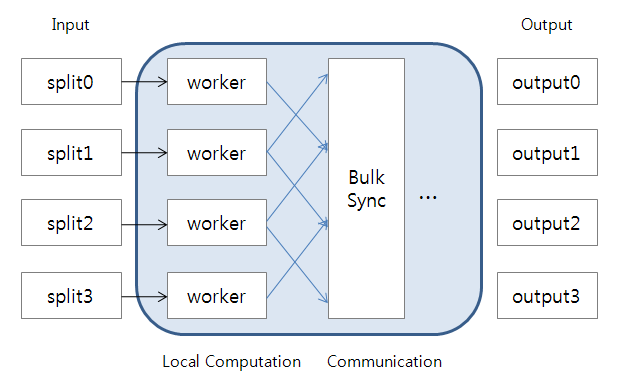
- The computation part based on BSP computation step consists of three sub
steps:
-  * Computation on data that reside in local storage; it is similar to map
operation in M/R.
-  * Each node communicates its necessary data into one another.
-  * All processors synchronize which waits for all of the communications
actions to complete.
-
- Let's see more detail in the diagram of computing method of Hamburg based on
BSP model.
-
-
[[http://lh4.ggpht.com/_DBxyBGtfa3g/SmQUYTHWooI/AAAAAAAABmk/cFVlLCdLVHE/s800/figure1.PNG]]
-
- When a job is submitted, each worker starts with processing the data
partitions that reside in local storage. During local computation, each worker
stores temporal data, which are needed to transmitted to appropriate other
workers, into a local queue. After all local computations finish, each worker
will perform bulk synchronization by using collected communication among
workers. The 'Computation' and 'Bulk synchronization' can be performed
iteratively. Data for synchronization can be compressed to reduce network
usage. The main difference between Hamburg and MR is that Hamburg does not make
intermediate data aggregate into reducer. Instead, each computation node
communicates only necessary data into one another at each bulk synchronization
step. It will be efficient if total communicated data is smaller then
intermediate data to be aggregated into reducers. Plainly, It aims to improve
the performance of traverse operations in Graph computing.
-
- === Initial contributors ===
-  * Edward J. (edwardyoon AT apache.org)
-  * Hyunsik Choi (hyunsik.choi AT gmail.com)
-
- Any volunteers are welcome.
-
- == Implementation ==
-
- === Informations ===
-  * [[http://throb.googlecode.com/|Prototype project]] -- work in progress
-   * Use this command to anonymously check out the latest project source code:
- {{{
- # Non-members may check out a read-only working copy anonymously over HTTP.
- svn checkout http://throb.googlecode.com/svn/trunk/ throb-read-only
- }}}
-
- === User Interface Design ===
-
- The user interface is likely to be a simple form that allows processing a
single item at a time.
-
- {{{
- User Interface:
-
-   /**
-    * @param input
-    * @param nextQueue
-    */
-   public void traverse(Map<V, Message> input, Map<K, Message> nextQueue,
-       Map<Object, Object> localCollector);
-
-   public void synchronize(Map<Object, Object> localCollector,
-       Iterator<Entry<Integer, Map<K, Message>>> outgoingQueue);
-
-   public void finalyze(Map<Object, Object> localCollector);
-
-   /**
-    * At initial time or when a local queue is empty, the picker chooses
-    * unvisited vertex from local graphs.
-    */
-   public V pick();
- }}}
-
- == Related Projects ==
-
-  * [[http://incubator.apache.org/hama|Hama]], A distributed matrix
computational package for Hadoop.
-  * [[http://rdf-proj.blogspot.com/|Heart]], A large-scale RDF data store and
a distributed processing engine.
-
- == Related Ideas ==
-
-  *
[[http://blog.udanax.org/2009/08/inference-anatomy-of-google-pregel.html|Inference
 anatomy of the Google Pregel]]
-  * [[http://blog.udanax.org/2009/08/graph-database-on-hadoop.html|Graph
database on Hadoop]]
-