------------------------ Yahoo! Groups Sponsor --------------------~-->
Make a clean sweep of pop-up ads. Yahoo! Companion Toolbar.
Now with Pop-Up Blocker. Get it for free!
http://us.click.yahoo.com/L5YrjA/eSIIAA/yQLSAA/GSaulB/TM
--------------------------------------------------------------------~->
There are 25 messages in this issue.

Topics in this digest:

      1. What are the Sampa representations for various |r|s?
           From: Sally Caves <[EMAIL PROTECTED]>
      2. Re: samhain?
           From: Steg Belsky <[EMAIL PROTECTED]>
      3. Re: What are the Sampa representations for various |r|s?
           From: "Jonathyn Bet'nct" <[EMAIL PROTECTED]>
      4. Re: Advanced English + Babel text
           From: Herman Miller <[EMAIL PROTECTED]>
      5. Re: What are the Sampa representations for various |r|s?
           From: Roger Mills <[EMAIL PROTECTED]>
      6. Re: What are the Sampa representations for various |r|s?
           From: Herman Miller <[EMAIL PROTECTED]>
      7. Re: USAGE: rhotics (was: Advanced English + Babel text)
           From: Philip Newton <[EMAIL PROTECTED]>
      8. Re: Question about word-initial velar nasal
           From: Philip Newton <[EMAIL PROTECTED]>
      9. Re: What are the Sampa representations for various |r|s?
           From: Philip Newton <[EMAIL PROTECTED]>
     10. rhotic miscellany  (was: Advanced English + Babel text)
           From: Ray Brown <[EMAIL PROTECTED]>
     11. Re: What are the Sampa representations for various |r|s?
           From: Sally Caves <[EMAIL PROTECTED]>
     12. Re: What are the Sampa representations for various |r|s?
           From: Philip Newton <[EMAIL PROTECTED]>
     13. Re: Advanced English + Babel text
           From: Andreas Johansson <[EMAIL PROTECTED]>
     14. Re: rhotic miscellany  (was: Advanced English + Babel text)
           From: Andreas Johansson <[EMAIL PROTECTED]>
     15. Re: Ashamed of [T]? (fy: /T/ -> /t_d/?)
           From: Andreas Johansson <[EMAIL PROTECTED]>
     16. Re: Advanced English + Babel text
           From: caeruleancentaur <[EMAIL PROTECTED]>
     17. Re: Ashamed of [T]? (fy: /T/ -> /t_d/?)
           From: Pablo Flores <[EMAIL PROTECTED]>
     18. Fwd:       Re: Ashamed of [T]? (fy: /T/ -> /t_d/?)
           From: caeruleancentaur <[EMAIL PROTECTED]>
     19. Re: USAGE: rhotics (was: Advanced English + Babel text)
           From: "J. 'Mach' Wust" <[EMAIL PROTECTED]>
     20. Re: rhotic miscellany (was: Advanced English + Babel text)
           From: "J. 'Mach' Wust" <[EMAIL PROTECTED]>
     21. Re: Fwd:       Re: Ashamed of [T]? (fy: /T/ -> /t_d/?)
           From: John Cowan <[EMAIL PROTECTED]>
     22. Re: Fwd:       Re: Ashamed of [T]? (fy: /T/ -> /t_d/?)
           From: Jan van Steenbergen <[EMAIL PROTECTED]>
     23. Re: Soleil
           From: caeruleancentaur <[EMAIL PROTECTED]>
     24. Re: rhotic miscellany  (was: Advanced English + Babel text)
           From: Sally Caves <[EMAIL PROTECTED]>
     25. Re: Disgusting thread... ;-)
           From: "Pascal A. Kramm" <[EMAIL PROTECTED]>


________________________________________________________________________
________________________________________________________________________

Message: 1
   Date: Wed, 3 Nov 2004 22:27:13 -0500
   From: Sally Caves <[EMAIL PROTECTED]>
Subject: What are the Sampa representations for various |r|s?

I'm posing the question under different cover, since I think many of you are
tuning out some threads, or are distracted by recent disappointing events.
I would really like to know what the Sampa representations are for the
various pronunciations of |r|, since I see a lot of people, including
myself, using plain old [r] to cover a number of sounds in their Sampa IPA
reps.

The retroflex "r."  What I, an American, say in pronouncing "American."

The final retroflex "r."  What I, an American, say in pronouncing "car."  Is
there much difference?  I feel that there is a minute one, maybe not enough
to count.

The flapped "r."  What a Latina might say in pronouncing her name "Sara."

The front trilled "r," what a Welshman might say in pronouncing Ronabwy.  Is
that [R]?

The voiceless front trilled "r," what a Welshman might say in pronouncing
"rhan."  This is sometimes not actually a trill, so much as a "kind" of
palatal fricative, the sound you get when you limit the voiceless trill to
one "beat."

The voiced velar fricative.  What a Frenchwoman would say when pronouncing
the word "rouge."  Is that the one represented by [R]?

The velar trill.  [R\]  What a uvularly athletic German of the "older
generation" ;) might say in pronouncing "geradeaus."  I notice this sign
requires two characters.  Does the backslash indicate that it is velar?

The retroflex flap, a sound I think I invented, which a Teonivar would say
when pronouncing "Erahenahil" [paradise].  I've given two detailed
descriptions of that sound in a thread called "Usage: rhotics, etc."   Is it
invented or not?

The alveolar flap (no retroflex), which is like the flapped Latin "r" but
articulated at the palate or post alveolar.  What a Teonivar would say when
pronouncing "yry firrimby" ("me all grateful," or "thank you.")

Maybe Sampa can't cover all of these.

Yry firrimby!
Sally


________________________________________________________________________
________________________________________________________________________

Message: 2
   Date: Thu, 4 Nov 2004 06:37:41 +0200
   From: Steg Belsky <[EMAIL PROTECTED]>
Subject: Re: samhain?

On Nov 4, 2004, at 12:09 AM, Mark J. Reed wrote:
> The old scheme is admittedly more interesting, but for "interesting" I
> prefer to switch calendars entirely. :) The Jews, for instance, change
> their year number in the fall - rather boringly on the first day of a
> month, and on the day called "New Year's" (or, rather, "Head of the
> Year") - but less boringly, they *number* their months starting in the
> *spring*, so that the calendar year begins in month 7 instead of month
> 1.  So even though AM 5765 just began in September, the day about to
> begin at sundown as I write this message is the 20th day of the 8th
> month.
> -Marcos


Although no one actually refers to the months by their original number
names anymore.  It's not like people are writing the date as 8/20/5764
or 20-8-5764 or 5764.8.20 or anything like that.  It's always _K'
(mar)hheshvan, (H')TShS"H_, with the numbers written as letters and the
month-name written out.  It would definitely be cool if people wrote
20-8-5764, though :-) .  Or even 20-2-5764, counting from the "New Year
for years".
Although how would you number the intercalated month in leap years?


-Stephen (Steg)
  "it's easier to ask forgiveness than to get permission."
      ~ walter slovotsky, _guardians of the flame_


________________________________________________________________________
________________________________________________________________________

Message: 3
   Date: Wed, 3 Nov 2004 20:24:27 -0800
   From: "Jonathyn Bet'nct" <[EMAIL PROTECTED]>
Subject: Re: What are the Sampa representations for various |r|s?

On Wednesday, November 3, 2004, at 07:27  PM, Sally Caves wrote:

> The retroflex "r."  What I, an American, say in pronouncing "American."

r\

> The final retroflex "r."  What I, an American, say in pronouncing
> "car."  Is
> there much difference?  I feel that there is a minute one, maybe not
> enough
> to count.

It's either the same, or ` on the end of the vowel. Not quite sure.

> The flapped "r."  What a Latina might say in pronouncing her name
> "Sara."

4

> The voiced velar fricative.

G

> The velar trill.

According to IPA a velar trill is impossible.

> The retroflex flap, a sound I think I invented, which a Teonivar would
> say
> when pronouncing "Erahenahil" [paradise].  I've given two detailed
> descriptions of that sound in a thread called "Usage: rhotics, etc."
> Is it
> invented or not?

It's real:
r`

> The alveolar flap (no retroflex), which is like the flapped Latin "r"
> but
> articulated at the palate or post alveolar.  What a Teonivar would say
> when
> pronouncing "yry firrimby" ("me all grateful," or "thank you.")

4


BTW, what's the difference between, say, /r/ and [r]?

Hasta la pasta,
Jonathyn Bet'nct

--
Web site: http://kreativekorp.cjb.net
AIM: tamchel215718
Yahoo: jonrelay
MSN: jonnie1717
ICQ: 76731065 Why would I need an icy cucumber?
I'm hardly ever on IM, but I'll usually answer my e-mail in less than a
day.

Dashboard - Like Desk Accessories, only uglier...


________________________________________________________________________
________________________________________________________________________

Message: 4
   Date: Wed, 3 Nov 2004 22:33:19 -0600
   From: Herman Miller <[EMAIL PROTECTED]>
Subject: Re: Advanced English + Babel text

Sally Caves wrote:

> BTW, how do you express in Sampa IPA all these different pronunciations of
> |r|?  In Teonaht, |r| is a retroflex tap. You curl the tongue back in the
> mouth and bring it forward across the back part of the alveolar ridge.
> Does
> anybody know of a natural language that does this?  Other r's are trilled
> with the tongue, especially initial r.

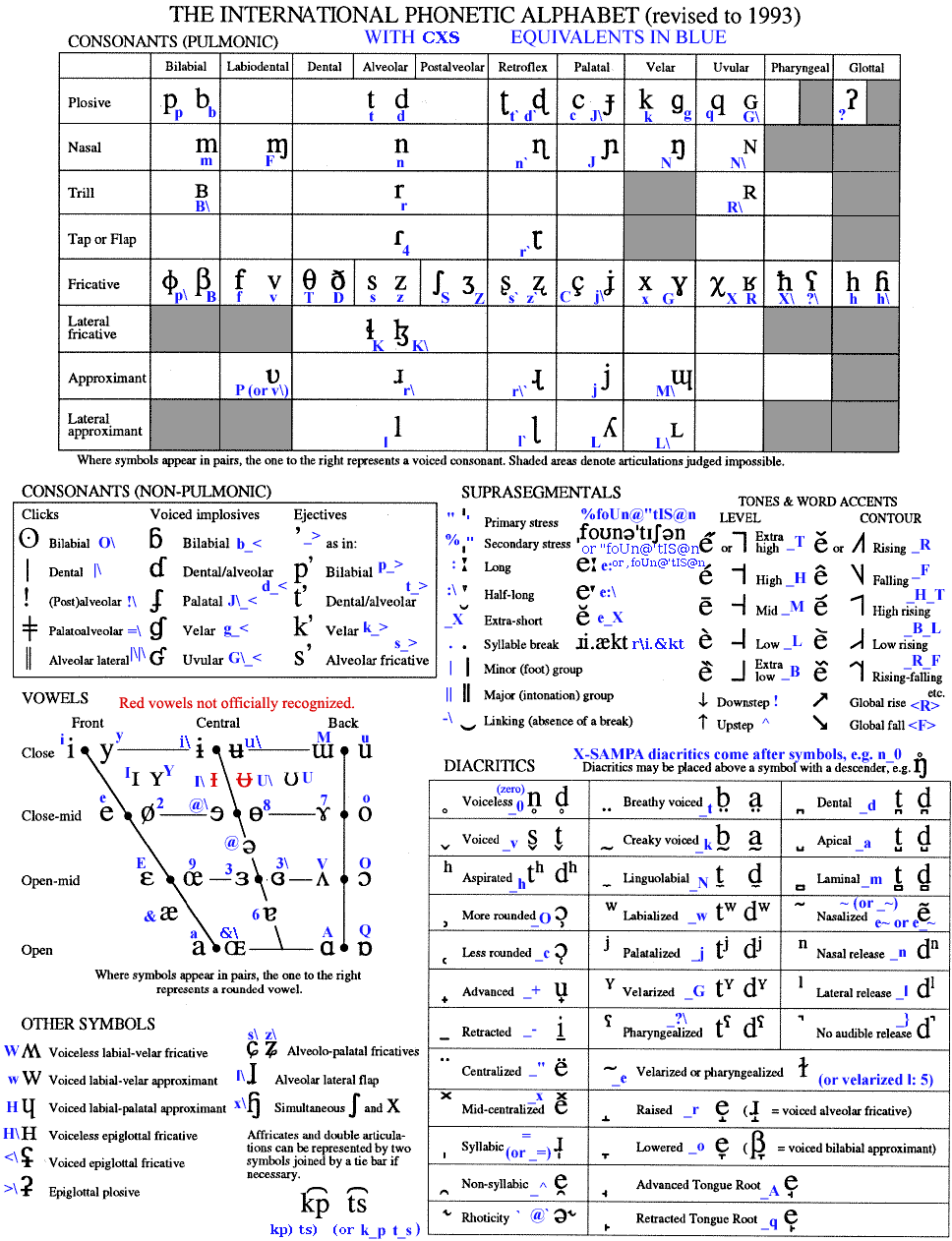
There's a nice CXS (Conlang X-SAMPA) chart at:

http://cassowary.free.fr/Linguistics/cxschart.png

There's [r] the alveolar trill, [4] the alveolar tap; the retroflex flap
(which exists in Hindi among others; my own lang Lindiga also has this
sound) is [r`], the uvular trill [R\], the uvular fricative [R], and the
approximants are [r\] (alveolar) and [r\`] (retroflex). The Chinese
retroflex fricative r is [z`]; this is also the "r" of many of the
Zireen languages.

CXS has some differences from standard X-SAMPA, but they're mainly in
the vowels and a few other things like stress marks (I don't think I've
seen [%] used for secondary stress all that often; my preference is for
[,]).


________________________________________________________________________
________________________________________________________________________

Message: 5
   Date: Thu, 4 Nov 2004 00:06:43 -0500
   From: Roger Mills <[EMAIL PROTECTED]>
Subject: Re: What are the Sampa representations for various |r|s?

Jonathyn Bet'nct wrote:

>
> BTW, what's the difference between, say, /r/ and [r]?
>
/r/ (note the slashes) is phonemic, that is, it represents a contrastive
sound in the phonological system of a given language.  [r] (note
sq.brackets) is the phonetic representation of a specific sound, in this
case the trilled [r] of e.g. Spanish, Italian.

English, French, German, Spanish all have an /r/ phoneme; but as you just
detailed in your msg., it is phonetically different in each of those
languages.

Phonemes to some extent are abstractions; the hypothetical Martial linguist
analyzing French, utterly unaware of its history and writing system, and
using the "Martian Phonetic Alphabet", might very well choose to use the
symbol for Uvular fricative or trill in his/her/its analysis of the Fr.
sound system.

Closer to home: some years back a Field Methods class at U.Michigan dealt
with the Ogan language, a Sumatran dialect _very_ closely related to
Malay/Indonesian. (The students were by and large unaware of that.) Anyhow,
Ogan has phonetic [x] in every case where Ml/Indo. has flap/trilled [r].
When they wrote up their phonemic analyses of the language, they proposed an
/x/ _phoneme_.  Not a wrong analysis, under the circumstances, but someone
aware of the relationships would probably call it phonemic /r/, pronounced
[x].


________________________________________________________________________
________________________________________________________________________

Message: 6
   Date: Wed, 3 Nov 2004 23:25:01 -0600
   From: Herman Miller <[EMAIL PROTECTED]>
Subject: Re: What are the Sampa representations for various |r|s?

Sally Caves wrote:

> I'm posing the question under different cover, since I think many of you
> are
> tuning out some threads, or are distracted by recent disappointing events.
> I would really like to know what the Sampa representations are for the
> various pronunciations of |r|, since I see a lot of people, including
> myself, using plain old [r] to cover a number of sounds in their Sampa IPA
> reps.
>
> The retroflex "r."  What I, an American, say in pronouncing "American."

I've replied in the other thread, but I'd like to comment on this as
well; Jarda has an actual retroflex approximant, which is probably
closer to the "l" in "Tamil" than an American /r/. I heard a similar
sounding /r/ in that I�upiaq site someone mentioned the other day
(http://www.alaskool.org/language/maniilaq/webhtm/Maniilaq_Intro.htm).

Samples of the Jarda /r/ (real audio, unfortunately; I'll have to
re-record them one of these days....):

http://www.io.com/~hmiller/ra/j-noer.ra [n2r`]
http://www.io.com/~hmiller/ra/j-relh.ra [r`eL]
http://www.io.com/~hmiller/ra/j-thlir.ra [Kir`]
http://www.io.com/~hmiller/ra/j-sjor.ra [s\or`]
http://www.io.com/~hmiller/ra/j-gur.ra [gur`]

I used to think American /r/ was retroflex, but I'm thinking that it's
probably more velarized with some slight lip rounding, something like
[r_G_w]. But this varies; Laddiefoged and Maddieson remark about the
American /r/ that "For some speakers this is alveolar or post-alveolar
in its articulation, but a more complex articulation occurs in the
so-called 'bunched r'. This sound is produced with constrictions in the
lower pharynx and ath the center of the palate, but with no raising of
the tongue tip of blade (Uldall 1958)." (The Sounds of the World's
Languages, p. 234).

Usually just plain [r\] is used for the American /r/; there isn't a
unique IPA symbol for it.

> The voiceless front trilled "r," what a Welshman might say in pronouncing
> "rhan."  This is sometimes not actually a trill, so much as a "kind" of
> palatal fricative, the sound you get when you limit the voiceless trill to
> one "beat."

The voiceless trills would just use the voiceless diacritic: [r_0].
(underscore zero, not underscore lowercase o, which is "lowered", or
underscore capital o, which is "more rounded" -- diacritics are one of
the most unfortunate parts of X-SAMPA....).

> The voiced velar fricative.  What a Frenchwoman would say when pronouncing
> the word "rouge."  Is that the one represented by [R]?
>
> The velar trill.  [R\]  What a uvularly athletic German of the "older
> generation" ;) might say in pronouncing "geradeaus."  I notice this sign
> requires two characters.  Does the backslash indicate that it is velar?

The backslash is an X-SAMPA extension, a way to essentially double the
number of available letters. So for instance, [L] is a palatal lateral
(IPA turned y) and [L\] is a velar lateral (IPA small capital L). CXS
extends that to include substitutes for less friendly X-SAMPA letters,
like [i\] and [u\] for the high central vowels.


________________________________________________________________________
________________________________________________________________________

Message: 7
   Date: Thu, 4 Nov 2004 06:54:56 +0100
   From: Philip Newton <[EMAIL PROTECTED]>
Subject: Re: USAGE: rhotics (was: Advanced English + Babel text)

On Wed, 3 Nov 2004 14:37:56 -0500, J. 'Mach' Wust <[EMAIL PROTECTED]> wrote:
> On Wed, 3 Nov 2004 17:06:29 +0100, Andreas Johansson <[EMAIL PROTECTED]> wrote:
>
> >Christophe used to tell us that the uvular trill is as good as dead in the
> >French of France today, the uvular fricative being close to universal.
>
> Thank you for this information, Andreas and Sally! I ignored it.

False friend? I ask because in French, "ignorer" means (AFAIK) "to be
ignorant of; to not know", which seems to fit the sentence better --
in English, "ignore" usually means something like "to be aware of (a
fact) but deliberately not take it into consideration" or "to cast
aside (advice)" -- a more active method.

Cheers,
--
Philip Newton <[EMAIL PROTECTED]>
Watch the Reply-To!


________________________________________________________________________
________________________________________________________________________

Message: 8
   Date: Thu, 4 Nov 2004 07:00:02 +0100
   From: Philip Newton <[EMAIL PROTECTED]>
Subject: Re: Question about word-initial velar nasal

On Thu, 4 Nov 2004 02:31:38 +0000, Tim May <[EMAIL PROTECTED]> wrote:
> Danny Wier wrote at 2004-10-24 06:38:00 (-0500)
>  > From: "Tim May"
>  >
>  > > Incidentally, what languages _do_ allow /N/ initally?  Offhand, I can
>  > > only think of Vietnamese and Tibetan, and it's a tricky thing to look
>  > > up.
>  >
>  > Albanian, and I have no idea how that happened.
>
> Really?  How is this indicated in Albanian writing?  I've just been
> looking into the language, and I can't see any mention of it.

"ng", I suppose.

At any rate, http://www.google.com/search?q=nga+site%3Aal finds a
number of hits for the word "nga" in Albanian sites.

(Strangely enough, it also finds a number of sentences containing
e-dot, which I had only known from Lithuanian -- I only know e-umlaut
for Albanian. Maybe a dialect compromise meaning "some dialects
pronounce this /�/, others /e/"?)

Cheers,
--
Philip Newton <[EMAIL PROTECTED]>
Watch the Reply-To!


________________________________________________________________________
________________________________________________________________________

Message: 9
   Date: Thu, 4 Nov 2004 07:08:36 +0100
   From: Philip Newton <[EMAIL PROTECTED]>
Subject: Re: What are the Sampa representations for various |r|s?

On Thu, 4 Nov 2004 00:06:43 -0500, Roger Mills <[EMAIL PROTECTED]> wrote:
> Jonathyn Bet'nct wrote:
>
> >
> > BTW, what's the difference between, say, /r/ and [r]?
> >
> /r/ (note the slashes) is phonemic, that is, it represents a contrastive
> sound in the phonological system of a given language.  [r] (note
> sq.brackets) is the phonetic representation of a specific sound, in this
> case the trilled [r] of e.g. Spanish, Italian.

Also, since phonemes only make sense in the context of a given
language, characters in /slashes/ can be a bit more ad-hoc, whereas
characters in [brackets] (IME) usually follow a specific system such
as IPA or an ASCII-friendly variant thereof.

Specifically, phonemic notation often simplifies as much as possible,
e.g. using /r/ for a language even if [r] is not a realisation of that
phoneme, rather than, say, /r\/ which would need extra characters.

Or it may use an even more non-IPA style; for example, Trager-Smith
for English, which uses things such as /i/ for [I] and /iy/ for [i],
or (IIRC) /j/ for [dZ]. (I remember I used to get barked at by PTD
over in sci.lang if I used something like /dZ/ for phonemicising
English.)

Cheers,
--
Philip Newton <[EMAIL PROTECTED]>
Watch the Reply-To!


________________________________________________________________________
________________________________________________________________________

Message: 10
   Date: Thu, 4 Nov 2004 06:57:55 +0000
   From: Ray Brown <[EMAIL PROTECTED]>
Subject: rhotic miscellany  (was: Advanced English + Babel text)

On Wednesday, November 3, 2004, at 05:11 , Sally Caves wrote:

[snip]
> I've never heard a uvular trill [R\] among francophones;

I have. The priest - he was a youngish man - who married my son &
daughter-in-law (she's French) almost a dozen years back had a most
vigorous uvular trill. It was, of course, used by Edith Piaff (je ne
regrette rien....) - but it is very rare now and usually considered the
mark of speakers even more antique than me  :)

Actually my elder grandson (who is more or less bilingual) used to have a
delightful uvular trill, but his 'French R' has now become the familiar
uvular approximant (there's practically no friction with the modern urban
French R). I'm told - tho I don't know how true this is - that this is
typical of young children: to start with trilling the uvular but gradually
to lose the trill.

> rather, the
> fricative [R] or the unvoiced fricative /x/, especially after "t": "trois,
> "
> etc.  The uvular trills I'm familiar with occur in Hebrew (in fact I was
> just practicing it with a group of Israelis the other night), and among
> certain German speakers.

You also find it, as I expect you know, among certain north Walian
speakers.

> Many Germans, I gather, don't trill, but merely
> fricatize the "r";

I gather this is so. At one time the trilled lingual r was also widespread.
  That was the /r/ used by Hitler, as you hear on ancient newsreels. It may
be - I don't know - that this accounts for its demise in the last half
century.

> but I have a teasing friend who tells me that I sound
> French when I pronounce German.  That may well be; my training has been
> mostly in French and Spanish.
>
> The history of |r| and its developments in not only France but Germany and
> England is an interesting and I think quite complex one.  Maybe somebody
> else, here, can unpack it.  As I understand it, and I may be wrong, /R/ in
> French was a fairly recent development--seventeenth/eighteenth century--

This is true. There is no real doubt that the Vulgar Latin /r/ was the
lingual trill which is still retained in modern Italian.  There is no
reason to suppose that it was any different in france. Certainly the
change of intervocalic and, sometimes, final /r/ to /z/ in the 16th & 17th
centuries (hence _chaire_ --> chaise, and the feminine of -eur being -euse
and the dropping of -r so often in words ending in -er) is clear testimony
of its linguo-dental nature. The uvular R could not have become general
till the 18th century and did not, apparently, become general in Parisian
speech till the beginning of the 19th century. Once it had become
fashionable in Parisian speech it spread not only to the rest of northern
France but also into the Netherlands and into Germany.

> and
> until then the common way to pronounce it was as a flap, as in Spanish,
> or a
> front trill.  I know from studying Old French that it was presumed to be
> flapped or trilled.

More likely trilled - tho we can't rule out the flap occurring also. That'
s one of those things that we'd probably need time-travel to resolve   :)

Certainly the lingually trilled /r/ is still alive in the south of France,
  especially in rural areas.

> But the change, I have read, came about with changes in
> England and Germany, especially the dropping of final /r/ in England.  Is
> this true?

I doubt very much that the dropping of final -r in English has anything to
do with French. The dropping of final -r in the -er infinitives and words
ending in -ier is comparatively recent in French and results from the
sound having first become [z] as explained above. In the case of English
it is almost certainly the "de-retroflexion" of "de-rhotacization" of
rhotacized (or reflexive) vowels, the r-colored vowels typical of American
English and still common in rural dialects of southern England & the
English Midlands as well as urban dialects of south west England.

Whether something similar happened in German, I do not know. I am not
aware of rhotacized vowels in any German dialects, but they may occur.
Certainly I know from personal experience that southern Germans don't
pronounce syllable final /r/ as a consonant but tend to produce either
long low vowels or centering diphthongs similar to those found in the RP
of south-east England. I've always assumed these were more recent
developments and resulted from the weakening of the already weak uvular
approximant.  But I may well be wrong. Can any of German conlangers tell
us whether German once had rhotacized vowels as in American English and
the English of rural southern England?

> BTW, how do you express in Sampa IPA all these different pronunciations of
> |r|?

We use a modified form of X-SAMPA known as CXS (Conlang X-SAMPA   :)

[r] = apical lingual trill
[4] = linguo-dental tap or flap (Spanish single /r/)
[r`] = retroflex tap
[r\] = the dental/alveolar approximant ("English /r/")
[R\] = uvular trill
[R] = uvular approximant and/or voiced uvular fricative
[X[ = voiceless uvular fricative

The symbol ` is used to show rhotacized or r-colored vowels: [a`], [EMAIL PROTECTED],
[i`] etc.

> In Teonaht, |r| is a retroflex tap. You curl the tongue back in the
> mouth and bring it forward across the back part of the alveolar ridge.
[r`]    :)

>  Does
> anybody know of a natural language that does this?

Hindi/Urdu has both the retroflex flap [r`] as well as the dental flap [4]
. I believe it is quite common in the languages of the Indian subcontinent.

Ray
===============================================
http://home.freeuk.com/ray.brown
[EMAIL PROTECTED]
===============================================
Anything is possible in the fabulous Celtic twilight,
which is not so much a twilight of the gods
as of the reason."      [JRRT, "English and Welsh" ]


________________________________________________________________________
________________________________________________________________________

Message: 11
   Date: Thu, 4 Nov 2004 02:54:59 -0500
   From: Sally Caves <[EMAIL PROTECTED]>
Subject: Re: What are the Sampa representations for various |r|s?

Sorry, I meant "uvular trill," the legitimacy of which in German has been
heatedly discussed in another thread.

----- Original Message -----
From: "Jonathyn Bet'nct" <[EMAIL PROTECTED]>


>> The velar trill.
>
> According to IPA a velar trill is impossible.


________________________________________________________________________
________________________________________________________________________

Message: 12
   Date: Thu, 4 Nov 2004 10:34:06 +0100
   From: Philip Newton <[EMAIL PROTECTED]>
Subject: Re: What are the Sampa representations for various |r|s?

On Thu, 4 Nov 2004 02:54:59 -0500, Sally Caves <[EMAIL PROTECTED]> wrote:
> Sorry, I meant "uvular trill,"

[R\]

Cheers,
--
Philip Newton <[EMAIL PROTECTED]>
Watch the Reply-To!


________________________________________________________________________
________________________________________________________________________

Message: 13
   Date: Thu, 4 Nov 2004 11:02:08 +0100
   From: Andreas Johansson <[EMAIL PROTECTED]>
Subject: Re: Advanced English + Babel text

Quoting Herman Miller <[EMAIL PROTECTED]>:

> Sally Caves wrote:
>
> > BTW, how do you express in Sampa IPA all these different pronunciations of
> > |r|?  In Teonaht, |r| is a retroflex tap. You curl the tongue back in the
> > mouth and bring it forward across the back part of the alveolar ridge.
> > Does
> > anybody know of a natural language that does this?  Other r's are trilled
> > with the tongue, especially initial r.
>
> There's a nice CXS (Conlang X-SAMPA) chart at:
>
> http://cassowary.free.fr/Linguistics/cxschart.png
>
> There's [r] the alveolar trill, [4] the alveolar tap; the retroflex flap
> (which exists in Hindi among others; my own lang Lindiga also has this
> sound) is [r`], the uvular trill [R\], the uvular fricative [R], and the
> approximants are [r\] (alveolar) and [r\`] (retroflex). The Chinese
> retroflex fricative r is [z`]; this is also the "r" of many of the
> Zireen languages.

And, to my considerable annoyance, there is no IPA, (X-)SAMPA or CXS
representation of the sublaminal retroflex trill, which is one of the chief
realizations of /r/ in my 'lect of Swedish.

In my own ASCII-IPA scheme, called 'JXS', I use [r`] for the retroflex trill and
[4`] for the retroflex tap or flap, which as an added benefit perfects the
symmetry between the signs for retroflex and alveolar sounds.

                                                                  Andreas


________________________________________________________________________
________________________________________________________________________

Message: 14
   Date: Thu, 4 Nov 2004 11:15:14 +0100
   From: Andreas Johansson <[EMAIL PROTECTED]>
Subject: Re: rhotic miscellany  (was: Advanced English + Babel text)

Quoting Ray Brown <[EMAIL PROTECTED]>:


> This is true. There is no real doubt that the Vulgar Latin /r/ was the
> lingual trill which is still retained in modern Italian.  There is no
> reason to suppose that it was any different in france. Certainly the
> change of intervocalic and, sometimes, final /r/ to /z/ in the 16th & 17th
> centuries (hence _chaire_ --> chaise, and the feminine of -eur being -euse
> and the dropping of -r so often in words ending in -er) is clear testimony
> of its linguo-dental nature. The uvular R could not have become general
> till the 18th century and did not, apparently, become general in Parisian
> speech till the beginning of the 19th century. Once it had become
> fashionable in Parisian speech it spread not only to the rest of northern
> France but also into the Netherlands and into Germany.

And, apparently, into Scandinavia - at least, that's the explanation I've heard
for the uvular realizations of /r/ common in southern Sweden. Some 'lects have
uvular /r/'s in some positions and alveolar/retroflex in others. They also
commonly totally lose /r/ in the positions where it in Standard Swedish merges
with a following dental; eg, while I pronounce /sport/ as [spOt`(:)], they
would say it as [spOt:]. (Well, there's no reason to think it's /sport/ for
them, since they pronounce _sport_ and _spott_ the same, and the later
certainly contains no /r/.)

I do not remember what happens in Danish.


                                                          Andreas


________________________________________________________________________
________________________________________________________________________

Message: 15
   Date: Thu, 4 Nov 2004 11:23:56 +0100
   From: Andreas Johansson <[EMAIL PROTECTED]>
Subject: Re: Ashamed of [T]? (fy: /T/ -> /t_d/?)

Quoting "Mark J. Reed" <[EMAIL PROTECTED]>:


> Another tricky word is "despise", whose intensity has varied dramatically
> over even recent history; these days it's basically a stronger version of
> "hate", whereas it used to be semantically different (whence the set phrase
> "hate and despise") and then, apparently at one point, it was a *milder*
> version of "hate".

This xenophone had picked up a semantic distinction that despise implies moral
condemnation, while hate does not necessarily so. Thus, 'hate' but not
'despise' could be appropriate for inanimate objects and "honourable enemies".
Was this at any point native usage?

Tangentially, in my Swedish usage, the strength of _hata_ 'hate' varies
drastically 'tween registers. In informal speech, it may mean little more than
'dislike' or even 'be envious of' (the later, I think, is taken from English
usage), while in higher registers, it's very strong, implying a wish to see the
object dead or destroyed. So strong, in fact, that one avoids using it with a
first person subject, since civilized people are supposed to be above such
extremes of animosity!

                                                   Andreas


________________________________________________________________________
________________________________________________________________________

Message: 16
   Date: Thu, 4 Nov 2004 11:28:46 -0000
   From: caeruleancentaur <[EMAIL PROTECTED]>
Subject: Re: Advanced English + Babel text

--- In [EMAIL PROTECTED], Andreas Johansson <[EMAIL PROTECTED]> wrote:

>In my own ASCII-IPA scheme, called 'JXS', I use [r`] for the
>retroflex trill and [4`] for the retroflex tap or flap, which as an
>added benefit perfects the symmetry between the signs for retroflex
>and alveolar sounds.

Speaking of symmetry, I am annoyed by c-J\ and C-j\.  I wonder why
these sounds weren't symbolized as c-j\ and C-J\.

Charlie


________________________________________________________________________
________________________________________________________________________

Message: 17
   Date: Thu, 4 Nov 2004 09:27:51 -0300
   From: Pablo Flores <[EMAIL PROTECTED]>
Subject: Re: Ashamed of [T]? (fy: /T/ -> /t_d/?)

On Mon, 1 Nov 2004 13:47:31 -0500, Roger Mills <[EMAIL PROTECTED]> wrote:
> .... In unstressed syllables it does tend to disappear, so
> "estaba" > [e'taBa]. I recall a story read years ago that used New Mexican
> dialect-- "est�" was always "ta".

I say "ta" all the time, e. g. when I'm agreeing about a plan somebody's
proposing. I usually can go on without "s�". In quick MSN-style online chat
and in speech, I say "ta bien" and "tamos", and even "ca toy" /,kah'toj/
< "ac� estoy" ("here I am").

Intervocalic phonemical voiced stops become approximants in my speech.
Some people drop /g/ and /d/ altogether, but over here that sounds uneducated.
I find that Cuban Spanish et al in that area drop some consonants even
more. Wasn't there an "essentialist" entry about that? "Cuban Spanish is
essentially Spanish minus all consonants"?

--Pablo


________________________________________________________________________
________________________________________________________________________

Message: 18
   Date: Thu, 4 Nov 2004 12:56:07 -0000
   From: caeruleancentaur <[EMAIL PROTECTED]>
Subject: Fwd:       Re: Ashamed of [T]? (fy: /T/ -> /t_d/?)

--- In [EMAIL PROTECTED], Pablo Flores <[EMAIL PROTECTED]>
wrote:

>I find that Cuban Spanish et al in that area drop some consonants
>even more. Wasn't there an "essentialist" entry about that? "Cuban
>Spanish is essentially Spanish minus all consonants"?

--Pablo

One of the weirdest examples of this that I ever heard was given to
us by our Cuban Spanish phonetics professor.  He asked the class
what "pepa" meant.

He finally explained that it was pez espada, with the s's gone as
well as the intervocalic d.

Which reminds me: What is the history behind the non-pronunciation of
the "w" in sword?

And another thing!  Latin "sol," Spanish "sol," Portuguese "sol,"
Italian "sole," Rumanian " soare.  Why are there 2 l's in the
French "soleil"?  Is it, perhaps, from a diminutive such as
*soliculus?


________________________________________________________________________
________________________________________________________________________

Message: 19
   Date: Thu, 4 Nov 2004 08:05:59 -0500
   From: "J. 'Mach' Wust" <[EMAIL PROTECTED]>
Subject: Re: USAGE: rhotics (was: Advanced English + Babel text)

On Wed, 3 Nov 2004 19:29:30 -0500, Sally Caves <[EMAIL PROTECTED]> wrote:

>Actually, I didn't really believe my friend.  He said my "r" pronunciation
>in German wasn't "robust" enough, but sounded French.

I fear we'll never know what he meant...

>  Actually, I think my
>best linguistic gifts lie in phonic mimicry.  (Which is why I thought of
>becoming an actress in my late teens).  I have a very good ear for
>pronunciations and can usually reproduce them pretty well, which has gotten
>me in trouble a few times when my rapid comprehension was not up to my
>speaking.

A most remarkable and seldom gift! I've known A Swiss German who told me
that native speaker of Spanish had taken him for mentally challenged because
of his lack of vocabulary.

>> I've always thought of the German non-rhoticity to
>> be related to the uvular realization of the /r/, but that might be wrong.
>
>It might be right.  I've heard "der" pronounced as though it rhymes with
>British English "hair."

German |her| and non-rhotic English |hair| may both be [hE6]

>> By the way, I assume that English also had a trill-flap /r/ originally,
>> but is there any evidence on the time it was fricativized?
>
>I'm unsure what you mean by fricativized when speaking of British English
>pronunciation.  Do you mean "flapped"?  Retroflex?

I should have said 'approximazed' (or something alike). For what I know,
English /r/ may be retroflex, but not necessarily, but it's almost always an
approximant [r\], not a trill-tap (as e.g. in Scots).

>Are you Swiss?  Do you or have you live(d) in Switzerland?

Yes, I do, I live in Berne and speak Bernese German.

[EMAIL PROTECTED]:
j. 'mach' wust


________________________________________________________________________
________________________________________________________________________

Message: 20
   Date: Thu, 4 Nov 2004 08:03:22 -0500
   From: "J. 'Mach' Wust" <[EMAIL PROTECTED]>
Subject: Re: rhotic miscellany (was: Advanced English + Babel text)

On Thu, 4 Nov 2004 06:57:55 +0000, Ray Brown <[EMAIL PROTECTED]> wrote:

>I'm told - tho I don't know how true this is - that this is
>typical of young children: to start with trilling the uvular but gradually
>to lose the trill.

Remarkable! I wonder whether the same could be said about German children.

>On Wednesday, November 3, 2004, at 05:11 , Sally Caves wrote:
>
>> Many Germans, I gather, don't trill, but merely
>> fricatize the "r";
>
>I gather this is so. At one time the trilled lingual r was also widespread.
>  That was the /r/ used by Hitler, as you hear on ancient newsreels. It may
>be - I don't know - that this accounts for its demise in the last half
>century.

I rather suppose this is because the pronunciation of standard German has
become less prescriptive. The prescribed realization of /r/ was a lingual
trill-tap [r], and in the first half of the 20th century, an strong uvular
trill was common on radio. I also suppose that the trill was favoured
because it's more clearly audible, taking into account that the sound
technology wasn't that avanced at this time and that it was the very first
generation that had electric amplification, since before, the bare human
voice had to be strong enough.

>The uvular R could not have become general
>till the 18th century and did not, apparently, become general in Parisian
>speech till the beginning of the 19th century. Once it had become
>fashionable in Parisian speech it spread not only to the rest of northern
>France but also into the Netherlands and into Germany.

Only to parts of these countries, and also to parts of (northern) Italy. In
the dialect of Berne, the patricians, that is, the old upper class, used to
have an uvular trill, whereas everybody else has a lingual trill-tap.

>>  I know from studying Old French that it was presumed to be
>> flapped or trilled.
>
>More likely trilled - tho we can't rule out the flap occurring also. That's
>one of those things that we'd probably need time-travel to resolve   :)

I'm using a lingual /r/, and my experience is that it's very hard to tell
whether it's a trill [r] or a flap [4]. It think it depends on the
neighbouring sounds, on speech speed, and on emphasis. I believe (without
prove) that this is normal in languages that have [r] (unless it's opposed
to [4], as in Spanish). So I believe that not even a time travel would
resolve it. [r] seems to be the more common sign and is used for that
undetermined [r] or [4].

I also believe that this indetermination is the reason for the (already
mentioned) IPA 'assymetry' in retroflex [r`] vs. alveolar [r, 4]: I guess
that the pronunciation of [r`] is as undetermined as the one of [r] (if not
opposed to [4]), and that there are no languages that oppose a retroflex
trill to a retroflex tap.

>I doubt very much that the dropping of final -r in English has anything to
>do with French.

Me too.

>In the case of English
>it is almost certainly the "de-retroflexion" of "de-rhotacization" of
>rhotacized (or reflexive) vowels, the r-colored vowels typical of American
>English and still common in rural dialects of southern England & the
>English Midlands as well as urban dialects of south west England.
>
>Whether something similar happened in German, I do not know. I am not
>aware of rhotacized vowels in any German dialects, but they may occur.

To my knowledge, they don't. Also, I haven't ever heard of a German dialect
that has an approximant [r\] as in English.

>Certainly I know from personal experience that southern Germans don't
>pronounce syllable final /r/ as a consonant but tend to produce either
>long low vowels or centering diphthongs similar to those found in the RP
>of south-east England. I've always assumed these were more recent
>developments and resulted from the weakening of the already weak uvular
>approximant.  But I may well be wrong.

I'm assuming the same as you. However, I'm not sure whether there are
south-eastern "non-rhotic" dialects that have an alveolar [r], not an uvular
one, which would disfavour the idea that the German "non-rhoticity"
originated in a weakening of the uvular approximant.

[EMAIL PROTECTED]:
j. 'mach' wust


________________________________________________________________________
________________________________________________________________________

Message: 21
   Date: Thu, 4 Nov 2004 08:32:04 -0500
   From: John Cowan <[EMAIL PROTECTED]>
Subject: Re: Fwd:       Re: Ashamed of [T]? (fy: /T/ -> /t_d/?)

caeruleancentaur scripsit:

> He finally explained that it was pez espada, with the s's gone as
> well as the intervocalic d.

Wow.  Like [dZitdZEt] for "Did you eat yet?"

> Which reminds me: What is the history behind the non-pronunciation of
> the "w" in sword?

See http://listserv.brown.edu/archives/cgi-bin/wa?A2=ind0105b&L=conlang&F=&S=&P=15680

> And another thing!  Latin "sol," Spanish "sol," Portuguese "sol,"
> Italian "sole," Rumanian " soare.  Why are there 2 l's in the
> French "soleil"?  Is it, perhaps, from a diminutive such as
> *soliculus?

The Catalan word is "solell", which strongly suggests an etymon
SOLELLU(S), though I haven't found any direct confirmation of this.

--
A mosquito cried out in his pain,               John Cowan
"A chemist has poisoned my brain!"              http://www.ccil.org/~cowan
        The cause of his sorrow                 http://www.reutershealth.com
        Was para-dichloro-                      [EMAIL PROTECTED]
Diphenyltrichloroethane.                                (aka DDT)


________________________________________________________________________
________________________________________________________________________

Message: 22
   Date: Thu, 4 Nov 2004 13:44:17 +0000
   From: Jan van Steenbergen <[EMAIL PROTECTED]>
Subject: Re: Fwd:       Re: Ashamed of [T]? (fy: /T/ -> /t_d/?)

 --- Charlie skrzypszy:

> And another thing!  Latin "sol," Spanish "sol," Portuguese "sol,"
> Italian "sole," Rumanian " soare.  Why are there 2 l's in the
> French "soleil"?  Is it, perhaps, from a diminutive such as
> *soliculus?

Hole in one! And what's more, it is a perfectly regular development.
Compare it to, for example AURIS > dim. AURICULA > Fr. _oreille_.
Especially French has a strong tendency towards using the Latin
diminutives as a source instead of the short form.

Jan

=====
"If you think you are too small to make a difference, try sleeping in a closed room
with a mosquito."

http://steen.free.fr/


___________________________________________________________ALL-NEW Yahoo! Messenger -
all new features - even more fun! http://uk.messenger.yahoo.com


________________________________________________________________________
________________________________________________________________________

Message: 23
   Date: Thu, 4 Nov 2004 14:52:43 -0000
   From: caeruleancentaur <[EMAIL PROTECTED]>
Subject: Re: Soleil

--- In [EMAIL PROTECTED], Jan van Steenbergen
<[EMAIL PROTECTED]> wrote:
 --- Charlie skrzypszy:

> And another thing!  Latin "sol," Spanish "sol," Portuguese "sol,"
> Italian "sole," Rumanian " soare.  Why are there 2 l's in the
> French "soleil"?  Is it, perhaps, from a diminutive such as
> *soliculus?

>>Hole in one! And what's more, it is a perfectly regular development.
>>Compare it to, for example AURIS > dim. AURICULA > Fr. _oreille_.
>>Especially French has a strong tendency towards using the Latin
>>diminutives as a source instead of the short form.

Jan


Thanks!  That's been plaguing me for years.  My next (rhetorical)
question is: Why would anyone want to make a diminutive
of "sun"?  "What a cute little sun!"  "Ear" I can understand!

Which prompts the question: if it's a regular development, why
does "oreille" have -lle, while "soleil" only has "-l"?

God, I love words!!!  :-)>

Charlie


________________________________________________________________________
________________________________________________________________________

Message: 24
   Date: Thu, 4 Nov 2004 09:49:35 -0500
   From: Sally Caves <[EMAIL PROTECTED]>
Subject: Re: rhotic miscellany  (was: Advanced English + Babel text)

Hi, Ray.  Long time.

----- Original Message -----
From: "Ray Brown" <[EMAIL PROTECTED]>


> On Wednesday, November 3, 2004, at 05:11 , Sally Caves wrote:
>
> [snip]
>> I've never heard a uvular trill [R\] among francophones;
>
> I have. The priest - he was a youngish man - who married my son &
> daughter-in-law (she's French) almost a dozen years back had a most
> vigorous uvular trill. It was, of course, used by Edith Piaff (je ne
> regrette rien....) - but it is very rare now and usually considered the
> mark of speakers even more antique than me  :)

:)  Antique is a state of mind that I don't think you succumb to.  I've
never heard it in France, but if it's true, it's quite wonderful.

> Actually my elder grandson (who is more or less bilingual) used to have a
> delightful uvular trill, but his 'French R' has now become the familiar
> uvular approximant (there's practically no friction with the modern urban
> French R). I'm told - tho I don't know how true this is - that this is
> typical of young children: to start with trilling the uvular but gradually
> to lose the trill.

Interesting.  And here I have to work hard to achieve it.  I'm not happy
with approximations; it has to sound like a little motor in the back of your
throat.  I find I can produce it best before back vowels, when the back of
my tongue is relaxed and lowered to accommodate the tip of the uvula.  It
vanishes immediately if I raise my tongue to pronounce a front vowel.  Then
it becomes an approximate.  I'm very interested in all of this, because I'm
thinking of giving Menarilihs a uvular trill that is very pronounced.

>> rather, the
>> fricative [R] or the unvoiced fricative /x/, especially after "t":
>> "trois,
>> "
>> etc.  The uvular trills I'm familiar with occur in Hebrew (in fact I was
>> just practicing it with a group of Israelis the other night), and among
>> certain German speakers.
>
> You also find it, as I expect you know, among certain north Walian
> speakers.

Actually, I didn't know that.  I stayed strictly in Swansea, with occasional
forays into Aberystwyth.  The only "gog" I knew was a tall chap who was so
socially frightening that I didn't have many conversations with him.  I knew
about the peculiar pronunciation of "y" in the north in words like dydd, and
some of the differences in vocabulary.  I knew that there was some rivalry
and sparring between North and Southwalian Welsh folk, and lots of jokes
poked by one at the other, but I didn't know about the uvular trill in North
Wales.  How interesting!  I've been to Caernarvon, Bangor, and Rhyl, but I
must have been too dazed by the beauty of it all to note this particular
feature. :)  People in Wales would almost always start speaking to me in
English when I started a conversation in Welsh, noting, I think, my limited
vocabulary (as j.'mach' wust describes in his post!).  I think bilingual
people will slip into the language they know is most facile for both
parties; they become self-conscious before a hesitant speaker.

>> Many Germans, I gather, don't trill, but merely
>> fricatize the "r";
>
> I gather this is so. At one time the trilled lingual r was also
> widespread.
>  That was the /r/ used by Hitler, as you hear on ancient newsreels. It may
> be - I don't know - that this accounts for its demise in the last half
> century.

Ah, I suspected that.  What a terrible shame!

>> but I have a teasing friend who tells me that I sound
>> French when I pronounce German.  That may well be; my training has been
>> mostly in French and Spanish.
>>
>> The history of |r| and its developments in not only France but Germany
>> and
>> England is an interesting and I think quite complex one.  Maybe somebody
>> else, here, can unpack it.  As I understand it, and I may be wrong, /R/
>> in
>> French was a fairly recent development--seventeenth/eighteenth century--
>
> This is true. There is no real doubt that the Vulgar Latin /r/ was the
> lingual trill which is still retained in modern Italian.  There is no
> reason to suppose that it was any different in france. Certainly the
> change of intervocalic and, sometimes, final /r/ to /z/ in the 16th & 17th
> centuries (hence _chaire_ --> chaise, and the feminine of -eur being -euse
> and the dropping of -r so often in words ending in -er) is clear testimony
> of its linguo-dental nature.

That makes perfect sense.  So the flap turned into an alveolar fricative.

> The uvular R could not have become general
> till the 18th century and did not, apparently, become general in Parisian
> speech till the beginning of the 19th century. Once it had become
> fashionable in Parisian speech it spread not only to the rest of northern
> France but also into the Netherlands and into Germany.

I suspected so.  It's one of those changes, like the Great Vowel Shift, that
will always be slightly mysterious.  Usually, it seems, the ruling class in
a large city will determine pronunciation (London dialect, for instance,
becoming the Received Standard English), but sometimes rural changes will
catch on.  I think the GVS was not elite--there is evidence that it was
resisted mightily in the sixteenth-century (I have read some pamphlets that
inveighed against it), but it was just so overwhelmingly used.  Like our
"lie/lay" confusion that is fast becoming standard, alas, in the US.  I hope
"nucular" doesn't catch on and become dominant.

>> and
>> until then the common way to pronounce it was as a flap, as in Spanish,
>> or a
>> front trill.  I know from studying Old French that it was presumed to be
>> flapped or trilled.
>
> More likely trilled - tho we can't rule out the flap occurring also. That'
> s one of those things that we'd probably need time-travel to resolve   :)

If only.  I assume it must have been flapped since, as you say, it was a
dialect that emerged from Latin.

> Certainly the lingually trilled /r/ is still alive in the south of France,
>  especially in rural areas.

Yes, that I knew.  What would be really interesting is to know when the
French ceased to pronounce some of its endings and why, and in what order.
You mention the dropping of the "r" in -er and -ier below, but what about
the disappearance of final "t" and "s"?  The spelling, I've read, is
fourteenth century.  What started to drop out, and why did the spelling
conventions persist?  I would imagine this took place over a long time,
hence the fierce clinging to the older spellings.  But of course, we English
speakers still insist on our precious "bought," hundreds of years after the
"gh" was no longer heard in this word.

>> But the change, I have read, came about with changes in
>> England and Germany, especially the dropping of final /r/ in England.  Is
>> this true?
>
> I doubt very much that the dropping of final -r in English has anything to
> do with French. The dropping of final -r in the -er infinitives and words
> ending in -ier is comparatively recent in French and results from the
> sound having first become [z] as explained above. In the case of English
> it is almost certainly the "de-retroflexion" of "de-rhotacization" of
> rhotacized (or reflexive) vowels, the r-colored vowels typical of American
> English and still common in rural dialects of southern England & the
> English Midlands as well as urban dialects of south west England.

I agree.  I find it interesting, though, that "r" was changing rapidly in
several countries during approximately the same time: eighteenth-nineteenth
century.

> Whether something similar happened in German, I do not know. I am not
> aware of rhotacized vowels in any German dialects, but they may occur.
> Certainly I know from personal experience that southern Germans don't
> pronounce syllable final /r/ as a consonant but tend to produce either
> long low vowels or centering diphthongs similar to those found in the RP
> of south-east England. I've always assumed these were more recent
> developments and resulted from the weakening of the already weak uvular
> approximant.  But I may well be wrong. Can any of German conlangers tell
> us whether German once had rhotacized vowels as in American English and
> the English of rural southern England?

Not me.

>> BTW, how do you express in Sampa IPA all these different pronunciations
>> of
>> |r|?
>
> We use a modified form of X-SAMPA known as CXS (Conlang X-SAMPA   :)
>
> [r] = apical lingual trill

"Apical" meaning "tip of the tongue"?

> [4] = linguo-dental tap or flap (Spanish single /r/)
> [r`] = retroflex tap
> [r\] = the dental/alveolar approximant ("English /r/")

meaning American retroflex r?

> [R\] = uvular trill
> [R] = uvular approximant and/or voiced uvular fricative
> [X[ = voiceless uvular fricative

What does [x] mean, then?

> The symbol ` is used to show rhotacized or r-colored vowels: [a`], [EMAIL PROTECTED],
> [i`] etc.

As in "idear"?  "He had an idear I liked, and that was to go to Africar in
the winter."  My Swansea barrister friend would say this, and my Bostonian
friend says it as well.

>> In Teonaht, |r| is a retroflex tap. You curl the tongue back in the
>> mouth and bring it forward across the back part of the alveolar ridge.
> [r`]    :)
>
>>  Does
>> anybody know of a natural language that does this?
>
> Hindi/Urdu has both the retroflex flap [r`] as well as the dental flap [4]
> . I believe it is quite common in the languages of the Indian
> subcontinent.

Aw shucks!  :)

Thanks...
Sally

I'm glad to see your website, Ray.  Is this relatively new?  Of course I've
been off Conlang for over a year.

> Ray
> ===============================================
> http://home.freeuk.com/ray.brown
> [EMAIL PROTECTED]
> ===============================================
> Anything is possible in the fabulous Celtic twilight,
> which is not so much a twilight of the gods
> as of the reason."      [JRRT, "English and Welsh" ]


________________________________________________________________________
________________________________________________________________________

Message: 25
   Date: Thu, 4 Nov 2004 10:11:53 -0500
   From: "Pascal A. Kramm" <[EMAIL PROTECTED]>
Subject: Re: Disgusting thread... ;-)

On Thu, 4 Nov 2004 03:13:35 +0100, Remi Villatel <[EMAIL PROTECTED]> wrote:
>Apparently, Pascal lives very close from the french border... Maybe that's
>where is first name comes from?  ;-)

Well, it's not that far from the border, but the Dutch border. Just somewhat
further south, there's the Belgian border, where they speak French as well.
There's still a noteable French influence here, e.g. all schools have French
as second foreign language, and some additionally have Latin to choose from.
Other languages are quite rare here.
French names (like mine) can be easily found, and there's lots of French
stuff in the supermarkets, esp. camembert. I *love* camembert. I also love
croissants and baguettes.

>That's very common in French to use "to be disgusted" to mean "to not like".

Guess it could be the French influence then.

>Ch'uis d�go�t� d'la vie. [SHi: degute dlavi:]
>= **I'm disgusted by the life.
>= I don't like what happened to me. (or) Life is unfair.
>
>C'est d�gueu', l'prof m'a coll� une sale note.
>= **That's disgusting; the teacher gave me a very bad grade.
>= I don't like the grade the teacher gave me.

Sounds very reasonable to me.

>"d�gueu" [deg2] is the shortcut for "d�gueulasse" [deg2las] which is the
>(formerly) unpolite form of "d�go�tant" (disgusting).
>
>T'es d�gueulasse ! Pourquoi t'l'as frapp� ?
>= **You're disgusting! Why did you hit him?
>= I don't like that you hit him. Why did you do it?
>
>Nowadays most french people think that "d�go�tant" is not strong enough to
>mean "r�pugnant" (repugnant) which they use instead when they mean to be
>polite. Otherwise they also use "d�gueulasse" which has the same roots as
>"d�gueuler" (to puke).
>
>So if I see a dead animal spread all over the road in front of my car:
>
>C'est d�geulasse (or) r�pugnant !
>= That's disgusting!
>
>It's just a matter of tone of voice... and context.

You're probably right there.

--
Pascal A. Kramm, author of Choton
official Choton homepage:
http://www.choton.org


________________________________________________________________________
________________________________________________________________________


------------------------------------------------------------------------
Yahoo! Groups Links

<*> To visit your group on the web, go to:
    http://groups.yahoo.com/group/conlang/

<*> To unsubscribe from this group, send an email to:
    [EMAIL PROTECTED]

<*> Your use of Yahoo! Groups is subject to:
    http://docs.yahoo.com/info/terms/

------------------------------------------------------------------------