------------------------ Yahoo! Groups Sponsor --------------------~-->
$9.95 domain names from Yahoo!. Register anything.
http://us.click.yahoo.com/J8kdrA/y20IAA/yQLSAA/GSaulB/TM
--------------------------------------------------------------------~->
There are 25 messages in this issue.

Topics in this digest:

      1. Re: CXS changes
           From: "Mark J. Reed" <[EMAIL PROTECTED]>
      2. Re: ANADEWISM: Natlangs that do comparison with true verbs?
           From: Keith Gaughan <[EMAIL PROTECTED]>
      3. Re: CXS changes
           From: "H. S. Teoh" <[EMAIL PROTECTED]>
      4. Re: Need some help with terms: was "rhotic miscellany"
           From: Roger Mills <[EMAIL PROTECTED]>
      5. Re: Old Nindic to Classical Modern Nindic
           From: Amanda Babcock <[EMAIL PROTECTED]>
      6. Ayeri: Longer text & Sound example
           From: Carsten Becker <[EMAIL PROTECTED]>
      7. Re: CXS changes
           From: Henrik Theiling <[EMAIL PROTECTED]>
      8. Re: CXS changes
           From: Henrik Theiling <[EMAIL PROTECTED]>
      9. Re: CXS changes
           From: Roger Mills <[EMAIL PROTECTED]>
     10. Re: back to "rhotic miscellany"
           From: John Cowan <[EMAIL PROTECTED]>
     11. Re: Spelling pronunciations (was: rhotic miscellany)
           From: Ray Brown <[EMAIL PROTECTED]>
     12. Re: Need some help with terms: was "rhotic miscellany"
           From: Ray Brown <[EMAIL PROTECTED]>
     13. Re: CXS changes
           From: Isaac Penzev <[EMAIL PROTECTED]>
     14. Re: Spelling pronunciations (was: rhotic miscellany)
           From: "Mark J. Reed" <[EMAIL PROTECTED]>
     15. Re: CXS changes
           From: "Mark J. Reed" <[EMAIL PROTECTED]>
     16. Re: CXS changes
           From: "Mark J. Reed" <[EMAIL PROTECTED]>
     17. Re: Need some help with terms: was "rhotic miscellany"
           From: Andreas Johansson <[EMAIL PROTECTED]>
     18. Fwd:       Re: back to "rhotic miscellany"
           From: caeruleancentaur <[EMAIL PROTECTED]>
     19. Re: Small relay
           From: caeruleancentaur <[EMAIL PROTECTED]>
     20. Re: Spelling pronunciations (was: rhotic miscellany)
           From: "Ph. D." <[EMAIL PROTECTED]>
     21. Re: Small relay
           From: "H. S. Teoh" <[EMAIL PROTECTED]>
     22. Re: Spelling pronunciations
           From: Tristan Mc Leay <[EMAIL PROTECTED]>
     23. Re: Small relay
           From: Sally Caves <[EMAIL PROTECTED]>
     24. Re: Spelling pronunciations (was: rhotic miscellany)
           From: "B. Garcia" <[EMAIL PROTECTED]>
     25. Re: ANADEWISM: Natlangs that do comparison with true verbs?
           From: Rene Uittenbogaard <[EMAIL PROTECTED]>


________________________________________________________________________
________________________________________________________________________

Message: 1
   Date: Mon, 8 Nov 2004 12:30:48 -0500
   From: "Mark J. Reed" <[EMAIL PROTECTED]>
Subject: Re: CXS changes

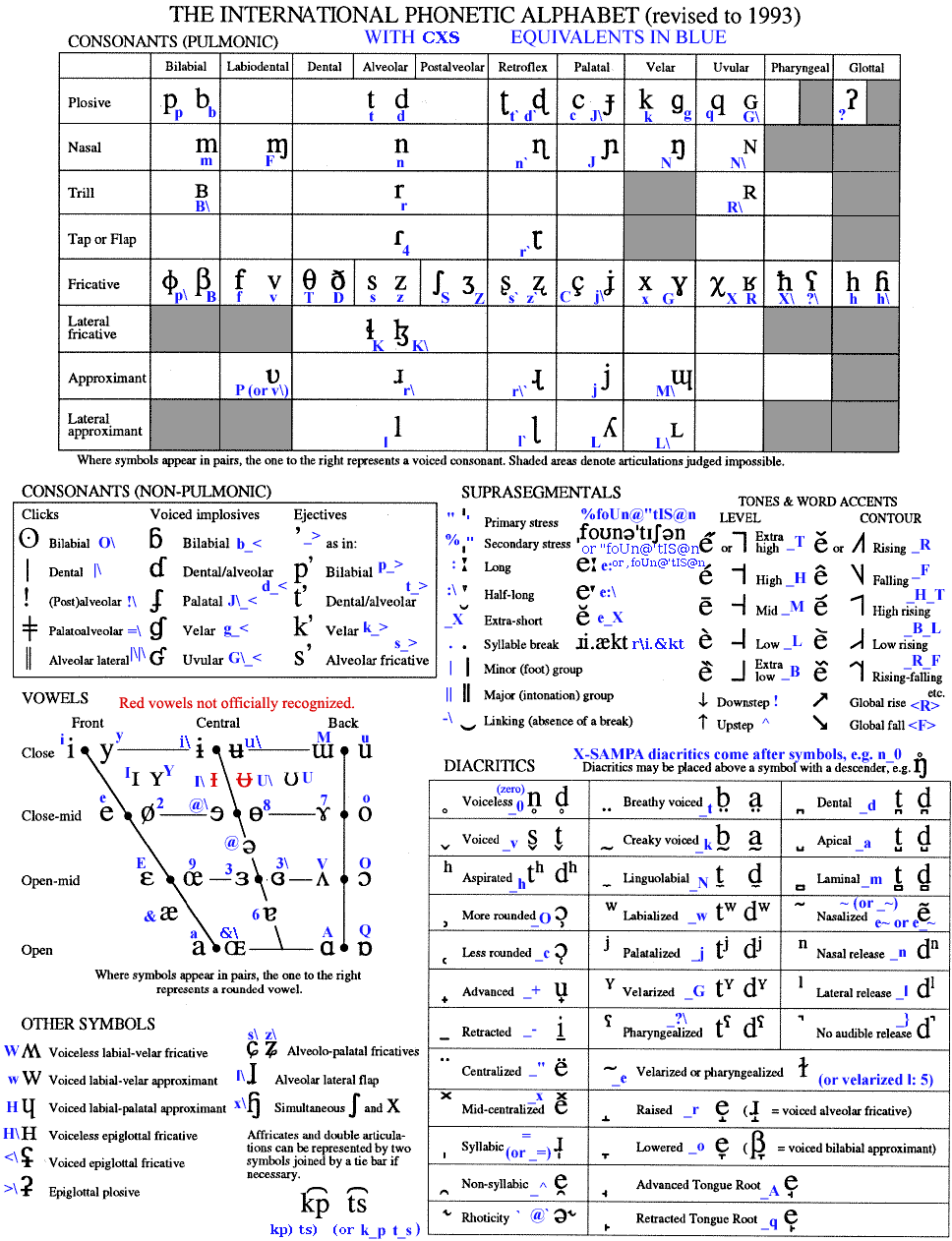
On Mon, Nov 08, 2004 at 05:58:35PM +0100, Andreas Johansson wrote:
> > I'd also count the numbers as  samples of extremely unintuitive assignments.
>
> They once were. By now, [2] and [9] are at least as ingrained in my
> brain as the proper IPA signs will ever become.

Well, I can only remember [2] and [9] because of Fr. deux and neuf.  [3]
and [8] at least resemble the IPA symbols; [6] I only remember becasue
it comes up on here so frequently (guess those YAEPTs are good for
something :)); [7] is completely hopeless.

> While we're discussing changes, I might mention moving [P] to the
> bilabial fricative (currently [p\]).

Absolutely.  Besides the reasons you give, there is the fact that in the
majority of cases, a fricative derived from a stop uses the uppercase
version of the stop symbol in CXS: g->G, b->B, d->D, t->T.  The other
exception is k->x (instead of *k->K), which is fine since it agrees with
the IPA.  But I must say I find the actual use of [K] in CXS - for the
lateral fricative - completely counterintuitive.


________________________________________________________________________
________________________________________________________________________

Message: 2
   Date: Mon, 8 Nov 2004 17:40:09 +0000
   From: Keith Gaughan <[EMAIL PROTECTED]>
Subject: Re: ANADEWISM: Natlangs that do comparison with true verbs?

Rene Uittenbogaard wrote:
> Philippe Caquant wrote:
>
>  >  --- Carsten Becker skrev:
>  >
>  > > Hello!
>  > >
>  > > I have a problem with Ayeri in that it uses true
>  > > verbs for the comparison of adjectives: "to be as
>  > > ... as", "to be more ... as", "to be less ... as" etc.
>  > > Are there any natlangs that do comparison the same
>  > > way, where I can ste... get ideas from?
>  > >
>  >
>  > L'homme �gale le loup en f�rocit� (Man equals wolf as
>  > far is ferocity is concerned)
>  >
>  > L'homme l'emporte sur le loup en f�rocit� (Man is
>  > superior to wolf as far as ferocity is concerned).
>  > L'homme d�passe (surpasse) le loup en f�rocit� (id)
>  >
>  > Le loup n'arrive pas � la cheville de l'homme pour la
>  > f�rocit� (Wolf doesn't get to the level of man's
>  > ankles for ferocity). Le loup n'atteint pas le niveau
>  > de l'homme... etc.
>
> It seems there are more languages with verbs like these.
> To stick with the same examples, here are the same
> comparisons in Dutch:
>
> De mens evenaart de wolf in wildheid.
> Man equals wolf in ferocity. (evenaren = to equal)
>
> De wolf overtreft de mens in wildheid.
> Wolf surpasses man in ferocity. (overtreffen = to surpass)
> (Deu. �bertreffen)
>
> De mens doet onder voor de wolf in wildheid.
> Man is inferior to wolf in ferocity. (onderdoen voor = to be
> inferior to)
>
> (I'm not sure about the choice of the preposition "in" in that
> last English sentence; is that correct?)

Perfect english. All the french sentences could have been directly
translated word-for-word to english too.

K.


________________________________________________________________________
________________________________________________________________________

Message: 3
   Date: Mon, 8 Nov 2004 09:47:05 -0800
   From: "H. S. Teoh" <[EMAIL PROTECTED]>
Subject: Re: CXS changes

On Mon, Nov 08, 2004 at 12:44:40PM +1100, Tristan Mc Leay wrote:
[...]
> (BTW And, the reason CXS is so good isn't because I did a really good
> job, it's because it's what we wanted to use---what we were
> using---anyway. All I did was modify an image and told everyone about
> it, started calling it CXS instead of X-Sampa-but-with-these-changes,
> and refused to accept every change thrown at me.* I certainly had no
> intention to snub anyone, I just wanted to stop calling something that
> wasn't X-Sampa 'X-Sampa' and make it easier for newbies. And make myself
> a little bit famous :)
[...]

If you do decide to go ahead with the changes, please let me know. I
have a copy of the CXS chart on my webserver, and would like to keep
it up-to-date with any recent changes (esp. since it is indexed by
Google). Thanks!


T

--
The problem with the world is that everybody else is stupid.


________________________________________________________________________
________________________________________________________________________

Message: 4
   Date: Mon, 8 Nov 2004 13:06:21 -0500
   From: Roger Mills <[EMAIL PROTECTED]>
Subject: Re: Need some help with terms: was "rhotic miscellany"

Ray Brown wrote:
> I cannot answer for John, but I've been assuming that Sally was talking
> about the |r| in |rack|, not the |r| in |car|.

No, it's always been about post-vocalic r.  See the quote below...

>
> As I think it is well known, in the urban speech of south east England &
> in RP there is no rhotic consonant in syllable coda. I pronounce |car| as
> [k_hA:].  On some words we use centering diphthongs, e.g. |here| [EMAIL
> PROTECTED]

Right; again, see below.
(snip some discussion as to whether r-colored vowels should be called
"retroflexed")
>
> But as Marcos has written, and I agreed with him, this usage is confusing
> as it is *not* the same usage as IPA point of articulation of consonants.
> IPA charts name he feature denoted by the diacritic which CXS represents
> thus [`] (my mailer doesn't seem to like the actual IPA symbol) as
> 'rhotocity'.
>
> I suspect this is where the confusion has come into this thread. We have
> not all been writing about the same thing or using the term 'retroflex' in
> the same way.

Personally, I don't find it confusing; retroflexed can refer to a state of
the tongue (in vowel articulations) as well as to the POA.
>
> Now, back to |car|. The rhotic dialects of south England & the midlands
> have [k_hA`], that is [A] pronounced with retroflexion of the tongue, i.e.
>   r-colored or rhoticized. But there's no consonant. It's rather like the
> nasal consonants in, say, French where a final nasal consonant ha been
> dropped leaving the vowel pronounced with nasalization. Similarly, in the
> rhotic dialects I am familiar with, the final /r/ has disappeared as a
> consonant, leaving only a rhoticized vowel.

That may be true of those dialects; IMO it's not the case in Amer.Engl., at
least not in monosyllables like "car, ear, core" etc. Below is a quote from
a long msg. I sent yesterday (Subj: "back to rhotic miscellany"; apparently
it reached the list since Charlie replied to it, but it has yet to come back
to me. It's in the archive in the Nov. Week 1 list). In any case, I'm
suggesting that -Vr# ~-VrC# sequences might better be viewed as diphthongs
involving the centralized/rhotic [EMAIL PROTECTED] (IPA schwa with hook)
------------------------------
QUOTE:
Not to confuse the issue, but note that [r\] (IPA inverted r) is not
precisely specified as to dental/alv/post-alv. in the chart at
http://cassowary.free.fr/Linguistics/cxschart.png -- note too that it's the
symbol used for "consonantal" (pre-vocalic) r, as in the ex. [r\i.&kt]
"react" under "Suprasegmentals". No argument there, I think.

It's post-vocalic, semi-vocalic r that's the problem.  In close phonetic
transcriptions, it is often indicated as a _modification_ of the vowel, esp.
of [EMAIL PROTECTED]/[3] (stressed/unstr. resp.), so ['[EMAIL PROTECTED],
[b3^d] "killer, bird".
Since [EMAIL PROTECTED], 3^] are unitary vowel sounds (no transitional movement
of the
tongue as in "are, ear"), it suggests that in other post-voc. environments
they're functioning as glides and producing a sort of diphthong-- just like
superscript _U and _I in e.g. [a_U, a_I]. Thus in a close phonetic
transcription of "card", perhaps we should write [EMAIL PROTECTED];  if we drawl
the word, we get almost 2-syl ['[EMAIL PROTECTED], just as drawled "cloud" will
come
out [kla.ud].  Obviously, to an audience of Engl. speakers it isn't
necessary to be that precise-- consequently the various shorthand ("broad
phonetic") variants [br\=d] (or even [br=d] though that's bad phonetics, OK
as phonemic), [kIlr\=], [kar\d]....
-------------------------------
(ASIDE: Ray proposes Brit. dial. "car" [ka`]. I think Americans have much
more of a diphthong-like sound. We may have pure rhotic/retro. vowels in
polysyllables e.g. "Carter, porter, gargle" perhaps
['[EMAIL PROTECTED]'[EMAIL PROTECTED]'[EMAIL PROTECTED] spoken at normal
tempo--though if I drawl
these out unnaturally, I still get that intrusive @^ offglide. Note that I
don't feel it's necessary to use the "retroflexed approximant" symbol [r`\]
IPA inverted r with tail-- I haven't yet gone to an IPA sound-sample site,
but I suspect [r`\] is NOT standard English/American /r/ in any environment.
-------------------------------
(resume quote)
Note that in non-rhotic dialects, [EMAIL PROTECTED] simply loses its
retroflexion but
survives as an [EMAIL PROTECTED] offglide, as in "beer" [EMAIL PROTECTED],
NYC-ese "sure, shore"
[EMAIL PROTECTED] (the vowel is actually somewhere between [U] and [o]) or
compensatory
length (Tristan's Australian [bI:], RP "court" [k_hO:t]-- quite on a par
with the dropping of the glide-[j] is Southern US, "I" [A:], "fire" [fAr\].
END QUOTE
----------------------------------

> But as I cannot hear Sally speak...,

I spoke with her once on the phone, and didn't notice anything peculiar
(i.e. radically different from me) about her r's, though that was not the
subject :-))

..I can make no judgment and it may well
> be that she and many other Merkans do have a separate _consonant_ here,
> namely the retroflex approximant.

I don't think so; I think we have that diphthongal [EMAIL PROTECTED] offglide. >
> If Sally does indeed have the retroflex approximant here, then CXS
> certainly has a symbol for it, albeit a compound symbol, namely [r\`].
>
> Do those speakers who have [r\`] in syllable coda, use the same
> approximant in onset position?  In other words, do Merkans generally
> pronounce /r/ in |car| the same as the /r/ in |rack|?

No to both questions, just speaking for self. For one thing, initial r
usually involves a slight bit of rounding (note that children just beginning
to speak often confuse onset /r/ (and /l/) with /w/).

Oh me, oh my, this poor bedraggled horse!! We ought all to gather someday in
a hall (The First Int'l Conlang Conference! [YAEPT parasession]) and compare
pronunciations ad nau...er infinitum. Failing that, we really ought to
create a website of recordings for those interested. Parallel with "Yer Ugly
Mug" (is it still alive?) we could call it "Yer Ugly Voice"
:-))))))))))))))))))))))


________________________________________________________________________
________________________________________________________________________

Message: 5
   Date: Mon, 8 Nov 2004 13:28:08 -0500
   From: Amanda Babcock <[EMAIL PROTECTED]>
Subject: Re: Old Nindic to Classical Modern Nindic

You can see how far behind in my email I am lately....

On Wed, Sep 29, 2004 at 09:37:22PM -0700, Elliott Lash wrote:

> "Look at the stars for they are beautiful
> in the sky above the World."

m�r�chi:

l�hlp'da �n t�t�ndi hr�vin f�maris�p't� � ku�bac�m � d�lch�m�.

/'lol_0pdA 'An te'tindi 'r_0ovIn 'fEmarisopte 'A ku'Ebakum 'A 'dElxeme/

(Anybody wondering about the diacritics, see
http://www.quandary.org/~langs/merechi/ for an explanation; they're the
meaningless product of a twelve-year-old mind, and they've been there
for twenty years and I'm not taking them out now.)

lo[hl]   -p  -da   a  -n  teti-n -di hrovin   femari   -so-p  -te
look[OPT]-IMP-2psg ART-PL star-PL-at because  beautiful-be-IMP-3ppl

a   kueba-cum a   delche-me
ART sky  -in  ART earth -over

Toma Heylm:

Lo delye mi ekaryok tam tembriyu, tal elyi dava pelyelid tyem syin
yuhele mi syin yudampe.

lo   delye mi  ekaryok    tam tembri-yu tal elyi dava 0   pelyeli  -d
2psg IRR   OBL look.at(m) PL  star  -PL for 3ppl IMPF COP beautiful-PL

tyem syin yu- hele mi    syin yu- dampe
in   ART  LOC-sky  above ART  LOC-world

Amanda


________________________________________________________________________
________________________________________________________________________

Message: 6
   Date: Mon, 8 Nov 2004 19:30:14 +0100
   From: Carsten Becker <[EMAIL PROTECTED]>
Subject: Ayeri: Longer text & Sound example

Hey!

I've put myself at translating the story of the "Northwind
and the Sun" (Temihin nay Perin) German > Ayeri > English finally.

Here's the FIRST SENTENCE. (T = Trigger, otherwise as usual)

| Einst stritten sich Nordwind und Sonne,
| time-some.LOC T:A PS.quarrel.3pl^a north-wind A.cold and sun.T,
| Viarilea ang macubriy�n temihin nusatyo nay Perinin,
| via4i'lea N ma'kub4iAn t_de'mihin nu'sat_d_jo nAi) pe'rinin
| At some time, quarreled northwind cold and sun,
|
| wer von ihnen beiden wohl der St�rkere w�re,
| REL.A among two.NMLZ.LOC T:A to=be=more=than.S_j.3pl^a.T A.strong,
| sang luga samnoea ang engongiy�nin numicyo,
| sAN 'luga sAmno'ea N eN'gONgiAnin nu'mik_jo
| who among the two would be stronger,
|
| als ein Wanderer,
| and this-time.LOC a.A-traveller.T T:A PS.come.3sg^e way.LOC,
| nay edauyiea loasanoin ang masahaiy� sasanoea,
| nAi) 'ed_dawi.'ea lwA'sanoin AN masa'hajE sa'sano.ea
| and at this time a traveller came on the way,
|
| der in einen warmen Mantel geh�llt war, des Weges daher kam.
| REL.A PS.wrap.CAU.3sg^e inside=of a.P-cloak.LOC OBL.warm .
| sang manaiconisaiy� cong metovaea eimato.
| sAN manA_j:kOni.'saiE kON met_dova'ea Ei)'mat_do
| who was wrapped into a cloak warm.

The soundfile is accessible at
www.beckerscarsten.de/conlang/ayeri/sounds/xmp_northwind[1].mp3
<http://www.beckerscarsten.de/conlang/ayeri/sounds/xmp_northwind%5B1%5D.mp3>

It's 16 sec long! The longest recording that has ever been
made in Ayeri :-)

Ack, I know that it has too much [aoaeaoiaoe] and
[nAnggAnggAng] in it. This is due to the grammar in
most cases and no language sounds 100% beautiful. OK, maybe
except Tolkien's langs, but he as t3h m45t0r 0f k0nl4n6z
th4t r0x0rz y00r s0x0rz doesn't count :-P

Enjoy & please comment,
Carsten

--
Eri silvev�ng aibannama padangin.
Nivaie evaenain eri ming silvoiev�ng caparei.


________________________________________________________________________
________________________________________________________________________

Message: 7
   Date: Mon, 8 Nov 2004 19:36:20 +0100
   From: Henrik Theiling <[EMAIL PROTECTED]>
Subject: Re: CXS changes

Hi!

"Mark J. Reed" <[EMAIL PROTECTED]> writes:
>...
> Well, I can only remember [2] and [9] because of Fr. deux and neuf.

And 2 has the same slash as the IPA symbol.

> ... [7] is completely hopeless.

The 7 is an arrow that points to the place on the virtual map of the
mouth.  You know that it is not u or M or o...

OK, this is not tooo intuitive...

I'd state again here that I would not want to change anything unless
the variants are in use on Conlang for a considerable amount of time.
Just to prevent chaos.

**Henrik


________________________________________________________________________
________________________________________________________________________

Message: 8
   Date: Mon, 8 Nov 2004 19:37:01 +0100
   From: Henrik Theiling <[EMAIL PROTECTED]>
Subject: Re: CXS changes

Hi!

"H. S. Teoh" <[EMAIL PROTECTED]> writes:
>...
> If you do decide to go ahead with the changes, please let me know. I
> have a copy of the CXS chart on my webserver, and would like to keep
> it up-to-date with any recent changes (esp. since it is indexed by
> Google). Thanks!

Same for me, I translated all that to a Unicode chart, etc.

**Henrik


________________________________________________________________________
________________________________________________________________________

Message: 9
   Date: Mon, 8 Nov 2004 13:56:29 -0500
   From: Roger Mills <[EMAIL PROTECTED]>
Subject: Re: CXS changes

Andreas Johansson and others have written:

> Quoting "J. 'Mach' Wust" <[EMAIL PROTECTED]>:
> > If you don't feel obliged to follow (X-)Sampa, then you could also get
> > rid
> > of the strange use of |J| for a nasal sound and use |n\| instead. I
> > believe
> > the only reason for that peculiar use of |J| is that by the time it was
> > introduced, there wasn't any general modifier sign yet as we now have
> > with
> > |\|.
>
> Personally, I think it would be nice to retain a monograph for this fairly
> common phone, and that the palatal conotations of |J| makes it fairly
> fitting.
> Obviously, [n\] might be used as an alternative.

Isn't " �"  (ALT 0241) generally viewable by all????
>
> While we're discussing changes, I might mention moving [P] to the bilabial
> fricative (currently [p\]); not only would this make for a monograph for
> another tolerably common sound which also increases symmetry with [p b B],
> the
> present use of [P] is for a labiodental approximant, which is, at least on
> this
> list, much less commonly mentioned than the bilabial fric, and which
> already has
> an alternative notation - [v\] - in X-SAMPA, which on top of it better
> suggests
> labiodentality.

Agree on both. (I thought "P" _was_ the voiceless bilab. fric...)


________________________________________________________________________
________________________________________________________________________

Message: 10
   Date: Mon, 8 Nov 2004 14:00:39 -0500
   From: John Cowan <[EMAIL PROTECTED]>
Subject: Re: back to "rhotic miscellany"

caeruleancentaur scripsit:

> I have always thought of
> myself as having no accent, at least none that marks me as from a
> particular region of America.  Who knows what Prof. Higgins might
> discern!  I believe that's known as a midwestern accent, the one that
> broadcasters try to emulate.  At least that's what my brother, the
> DJ, told me.

What broadcasters learn (except on country music stations, of course) is
pretty much a California accent with localisms minimized.

--
A witness cannot give evidence of his           John Cowan
age unless he can remember being born.          [EMAIL PROTECTED]
  --Judge Blagden                               http://www.ccil.org/~cowan


________________________________________________________________________
________________________________________________________________________

Message: 11
   Date: Mon, 8 Nov 2004 19:19:13 +0000
   From: Ray Brown <[EMAIL PROTECTED]>
Subject: Re: Spelling pronunciations (was: rhotic miscellany)

On Sunday, November 7, 2004, at 09:51 , Ph. D. wrote:

> Ray Brown wrote:
>>
>> I've been talking all the time about 'British waistcoats',
>> which you LeftPondians quaintly call 'vests'. The were
>> once (and hopefully still are) called 'weskits'. Over here,
>> as I guess you know, 'vest' always means what you call
>> an 'undervest'
>
> I've never heard the term "undervest" in the United
> States. Perhaps this is what we call an "undershirt"?

OOPS! I guess it is.

I think I was misled by:
British _pants_ = American _underpants_

So British _vest_ is the American _undershirt_? Sort of logical, I guess -
except that over here there are some guys who, when the weathers warmer,
don't wear the vest/undershirt under anything  :)

Who was it said the UK and the USA are two nations divided by the same
language?

Ray
===============================================
http://home.freeuk.com/ray.brown
[EMAIL PROTECTED]
===============================================
Anything is possible in the fabulous Celtic twilight,
which is not so much a twilight of the gods
as of the reason."      [JRRT, "English and Welsh" ]


________________________________________________________________________
________________________________________________________________________

Message: 12
   Date: Mon, 8 Nov 2004 19:19:00 +0000
   From: Ray Brown <[EMAIL PROTECTED]>
Subject: Re: Need some help with terms: was "rhotic miscellany"

On Sunday, November 7, 2004, at 08:50 , Andreas Johansson wrote:

> Quoting Ray Brown <[EMAIL PROTECTED]>:
>
>> Thinks: if there's a retroflex lateral approximant - and there is in some
>> Indic languages - why ain't there any retroflex lateral fricatives? (Umm
>> -
>> a bit difficult to pronounce).
[snip]

> I can produce sublaminal lateral fricative too, and I do not find it any
> harder
> than your run-of-the-mill apico-alveolar lateral fric, so I would not be
> surprised if it's used somewhere.

I guess I could acquire it - it's just that I am used to [K].

>  The lack of an IPA sign need only mean that
> no language distinguishes phonologically from apico-alveolars, and since,
>  I
> believe, both retroflex-alveolar distinctions and lateral fricatives are
> relatively rare typologically, the lack of such languages might simply be
> due
> to combinatorics.

Yes - but I thought IPA was meant to provide symbols for _phonetic_
representation as well as phonological representation.

Obviously the blacked-out cells in the IPA place of articulation/manner of
articulation matrix mean that the sound that would in theory fill the cell
is in fact physically impossible. I have assumed that the empty cells
which are not blacked-out were sounds that were theoretically possible but
not attested in any known natlang. Is this assumption mistaken?

Ray
===============================================
http://home.freeuk.com/ray.brown
[EMAIL PROTECTED]
===============================================
Anything is possible in the fabulous Celtic twilight,
which is not so much a twilight of the gods
as of the reason."      [JRRT, "English and Welsh" ]


________________________________________________________________________
________________________________________________________________________

Message: 13
   Date: Mon, 8 Nov 2004 21:26:08 +0200
   From: Isaac Penzev <[EMAIL PROTECTED]>
Subject: Re: CXS changes

Henrik Theiling wrote:


> I'd state again here that I would not want to change anything unless
> the variants are in use on Conlang for a considerable amount of time.
> Just to prevent chaos.

As a contributor to the present-day CXS, I wholeheartedly agree with Henrik.
Indeed I strongly oppose any changes unless they are approved by long-time
use, or by a unanimous agreement of the members. CXS is not blameless, but
at least it is a kind of standard system preventing chaos.

-- Yitzik


________________________________________________________________________
________________________________________________________________________

Message: 14
   Date: Mon, 8 Nov 2004 14:47:06 -0500
   From: "Mark J. Reed" <[EMAIL PROTECTED]>
Subject: Re: Spelling pronunciations (was: rhotic miscellany)

On Mon, Nov 08, 2004 at 07:19:13PM +0000, Ray Brown wrote:
> So British _vest_ is the American _undershirt_?

Maybe.  It depends on what you mean by "vest".  An "undershirt" is a
shirt designed to be worn under another shirt, not just for the warmth
of double layers but, e.g., to absorb sweat and keep it from staining
the outer shirt.  They are sometimes called "T-shirts" because of their
shape, but that's a more general term (see below).  They are usually
made of cotton, white, and short-sleeved; they may instead have no
sleeves, in which case they're not T-shirts but "tank tops", sometimes
referred to as "wife beaters" because they seem to be the favored form
of undershirt used by the people who show up on "Cops" - at least, those
few who show up wearing anything at all.  :)

> Sort of logical, I guess - except that over here there are some guys
> who, when the weathers warmer, don't wear the vest/undershirt under
> anything  :)

Then they're just T-shirts.  That's a more general term applied to all shirts
shaped that way, whether worn as undershirts or not.  Although if there
is an actual collar and a few buttons at the neck, then it's not a
T-shirt but a "golf shirt" or "polo shirt".

> Who was it said the UK and the USA are two nations divided by the same
> language?

Shaw?

-Marcos


________________________________________________________________________
________________________________________________________________________

Message: 15
   Date: Mon, 8 Nov 2004 14:33:49 -0500
   From: "Mark J. Reed" <[EMAIL PROTECTED]>
Subject: Re: CXS changes

On Mon, Nov 08, 2004 at 01:56:29PM -0500, Roger Mills wrote:
> Isn't " �"  (ALT 0241) generally viewable by all????

Maybe, but then you open up the Pandora's box of non-ASCII characters.
Once you do that,  are all sorts of things that have better
alternatives, even just within Latin-1: [�] for [T], [�] for [D], [�]
for [2], [�] for [&] - of course, if we have [�], folks will wonder why
we don't have the o-e ligature for [9] (answer: it's not in Latin-1) . .
.

-Marcos


________________________________________________________________________
________________________________________________________________________

Message: 16
   Date: Mon, 8 Nov 2004 14:39:48 -0500
   From: "Mark J. Reed" <[EMAIL PROTECTED]>
Subject: Re: CXS changes

On Mon, Nov 08, 2004 at 02:33:49PM -0500, Mark J. Reed wrote:
> Maybe, but then you open up the Pandora's box of non-ASCII characters.
> Once you do that,  are all sorts of things that have better

Hm.  Dropped a "there" there.

My point, though, is that ASCII, while somewhat arbitrary, is a pretty
easy limitation to explain: no diacritical marks, no ligatures, no
non-Roman letters, etc.  If you open it up to Latin-1 but not Unicode,
you suddenly have to worry about the much more arbitrary-seeming list of
*which* diacritical marks, ligatures, and non-Roman letters you can use
out of all the ones you can't.  That will lead to obvious
assymetries/inconsistencies like using � but not using oe (oe lig).

-Marcos


________________________________________________________________________
________________________________________________________________________

Message: 17
   Date: Mon, 8 Nov 2004 20:46:47 +0100
   From: Andreas Johansson <[EMAIL PROTECTED]>
Subject: Re: Need some help with terms: was "rhotic miscellany"

Quoting Ray Brown <[EMAIL PROTECTED]>:

> On Sunday, November 7, 2004, at 08:50 , Andreas Johansson wrote:
>
> >  The lack of an IPA sign need only mean that
> > no language distinguishes phonologically from apico-alveolars, and since,
> >  I
> > believe, both retroflex-alveolar distinctions and lateral fricatives are
> > relatively rare typologically, the lack of such languages might simply be
> > due
> > to combinatorics.
>
> Yes - but I thought IPA was meant to provide symbols for _phonetic_
> representation as well as phonological representation.
>
> Obviously the blacked-out cells in the IPA place of articulation/manner of
> articulation matrix mean that the sound that would in theory fill the cell
> is in fact physically impossible. I have assumed that the empty cells
> which are not blacked-out were sounds that were theoretically possible but
> not attested in any known natlang. Is this assumption mistaken?

Sort-of. To have a separate IPA symbol a phone is supposed to be _contrastive_
in some natlang. Now, there are some failures to achieve that (Tamil's
distinction 'tween alveolars and dentals can't be captured without recourse to
diacritics, and I rather doubt that all the signs for mid-central vowels are
strictly necessary for achieving that aim), but that's the basic idea.

                                                        Andreas

PS Incidentally, does anyone know if there's a lang contrasting /F/ against both
/m/ and /n/?


________________________________________________________________________
________________________________________________________________________

Message: 18
   Date: Mon, 8 Nov 2004 19:58:19 -0000
   From: caeruleancentaur <[EMAIL PROTECTED]>
Subject: Fwd:       Re: back to "rhotic miscellany"

Sorry!  For many of us here in the U.S., the war began on December 7,
1941. I was born 12/12/40.  My apologies to those who had to endure
the war for several years earlier.

Charlie

--- In [EMAIL PROTECTED], Andreas Johansson <[EMAIL PROTECTED]> wrote:
Quoting caeruleancentaur <[EMAIL PROTECTED]>:

> --- In [EMAIL PROTECTED], Sally Caves <[EMAIL PROTECTED]> wrote:
> ----- Original Message -----
>
> >>Yes it is!  If you don't mind my asking, I wonder where you're
from
> >>in the States (are you from the States?).
>
> I was born in CA a year before WWII.

Does that mean 1938 or 1940? Or even 1936?

                             Andreas
--- End forwarded message ---


________________________________________________________________________
________________________________________________________________________

Message: 19
   Date: Mon, 8 Nov 2004 20:13:50 -0000
   From: caeruleancentaur <[EMAIL PROTECTED]>
Subject: Re: Small relay

--- In [EMAIL PROTECTED], Yann Kiraly <[EMAIL PROTECTED]> wrote:

>Great! As I'm happy with the present state of my  minimalist conlang
>manaki (small words :)), except for vocabulary of course, I'd be
>ready any time. So, if , say, 8 more people reply to this thread, we
>could get started.
--- End forwarded message ---

I was hoping that somehow in the messages I would discover what
a "relay" was.  I haven't been able to.  Would someone explain to a
newbie, please?

Charlie


________________________________________________________________________
________________________________________________________________________

Message: 20
   Date: Mon, 8 Nov 2004 15:02:26 -0500
   From: "Ph. D." <[EMAIL PROTECTED]>
Subject: Re: Spelling pronunciations (was: rhotic miscellany)

Mark J. Reed wrote:
> Ray Brown wrote:
>> So British _vest_ is the American _undershirt_?
>
> Maybe.  It depends on what you mean by "vest".  An
> "undershirt" is a shirt designed to be worn under
> another shirt, not just for the warmth of double
> layers but, e.g., to absorb sweat and keep it from
> staining the outer shirt.  They are sometimes called
> "T-shirts" because of their shape, but that's a more
> general term (see below).  They are usually made of
> cotton, white, and short-sleeved; they may instead
> have no sleeves, in which case they're not T-shirts
> but "tank tops", sometimes referred to as "wife
> beaters" because they seem to be the favored form
> of undershirt used by the people who show up on
> "Cops" - at least, those few who show up wearing
> anything at all.  :)

Hmmm. I've never thought of T-shirts as being called
undershirts, although I know lots of men wear them
under regular shirts. To me, "undershirt" always means
the sleeveless variety, "tank tops" are this style
when worn by women, and "muscle shirts" when worn by
men.


>> Sort of logical, I guess - except that over here
>> there are some guys who, when the weathers warmer,
>> don't wear the vest/undershirt under anything  :)
>
> Then they're just T-shirts.  That's a more general
> term applied to all shirts shaped that way, whether
> worn as undershirts or not.  Although if there is
> an actual collar and a few buttons at the neck, then
> it's not a T-shirt but a "golf shirt" or "polo shirt".

Not necessarily. It's considered lower-class and
vulgar, but some men do wear the sleeveless
undershirts by themselves during the summer.


>> Who was it said the UK and the USA are two nations
>> divided by the same language?
>
> Shaw?

Wasn't it Winston Churchill?

--Ph. D.


________________________________________________________________________
________________________________________________________________________

Message: 21
   Date: Mon, 8 Nov 2004 12:24:44 -0800
   From: "H. S. Teoh" <[EMAIL PROTECTED]>
Subject: Re: Small relay

On Mon, Nov 08, 2004 at 08:13:50PM -0000, caeruleancentaur wrote:
[...]
> I was hoping that somehow in the messages I would discover what
> a "relay" was.  I haven't been able to.  Would someone explain to a
> newbie, please?

It's the CONLANG equivalent of the "telephone game". We start with a
text in conlang #1, and then pass it to the next person who translates
it into conlang #2, who then passes it to the following person, etc..
After everyone is done, the last person passes it back to the first
person who translates it back to conlang #1, and then publishes the
result so we can compare the two texts and see how they have mutated.


T

--
Lottery: tax on the stupid. -- Slashdotter


________________________________________________________________________
________________________________________________________________________

Message: 22
   Date: Tue, 9 Nov 2004 08:11:42 +1100
   From: Tristan Mc Leay <[EMAIL PROTECTED]>
Subject: Re: Spelling pronunciations

Ray Brown wrote:

> So British _vest_ is the American _undershirt_? Sort of logical, I
> guess -
> except that over here there are some guys who, when the weathers warmer,
> don't wear the vest/undershirt under anything  :)


I think I finally understand! (I've always heard people say that one
groups 'vest' is another's 'waistcoat', but had no idea what either
group meant by either term.) Australians call these devices _singlets_
unless I'm mistaken ('singlet' is appropriate for most sleeveless tops).
And I think we use the American meaning for _vest_.


--
Tristan.


________________________________________________________________________
________________________________________________________________________

Message: 23
   Date: Mon, 8 Nov 2004 16:39:03 -0500
   From: Sally Caves <[EMAIL PROTECTED]>
Subject: Re: Small relay

Yann, you do know that there is whole listserv devoted to Relays, set up by
Irina Rempt?  [EMAIL PROTECTED]  Perhaps somebody else can give the
subscription information, because I've forgotten it.  If what you want is a
small one, we could do it here.  But the list was created to avoid
cluttering up the CONLANG list with our comments about it.

As for the rules of the Relay, Charlie, I posted them here:

http://www.frontiernet.net/~scaves/relayrule.html

We've done over ten of them in the past five years.
Sally


----- Original Message -----
From: "Yann Kiraly" <[EMAIL PROTECTED]>
To: <[EMAIL PROTECTED]>
Sent: Monday, November 08, 2004 11:44 AM
Subject: Re: Small relay


> Great! As I'm happy with the present state of my  minimalist conlang
> manaki (small words :)), except for vocabulary of course, I'd be ready any
> time. So, if , say, 8 more people reply to this thread, we could get
> started.
>


________________________________________________________________________
________________________________________________________________________

Message: 24
   Date: Mon, 8 Nov 2004 13:36:45 -0800
   From: "B. Garcia" <[EMAIL PROTECTED]>
Subject: Re: Spelling pronunciations (was: rhotic miscellany)

On Mon, 8 Nov 2004 08:54:15 -0500, John Cowan <[EMAIL PROTECTED]> wrote:
>
> /@gejn(st)/ seems British to me, and
> /Et/ comes across as an archaic vulgarism, the sort of thing my father
> (1904-1993) said when he was being funny.

My grandmother (born 1920) was raised on a farm in the north eastern
corner of Kansas, and she often says /Et/ where I say /ejt/. To me the
use of /Et/ has a Kansan quality to it, much like using /wArS/ for
/wAS/

--
You can turn away from me
but there's nothing that'll keep me here you know
And you'll never be the city guy
Any more than I'll be hosting The Scooby Show

Scooby Show - Belle and Sebastian


________________________________________________________________________
________________________________________________________________________

Message: 25
   Date: Mon, 8 Nov 2004 23:01:47 +0100
   From: Rene Uittenbogaard <[EMAIL PROTECTED]>
Subject: Re: ANADEWISM: Natlangs that do comparison with true verbs?

I wrote:

 > Man is inferior to wolf in ferocity.
 > (I'm not sure about the choice of the preposition "in" in that
 > last English sentence; is that correct?)

Keith Gaughan wrote:

 > Perfect english.

Carsten Becker wrote:

 > Ren�: Maybe it would have been better to choose "as for"
 > instead of the second "is". Maybe it would have been
 > better, too, to say "was seine Wildheit betrifft" (what
 > concerns his ferocity) instead of "in seiner Wildheit".

Thanks for your remarks!

I wasn't sure whether I could say:

Man is inferior to wolf in ferocity.
Man is inferior to wolf with respect to ferocity.
Man is inferior to wolf as concerns ferocity.

Carsten suggests if I understand correctly:

Man is inferior to wolf as for ferocity.
Man is inferior to wolf what concerns his ferocity.

My dictionary lists "as concerns" as a synonym for "in respect to";
should I have used that instead?

Man is inferior to wolf in respect to ferocity.

So which sentences are correct? And what is more, which sentences are
usual/unusual?

Choosing the right preposition is currently one of the things that I
find hardest about English. I'd really appreciate it if you would keep
correcting me :)

BTW, is there a general term for "prepositional constructs" like "with
respect to"? I usually refer to them as "compound prepositions", but
what is the official terminology?


Emor�ni,
Ren�


________________________________________________________________________
________________________________________________________________________


------------------------------------------------------------------------
Yahoo! Groups Links

<*> To visit your group on the web, go to:
    http://groups.yahoo.com/group/conlang/

<*> To unsubscribe from this group, send an email to:
    [EMAIL PROTECTED]

<*> Your use of Yahoo! Groups is subject to:
    http://docs.yahoo.com/info/terms/

------------------------------------------------------------------------