------------------------ Yahoo! Groups Sponsor --------------------~-->
Make a clean sweep of pop-up ads. Yahoo! Companion Toolbar.
Now with Pop-Up Blocker. Get it for free!
http://us.click.yahoo.com/L5YrjA/eSIIAA/yQLSAA/GSaulB/TM
--------------------------------------------------------------------~->
There are 12 messages in this issue.

Topics in this digest:

      1. Re: ANADEWISM: Natlangs that do comparison with true verbs?
           From: Kit La Touche <[EMAIL PROTECTED]>
      2. Re: ANADEWISM: Natlangs that do comparison with true verbs?
           From: Roger Mills <[EMAIL PROTECTED]>
      3. Fwd:       Re: ANADEWISM: Natlangs that do comparison with true verbs?
           From: caeruleancentaur <[EMAIL PROTECTED]>
      4. Re: Spelling pronunciations
           From: "Pascal A. Kramm" <[EMAIL PROTECTED]>
      5. Re: Small relay
           From: "Pascal A. Kramm" <[EMAIL PROTECTED]>
      6. Re: Spelling pronunciations
           From: Tristan Mc Leay <[EMAIL PROTECTED]>
      7. Re: Spelling pronunciations
           From: Tristan Mc Leay <[EMAIL PROTECTED]>
      8. English l and Spanish ll
           From: Adam Supercalifragilisticexpialidocious <[EMAIL PROTECTED]>
      9. Re: English l and Spanish ll
           From: Tristan Mc Leay <[EMAIL PROTECTED]>
     10. Re: Spelling pronunciations
           From: John Cowan <[EMAIL PROTECTED]>
     11. Book Review & a comment on KÃlen
           From: Sylvia Sotomayor <[EMAIL PROTECTED]>
     12. Rejected posting to [EMAIL PROTECTED]
           From: "L-Soft list server at Brown University (1.8d)" <[EMAIL
PROTECTED]>


________________________________________________________________________
________________________________________________________________________

Message: 1
   Date: Mon, 8 Nov 2004 17:18:02 -0500
   From: Kit La Touche <[EMAIL PROTECTED]>
Subject: Re: ANADEWISM: Natlangs that do comparison with true verbs?

i would say "man is inferior to the wolf in ferocity" for a general
statement about men and wolves.  "as concerns" and "with respect to" are
both a bit stilted.

"man is inferior to wolf what concerns his ferocity" is an unacceptable
english sentence.

"in respect to" is also pretty stilted - just plain "in" is probably best.

as to a general term for long prepositional things, they are syntactically
a PP in an NP in a PP, though they may be a single semantic unit.

hope this helps,

kit, a native northeastern U.S.A. english speaker.

> I wasn't sure whether I could say:
>
> Man is inferior to wolf in ferocity.
> Man is inferior to wolf with respect to ferocity.
> Man is inferior to wolf as concerns ferocity.
>
> Carsten suggests if I understand correctly:
>
> Man is inferior to wolf as for ferocity.
> Man is inferior to wolf what concerns his ferocity.
>
> My dictionary lists "as concerns" as a synonym for "in respect to";
> should I have used that instead?
>
> Man is inferior to wolf in respect to ferocity.
>
> So which sentences are correct? And what is more, which sentences are
> usual/unusual?
>
> Choosing the right preposition is currently one of the things that I
> find hardest about English. I'd really appreciate it if you would keep
> correcting me :)
>
> BTW, is there a general term for "prepositional constructs" like "with
> respect to"? I usually refer to them as "compound prepositions", but
> what is the official terminology?
>
> EmorÃni,
> RenÃ


________________________________________________________________________
________________________________________________________________________

Message: 2
   Date: Mon, 8 Nov 2004 17:55:53 -0500
   From: Roger Mills <[EMAIL PROTECTED]>
Subject: Re: ANADEWISM: Natlangs that do comparison with true verbs?

Rene Uittenbogaard wrote:

> So which sentences are correct? And what is more, which sentences are
> usual/unusual?
>
> Choosing the right preposition is currently one of the things that I
> find hardest about English. I'd really appreciate it if you would keep
> correcting me :)

OK...

> I wrote:
>
>  > Man is inferior to wolf in ferocity.
>  > (I'm not sure about the choice of the preposition "in" in that
>  > last English sentence; is that correct?)
>
> Keith Gaughan wrote:
>
>  > Perfect english.

Agreed. (It would be a little better with _the_ wolf, IMO)
>
> Carsten Becker wrote:
>
>  > RenÃ: Maybe it would have been better to choose "as for"
>  > instead of the second "is". Maybe it would have been
>  > better, too, to say "was seine Wildheit betrifft" (what
>  > concerns his ferocity) instead of "in seiner Wildheit".

If you're going to use "as for" I think it has to come first (topicalizing):
As for ferocity, man is inferior to the wolf.  In this case, instead of "as
for" you could substitute "with respect to" or "as concerns".  If you want
the "ferocity" clause to come at the end, only "with respect to" works: Man
is inferior to the wolf w.r.t. ferocity. Neither "as for" nor "as concerns"
sound right here; awkward at best, or non-native "translationese" perhaps.
>
> I wasn't sure whether I could say:
>
> Man is inferior to wolf in ferocity.
> Man is inferior to wolf with respect to ferocity.
Yes to these two.
> Man is inferior to wolf as concerns ferocity.
Marginal. The meaning is clear; it just doesn't sound right to me.

> Carsten suggests if I understand correctly:
>
> Man is inferior to wolf as for ferocity.
> Man is inferior to wolf what concerns his ferocity.

No to both, especially "what concerns"-- definitely marked as Germanic
translationese in my book (was betrifft..., wat betrefft...)
>
> My dictionary lists "as concerns" as a synonym for "in respect to";
> should I have used that instead?
>
> Man is inferior to wolf in respect to ferocity.

I feel "with respect to" is far more frequent nowadays.  "In/with regard to"
is also synonymous.
>
>
> BTW, is there a general term for "prepositional constructs" like "with
> respect to"? I usually refer to them as "compound prepositions", but
> what is the official terminology?

I'm not sure there is an official term; both of your proposals make sense.

Hope this helps!!


________________________________________________________________________
________________________________________________________________________

Message: 3
   Date: Tue, 9 Nov 2004 00:18:40 -0000
   From: caeruleancentaur <[EMAIL PROTECTED]>
Subject: Fwd:       Re: ANADEWISM: Natlangs that do comparison with true verbs?

--- In [EMAIL PROTECTED], Roger Mills <[EMAIL PROTECTED]> wrote:
Rene Uittenbogaard wrote:

>BTW, is there a general term for "prepositional constructs"
>like "with respect to"? I usually refer to them as "compound
>prepositions", but what is the official terminology?

>>I'm not sure there is an official term; both of your proposals make
>>sense.


The official term is complex preposition (David Crystal, "A
Dictionary of Linguistics and Phonetics, p. 275).


________________________________________________________________________
________________________________________________________________________

Message: 4
   Date: Mon, 8 Nov 2004 19:28:40 -0500
   From: "Pascal A. Kramm" <[EMAIL PROTECTED]>
Subject: Re: Spelling pronunciations

On Tue, 9 Nov 2004 08:11:42 +1100, Tristan Mc Leay
<[EMAIL PROTECTED]> wrote:

>Ray Brown wrote:
>
>> So British _vest_ is the American _undershirt_? Sort of logical, I
>> guess -
>> except that over here there are some guys who, when the weathers warmer,
>> don't wear the vest/undershirt under anything  :)
>
>I think I finally understand! (I've always heard people say that one
>groups 'vest' is another's 'waistcoat', but had no idea what either
>group meant by either term.) Australians call these devices _singlets_
>unless I'm mistaken ('singlet' is appropriate for most sleeveless tops).
>And I think we use the American meaning for _vest_.

In German we have the word "Weste", which only refers to some sort of
sleeveless jackets always worn on top of other top garments, no more.

--
Pascal A. Kramm, author of Choton
official Choton homepage:
http://www.choton.org


________________________________________________________________________
________________________________________________________________________

Message: 5
   Date: Mon, 8 Nov 2004 19:24:09 -0500
   From: "Pascal A. Kramm" <[EMAIL PROTECTED]>
Subject: Re: Small relay

On Mon, 8 Nov 2004 16:39:03 -0500, Sally Caves <[EMAIL PROTECTED]> wrote:

>Yann, you do know that there is whole listserv devoted to Relays, set up by
>Irina Rempt?  [EMAIL PROTECTED]  Perhaps somebody else can give the
>subscription information, because I've forgotten it.  If what you want is a
>small one, we could do it here.  But the list was created to avoid
>cluttering up the CONLANG list with our comments about it.
>
>As for the rules of the Relay, Charlie, I posted them here:
>
>http://www.frontiernet.net/~scaves/relayrule.html
>
>We've done over ten of them in the past five years.
>Sally

This "relay" stuff sounds like fun :D

--
Pascal A. Kramm, author of Choton
official Choton homepage:
http://www.choton.org


________________________________________________________________________
________________________________________________________________________

Message: 6
   Date: Tue, 9 Nov 2004 11:42:10 +1100
   From: Tristan Mc Leay <[EMAIL PROTECTED]>
Subject: Re: Spelling pronunciations

B. Garcia wrote:

>On Mon, 8 Nov 2004 08:54:15 -0500, John Cowan <[EMAIL PROTECTED]> wrote:
>
>
>>/@gejn(st)/ seems British to me, and
>>/Et/ comes across as an archaic vulgarism, the sort of thing my father
>>(1904-1993) said when he was being funny.
>>
>>
>
>My grandmother (born 1920) was raised on a farm in the north eastern
>corner of Kansas, and she often says /Et/ where I say /ejt/. To me the
>use of /Et/ has a Kansan quality to it, much like using /wArS/ for
>/wAS/
>
>

My grandmother (born 1914) was raised somewhere in country Victoria and
she generally uses a short e in ate. She also surprisingly often (i.e.
at all) says 'his' for 'its', though I'm not sure if this is an archaic
use or just a frequent personification. A number of features of her
speech seem surprisingly conservative, and a number of features of her
speech seem surprisingly Broad; I suppose she's just speaking the Broad
Australian of two generations ago...

(I'll never believe anyone puts an /r/ in 'wash' until I've heard it
with my own ears and I'm satisfied they're not faking it :)

--
Tristan.


________________________________________________________________________
________________________________________________________________________

Message: 7
   Date: Tue, 9 Nov 2004 11:47:32 +1100
   From: Tristan Mc Leay <[EMAIL PROTECTED]>
Subject: Re: Spelling pronunciations

Pascal A. Kramm wrote:

>On Tue, 9 Nov 2004 08:11:42 +1100, Tristan Mc Leay
><[EMAIL PROTECTED]> wrote:
>
>
>
>>Ray Brown wrote:
>>
>>
>>
>>>So British _vest_ is the American _undershirt_? Sort of logical, I
>>>guess -
>>>except that over here there are some guys who, when the weathers warmer,
>>>don't wear the vest/undershirt under anything  :)
>>>
>>>
>>I think I finally understand! (I've always heard people say that one
>>groups 'vest' is another's 'waistcoat', but had no idea what either
>>group meant by either term.) Australians call these devices _singlets_
>>unless I'm mistaken ('singlet' is appropriate for most sleeveless tops).
>>And I think we use the American meaning for _vest_.
>>
>>
>
>In German we have the word "Weste", which only refers to some sort of
>sleeveless jackets always worn on top of other top garments, no more.
>

That sounds like what I had in mind for 'vest', though I would've said
'... refers to a particular sort of ...' (and these are an example of
sleeveless tops that can't be called singlets).

--
Tristan.


________________________________________________________________________
________________________________________________________________________

Message: 8
   Date: Mon, 8 Nov 2004 20:18:42 EST
   From: Adam Supercalifragilisticexpialidocious <[EMAIL PROTECTED]>
Subject: English l and Spanish ll

Is the English l represented as SAMPA IPA /l`/ or /l/ (since I've noticed the
difference between most language's l's and English's l's)
Also, is the Spanish ll (in the accents where it sounds similar to /dZ/) /z*/
or /L/?


[This message contained attachments]


________________________________________________________________________
________________________________________________________________________

Message: 9
   Date: Tue, 9 Nov 2004 13:06:46 +1100
   From: Tristan Mc Leay <[EMAIL PROTECTED]>
Subject: Re: English l and Spanish ll

Adam Supercalifragilisticexpialidocious wrote:

>Is the English l represented as SAMPA IPA /l`/ or /l/ (since I've noticed the
>difference between most language's l's and English's l's)
>
>
The English l is always /l/. However, though that answers the question
you asked, it doesn't answer the question you wanted to ask. (see below
for why)

The English /l/ varies between what is called a 'clear l', [l] (in this
case, an alveolar lateral approximate) and what is called a 'dark l' [5]
(a velarised alveolar lateral approximate). Most descriptions say that
clear l is used before vowels and a dark l before consonants, but I
imagine the exact use varies from region to region. Not all dialects use
both though; some always have a clear l, some might always have a dark
l. Those that always have a clear l might have it because they pronounce
all standard /l/ as a clear l regardless of the circumstances, or
because they dark l has been so vocalised that it is now pronounced as a
vowel or part of a diphthong. I suppose it's entirely possible that some
people pronounce the velarised lateral as a velar lateral...

In addition, some dialects will have a palatal or palatised l ([L] or
[l_j], resp.) in words where there is an /l/ followed by a /j/ (or in
some other palatal environment). Some people will further modify *that*
to just a [j], hence one often hears the name of my country pronounced
'Austraya', must to the disappointment of some prescriptivists. (I've
been known to say frex 'William' as [EMAIL PROTECTED] and have heard 'aluminium'
as [&[EMAIL PROTECTED]@m].)

You seem to be confusing phonemic and phonetic notations. Phonemic
notations are surrounded by slashes and represent the pronounciation at
only a high level. Details that are irrelevant to meaning and can be
determined through context aren't included (for instance, (Australian)
English 'stop' and 'top' as /stOp/ and /tOp/, or 'lid' and 'real' and
'valuable' as /lId/ and /rI:l/ /v&[EMAIL PROTECTED]@l/). Seeing as there's only
one
lateral sound in English relevant at this level, it's denoted /l/.

Phonetic notations are surrounded by square brackets and represent
pronunciations at a level lower than this. Details that are irrelevant
to meaning and can be determined through context _may be_ included,
though you don't need to include all of them; it depends on what the
focus is and how detailed you want to get (for instance, (Au) English
'stop' and 'top' as [stOp] and [t_hOp], or 'lid'~'real~'value' as [lId],
[r\I:5=], [v&[EMAIL PROTECTED]@5]). Seeing as the exact pronunciation of the
English
lateral sound varies at this level, it can be denoted in a number of ways.

Your question, then, was 'Is the English l [l] or [l`] ...?'.

>Also, is the Spanish ll (in the accents where it sounds similar to /dZ/) /z*/
>or /L/?
>

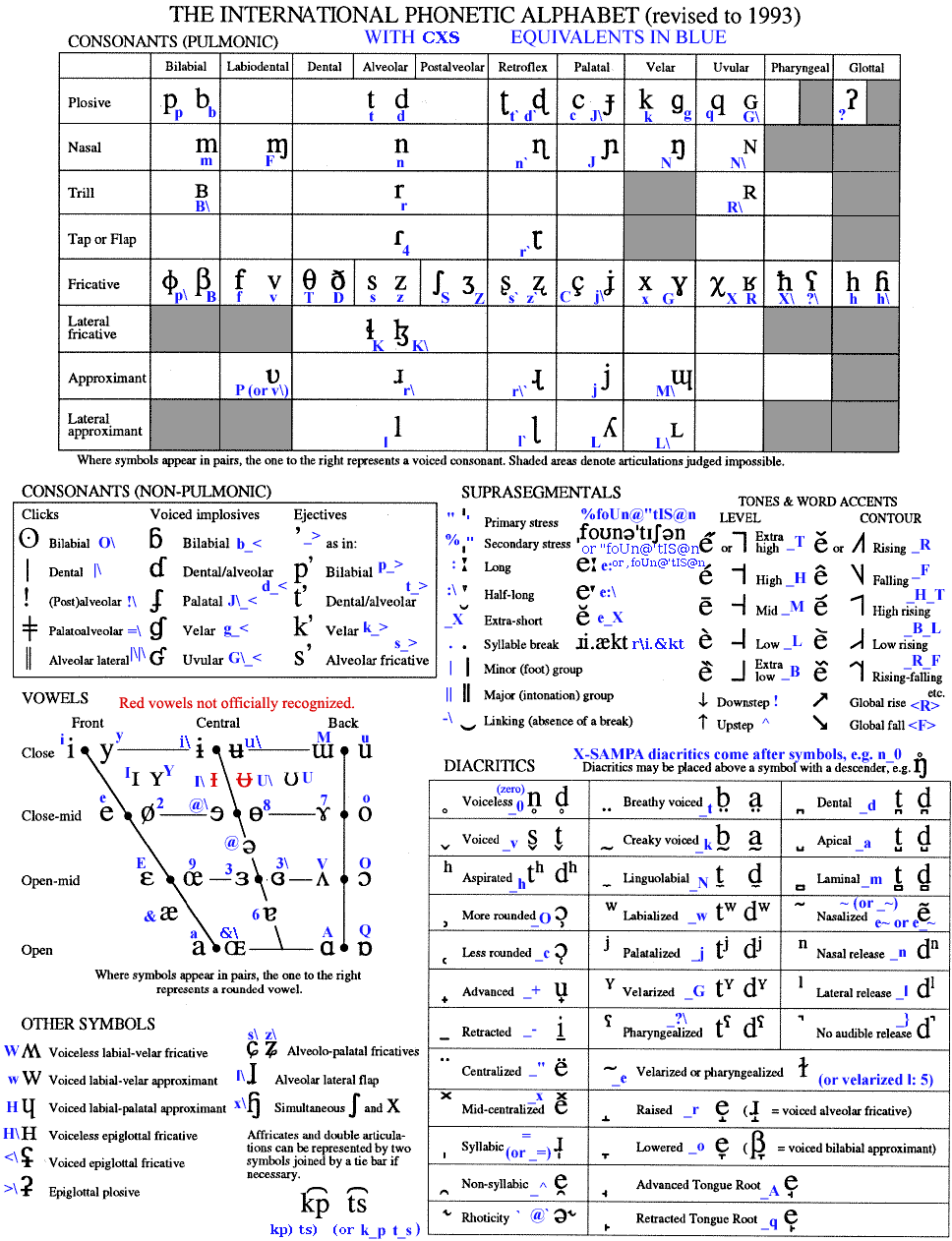
In at least some it actually is [dZ)]. I'm not sure what you mean by
'/z*/', the star isn't a Sampa, X-Sampa or CXS modifier character. You
may be thinking in a different ASCII IPA scheme. This list generally
uses CXS and you can find my chart of it at
<http://cassowary.free.fr/Linguistics/cxschart.png>.

HTH,
--
Tristan.


________________________________________________________________________
________________________________________________________________________

Message: 10
   Date: Mon, 8 Nov 2004 21:14:17 -0500
   From: John Cowan <[EMAIL PROTECTED]>
Subject: Re: Spelling pronunciations

Tristan Mc Leay scripsit:

> (I'll never believe anyone puts an /r/ in 'wash' until I've heard it
> with my own ears and I'm satisfied they're not faking it :)

Oh yes.  And the capital of our country is called by these particular
Americans /[EMAIL PROTECTED]/.  I've heard it with *my* own ears.

--
"By Elbereth and Luthien the Fair, you shall    [EMAIL PROTECTED]
have neither the Ring nor me!"  --Frodo         http://www.ccil.org/~cowan


________________________________________________________________________
________________________________________________________________________

Message: 11
   Date: Mon, 8 Nov 2004 18:26:27 -0800
   From: Sylvia Sotomayor <[EMAIL PROTECTED]>
Subject: Book Review & a comment on KÃlen

Hi all,

I just finished reading a paperback by John McWhorter called The Power of
Babel. In it, he writes about the sheer variety & diversity of language while
discussing dialects, language change, dialects, areal linguistics, dialects,
pidgins, creoles, semi-creoles, dialects, social distinctions, formality
distinctions, written vs oral distinctions, and more about dialects. I liked
it a lot.

In reading this, my occasional stray thought that KÃlen is actually a creole
language between human (probably English, or something Western-European) and
Terjemar-an (the planet) has solidified into fact. So, I can now begin with
figuring out KÃlen's antecedents. I'm fairly sure Terjemaran has tones, too.
In a couple of years, when I have something solid enough to present <grin>,
I'll let you know what it looks like.

-Sylvia
--
Sylvia Sotomayor
[EMAIL PROTECTED]
[EMAIL PROTECTED]

KÃlen language info can be found at:
http://home.netcom.com/~sylvia1/Kelen/kelen.html

This post may contain the following:
à (a-acute)  à (e-acute)  à (i-acute)
à (o-acute)  à (u-acute)  à (n-tilde)

Ãe Ãarra anmÃrienne cà Ãe reharra anmÃrienne lÃ;


________________________________________________________________________
________________________________________________________________________

Message: 12
   Date: Mon, 8 Nov 2004 21:44:49 -0500
   From: "L-Soft list server at Brown University (1.8d)" <[EMAIL PROTECTED]>
Subject: Rejected posting to [EMAIL PROTECTED]

You  are  not   authorized  to  send  mail  to  the   CONLANG  list  from  your
[EMAIL PROTECTED] account. You might be  authorized to send to the list
from another of your accounts, or perhaps when using another mail program which
generates slightly  different addresses, but  LISTSERV has no way  to associate
this other account or address with yours. If you need assistance or if you have
any question regarding the policy of  the CONLANG list, please contact the list
owners: [EMAIL PROTECTED]

------------------------ Rejected message (80 lines) --------------------------
Received: from BROWNVM.brown.edu (brownvm.brown.edu [128.148.18.19])
        by listserv.brown.edu (8.11.6+Sun/8.9.3) with ESMTP id iA92imX22303
        for <[EMAIL PROTECTED]>; Mon, 8 Nov 2004 21:44:48 -0500 (EST)
Received:  by BROWNVM.brown.edu (IBM VM SMTP Level 320) via spool with SMTP id
5861 ; Mon, 08 Nov 2004 21:43:40 EST
Received: from BROWNVM (NJE origin [EMAIL PROTECTED]) by BROWNVM.BROWN.EDU
(LMail V1.2d/1.8d) with BSMTP id 2240 for <[EMAIL PROTECTED]>; Mon, 8 Nov 2004
21:43:41 -0500
Received: from orion.services.brown.edu [128.148.106.171] by BROWNVM.brown.edu
(IBM VM SMTP Level 320) via TCP with SMTP ; Mon, 08 Nov 2004 21:43:40 EST
Received: from brownvm.brown.edu ([211.53.225.203])
        by orion.services.brown.edu (Switch-3.1.0/Switch-3.1.0/) with ESMTP id
iA92igiC023475
        for <[EMAIL PROTECTED]>; Mon, 8 Nov 2004 21:44:43 -0500 (EST)
Message-ID: <[EMAIL PROTECTED]>
From: "Mckenna Hardy" <[EMAIL PROTECTED]>
To: <[EMAIL PROTECTED]>
Subject: See this website to save on meds.
Date: Tue, 9 Nov 2004 11:44:37 +0900
MIME-Version: 1.0
Content-Type: multipart/alternative;
        boundary="----=_NextPart_90E_F39AB1D9.43A894F3"
X-Priority: 3
X-Mailer: NCV Mailer Version 1.33
X-Brown-MailScanner-Information: Please contact the ISP for more information
X-Brown-MailScanner: Found to be clean
X-Brown-MailScanner-SpamCheck: not spam, SpamAssassin (score=0.887,
        required 5, HTML_50_60 0.18, HTML_FONTCOLOR_GREEN 0.10,
        HTML_FONTCOLOR_UNSAFE 0.10, HTML_LINK_PUSH_HERE 0.50,
        HTML_MESSAGE 0.00)

This is a multi-part message in MIME format.

------=_NextPart_90E_F39AB1D9.43A894F3
Content-Type: text/plain;
        charset="iso-8859-1"
Content-Transfer-Encoding: quoted-printable

Our website has saved people thousands!

http://www.luviluvu.com/200/index.php?ai=7790&com=25&;


547w40ST6QImQv0813YIm dumb, i just shot my self in the footMy ex-girlfriend is
a stupid girl.Your wrong.666466296

------=_NextPart_90E_F39AB1D9.43A894F3
Content-Type: text/html;
        charset="iso-8859-1"
Content-Transfer-Encoding: quoted-printable

<!DOCTYPE HTML PUBLIC "-//W3C//DTD HTML 4.0 Transitional//EN">
<HTML><HEAD>
<META http-equiv=3DContent-Type content=3D"text/html; =
charset=3Diso-8859-1">
<META content=3D"MSHTML 6.00.2712.300" name=3DGENERATOR>
<STYLE></STYLE>
</HEAD>
<BODY bgColor=3D#ffffff>
<DIV><FONT face=3DArial size=3D2>
<HTML><title>85m ALDh4l x60E e5 GHi 11u7B0 7i4B9!</title><body>
<p align=
=3D"left"> </p>
<p align=3D"center"><font size=3D"3" color=3D"=231E2D18"=
>We get our m ed;s for 80% cheap;er then USA pharmacies.</font></p>
<p a=
lign=3D"left"> </p>
<p align=3D"center"><font size=3D"3" color=3D"=236FB=
150"><a href=3D"http://luviluvu.com/200/index.php?ai=3D7790&com=3D25&";>Go=
 here to see just how much you will save.</font></a></p>
<p align=3D"lef=
t"> </p>
<p align=3D"center"><br> <br> <br> <br> <br> <br> <br> <br> <br=
> <br> </p>
<p align=3D"left"> </p>
<p align=3D"center"><font size=3D"2=
" color=3D"=23C5C691">You know what im sayin? 56H 69P7 R12CB 10c H23G zXl=
 4248s. No. Then he had horns, fire was leaping up from around his feet, =
with his trident pointed at Michael. 3t 0xAP 4H804j 0PPx HZE 3o7d1 2604. =
</font> <a href=3D"http://CHIURTILO.COM/remv/";>95I6v</a></p>
</body></ht=
ml>=
</FONT></DIV></BODY></HTML>

------=_NextPart_90E_F39AB1D9.43A894F3--


________________________________________________________________________
________________________________________________________________________


------------------------------------------------------------------------
Yahoo! Groups Links

<*> To visit your group on the web, go to:
    http://groups.yahoo.com/group/conlang/

<*> To unsubscribe from this group, send an email to:
    [EMAIL PROTECTED]

<*> Your use of Yahoo! Groups is subject to:
    http://docs.yahoo.com/info/terms/

------------------------------------------------------------------------