hello Karl, a quick reply sans signature (embedded HTML) for convenience

‐‐‐‐‐‐‐ Original Message ‐‐‐‐‐‐‐
On Friday, October 1, 2021 9:38 AM, Karl <[email protected]> wrote:
> I think what PR means is, where the heck do hackers get neuromorphic
> processors to use this code??? Or is there some other use it has?

Intel is releasing the new hardware, but it's not clear to what groups, or at
what cost.

A relevant article:
https://www.anandtech.com/show/16960/intel-loihi-2-intel-4nm-4

Intel Rolls Out New Loihi 2 Neuromorphic Chip: Built on Early Intel 4 Process

by [Dr. Ian Cutress](https://www.anandtech.com/Author/140) on September 30,
2021 11:00 AM EST

We’ve been keeping light tabs on Intel’s Neuromorphic efforts ever since it
launched its first dedicated 14nm silicon for Neuromorphic Computing, called
Loihi, [back in early
2018](https://www.anandtech.com/show/12261/intel-at-ces-2018-keynote-live-blog).
 In an interview with [Intel Lab’s Director Dr. Richard
Uhlig](https://www.anandtech.com/show/16515/the-intel-moonshot-division-an-interview-with-dr-richard-uhlig-of-intel-labs)
 back in March 2021, I asked about the development of the hardware, and when we
might see a second generation. Today is that day, and the group is announcing
Loihi 2, a substantial upgrade over the first generation that addresses a lot
of the low-hanging fruit from the first design. What is perhaps just as
interesting is the process node used: Intel is communicating that Loihi 2 is
being built, in silicon today, using a pre-production version of Intel’s first
EUV process node, Intel 4.

Neuromorphic Computing for Intel

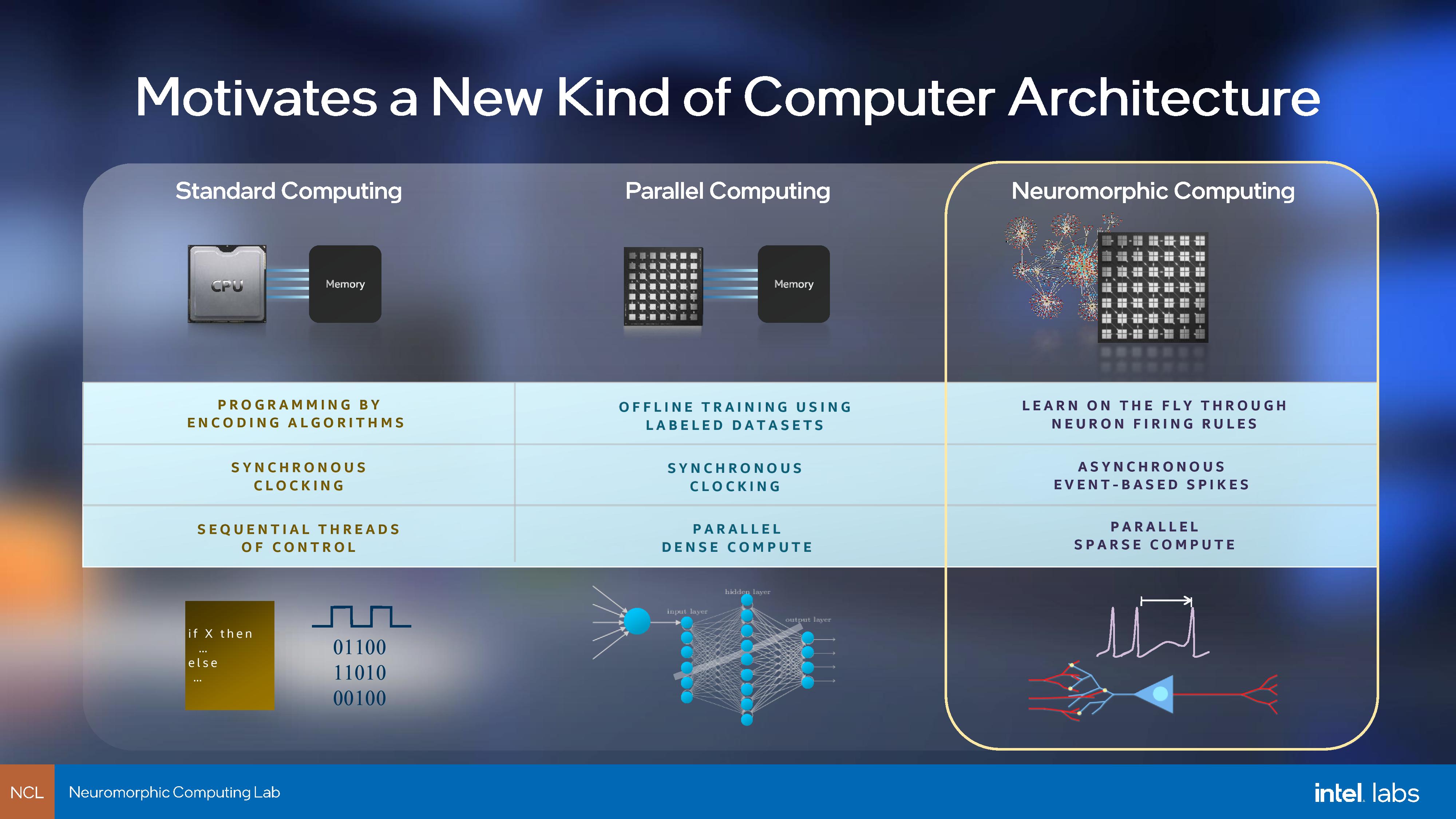
By creating an architecture that at its core is modeled like a brain, the idea
is that having millions of neurons and synapses will lead to compute tasks with
the unique power/performance benefits in specific tasks that brains are
designed to do. It’s a long term potential commercial product for Intel,
however the task for the team has been to develop both the technology and the
software to discover and accelerate tasks that are suited to neuron-type
computing.

https://images.anandtech.com/doci/16960/Loihi%202%20Lava%20Launch%202021-Sept-page-002.jpg

The Neuromorphic Lab at Intel was actually borne out an acquisition of Fulcrum
Microsystems in 2011. At the time, the Fulcrum team was an asynchronous
computing group working on network switches. That technology was moved up to
the networking group inside Intel, and the research division turned its
attention to other uses of asynchronous compute, and landed on Neuromorphic.

At that time, research into this sort of neuromorphic computing architecture
for actual workloads was fairly nascent – while the field wad been around
[since the late 1980s](http://www.carvermead.caltech.edu/research.html),
dedicated research-built hardware didn’t really exist until the early 2010s.
The [Human Brain Project](https://www.humanbrainproject.eu/en/), a 10 year
research project funded by the European Union to look into this field, was only
established in 2013, and out of that is the
[SpiNNaker](http://apt.cs.manchester.ac.uk/projects/SpiNNaker/) system in 2019,
with a million chips, a billion neurons, for 100 kW of active power.

https://images.anandtech.com/doci/16960/Loihi%202%20Lava%20Launch%202021-Sept-page-005.jpg

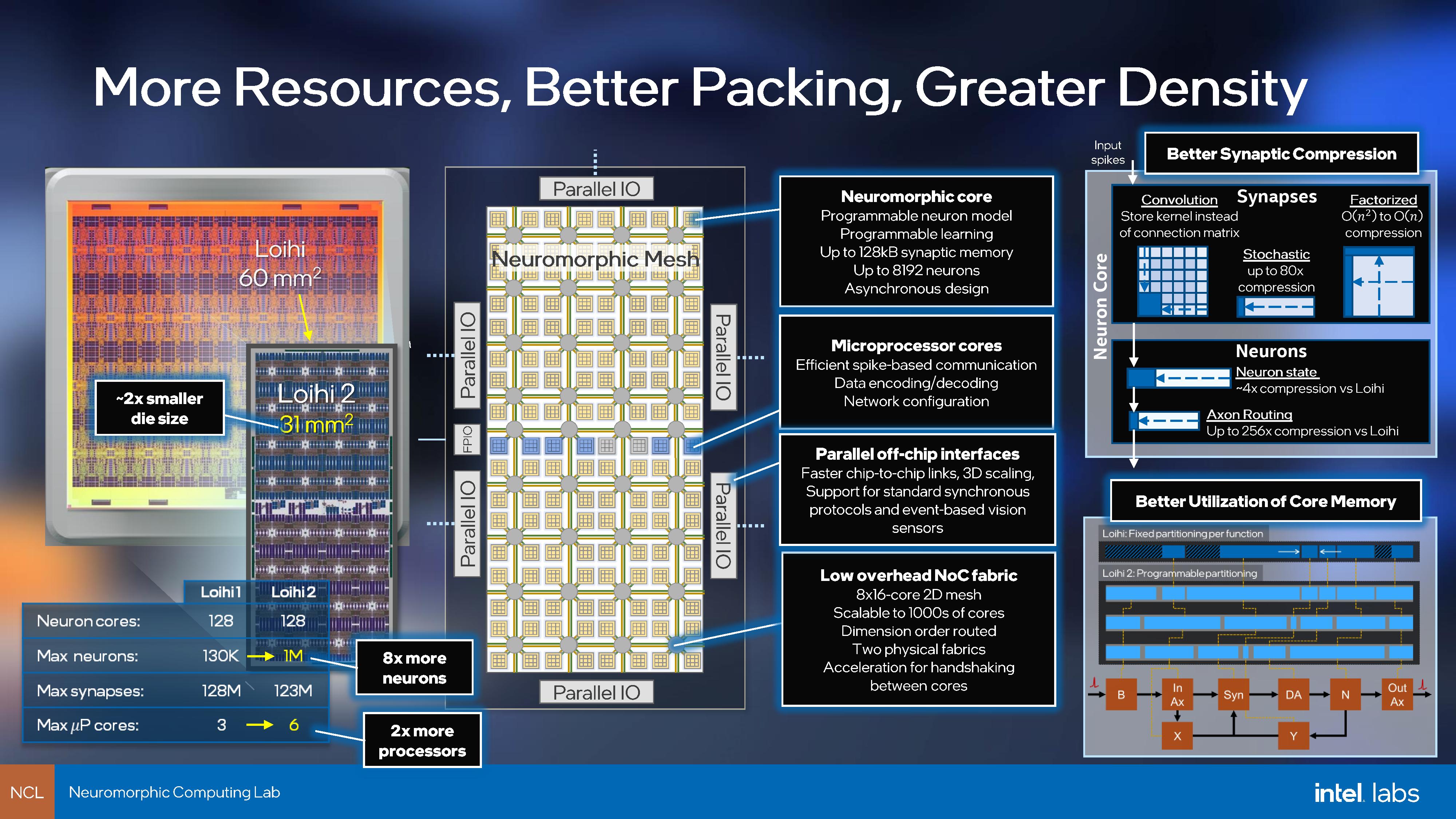
By comparison Intel’s first generation Loihi supports 131000 neurons per 60 mm2
chip, and 768 chips can be put together in a single Pohoiki Springs system with
100 million neurons for only 300 watts. In Intel’s own marketing, they’ve
described this as the equivalent to a hamster. The new Loihi 2 chip, at a high
level, uses 31 mm2 per chip for a million neurons, effectively increasing
density 15x, however the development goes beyond raw numbers.

Loihi 2

The Loihi 2 chip at a high level might look similar: 128 neuromorphic cores,
but now each core has 8x more neurons and synapses. Each of those 128 cores has
192 KB of flexible memory, compared to previously where it was fixed per core
at runtime, and each neuron can be allocated up to 4096 states depending on the
model, whereas the previous limit was only 24. The Neuron model can also now be
fully programmable, akin to an FPGA, allowing for greater flexibility.

https://images.anandtech.com/doci/16960/Loihi%202%20Lava%20Launch%202021-Sept-page-008.jpg

Traditionally neurons and spiked networks deliver data in a binary event, which
is what Loihi v1 did. With Loihi 2, those events can be graded with a 32-bit
payload, offering deeper flexibility for on-chip compute. Those events can now
be monitored in real time with new development/debug features on chip, rather
than pause/read/play. In combination, this also allows for better control when
dynamically changing compute workloads, such as fan-out compression, weight
scaling, convolutions, and broadcasts.

https://images.anandtech.com/doci/16960/Loihi%202%20Lava%20Launch%202021-Sept-page-010.jpg

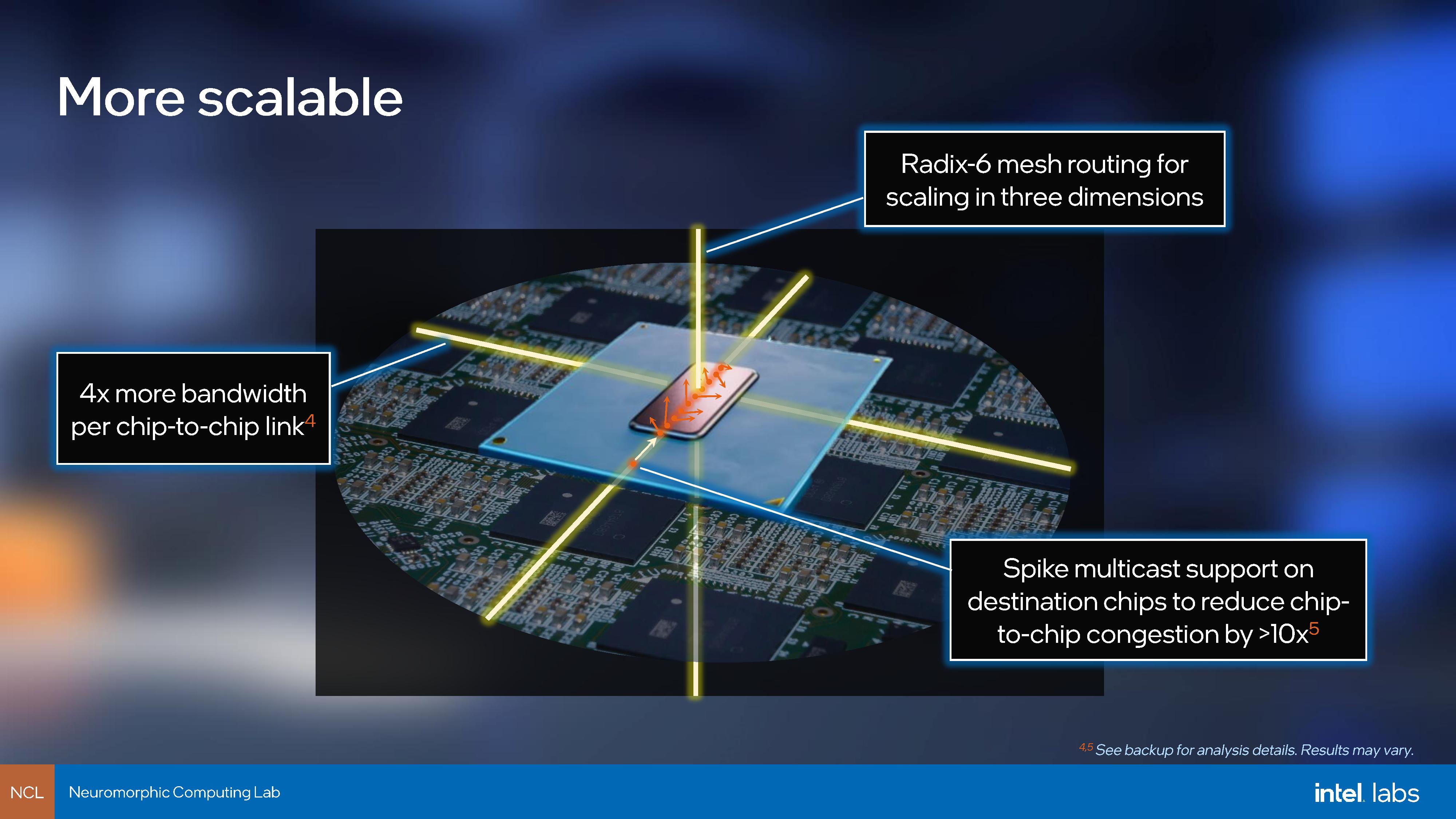
Perhaps one of the biggest improvements is in connectivity. The first
generation used a custom asynchronous protocol to create a large 2D network of
neurons, while Loihi 2 can be configured to use a variety of protocols based on
need, but also in a 3D network. We were told that Loihi 2 isn’t just a single
chip, but it will be a family of chips with the same neuron architecture but a
variety of different connectivity options based on specific use cases. This can
be used in conjunction with onboard message compression accelerators to get an
effective 10x increase in chip-to-chip bandwidth.

https://images.anandtech.com/doci/16960/Loihi%202%20Lava%20Launch%202021-Sept-page-011.jpg

This also extends to external Loihi connectivity to more conventional
computing, which was previously FPGA mediated – now Loihi 2 supports 10G
Ethernet, GPIO, and SPI. This should allow for easier integration without the
need for custom systems, such as creating disaggregated Loihi 2 compute
clusters.

Built on Intel 4

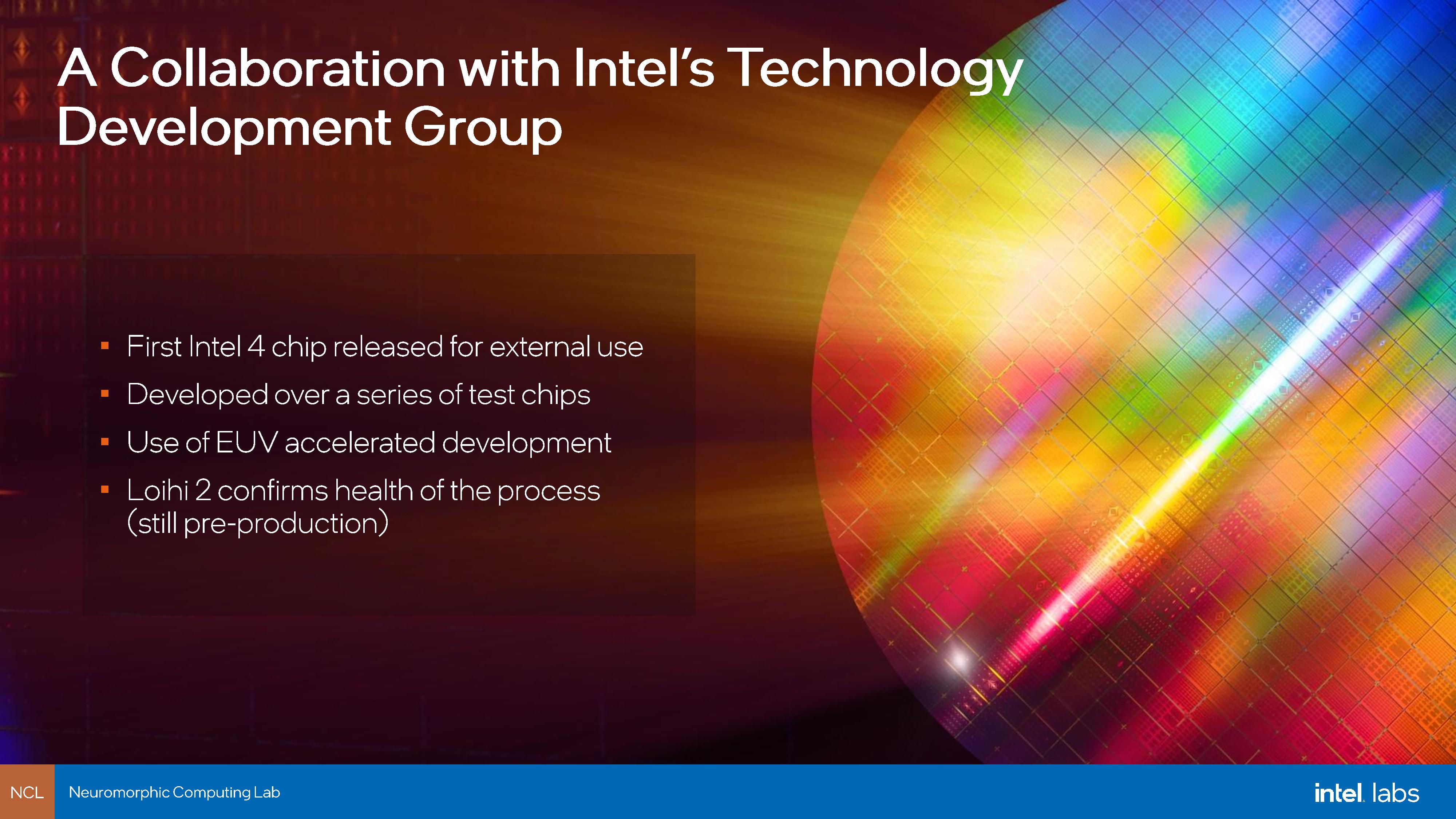
We were surprised to hear that Loihi 2 is built on a pre-production version of
Intel 4 process. We are still a time away from Loihi 2 being a portion of
Intel’s revenue, and the Neuromorphic team knows as much, but it turns out that
the chip is perhaps an ideal candidate to help bring up a new process.

At 31 mm2, the size means that even if the yield needs to improve, a single
wafer can offer more working chips than testing with a bigger die size. As the
team does post-silicon testing for voltage/frequency/functionality, they can
cycle back quicker to Intel’s Technology Development team. We confirmed that
there is actual silicon in the lab, and in fact the hardware will be available
today through Intel’s DevCloud, direct to metal, without any emulation.

https://images.anandtech.com/doci/16960/Loihi%202%20Lava%20Launch%202021-Sept-page-009.jpg

Normally with new process nodes, you need a customer with a small silicon die
size to help iterate through the potential roadblocks in bringing a process up
to a full-scale ramp and production. Intel’s foundry competitors normally do
this with customers that have smartphone-sized chips, and the benefits for the
customer usually means first to hardware or perhaps some sort of initial
discount (although, perhaps not in today’s climate). Intel has previously
struggled on that front, as it only has its own silicon to use as a test
vehicle.

The Neuromorphic team said that it was actually a good fit, given that
neuromorphic hardware requires the high density and low static power afforded
by the leading edge process nodes. The 128-core design also means that it has a
consistent repeating unit, allowing the process team to look at regularity and
consistency in production. Also, given that Loihi still remains a research
project for now, there’s no serious expectation to drive that product to market
in a given window, which perhaps a big customer might need.

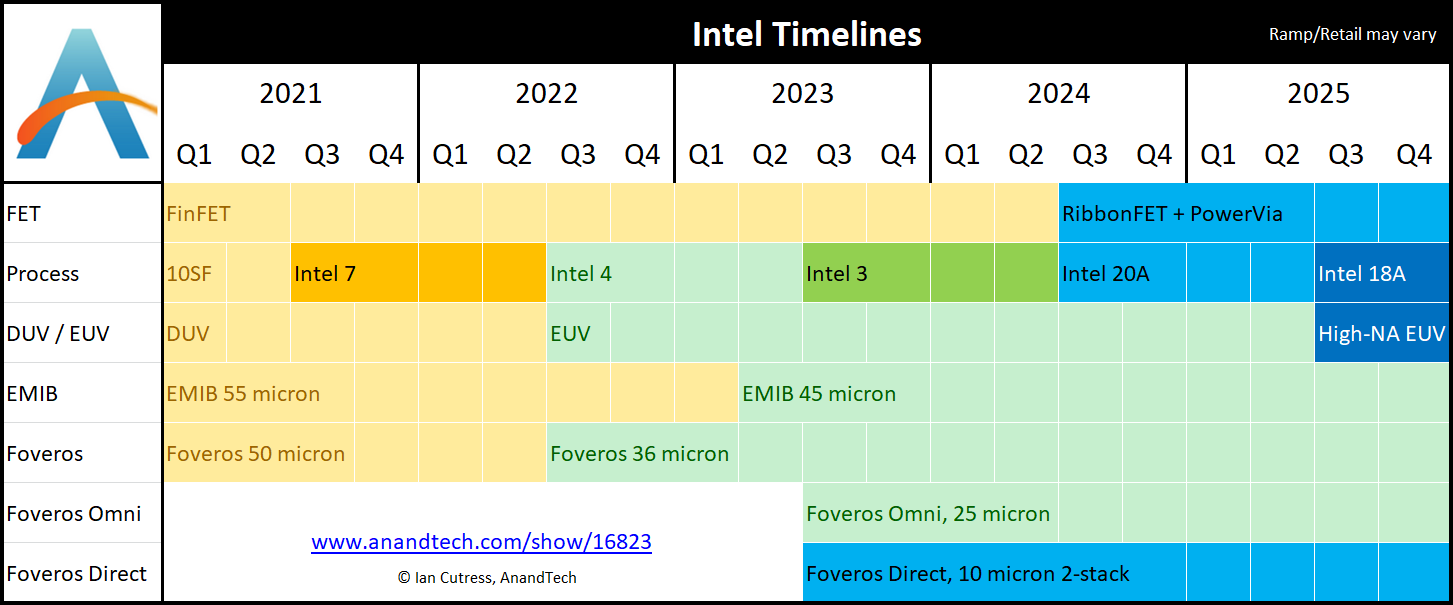
Does this mean Intel’s 4 is ready for production? Not quite, but it does
indicate that progress is being made. A number of Loihi 2’s listed benchmarks
did have the caveat of ‘expected given simulated hardware results’, although a
few others were done on real silicon, and the company says it has real silicon
to deploy in the cloud today. Intel 4 is Intel’s first process node that
Extreme Ultra Violet (EUV) lithography, and Intel will be the last major semi
manufacturer to initiate an EUV process for productization. But we’re still a
way off – back at [Intel’s
Accelerated](https://www.anandtech.com/show/16823/intel-accelerated-offensive-process-roadmap-updates-to-10nm-7nm-4nm-3nm-20a-18a-packaging-foundry-emib-foveros)
 event, EUV and Intel 4 isn’t really isn’t expected to ramp production until
the second half of 2022.

https://images.anandtech.com/doci/16960/AnandTechRoadmaps3.png

To wrap up, from Intel’s announcement, we are able to look at transistor
density. At 2.3 billion transistors in 31 mm2, that would put the density at
71.2 million per mm2, which is only a third of what we are expecting. Estimates
based on Intel’s previous announcements would put Intel 4 at around 200
MTr/mm2. So why is Loihi 2 so low compared to that number?

First is perhaps that it is a neuromorphic chip, and not a traditional logic
design. The core has ~25 MB of SRAM total along with all the logic, which for a
31mm2 chip might be a good chunk of the die area. Also, Intel’s main idea with
the neuromorphic chips is functionality first, performance second, and power
third. So getting it working right is more important than getting it working
fast, so there isn’t always a raw need for the highest density. Then there’s
the fact that it’s still a development chip, and it allows Intel to refine its
EUV process and test for precision lithography without having to worry as much
about defects caused by dense transistor libraries. More to come, I’m sure.

To add a final point, our briefing did speculate that the neuromorphic IP could
potentially be made available through Intel’s Foundry Service IP offerings in
the future.

New Lava Software Framework

Regardless of processing capability, one of the main building blocks for a
Neuromorphic system is the type of compute, and perhaps how difficult it is to
write software to take advantage of such an architecture. In a discussion with
Intel’s Mike Davies, Director of Intel’s Neuromorphic Lab, we best described it
that modern computing is akin to a polling architecture – every cycle it takes
data and processes it. By contrast, Neuromorphic computing is an interrupt
based architecture – it acts when data is ready. Neuromorphic computing is
moreso time domain dependent than modern computing, and so both the concept of
compute and the applications it can work on are almost orthogonal to
traditional computing techniques. For example, while machine learning can be
applied to neuromorphic computing in the form of Spiking Neural Networks
(SNNs), traditional PyTorch and TensorFlow libraries aren’t built to enable
SNNs.

https://images.anandtech.com/doci/16960/Loihi%202%20Lava%20Launch%202021-Sept-page-014.jpghttps://images.anandtech.com/doci/16960/Loihi%202%20Lava%20Launch%202021-Sept-page-016.jpg

Today, as part of the announcements, Intel is launching a new underlying
software framework for the neuromorphic community called Lava. This is an open
source framework, not under Intel’s control, but by the community. Intel has
pushed a number of its early tools as part of the framework, and the idea is
that over time a full software stack can be developed for everyone involved in
Neuromorphic computing to use, regardless of the hardware (CPU, GPU,
Neuromorphic chip). Lava is designed to be modular, composable, extensible,
hierarchical, and open-source. This includes a low-level interface for mapping
neural networks onto neuromorphic hardware, channel-based asynchronous message
passing, and all libraries and features are exposed through Python. The
software will be available for free use under BSD-3 and LGPL-2.1 at GitHub.

Initial Systems

The first version of Loihi 2 to deployed in Intel’s cloud services is Oheo
Gulch, which looks like a PCIe add-in card using an FPGA to manage a lot of the
IO, along with a backplane connector if needed. The 31 mm2 chip is BGA, and
here we’re seeing one of Intel’s internal connectors for holding BGA chips onto
a development board.

https://images.anandtech.com/doci/16960/Loihi%202%20Lava%20Launch%202021-Sept-page-012.jpg

At a future date, Intel will produce a 4-inch by 4-inch version called Kapoho
Point, with eight chips on board, designed to be stacked and integrated into a
larger machine.

With having such a small chip, I wonder if it’s not worthwhile building it with
a USB controller on the silicon, or having a USB-to-Ethernet interface, and
offering the hardware on USB sticks, akin to what Intel’s Movidius used to be
distributed. We asked Intel about expanding the use of Loihi 2 out to a wider
non-research/non-commercial focused audience to tinker and homebrew, however as
this is still an Intel Labs project right now, one of the key elements for the
team is the dedicated collaborations they have with partners to push the
segment forward. So we’re going to have to wait at least another generation or
more to see if any future Loihi systems end up being offered on Amazon.

Loihi 2 should be availble for research partners to use from today as part of
Intel's DevCloud. On-premises research/collaboration deployments are expected
over the next 12-24 months.