https://jewishreviewofbooks.com/jewish-history/14777/blessing-and-rebuke/
  Blessing and Rebuke

  * ByNeil Arditi <https://jewishreviewofbooks.com/author/neil-arditi>
  * Fall 2023 <https://jewishreviewofbooks.com/issue/fall-2023/>

  * Print//
  * Email//
    <https://jewishreviewofbooks.com/jewish-history/14777/blessing-and-rebuke/#>
  * Facebook//

<https://www.facebook.com/sharer/sharer.php?u=https%3A%2F%2Fjewishreviewofbooks.com%2Fjewish-history%2F14777%2Fblessing-and-rebuke%2F>
  * Twitter//

<https://twitter.com/intent/tweet?text=Blessing%20and%20Rebuke&url=https%3A%2F%2Fjewishreviewofbooks.com%2Fjewish-history%2F14777%2Fblessing-and-rebuke%2F&via=JRBooks>


      Memory Rose into Threshold Speech: The Collected Earlier Poetry; A
      Bilingual Edition

<https://www.amazon.com/Memory-Rose-into-Threshold-Speech/dp/0374603235/ref=sr_1_1?crid=1INUPWN49U24D&keywords=Memory+Rose+into+Threshold+Speech%3A+The+Collected+Earlier+Poetry%3B+A+Bilingual+Edition&qid=1694616076&s=books&sprefix=memory+rose+into+threshold+speech+the+collected+earlier+poetry+a+bilingual+edition%2Cstripbooks%2C103&sr=1-1>

Paul Celan, translated by Pierre Joris, with commentary by Pierre Joris
and Barbara Wiedemann

Farrar, Straus, and Giroux
592 pp., $45

AMAZON
<https://www.amazon.com/Memory-Rose-into-Threshold-Speech/dp/0374603235/ref=sr_1_1?crid=1INUPWN49U24D&keywords=Memory+Rose+into+Threshold+Speech%3A+The+Collected+Earlier+Poetry%3B+A+Bilingual+Edition&qid=1694616076&s=books&sprefix=memory+rose+into+threshold+speech+the+collected+earlier+poetry+a+bilingual+edition%2Cstripbooks%2C103&sr=1-1>BOOKSHOP

<https://bookshop.org/a/1016/9780374603236>


      Breathturn into Timestead: The Collected Later Poetry; A Bilingual
      Edition

<https://www.amazon.com/Breathturn-into-Timestead-Collected-Bilingual/dp/0374608032/ref=sr_1_1?crid=15XWQR9RVR3UE&keywords=Breathturn+into+Timestead%3A+The+Collected+Later+Poetry%3B+A+Bilingual+Edition&qid=1694616116&s=books&sprefix=breathturn+into+timestead+the+collected+later+poetry+a+bilingual+edition%2Cstripbooks%2C80&sr=1-1>

Paul Celan, translated and with commentary by Pierre Joris

Farrar, Straus, and Giroux
736 pp., $40

AMAZON
<https://www.amazon.com/Breathturn-into-Timestead-Collected-Bilingual/dp/0374608032/ref=sr_1_1?crid=15XWQR9RVR3UE&keywords=Breathturn+into+Timestead%3A+The+Collected+Later+Poetry%3B+A+Bilingual+Edition&qid=1694616116&s=books&sprefix=breathturn+into+timestead+the+collected+later+poetry+a+bilingual+edition%2Cstripbooks%2C80&sr=1-1>BOOKSHOP

<https://bookshop.org/a/1016/9780374608033>

Many great and humane poems have been written since, and even about,
Auschwitz, Theodor Adorno’s famous dictum notwithstanding. But none
written in German, or by a Holocaust survivor, has approached the
greatness of Paul Celan’s strongest poems. The trauma of the war years
ultimately cost Celan his life. He ended it in 1970, at age forty-nine,
drowning himself in the Seine in Paris, where he had chosen “to live out
to the end the destiny of the Jewish spirit in Europe.” But writing
poems was almost always possible for him. Even in what Celan later
referred to as “the so-called labor camps in Romania” and later, between
his final bouts of madness and hospitalization, he continued to write
and translate.

Now in paperback, the two volumes of Pierre Joris’s bilingual edition of
Celan, which gather together for the first time in English all nine of
his published volumes*,*testify to the possibility of translating Celan
into English, although the challenge is considerable and the losses
inescapable. No translation can wholly recover the uncanny resonance of
Celan’s German. “Reachable, near and not lost, there remained in the
midst  of  the losses this one thing: language,” he told a German
audience in 1958 in Bremen:

    It, the language, remained, not lost, yes in spite of everything.
    But it had to pass through its own answerlessness, pass through
    frightful muting, pass through the thousand darknesses of
    deathbringing speech. It passed through and gave back no words for
    that which happened; yet it passed through this happening. Passed
    through and could come to light again, “enriched” by all this.

Hitler’s “Thousand-Year Reich” lurks in Celan’s “thousand darknesses”
and “enriched” (“/angereichert,/” in shudder quotes), as his biographer
and translator John Felstiner noticed. Celan has “no words for that
which had happened.” Instead, his words bear the mark of their passage
through history in a way no language could, other than German, his
mother tongue and the language of his parents’ murderers.

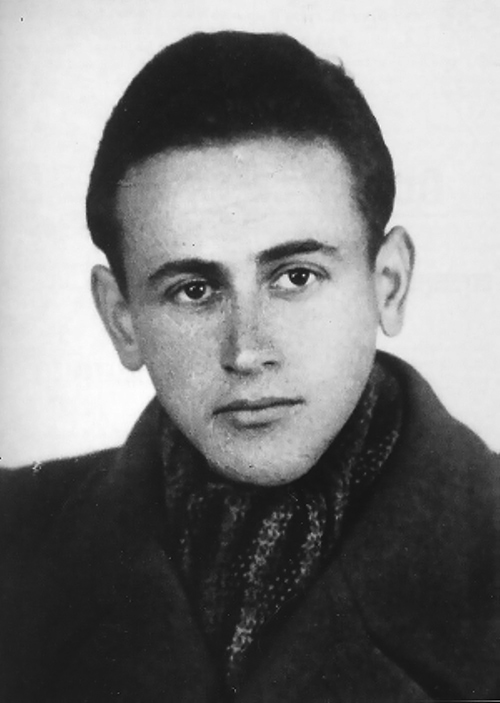
<https://jewishreviewofbooks.com/wp-content/uploads/2023/09/Arditi.jpg>/Paul
Celan, ca. 1938./

“Deathfugue” (“/Todesfuge/”), Celan’s most famous poem and his first to
appear in print, is the one exception to this wordlessness. Drafted as
early as 1944, shortly after he escaped or was released from the camps
as the Soviet Army moved west, “Deathfugue” is the most overt poem Celan
ever published. It depicts the Nazi practice of forcing Jews to perform
music even as they dug their own graves, a horror that brings to mind
Psalm 137: “For they that carried us away captive required of us a
song.” Relentless and incantatory from start to finish, “Deathfugue”
opens with the recurring lamentation of a choral “we” nurtured only by
death and liberated only by incineration:

    Black milk of morning we drink you evenings

    we drink you at noon and mornings we drink you at night

    we drink and we drink

    we dig a grave in the air there one lies at ease

Other strains emerge in the fugue’s counterpoint: the shouts of a
death-camp commandant and a vision of a man writing in a house—“he plays
with the snakes”—and dreaming of Margarete from Goethe’s/Faust/(who
blurs, in a plangent stroke of genius, with the beloved Shulamit of the
Song of Songs):

    He calls out play death more sweetly death is a master from Deutschland

    he calls scrape those fiddles more darkly then as smoke you’ll rise
    in the air

    then you’ll have a grave in the clouds there you’ll lie at ease


    Black milk of dawn we drink you at night

    we drink you at noon death is a master from Deutschland

    we drink you evenings and mornings we drink and drink

    death is a master from Deutschland his eye is blue

    he strikes you with lead bullets his aim is true

    a man lives in the house your golden hair Margarete

    he sets his dogs on us he gifts us a grave in the air

    he plays with the snakes and dreams death is a master from Deutschland


    your golden hair Margarete

    your ashen hair Shulamit

The most famous phrase in all of Celan is his thrice-repeated
refrain,/“Tod ist ein Meister aus Deutschland”/: “death is a master from
Germany” or “death is a master from Deutschland,” as Joris renders it,
leaving the name of the German nation untranslated. Celan would never
use the word again in a poem.


*No doubt many admirers of “Deathfugue”*have been baffled when turning
to Celan’s other poems. In the poems he began writing in the late 1950s
in particular, it can sometimes seem as if all context has vanished,
leaving words stranded on the page, beyond interpretation. Lamentation
and elegy remain, but their explicit subject is pushed into the white
space that surrounds Celan’s text, like an invisible force field. For
instance:

The snowbed under us both, the snowbed.

    Crystal after crystal,

    meshed timedeep, we fall,

    we fall and we lie and we fall.


    Or:


    A stillness came, a storm too came,

    all the seas came.

    I dig, you dig, and the worm too digs,

    and what sings over there says: they dig.


    O one, o no one, o noone, o you:

    Where did it lead, as it led nowhere?

Even in translation, the reader can see some of the challenges presented
by Celan’s originals. Newly minted words like “snowbed” (/Schneebett/)
and “timedeep” (/zeittief/) sound more studied in English than in
German, a language in which compound nouns and modifiers abound. In the
final stanza above (from “There was earth inside them”), Joris takes the
additional liberty of creating a compound word in English—“noone”—where
Celan merely employed the common indefinite pronoun/niemand/, usually
translated as “nobody” or “no one.” (Felstiner and Michael Hamburger, by
contrast, both render the line, “O one, o none, o no one, o you.”)

Joris takes a similar approach to “Psalm,” Celan’s most well-known poem
after “Deathfugue”:

    NoOne kneads us again of earth and clay,

    noOne conjures our dust.

    Noone.


    Praised be thou, NoOne.

    For your sake we

    want to flower.

    Toward

    you.


    A Nothing

    we were, we are, we will

    remain, flowering:

    the Nothing-, the

    NoOnesRose.


    With

    pistil soul-bright,

    stamen heaven-desolate,

    the corona red

    from the scarlet-word, that we sang

    above, O above

    the thorn.

Orphaned and imprisoned by the Nazis, while never ceasing as a poet,
Celan knew what it was to sing “above, O above / the thorn.” As Joris
observes in his extensive notes, “Psalm” draws not only on the image of
God forming man out of clay in Genesis but also, most crucially, on
Psalm 103:15: “As for man, his days are as grass: as a flower of the
field, so he flourisheth.” To the beauty and brevity of that
flourishing, Celan adds an uncanny vulnerability: body and soul exposed,
proffered like the reproductive organ of a flower to a godforsaken sky.

Unsurprisingly, Celan’s original is at times untranslatable. As
Felstiner noted,/Griffel/(pistil) can also mean “stylus,” a utensil for
writing—a redolent double-meaning for which neither Felstiner nor Joris
have a satisfying solution. And there is the insoluble problem
of/entgegen/, which Joris translates as “toward”: “For your sake we /
want to flower. / Toward / you.” But/entgegen/can also mean “against” or
“in spite of,” as in Felstiner’s version:

    Blessèd art thou, No One.

    In thy sight would

    we bloom.

    In thy

    spite.

Celan, of course, wanted both meanings, and so both Joris’s and
Felstiner’s versions are inaccurate or insufficient, as any English
translation will be. Only Celan’s original is perfectly natural and
perfectly poised between invocation and repudiation—blessing and
rebuke—as it turns both toward and against/“Niemand.”/


*Alhough he didn’t make their task easy,*Celan would have appreciated
the efforts of his translators. He began translating French, English,
and Russian poems into German in his early teens, and during his
nineteen months of forced labor, he made translations of Shakespeare’s
sonnets and poems by Verlaine, Housman, and Éluard. He later translated
Apollinaire, Baudelaire, Rimbaud, Valéry, Andrew Marvell, Lewis Carroll,
Kafka (into Romanian), Dickinson, Frost, Yeats, Marianne Moore,
Mandelstam, and Yevtushenko, among others. He considered his extensive
translation of Mandelstam’s poems to be as important as his own work.
Even “Celan” is a translation of sorts: a Frenchified anagram of
“Ancel,” the
Romanian spelling of his family name, “Antschel” (it appeared for the
first time in his poetic debut, a Romanian translation of “Deathfugue,”
which he oversaw).

Joris suggests in his introduction that composition itself was a form of
translation for Celan, from German into a hitherto nonexistent tongue:
an “invented German” encompassing archaisms, dialect, specialized
vocabularies, nonce words, neologisms, multilingual puns, etymological
wordplay—even Hebrew. Etymologically, to translate is “to carry over,”
which is often how Celan characterized his relationship to language.
Language must survive a passage, must be rescued. “To save the word,” he
wrote in “The Sluice,” it had to be carried “back / to and across and
over the saltflood” (the word in question turns out to be/yizkor/).

The word’s journey from author to reader is also perilous, particularly
in translation, and even in Celan’s invented German. He famously said in
his Bremen speech, “A poem can be a message in a bottle, sent out in
the—not always greatly hopeful—belief that somewhere and sometime it
could wash up on land, on heartland perhaps.” But my favorite of Celan’s
metaphors for poetry is almost the opposite of a message in a bottle. In
an untitled lyric from his most beautiful collection,/NoOnesRose/(1963),
he envisions his poem as a boomerang, tossed into the void with such
craft and velocity as to promise a perfect return to the consciousness
of its maker, even if no one else can catch its meaning:

    A boomerang, on breathroutes,

    as it wanders, the wing-

    mighty, the

    True. On

    star-

    orbits, kissed by

    world-splinters, by time-

    kernels scarred, by timedust, co-

    orphaned . . .

    displaced and discarded,

    by itself the rhyme,—

    thus it comes

    flying, thus it comes

    again and home

  * Print//
  * Email//
    <https://jewishreviewofbooks.com/jewish-history/14777/blessing-and-rebuke/#>
  * Facebook//

<https://www.facebook.com/sharer/sharer.php?u=https%3A%2F%2Fjewishreviewofbooks.com%2Fjewish-history%2F14777%2Fblessing-and-rebuke%2F>
  * Twitter//

<https://twitter.com/intent/tweet?text=Blessing%20and%20Rebuke&url=https%3A%2F%2Fjewishreviewofbooks.com%2Fjewish-history%2F14777%2Fblessing-and-rebuke%2F&via=JRBooks>


    ABOUT THE AUTHOR


      Neil Arditi

Neil Arditi is a professor of literature at Sarah Lawrence College.

*******************************************************************************
This moderated discussion group is for information exchange on the subject of
 Czernowitz and Sadagora Jewish History and Genealogy. The opinions expressed
 in these posts are the opinions of the original poster only and not necessarily
 the opinions of the List Owner, the Webmaster or any other members
 or entities connected with this mailing list. The Czernowitz-L list has
 an associated web site at http://czernowitz.ehpes.com that includes a
 searchable archive of all messages posted to this list.  Beginning in 2021,
archived messages can be found at:
https://www.mail-archive.com/[email protected]/

To send mail to the list, address it to <[email protected]>.

To remove your address from this e-list follow the directions at
https://it.cornell.edu/lyris/leave-e-lists-lyris

To receive assistance for this e-list send an e-mail message to:
[email protected]
-----------------------------------------------------------------------------