From: "Thomas Schmitt" <[email protected]>
Date: Thu, 14 May 2026 10:01:05 +0200
> A CD/DVD/BD burner, a USB stick, a hard disk ?
HDD connected by USB.

> How much storage capacity does it offer ?

Nominally 500 GB; significantly larger than other drives in the
system.

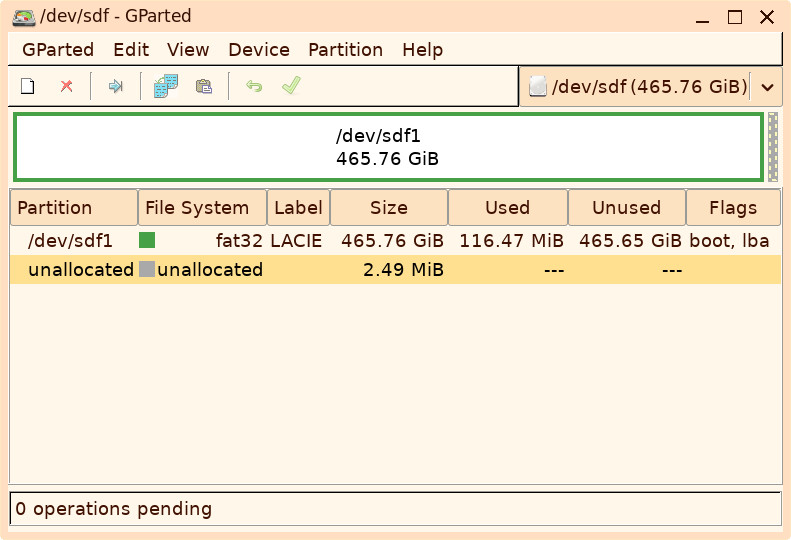
Rebooted since composing the orginal message.  Currently the drive is sdf.
Image from Gparted here.  https://easthope.ca/LaCieGparted.jpg

> The emerging ISO would occupy 2258784 "CD data sectors" of 2048 bytes
> each (4412 MiB)) whereas the medium offers only 951368 * 2048 bytes
> of remaining capacity (1868 MiB).

> This is quite surely not the drive which only offers 1868 MiB of free
> space.
> That drive was "blank" or "appendable", or else xorriso should not
> have reached the point where it complains about the lack of space.
>
> /dev/sdd is probably a USB stick or a hard disk. This kind of drive
> is considered by xorriso as holding an overwritable medium.
> So this statement from man xorriso applies:
>
> Closed is the state of DVD-ROM media and of multi-session media which
> were written with command -close on. [...]
> Overwritable media assume this state [...] if they contain
> unrecognizable data in the first 32 data blocks.
>
> Obviously your /dev/sdd contains non-zero data in these 64 KiB, but
> these data do not indicate the presence of an ISO 9660 filesystem.
> Considering such a "medium" as closed is a safety precaution against
> destroying data without knowing what they might mean.
>
> Yes. After being very very sure (*) that /dev/sdd is the right drive
> address, do
>
>   xorriso -outdev stdio:/dev/sdd -blank as_needed
>
> xorriso will then write 64 KiB of zeros to the beginning of the drive,
> which invalidates a possible partition table and might invalidate
> a possible other filesystem which is currently on /dev/sdd.

I contemplate Gparted deleting the FAT part. Any disadvantage there?

A twin of this drive was deployed more than a year ago.  Don't
remember how I initialized it.  =8~/

> -----------------------------------------------------------------------
> (*)
> Excluding any other drive from being overwritten is of course crucial.
>
> With USB sticks i use such opportunities to test xorriso-dd-target
> with its plug-in identification of USB drives:
>
>   xorriso-dd-target -with_sudo -plug_test
>
> This run will ask you to first have the drive unplugged, press Enter,
> then plug in the drive, and press Enter again.
> The result will be something like
>   sdd : YES : usb+ has_vfat+ : INTENSO USB
> or
>   sdd : NO  : usb+ ... has_ext2- : INTENSO USB
>
> The evaluation "YES" or "NO" is not decisive in this case, because you
> want to overwrite the device in any case.
> Decisive is the device address "sdd", which belongs to the drive that
> was plugged in during the xorriso-dd-target run.

Thanks.  =8~) The Gparted graphical presentation also may help me
avoid blunders.

Thx,                    ... P.

--
mobile:  +1 778 951 5147
VoIP:    +1 778 508 0020
Bcc: peter at e a s t h o p e dot c a
projects: en.wikibooks.org/wiki/User:PeterEasthope