This UIXP could be useful, but I think that it is too much for my use-case.
That would be a shame to try to display it in every page when we only need
it in a single one!
2016-06-28 12:05 GMT+02:00 Ecaterina Moraru (Valica) <[email protected]>:

> Hi,
>
> I propose you a third solution:
> Implement the "Content Title - After" UIXP, see
> http://jira.xwiki.org/browse/XWIKI-13080
>
> For your particular use case it's exactly what you need. You can use CSS
> then to make sure you display your content right floated and with the width
> of your second administration column.
>
> The after title is a generic UIXP that could be used in multiple cases.
>
> Thanks,
> Caty
>
> On Tue, Jun 28, 2016 at 12:45 PM, Guillaume Delhumeau <
> [email protected]> wrote:
>
> > Hello developers.
> >
> > I send this e-mail because I want to talk about the concept of UIX when
> it
> > comes to inject content in a application that has already a mechanism to
> > append content.
> >
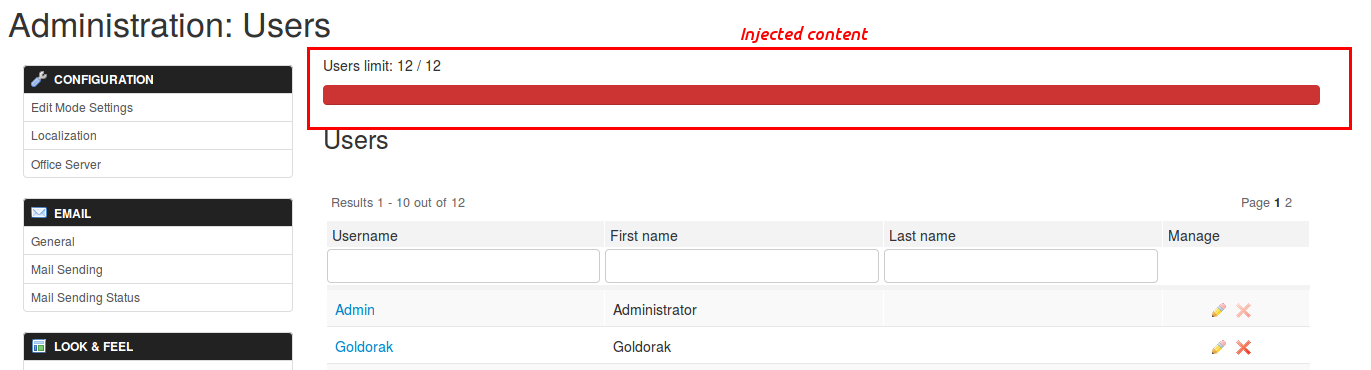
> > Use-case: being able to inject some content in an administration page.
> >
> > Example: I would like to write an extension that display some
> informations
> > on the "users" section of the administration.
> > See the image:
> > http://jira.xwiki.org/secure/attachment/32664/32664_example.png
> >
> > Currently, the only solution that I have is to overwrite
> > XWiki.AdminUsersSheet which generate 2 problems:
> > - it's a mess to maintain when XWiki is upgraded.
> > - 2 different extensions cannot inject content in the same page (one will
> > overwrite the other).
> >
> > Generally, we implement UI extension for this kind of problems, and that
> > was my first intention.
> >
> > In the commit
> >
> >
> https://github.com/xwiki/xwiki-platform/commit/374903eea354db2d25b6541f8fd7106c45fae29f#diff-0
> > (on a branch), I've introduced a UIX point on the top of the right side
> of
> > the administration. It can display several ordered extensions. And it can
> > be displayed in a particular section, or in all of them.
> >
> > The UI extension has the following benefits:
> > - we can easily create extensions to inject content anywhere.
> > - if the UIX is supposed to be injected in a particular section and if
> that
> > section does not actually exists (for example: if it has a part of an
> > optional application that is not installed), the UIX is simply not
> > displayed.
> > - the mechanism is already used in a lot of places and is well-known.
> >
> > But in this particular context, this solution has a drawback: it creates
> a
> > kind of duplication with the ConfigurableClass mechanism that we use to
> > display sections in the administration (
> >
> >
> http://extensions.xwiki.org/xwiki/bin/view/Extension/Administration+Application#HMakingyourapplicationconfigurablewithConfigurableClass
> > ).
> >
> > So I've tried to create a ConfigurableClass object to implement my
> > use-case. However, it has several issues:
> > - if 2 XObjects define the same section in the administration, both of
> them
> > are displayed but we cannot select the order.
> > - one of the 2 xobjects is automatically added in a form, which is not
> what
> > I want.
> >
> > According to the documentation:
> >   " codeToExecute is executed before the form is begun, however if you
> have
> > multiple ConfigurableClass objects in the
> >     same application which are also shown in the same section of the
> > administration application (perhaps with different
> >     headers) then codeToExecute of any ConfigurableClass object after the
> > first will be executed inside of the form. "
> >
> > There is one image to show this:
> > http://jira.xwiki.org/secure/attachment/32665/32665_problems.png
> >
> > The mechanism has also the following limitations:
> > - there is no way to inject content in ALL the sections of the
> > administration.
> > - if you want to inject content in a section only if that section exists,
> > you cannot. Because of the presence of your object, the section will be
> > displayed all the time. This is bad if you want to inject some content in
> > an optional application that might be or not installed.
> >
> > So I'm front of 2 possible implementations:
> > - introduce the UIX anyway, with all it benefits.
> > - improve the ConfigurableClass mechanism, with special attention to not
> > break the backward compatibility (I think about the "codeToExecute"
> > parameter).
> >
> > The first solution have my preference. Not only because it's easier to
> > implement (see my patch), but also because of its benefits. Moreover, the
> > use-case is NOT to create a section in the administration. It is only
> about
> > INJECTING content on an existing section, and this is exactly the purpose
> > of UIXs.
> >
> > I believe this debate exceeds this particular use-case, and that we might
> > have the same question for any application that define some custom way to
> > be modular.
> >
> > So I propose this rule:
> >
> > - it's OK to create a custom mechanism to *structure* a modular
> > application.
> > - it's OK to add some UIX points in it too when the goal is to be able to
> > inject content in an existing section.
> >
> > But I find this definition quite imprecise.
> >
> > What do you think about this?
> >
> > For the record, this is the JIRA issue about this topic:
> > http://jira.xwiki.org/browse/XWIKI-13494
> >
> > Thanks,
> >
> > --
> > Guillaume Delhumeau ([email protected])
> > Research & Development Engineer at XWiki SAS
> > Committer on the XWiki.org project
> > _______________________________________________
> > devs mailing list
> > [email protected]
> > http://lists.xwiki.org/mailman/listinfo/devs
> >
> _______________________________________________
> devs mailing list
> [email protected]
> http://lists.xwiki.org/mailman/listinfo/devs
>


--
Guillaume Delhumeau ([email protected])
Research & Development Engineer at XWiki SAS
Committer on the XWiki.org project
_______________________________________________
devs mailing list
[email protected]
http://lists.xwiki.org/mailman/listinfo/devs