Hi,

For ConfigurableClass, I`m not sure UIXP are a solution, since we would
have to add one UIXP for each thing we want to do (top, bottom, in
between?, etc.). Since ConfigurableClass already defines sections, it would
just be a matter of extending it to also introduce order in those sections.
Additionally, we can have an option that says add this section only if
others already exist (so that it alone will not trigger the entry to be
displayed) and, of course, we can have some flags on how it should be
displayed (if it should include the title or not, i.e. the "Unexpected"
part from http://jira.xwiki.org/secure/attachment/32665/32665_problems.png).
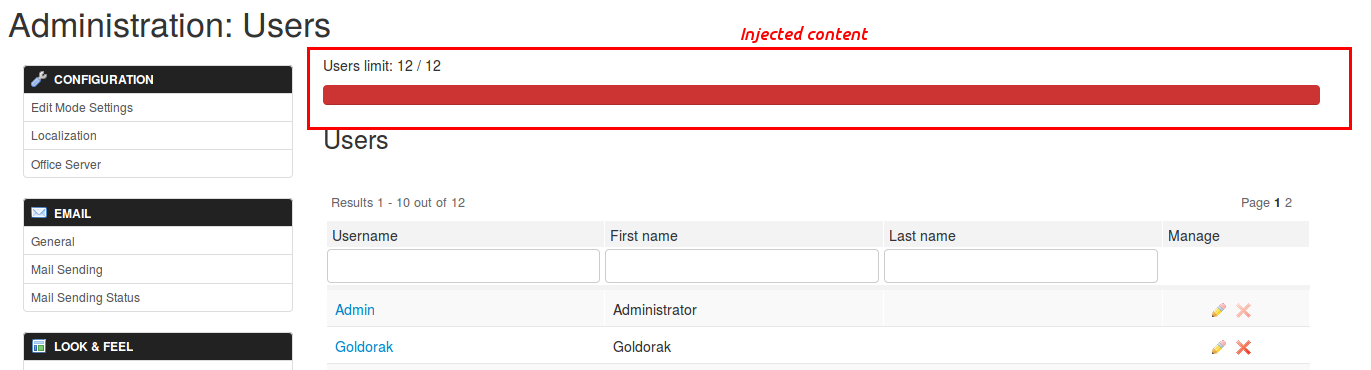
Specifically about the users limitations, I believe that it could be
included as a feature of the Users module itself (to display the current
users limit status, if any limit is set).

About generically extending existing administration sections, I believe
that we should keep using ConfigurableClass (and extending it to fit all
our needs) instead of mixing too many concepts.

UIXPs should be used mostly for the skin, IMO, while applications can
define their own, specialized, customization/extensibility mechanisms.

Thanks,
Eduard

On Tue, Jun 28, 2016 at 1:22 PM, Guillaume Delhumeau <
[email protected]> wrote:

> This UIXP could be useful, but I think that it is too much for my use-case.
> That would be a shame to try to display it in every page when we only need
> it in a single one!
>
> 2016-06-28 12:05 GMT+02:00 Ecaterina Moraru (Valica) <[email protected]>:
>
> > Hi,
> >
> > I propose you a third solution:
> > Implement the "Content Title - After" UIXP, see
> > http://jira.xwiki.org/browse/XWIKI-13080
> >
> > For your particular use case it's exactly what you need. You can use CSS
> > then to make sure you display your content right floated and with the
> width
> > of your second administration column.
> >
> > The after title is a generic UIXP that could be used in multiple cases.
> >
> > Thanks,
> > Caty
> >
> > On Tue, Jun 28, 2016 at 12:45 PM, Guillaume Delhumeau <
> > [email protected]> wrote:
> >
> > > Hello developers.
> > >
> > > I send this e-mail because I want to talk about the concept of UIX when
> > it
> > > comes to inject content in a application that has already a mechanism
> to
> > > append content.
> > >
> > > Use-case: being able to inject some content in an administration page.
> > >
> > > Example: I would like to write an extension that display some
> > informations
> > > on the "users" section of the administration.
> > > See the image:
> > > http://jira.xwiki.org/secure/attachment/32664/32664_example.png
> > >
> > > Currently, the only solution that I have is to overwrite
> > > XWiki.AdminUsersSheet which generate 2 problems:
> > > - it's a mess to maintain when XWiki is upgraded.
> > > - 2 different extensions cannot inject content in the same page (one
> will
> > > overwrite the other).
> > >
> > > Generally, we implement UI extension for this kind of problems, and
> that
> > > was my first intention.
> > >
> > > In the commit
> > >
> > >
> >
> https://github.com/xwiki/xwiki-platform/commit/374903eea354db2d25b6541f8fd7106c45fae29f#diff-0
> > > (on a branch), I've introduced a UIX point on the top of the right side
> > of
> > > the administration. It can display several ordered extensions. And it
> can
> > > be displayed in a particular section, or in all of them.
> > >
> > > The UI extension has the following benefits:
> > > - we can easily create extensions to inject content anywhere.
> > > - if the UIX is supposed to be injected in a particular section and if
> > that
> > > section does not actually exists (for example: if it has a part of an
> > > optional application that is not installed), the UIX is simply not
> > > displayed.
> > > - the mechanism is already used in a lot of places and is well-known.
> > >
> > > But in this particular context, this solution has a drawback: it
> creates
> > a
> > > kind of duplication with the ConfigurableClass mechanism that we use to
> > > display sections in the administration (
> > >
> > >
> >
> http://extensions.xwiki.org/xwiki/bin/view/Extension/Administration+Application#HMakingyourapplicationconfigurablewithConfigurableClass
> > > ).
> > >
> > > So I've tried to create a ConfigurableClass object to implement my
> > > use-case. However, it has several issues:
> > > - if 2 XObjects define the same section in the administration, both of
> > them
> > > are displayed but we cannot select the order.
> > > - one of the 2 xobjects is automatically added in a form, which is not
> > what
> > > I want.
> > >
> > > According to the documentation:
> > >   " codeToExecute is executed before the form is begun, however if you
> > have
> > > multiple ConfigurableClass objects in the
> > >     same application which are also shown in the same section of the
> > > administration application (perhaps with different
> > >     headers) then codeToExecute of any ConfigurableClass object after
> the
> > > first will be executed inside of the form. "
> > >
> > > There is one image to show this:
> > > http://jira.xwiki.org/secure/attachment/32665/32665_problems.png
> > >
> > > The mechanism has also the following limitations:
> > > - there is no way to inject content in ALL the sections of the
> > > administration.
> > > - if you want to inject content in a section only if that section
> exists,
> > > you cannot. Because of the presence of your object, the section will be
> > > displayed all the time. This is bad if you want to inject some content
> in
> > > an optional application that might be or not installed.
> > >
> > > So I'm front of 2 possible implementations:
> > > - introduce the UIX anyway, with all it benefits.
> > > - improve the ConfigurableClass mechanism, with special attention to
> not
> > > break the backward compatibility (I think about the "codeToExecute"
> > > parameter).
> > >
> > > The first solution have my preference. Not only because it's easier to
> > > implement (see my patch), but also because of its benefits. Moreover,
> the
> > > use-case is NOT to create a section in the administration. It is only
> > about
> > > INJECTING content on an existing section, and this is exactly the
> purpose
> > > of UIXs.
> > >
> > > I believe this debate exceeds this particular use-case, and that we
> might
> > > have the same question for any application that define some custom way
> to
> > > be modular.
> > >
> > > So I propose this rule:
> > >
> > > - it's OK to create a custom mechanism to *structure* a modular
> > > application.
> > > - it's OK to add some UIX points in it too when the goal is to be able
> to
> > > inject content in an existing section.
> > >
> > > But I find this definition quite imprecise.
> > >
> > > What do you think about this?
> > >
> > > For the record, this is the JIRA issue about this topic:
> > > http://jira.xwiki.org/browse/XWIKI-13494
> > >
> > > Thanks,
> > >
> > > --
> > > Guillaume Delhumeau ([email protected])
> > > Research & Development Engineer at XWiki SAS
> > > Committer on the XWiki.org project
> > > _______________________________________________
> > > devs mailing list
> > > [email protected]
> > > http://lists.xwiki.org/mailman/listinfo/devs
> > >
> > _______________________________________________
> > devs mailing list
> > [email protected]
> > http://lists.xwiki.org/mailman/listinfo/devs
> >
>
>
>
> --
> Guillaume Delhumeau ([email protected])
> Research & Development Engineer at XWiki SAS
> Committer on the XWiki.org project
> _______________________________________________
> devs mailing list
> [email protected]
> http://lists.xwiki.org/mailman/listinfo/devs
>
_______________________________________________
devs mailing list
[email protected]
http://lists.xwiki.org/mailman/listinfo/devs