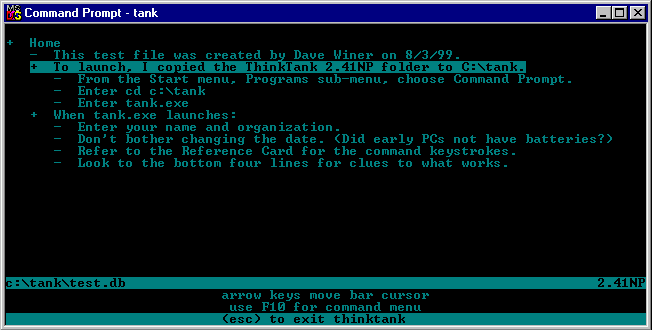
Hey,

I acctually think so to, if you visit his website you can see that back
in 1987 he started using this in his interfaces (
http://static.userland.com/misc/outliners/images/tank241pc/outliner1.gif
) and
http://static.userland.com/misc/outliners/images/more11c/outline1.gif .
His website beign http://www.outliners.com/ .
Best Regards,

Bojhan Somers

Murli Nagasundaram schreef:
> I recall outliner programs such as ThinkTank (by Dave Winer?) as being among
> the first to use the +/- notation for expand and collapse.  This was in the
> mid to late 1980's.
>
> - murli
>
> On Tue, Mar 18, 2008 at 7:57 PM, Chauncey Wilson <[EMAIL PROTECTED]>
> wrote:
>
>
>> There are several pictorial histories of GUIs that have examples of
>> interface objects that go back as far as the Xerox Alto
>>
>> http://toastytech.com/guis/
>> http://www.guidebookgallery.org/icons
>>
>> The object with the + sign is often associated with a treeview object
>> so you might try searching on that.  I looked in my Windows 3.1 guide
>> and in that book, there is no treeview, but hierarchical folders for
>> file operations (no +).  One trick that many people, even after many
>> years don't know (or aren't aware of) is that the plus sign in Windows
>> often allows you to open things up without changing the selection
>> focus (different tree view widget may allow different types of
>> interactions).
>>
>> Since the plus is possible in character cell applications, you might
>> want to look at some of the early office products.
>>
>> You might also want to search for examples of "file managers".
>> Wikipedia has a good list of file managers that might use the plus
>> sign.
>>
>> http://en.wikipedia.org/wiki/File_manager
>>
>> Chauncey
>>
>> On Tue, Mar 18, 2008 at 9:47 AM, Charles Hannon <[EMAIL PROTECTED]>
>> wrote:
>>
>>> I am interested in the history of (+). I am tracking the "evolution" of
>>>
>> this
>>
>>> interaction idiom (and others) and the ways in which user mental models
>>>
>> have
>>
>>> to adapt to such changes.
>>> je
>>>
>>  > I think (+) first meant "expand" as opposed to (-) which meant
>> "collapse."
>>
>>> In iTunes it means "Add Playlist" and this has been copied (very
>>>
>> crudely) in
>>
>>> the Sony Reader eBook Library application. In the original iPhone/iPod
>>>
>> Touch
>>
>>> Safari interface it meant "Add Bookmark" but after the January 2008
>>>
>> upgrade
>>
>>> it has been generalized to mean "Add Something."
>>>
>>> I am not a long-time Mac user so I wonder if (+) has always been part of
>>>
>> the
>>
>>> Apple lexicon, or if it is new. Also, has anyone on this list seen (or
>>> created) different implementations/meanings of (+) in other products?
>>>
>>> Charlie
>>>
>>>
>>> ________________________________________________________________
>>> Welcome to the Interaction Design Association (IxDA)!
>>> To post to this list ....... [EMAIL PROTECTED]
>>> Unsubscribe ................ http://www.ixda.org/unsubscribe
>>> List Guidelines ............ http://www.ixda.org/guidelines
>>> List Help .................. http://www.ixda.org/help
>>>
>>>
>> ________________________________________________________________
>> Welcome to the Interaction Design Association (IxDA)!
>> To post to this list ....... [EMAIL PROTECTED]
>> Unsubscribe ................ http://www.ixda.org/unsubscribe
>> List Guidelines ............ http://www.ixda.org/guidelines
>> List Help .................. http://www.ixda.org/help
>>
>>
> ________________________________________________________________
> Welcome to the Interaction Design Association (IxDA)!
> To post to this list ....... [EMAIL PROTECTED]
> Unsubscribe ................ http://www.ixda.org/unsubscribe
> List Guidelines ............ http://www.ixda.org/guidelines
> List Help .................. http://www.ixda.org/help
>
>
>
>

________________________________________________________________
Welcome to the Interaction Design Association (IxDA)!
To post to this list ....... [EMAIL PROTECTED]
Unsubscribe ................ http://www.ixda.org/unsubscribe
List Guidelines ............ http://www.ixda.org/guidelines
List Help .................. http://www.ixda.org/help