Regarding my contention that very poor human populations have a much greater
impact on the environment than do wealthy ones, a friend wrote and suggested I
mention the obvious differences that exist between Haiti and the Dominican
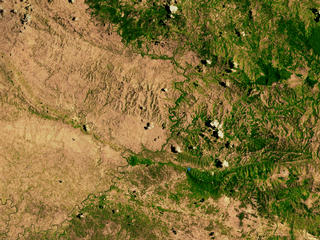
Republic. It only took a minute's searching to find this NASA photograph:
   http://svs.gsfc.nasa.gov/vis/a000000/a002600/a002640/haiti_still_web.jpg

The political border between Haiti and the Dominican Republic is as clearly
marked here as anywhere in the world from space. Haiti, the poorest country in
the Hemisphere, lies to the left of the river in the photograph. While the
Dominican Republic is not wealthy, neither is it so poor that its people have
been forced to not merely deforest its landscape, but to denude it, further
greatly impovishering the population through soil erosion and leaving them
subject
to disasterous flooding.

Let me go not very far out on a limb and paint a different world, however.
Let me suggest that if the average Haitian were as wealthy and as well-educated
as the average San Franciscan, this image from space would be very different.
The human population on Haiti would be heavily urbanized into a few coastal
cities and these forest areas would not only be verdant but would have become
highly protected areas.

There are certain populational forces that seem inevitable to me. When
disease and early childhood deaths are minimized, the pressure to have very
large
families dissipates. Similarly, if some semblance of lifetime economic security
can be established, the pressure to have very large families is even further
dissipated. And most importantly, when young women are provided significant
economic and educational opportunities, populations begin to fall even below
replacement rate. Simultaneous with all of these events, as human populations
become more healthy and wealthy, they begin to concentrate themselves into much
lower-impact urban areas. And as they become more educated, they begin to
demand
protection of the natural world.

This pattern is not relegated to the United States alone. It is being
repeated in every developed nation in the world no matter its size: in Europe,
in
Japan or in Singapore. And I am sure that it will be repeated in China and
India
too as they too become increasingly more wealthy. As to the inevitability of
the pattern, I've enclosed an article below from the New York Times from a few
weeks ago. While this one article could be dismissed only as ancedotal
evidence, I take it rather to be one data point in a relatively obvious trend,
one
that says even when substantial economic protectionism is attempted, the trend
can't be stopped.

As I wrote earlier, the knee-jerk reaction among ecology graduate students is
to often see a future dominated by dark clouds, of increasing pollution, of
limited resources, of burgeoning populations, starvation and massive losses of
biodiversity. That all could well come to pass, but I am enormously more
optimistic than that. I believe that a far more accurate portrait of the
current
situation is one of the world becoming increasingly more healthy, wealthy and
wise. These are not situations we should bemoan. If we truly want to protect
the
biodiversity of our planet, our primary enemies should be ignorance, poverty
and disease -- as evident in the NASA photograph above.

Wirt Atmar

=======================================

["The Urbanization of Nebraska"]
HOME ECONOMICS: Personal Accounts; Nebraska's Nostalgia Trap
By RICHARD DOOLING (NYT) 730 words
Published: February 5, 2006

Omaha - ON average, Nebraska's economy is doing just fine. But a man whose
head is in the oven and whose feet are in the freezer takes no comfort in
knowing that his average body temperature is perfectly normal. In the same
vein, a
casual glance at a graph of Nebraska's population growth shows slow, steady
increases, going all the way back to 1900, and conceals the fact that 74 of
Nebraska's 93 counties are in extremis, with lower populations today than they
had
in 1920.

Over a third of the state's 1.7 million residents live in greater Omaha,
which is booming by many measures, including population growth. According to
Ernie
Goss, an economist at Creighton University here, Omaha is growing faster than
Des Moines, Kansas City and St. Louis.

What about the rest of Nebraska? Well, it's big: over 77,000 square miles
(about 10 percent bigger than the six New England states combined) and 450
miles
wide, roughly the distance from Boston to the District of Columbia. Most of
the economic growth occurs along the thoroughfares that form what local
economists call ''the fishhook'': Highway 275 from Omaha to Norfolk being the
hook,
and Interstate 80 from Omaha to Colorado being the stem.

Outside of Omaha and the fishhook, large parts of Nebraska are arguably in
trouble. The dismal statistic that trends lower, year after year, for many of
these struggling counties, is population.

Farms double in size with a regularity that rivals the seasons, while, almost
in tandem, the number of farming families falls by half. The costs for
schools, roads and police and fire departments remain relatively constant, but
the
bodies paying taxes, buying goods and developing land keep disappearing. County
officials call it rural flight, brain drain or even mass migration, but
despite the alarums, nobody has found a way to stop the excursions.

States like Iowa, Kansas, Minnesota, Missouri, North Dakota, Oklahoma and
Wisconsin have tried to fight the trend by restricting the corporate
consolidation of farms: Keep the farmers on their land by stopping vast
corporations from
buying 10 farms and consolidating them into one, which is basically what keeps
happening.

In 1982, Nebraska went even farther and embedded a ban on corporations owning
and operating farms -- Initiative 300 -- in its Constitution. Last December,
a federal judge in Omaha ruled that the ban violates the Commerce Clause of
the United States Constitution and the Americans with Disabilities Act (because
the ban also requires that the person owning most of the farmland also supply
most of the daily labor). Some Nebraskans hope the ruling will be overturned,
but that seems unlikely.

Opponents of these laws, which purport to protect family farmers, view them
as economic nostalgia -- like trying to protect the local paper by banning
Internet news sites and mandating that the newspaper be delivered by a
towheaded
kid on a bicycle. If rank protectionism is not the solution, then what is?

Doug German, executive director of Legal Aid of Nebraska, who lives in the
central part of the state, just off the fishhook, in Eustis (pop. 425), and
provides legal services to the casualties of the state's poorer counties,
agrees
that rural Nebraska is at a ''tipping point.'' The antidote to its economic
depopulation, he believes, does not lie in bringing Intel or Toyota factories
to
the heartland, but in Nebraskans resolutely blooming where they are planted
and developing micro industries capable of flourishing anywhere, with the help
of computer and Internet technologies.

I hope Mr. German is right, but I wonder what kind of micro industry will
save the likes of Arthur County (half the size of Rhode Island), where the
population peaked at 1,412 in 1920, was 442 in 2000, and 402 in 2004? In these
parts, during election season, the signs along the road say ''Vote for Helen,
County Assessor,'' because there's only one Helen, and she's running unopposed.

Instead of micro industries, a cynical futurist might see mega-farms, owned
by global corporations, and farmed by armies of robot combines, controlled by
global positioning satellite technology from offices in Omaha.

=======================================