You make some good points, Christian, deserving a better response than I'm
going to provide right now at 11 p.m.
First, the basic problem is not so much overpopulation as it is
overconsumption.  According to one source I've read, the average U.S.
citizen has a consumption footprint as large as 90 Bangladeshis.
Second, many religions, including mainstream Protestants, promote or at
least tolerate birth control and other limits on procreation.
Third, I can teach (and have taught) cosmological, geological and biological
evolution in my church's youth and adult education programs.  The myths and
metaphors of our religious heritage (what you call "lies") frequently
parallel current science. And they try to answer questions that current
science cannot answer, e.g., "Why is there something instead of nothing?"
"Why is there life?"  "Why is their human intelligence and cognition?" "Why
are humans altruistic to other humans outside their genetic clan?" "Why are
we here?"
Warren W. Aney
Senior Wildlife Ecologist
Tigard, OR  97223

-----Original Message-----
From: Ecological Society of America: grants, jobs, news
[mailto:[email protected]] On Behalf Of Christian Vincenot
Sent: Thursday, 08 December, 2011 18:56
To: [email protected]
Subject: Re: [ECOLOG-L] overpopulation and the abuse of facts by religon

> Why is this forum arguing about the influence of Judaic religions on
> population growth?
I believe that Nathan answered this question in the very first post. Simply
because there is indeed an obvious dogma coming with these religions (and a
few other ones) that forbids abortion and/or promotes uncontrolled
procreation while spreading flat lies about the carrying capacity of our
Earth. This in turn obviously impacts demography. I find the link
straightforward and the original question raised in this thread legitimate.

> If the population growth of the earth is going to be impacted it won't be
> by coaxing popular religions like Catholicism and Christianity to be
> less"fruitful".
Will it be by acknowledging or even ignoring what these religions preach
then?

> Despite the predominance of these religions in countries
> like the U.S. and Britain, the growth rate in these countries are
> decreasing and have been steadily for years. Why?
Of course, education and birth control played a role... but the decrease of
power of religions also did. Actually the two are linked. Education
generally lowers the belief in archaic mysticisms like religions. (Actually,
I am pretty sure that the strength of belief in religions could be seen as a
metric to measure the level of education of countries.)
Also, note that the US or GB are not really examples of extremely religious
countries relatively to the rest of the world (although they definitely are
compared to other developed countries).

> On the other hand, the countries with the highest population growth rates
> such as Liberia, Burundi, Afghanistan, W. Sahara, E. Timer, Niger,
> Eritrea, Uganda, DR Congo, and the Palestinian Territories, etc have what
> sort of women's rights? What do you know, (...)
With all due respect, most of the countries that you cite are Christian
countries (i.e. Liberia, Burundi, DR Congo, Uganda, East Timor), and on top
of this, all of them are way more religious than the US or GB.

> Take a look at all the countries with growth rates higher than 2% and then
> look at how women are treated in that nation.
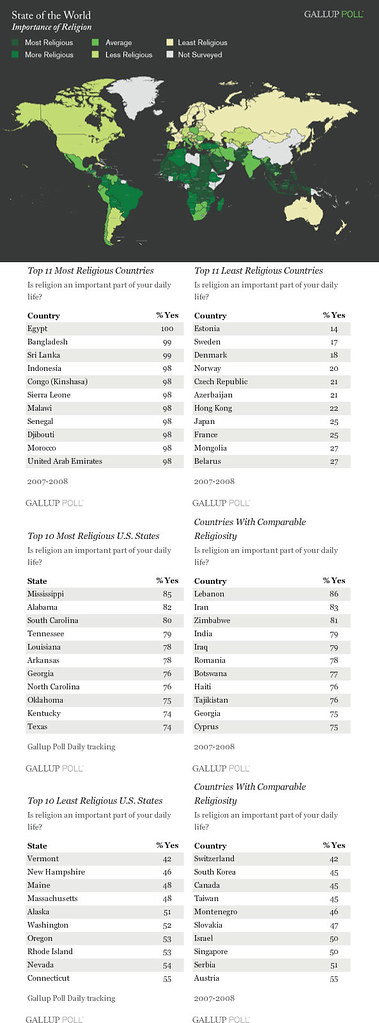
Take a look at all the countries with growth rates higher than 2%, and then
look at how religious they are. You will also be surprised. Again, your
argumentation against the importance of religions in this issue does not
stand. Take a look at this survey:
http://farm4.static.flickr.com/3423/3277768007_e06378be14_b.jpg

What you are ignoring is the opposition between religion and education. Of
course education would and hopefully will solve the issue of overpopulation,
but it will do so by explaining the flat lies that religions carry, and
which  prevent women from enjoying their rights and freedom in terms of
birth control (and others). Therefore, you cannot deny the fact that, in
many cases (like in the one originally brought up by Nathan), there is a
link between religion (especially what you refer to as "Judaic religions")
and demography. You cannot fight one without fighting the other.

Best regards,
Christian Vincenot