Hi Christian,

I'm afraid that I jumped into this discussion a little late and may have
missed some of the earlier points you made.  I will try to address them now
as I understand them from your allusions in this last post.
I think our main difference here is that you are painting with a very broad
brush when you talk about religions.  For example, you say that if one does
not take scripture literally, "then I believe that you are not what is
defined as "Christian" or even "believer", but somebody reading the Bible
as any other novel or essay (no negative meaning here) and thinking about
life. You are a philosopher, and you are not part of the billions of
believers which form what is referred to as the Christian religion."

I argue that terms like religion and spirituality cast a much larger net
than what you are describing and actually includes what you describe as a
philosopher. There are many, many folks who take a far more humble approach
to their religious or spiritual life.  Even the term "spiritual" has become
preferred by many over "religious" because they feel that "religious"
connotes the kind of rigidity and arrogance you describe.  But that's
really a sidebar.

More to the point, I'll take up the challenge of positive influences from
religion.  When we talk about positive influences from science, what we
really mean are good things that scientists have done or accomplished
through adherence to the scientific method.  So, I'll point to good things
or accomplishments religious folks have done in adherence to and motivated
by their religious beliefs.  Here's a sense of the baby I wouldn't throw
out with the bathwater.

Mohandas Gandhi is the first person who comes to mind.  Most of us know he
was a pioneer in nonviolent civil resistance.  He also spent a lot of his
time trying to access "truth" in a rather nonscientific way.  His
autobiography is call "The Story of My Experiments with Truth."  The
"experiments" in the title doesn't indicate stats or a control group so
much as a sense of humility with which he approached the topic.

Perhaps its fitting to put Martin Luther King Jr. next in line in light of
his admiration for Gandhi.  He and his band of ministers had a powerful
impact on civil rights in the US.  Probably enough said on him.

Mother Theresa probably deserves a spot on the short list.  She actually
reported receiving a call from God to help others. As I mentioned, I'm
dubious of such direct links, but her call led her to found the Missions of
Charity which now has hundreds of missions around the globe dedicated to
relieving suffering of the poor and sick, not to mention her Home for
Dying, which accepts people of any religion.

Albert Schweitzer, who you may think of more as a philosopher, but the work
he did in Africa stemmed largely from his Christian beliefs, which told him
that he had a responsibility to give back to the world.

I'll even throw Jimmy Carter into the mix.  Not a great president, but the
work he's done to negotiate peace around the world and to house people
through Habitat for Humanity are commendable.  He's a born again Christian,
a category that I tended to associate with the misguided and rigid ideas
that you've cited, but I listened to him in a Fresh Air interview a few
years back and was quite impressed by his humility regarding his own
spiritual beliefs.

My point here is that these people were motivated by their religious and/or
spiritual beliefs to do amazing things that, I believe, have helped the
world.  Most of them didn't run around quoting scripture or trying to sell
their particular brand of spirituality to others.  Rather, they were
motivated by and spoke about a sense of world community, a connection to
others that supports our concepts of justice and caring.  Can one believe
in these concepts without religion?  Yes, of course.  But for these folks,
the foundations that supported their beliefs and actions were religious
ones.  These are the babies I don't want thrown out with the bathwater.

To keep the discussion relevant to this list, we might talk about lesser
known people who are doing environmental work in the context of their
religion.  The most impressive example of this for me is Thomas Berry, a
Catholic priest who presented reasons for environmentally responsible
action within a religious context.  Movements like Deep Ecology borrow
heavily from Buddhism and have distinctly spiritual aspects.  These are
babies too.

On a more local scale, I can point to church's or religious groups who are
running homeless shelters, food pantries, or river or beach clean-ups.  I
commend such efforts rather than condemn them because they are based on
religious beliefs.

Finally, to clarify my statement about sounding arrogant and pedantic, you
wrote in your last posting "that science is anyway the only tool which will
give answers to "holy" suppositions."  I think from your comments earlier
in the posting that you agree that science isn't providing a window to
ultimate truth, but this statement sounds like just the opposite, that
science is the only thing that can provide any answers to important
questions.

Again, science doesn't weigh in on questions of value, which I argue are
rather important ones.  So, something must complement it. A value judgment
is needed to get us, for example, from "overpopulation is contributing to
loss of biodiversity" to "we should curb population growth."  I think you
would argue that philosophy can get us there, and for some that's true.
But for many others, path includes religion and spirituality.  I call that
a baby too.

Note that instead of using the term "value judgment," we could say
"belief."  Even scientists hold beliefs that science cannot address (e.g.,
the welfare of other does matters, the welfare of future populations
matters, other species matter).

Here's a mental experiment.  You are the head of an NGO working on family
planning.  A born-again Christian offers his support (in the form of money,
time, skills, whatever) because he believes that as a Christian he has a
duty to God to make the world a better place for others, and to him, that
means, family planning.  Do you kick this religious crazy out the door and
tell him to take his superstitions someplace where people are stupid enough
to buy them?  Or do you accept that the two of you want the same thing for
different ontological reasons, and that's ok?

I always start these things with the intent to be succinct, and then fail
miserably.  My apologies for that.

Cheers,
Richard


.


On Sun, Dec 11, 2011 at 12:26 AM, Christian Vincenot <
[email protected]> wrote:

> Hello Richard,
>
> > stupid ideas presented by religious folks rather than religious
> > doctrines.
> Then, for instance, when the Old Testament claims that humans were
> created by an omnipotent god, is it a problem of people misinterpreting
> the "holy" texts? What else are people supposed to read?
> I am afraid that the problem comes from "religious doctrines", which
> mislead "religious folks" and push them to believe a false yet
> reassuring vision of the world. I feel that it is a bit too easy to
> reject all the responsibility on "religious folks" who would just
> misunderstand or misuse what was written. Even if they did, they still
> represent the majority that form and define the content of the various
> religions, and so they ARE the religions.
>
> > I could point to a long list of bad scientific ideas too.  Here's one
> > just for fun (...)
> There is a fundamental difference that you omit and that I already
> mentioned repeatedly in my previous posts: as you know, science never
> considers anything as "truth" as the scientific method is built upon the
> Cartesian doubt. As a consequence, science has never intended to give
> any unquestionable truth while allowing and promoting to challenge
> current ideas. Religion does not. Religions are built on fundamentals
> that they consider as undeniable and unquestionable truth and they do
> not allow for any doubt on these (hence the many historical wars, the
> schisms, and also the modern "war machine" tactics that I mentioned in a
> previous post). Therefore, the parallel that you propose does not stand,
> because the errors that you present are "acceptable" in a scientific
> paradigm, while the "mistakes" of the Christian church that we mentioned
> are contradictory with the intrinsic "truth" that it claims to promote
> and without which it becomes inconsistent and moot.
>
> > Rather, I want to point out that you are focusing on only the
> > negative aspects of religion and spirituality.
> There is a simple reason for this. I cannot find any positive aspect,
> and none of my interlocutors so far have been able to tell me any. Note
> that in my previous post, I have been asking for even a single example
> of benefit that religions have offered mankind in several millennia of
> existence, and which would support the idea that they could
> cross-fertilize science. Again, I would be glad to hear about any
> (especially considering the enormous amount of fatalities and
> destructions that they have historically inflicted upon mankind).
>
> > I would similarly suggest that as far as I know most religious folks
> > are now on board with the idea of a round earth.
> It seems to me that this really does not serve your point. They do not
> believe in a flat Earth anymore, not because of religious advances, but
> because of scientific discoveries (which were contrary to "religious
> doctrines" and were accordingly violently rejected by "religious folks").
> Also, it took quite a lot of time for this to happen (having to wait
> until 1992, several men on the Moon, numerous satellites orbiting around
> Earth, to finally hear the Pope praise Galileo...) and for the
> scientific ideas to enter general knowledge to a point at which it
> became unsustainable for the Church to maintain their support of
> statements from the holy texts that were obviously wrong. This is not a
> sign of open-mindedness and will to serve mankind, but a proof of the
> nonsensical statements of "holy" texts and what I called the "war
> machine" tactics in my previous post.
> Finally, it is the same religion that pushes people nowadays towards the
> idea of creationism that you disapprove of. What is the difference here?
> In your opinion, why does the Church continue to support such ideas from
> the holy texts? Also, you were suggesting positive aspects of religions.
> Then what is the use of a form of spirituality which one shall defend,
> but only until it is obsoleted by science (which it always has been...
> again, any counter-example would be necessary)?
>
>
> > I find it immensely frustrating and baffling how many Americans are
> > willing to throw away the findings of evolutionary biology in order
> > to maintain an overly literal interpretation of a passage written in
> > a book thousands of years old.
> In my opinion, this happens because of two reasons (outside of the
> obvious education problem):
> 1. They simply read the holy texts... and they believe it, which is what
> religion is about. I really cannot condemn them for this.
> 2. Please do not take it personally, but I believe that having some
> scientists tell them that science is compatible with the "holy" texts is
> only aggravating the situation.
>
> Many "modern" believers (Christians but also Muslims) talk about
> problems of interpretation to explain the inconsistency between the holy
> texts and what is. I think that are only two ways of reading: taking
> literally (which should be the suitable form of reading for a text which
> is supposed to help and be useful to mankind...), or interpreting. In
> the latter case, you can have any sentence mean anything, so the text
> becomes useless (or an interesting versatile tool to manipulate
> "believers" by changing the content of the "holy" message...). So, in
> any case, there is no good way of getting something out of the holy
> texts, especially given that science is anyway the only tool which will
> give answers to "holy" suppositions.
>
> > I suggest that the problem, with both science and religion, comes when
> > one claims, in the name of either, to have access to some sort of
> > ultimate truth.  I think we'd both agree that "I read it in the
> > [Insert holy book of choice here]. Therefore, ,no amount of evidence
> > to the contrary will change my view," is not a valid argument.
> But this is exactly what mainstream religions do (and what science does
> not allow to do). And again, this is the only thing that they can do, as
> they do not offer any alternative to the scientific method to discern
> what is true from what is wrong.
>
> > The beliefs of people who disregard scientific findings merely because
> > they contradict a literal interpretation of their holy book are indeed
> > incompatible with science, but this does not make spirituality by
> > definition incompatible with science.
> It does, for the reasons that I gave in my previous posts (and for which
> I still haven't received any answer). In short, the process of belief
> inherent to spirituality is by nature incompatible with the scientific
> method (Cartesian doubt especially).
>
> > You might suggest that philosophy is a bit like religion, but without
> > all the crazy stories.
> Not only. I would follow Michel Onfray's main distinction between
> philosophy and religion. He stated that philosophy is an analysis
> inherently subjective and possibly valid only for the philosopher, while
> religion is the same type of thinking but elevated to a state of
> universalism and validity for the whole mankind.
>
> > You call these metaphors lies. Any metaphor is a lie when taken
> > literally.
> If these are all metaphors, then why do people go to places that they
> consider as "holy" like churches? Why do they address prayers to an
> omnipotent god? Why do they venerate Jesus and talk to Mary? These are
> not metaphors but literal readings. That is Christianity. If you tell me
> that you do not pray to god nor follow any such cultural systems, then I
> believe that you are not what is defined as "Christian" or even
> "believer", but somebody reading the Bible as any other novel or essay
> (no negative meaning here) and thinking about life. You are a
> philosopher, and you are not part of the billions of believers which
> form what is referred to as the Christian religion.
>
> > I suppose I'm saying in a very long-winded way, let's not throw the
> > baby out with the bathwater.
> Quite an appropriate metaphor for this thread :) Again, I am willing to
> "keep the baby", if anybody can give me examples of what it has brought
> to mankind in millennia of existence (and which could possibly balance
> the terrible things that it has inflicted to mankind).
>
> > Rather, it comes off as arrogant and pedantic in the same way
> > that "because the Bible says so" folks sound to you.
> I read my previous posts again, and I am afraid that I cannot understand
> in what manner I was arrogant and pedantic (I am not a native speaker,
> so I may have missed something). I am sorry if I sounded so. I have only
> tried to answer comments and ask questions in return, most of which were
> not rhetorical and sadly still remain without reply.
>
> I thank you for reading too.
>
> Sincerely,
> Christian
>
>
> On 12/11/2011 01:25 AM, Richard wrote:
> > Christian,
> >
> > I assume your arguments here are intended to promote science, or at
> > least to present why science should be promoted and to the exclusion of
> > religion. However, I think that your characterization of science, in
> > addition to being somewhat misleading, does more to hurt that cause than
> > to help it.
> >
> > First, let me point out where I agree with you.  You mention that the
> > list of lies stated by religions is too long to enumerate and you point
> > to "just a few random examples: flat Earth, the heretical nature, of
> > medical sciences, the Evil inside divorced or even pregnant women,
> > possession and exorcism, etc."  I would characterize these examples,
> > which I agree just scratch the surface, as representative of a long list
> > of stupid ideas presented by religious folks rather than religious
> > doctrines.  This is perhaps a semantic distinction, but it points to
> > where I feel you are missing the usefulness of religion or spirituality.
> >
> > I could point to a long list of bad scientific ideas too.  Here's one
> > just for fun: Craniometry, the scientific study of the human skull, as a
> > tool for measuring intelligence.  Using cranial capacity data,
> > scientists showed why, objectively speaking, men (with there on average
> > larger skulls) are mentally superior to women.  It was also used to show
> > why Europeans were mentally superior to Asians and Africans.
> >
> > My intention is not to see who--scientists or religious folks--have come
> > up with the most stupid ideas historically.  Rather, I want to point out
> > that you are focusing on only the negative aspects of religion and
> > spirituality.  You might say that scientists no longer take cranial
> > capacity as an indication of intelligence.  I would similarly suggest
> > that as far as I know most religious folks are now on board with the
> > idea of a round earth.
> >
> > Of course there are still many scientific ideas that significant
> > proportions of religious folks still resist.  I find it immensely
> > frustrating and baffling how many Americans are willing to throw away
> > the findings of evolutionary biology in order to maintain an overly
> > literal interpretation of a passage written in a book thousands of years
> > old.  I'm sure you could cite other examples equally as frustrating and
> > baffling to you.
> >
> > I suggest that the problem, with both science and religion, comes when
> > one claims, in the name of either, to have access to some sort of
> > ultimate truth.  I think we'd both agree that "I read it in the [Insert
> > holy book of choice here]. Therefore, ,no amount of evidence to the
> > contrary will change my view," is not a valid argument.
> >
> > Postmodern philosophy (as well as neuroscience) has shown us that
> > science is not a window into ultimate truth either.  Rather, science is
> > a powerful method for making predictive models that help us in countless
> > ways.  This makes science great for making statements like, "If I do X,
> > then Y will happen and here is the proposed mechanism that allows me to
> > make that prediction."
> >
> > The beliefs of people who disregard scientific findings merely because
> > they contradict a literal interpretation of their holy book are indeed
> > incompatible with science, but this does not make spirituality by
> > definition incompatible with science.
> >
> > Asking "Why?" in a scientific context is really a question about the
> > proposed model or mechanism for a set of events."  Conversely, when
> > someone asks "Why?" in a religious or spiritual context, it is a
> > question of meaning.  Science has nothing do say about meaning?  Science
> > can paint a pretty detailed picture about a body's responses to being
> > stabbed in the heart, but it can't tell us such a stabbing is wrong.
> >
> > I think what you would say here (and please correct me if I'm wrong) is
> > that this is the area for philosophy, which you accept as having a role
> > alongside science.  You might suggest that philosophy is a bit like
> > religion, but without all the crazy stories.
> >
> > Here's the rub: we tend to think in terms of stories.  For most people
> > today and through history, stories affect us far more powerfully than
> > philosophical arguments.  They use metaphor, as Emily pointed out.  You
> > call these metaphors lies. Any metaphor is a lie when taken literally.
> > The Greek myths you mentioned are still taught and reflected upon, not
> > because they are quaint pieces of a time past, but because of the
> > metaphorical truth they still hold.  Metaphors can convey complex ideas
> > in succinct and powerful ways.  Alasdair MacIntyre famously said, I
> > cannot tell you what I am to do unless I first know of what stories I am
> > a part.  We define ethical action within the context of stories.
> >
> > So, while I too rail against misinformation spread by misguided
> > religious folks, I am unwilling to write off the religious and the
> > spiritual as an important part of the human experience.  Some may prefer
> > to couch their beliefs in the context of philosophy. That's fine.  As a
> > pragmatist, I don't care if someone decides to behave environmentally
> > responsibly (say, by limiting offspring) because they believe in a
> > Kantian universal law regarding the consideration for future generations
> > or because they feel that they have a responsibility to treat God's
> > creation well.
> >
> > I don't believe that your arguments about science are going to help sway
> > anyone, who isn't already taking science seriously, to change their
> > ways.  Rather, it comes off as arrogant and pedantic in the same way
> > that "because the Bible says so" folks sound to you.
> >
> > I suppose I'm saying in a very long-winded way, let's not throw the baby
> > out with the bathwater.  If you've gotten this far in the email, thanks
> > for reading.
> >
> > Cheers,
> > Richard Plate
> >
> >
> >
> >
> >
> >
> >
> >
> > You present science as the only path to Truth.  I'm adding the capital T
> > there, but I presume since you put spiritual "truth" in
> >
> > On Fri, Dec 9, 2011 at 10:14 PM, Christian Vincenot
> > <[email protected]
> > <mailto:[email protected]>> wrote:
> >
> >     Dear Emily,
> >
> >     > I think that when we generalize and start debasing spirituality
> that
> >     > corresponds with an organized religion we lessen our arguments by
> >     > being ignorant to the fact that it is the Religion as an
> Institution
> >     > that has become corrupt and dogmatic, not necessarily the
> individuals.
> >     In the case of the mainstream religions, the issues already appear
> when
> >     reading the "holy" texts themselves. The institutions are only the
> part
> >     of the war machine responsible for adapting and "interpreting the
> >     metaphors" to have the groundless statements of the "holy" texts
> survive
> >     the embarrassment of being proved wrong by science and common
> knowledge.
> >     The problems are as much the "holy" texts, as the process of belief,
> as
> >     the institution. All of them are incompatible with the scientific
> >     method.
> >
> >     > It is true that many wars or hostilities have been based on
> religious
> >     > conflicts, or carried out in the name of a religion, but it is
> >     > ridiculous to say that religion is /based/ on being /antagonistic/
> to
> >     > science. Religion and Science were born of the same Philosophical
> >     > questions, but diverged when the questions began to be asked in
> >     > different ways. "/Why/ does this exist" vs "/How/ does this exist?"
> >     First, they are antagonistic for the reasons that I gave in all my
> >     previous posts. Feel free to counter all my arguments one by one.
> >     Second, it is not because they were born from the same curiosity and
> >     tackle the same questions that they are compatible. The way that they
> >     propose to study the issues is incompatible. As a consequence,
> religion
> >     and science are antagonistic. To summarise the most obvious
> antagonism:
> >     Religions claim to tell the "truth" (and refuse to discuss it), the
> >     scientific method tries to uncover it (and encourages to challenge
> its
> >     results).
> >
> >     Best regards,
> >     Christian Vincenot
> >
> >     On 12/10/2011 12:20 AM, Emily Bingham wrote:
> >     > I think that this mass generalization of the use of the words
> >     > "religions" and "religious" are confusing the sentiment of this
> >     discussion.
> >     >
> >     > On a whole, having spirituality in the form of a religious faith or
> >     > belief system does not inherently clash with having scientific
> >     > understanding.
> >     >
> >     > I think that when we generalize and start debasing spirituality
> that
> >     > corresponds with an organized religion we lessen our arguments by
> >     being
> >     > ignorant to the fact that it is the Religion as an Institution
> >     that has
> >     > become corrupt and dogmatic, not necessarily the individuals.
> >     >
> >     > christian says " Religion
> >     > is based on a process of belief that is TOTALLY antagonistic and
> >     > incompatible with scientific reasoning and methodology"
> >     >
> >     > It is true that many wars or hostilities have been based on
> religious
> >     > conflicts, or carried out in the name of a religion, but it is
> >     > ridiculous to say that religion is /based/ on being /antagonistic/
> to
> >     > science. Religion and Science were born of the same Philosophical
> >     > questions, but diverged when the questions began to be asked in
> >     > different ways. "/Why/ does this exist" vs "/How/ does this
> >     exist?" etc etc.
> >     >
> >     > Religion and Politics as institutions have both become bastardized
> >     > versions of their model pursuits --I do not believe that even
> >     Democracy
> >     > truly exist in practice-- and anyone in power, whether political or
> >     > religious, becomes corrupt with their own agendas.
> >     >
> >     >
> >     >
> >     > On Fri, Dec 9, 2011 at 4:03 AM, Christian Vincenot
> >     > <[email protected]
> >     <mailto:[email protected]>
> >     > <mailto:[email protected]
> >     <mailto:[email protected]>>> wrote:
> >     >
> >     >     Dear Warren,
> >     >
> >     >     > First, the basic problem is not so much overpopulation as it
> is
> >     >     > overconsumption.
> >     >     I totally second your point of view. Nevertheless, we sadly
> >     have to
> >     >     recognise that the two problems are basically entangled and
> >     synergistic.
> >     >
> >     >     > Second, many religions, including mainstream Protestants,
> >     promote or
> >     >     > at least tolerate birth control and other limits on
> procreation.
> >     >     Indeed, some of them do, but the fact is that the Christian
> >     church on
> >     >     the whole does not.
> >     >     Moreover, most of the religions that tolerate birth control
> >     also promote
> >     >     the idea that having a large family is "healthy".
> >     >     Finally, religion is a factor of quarrels (not to say
> >     wars...), and
> >     >     pushes its members directly or indirectly to overwhelm the
> other
> >     >     religions through nativity. This is a real problem that can be
> >     observed
> >     >     as much in radical Islamic movements, as in "mainstream"
> >     Christianity.
> >     >     For example, even among the US Protestants that you mention, I
> >     don't
> >     >     need to tell you that the Quiverfull openly state that it is
> >     part of
> >     >     their missionary duty to procreate as much as possible to
> >     propagate
> >     >     their beliefs.
> >     >
> >     >     > Third, I can teach (and have taught) cosmological,
> >     geological and
> >     >     > biological evolution in my church's youth and adult education
> >     >     > programs.
> >     >     I disagree quite strongly on this, but I am afraid that this
> >     discussion
> >     >     is off-topic anyway. Still, I will summarise my point of view.
> >     Religion
> >     >     is based on a process of belief that is TOTALLY antagonistic
> and
> >     >     incompatible with scientific reasoning and methodology. Our
> >     predecessors
> >     >     have learned to the cost of their lives how much religions
> >     have been
> >     >     deceiving and incompatible with a methodological scientific
> >     approach to
> >     >     the analysis of our world. This has been true since Copernicus
> and
> >     >     Galileo until nowadays.
> >     >     Therefore, I do not know how one can sincerely teach science
> and
> >     >     religion at the same time without seeing any internal conflict
> or
> >     >     contradiction. With all due respect, what would somebody like
> >     you have
> >     >     taught a few centuries ago then? That the Earth was flat or
> >     not? What do
> >     >     you teach nowadays? Creationism or Darwinism? Also,
> >     ultimately, what
> >     >     prevails inside of you: the scientific proof or the religious
> >     belief?
> >     >
> >     >     (Do not get me wrong. Believing inside of oneself that
> >     something MAY be
> >     >     true withtout any proof is one acceptable thing I think. We do
> >     it as
> >     >     scientists ourselves. On the other hand, what is unacceptable
> >     is the
> >     >     formation of lobbying groups from which a real diktat emerges
> >     to enforce
> >     >     their groundless suppositions as a truth and which create
> >     visions of the
> >     >     world and rules of how to live which shall be applied to
> >     everyone. THIS
> >     >     is what the mainstream religions have always been about, and
> >     this is
> >     >     also what distinguishes philosophy from religion.)
> >     >
> >     >     > The myths and metaphors of our religious heritage (what
> >     >     > you call "lies") frequently parallel current science.
> >     >     With all due respect, what I call "lies" ARE lies and not
> >     metaphors. The
> >     >     list of all the "facts" that have been openly stated and
> >     ENFORCED by
> >     >     religions and which proved to be blatantly false would be too
> >     long to
> >     >     enumerate (just a few random examples: flat Earth, the
> >     heretical nature
> >     >     of medical sciences, the Evil inside divorced or even pregnant
> >     women,
> >     >     possession and exorcism, etc). Let's not have such a short-term
> >     >     memory... Also, this dual nature of the religious teachings -
> once
> >     >     metaphoric, once strictly unequivocal and direct - is in my
> >     opinion an
> >     >     ultimate way of fooling people. "Sure, this was told and
> enforced
> >     >     stricto sensu by our church during centuries, but actually
> >     people were
> >     >     misunderstanding the metaphoric nature of the holy statements
> >     at that
> >     >     time". Sincerely...
> >     >
> >     >     > And they try to answer questions that current science cannot
> >     answer, >
> >     >     e.g., "Why is there something instead of nothing?"
> >     >     > "Why is there life?"  "Why is their human intelligence and
> >     >     > cognition?" "Why are humans altruistic to other humans
> >     outside their
> >     >     > genetic clan?" "Why are we here?"
> >     >     The problems are the methodology for hypothesis creation and
> >     what is
> >     >     done with this so-called "truth" afterwards.
> >     >     First, proofing these hypothesises can only be done by
> >     science. If you
> >     >     can propose any religious methodology for proofing any of the
> >     groundless
> >     >     suggestions that can be made based on the theological
> >     approach, I would
> >     >     be glad to discuss it. As a consequence, religions do not
> generate
> >     >     knowledge and never will.
> >     >     Second, philosophy can help develop theories for subjects that
> >     science
> >     >     is unable to tackle due to their nature. Actually, some
> >     questions that
> >     >     you mention are typical philosophical questions. No religion
> >     is needed
> >     >     for this.
> >     >     Third, religion would in no way bring any satisfying answer to
> >     these
> >     >     problems. Actually, it has never done so. You mention about
> >     the origin
> >     >     of life... if we were still believing the Catholic church, we
> >     would
> >     >     still be thinking that life was created by an omnipotent
> >     omniscient god
> >     >     in six days. Catholic theology has never challenged this point
> >     of view
> >     >     (and AFAIK it still defends it). The only reason why we
> >     progressed on
> >     >     this is thanks to Cartesian reasoning.
> >     >
> >     >     I am sure that you will understand that nothing in my post was
> >     meant to
> >     >     offend you personally.
> >     >
> >     >     Sincerely,
> >     >     Christian Vincenot
> >     >
> >     >
> >     >     On 12/09/2011 04:26 PM, Warren W. Aney wrote:
> >     >     > You make some good points, Christian, deserving a better
> >     response
> >     >     than I'm
> >     >     > going to provide right now at 11 p.m.
> >     >     > First, the basic problem is not so much overpopulation as it
> is
> >     >     > overconsumption.  According to one source I've read, the
> >     average U.S.
> >     >     > citizen has a consumption footprint as large as 90
> Bangladeshis.
> >     >     > Second, many religions, including mainstream Protestants,
> >     promote
> >     >     or at
> >     >     > least tolerate birth control and other limits on procreation.
> >     >     > Third, I can teach (and have taught) cosmological,
> >     geological and
> >     >     biological
> >     >     > evolution in my church's youth and adult education programs.
> >      The
> >     >     myths and
> >     >     > metaphors of our religious heritage (what you call "lies")
> >     frequently
> >     >     > parallel current science. And they try to answer questions
> that
> >     >     current
> >     >     > science cannot answer, e.g., "Why is there something instead
> of
> >     >     nothing?"
> >     >     > "Why is there life?"  "Why is their human intelligence and
> >     >     cognition?" "Why
> >     >     > are humans altruistic to other humans outside their genetic
> >     clan?"
> >     >     "Why are
> >     >     > we here?"
> >     >     >
> >     >     > Warren W. Aney
> >     >     > Senior Wildlife Ecologist
> >     >     > Tigard, OR  97223
> >     >     >
> >     >     > -----Original Message-----
> >     >     > From: Ecological Society of America: grants, jobs, news
> >     >     > [mailto:[email protected]
> >     <mailto:[email protected]>
> >     >     <mailto:[email protected]
> >     <mailto:[email protected]>>] On Behalf Of Christian Vincenot
> >     >     > Sent: Thursday, 08 December, 2011 18:56
> >     >     > To: [email protected]
> >     <mailto:[email protected]> <mailto:[email protected]
> >     <mailto:[email protected]>>
> >     >     > Subject: Re: [ECOLOG-L] overpopulation and the abuse of
> facts by
> >     >     religon
> >     >     >
> >     >     >> Why is this forum arguing about the influence of Judaic
> >     religions on
> >     >     >> population growth?
> >     >     > I believe that Nathan answered this question in the very
> first
> >     >     post. Simply
> >     >     > because there is indeed an obvious dogma coming with these
> >     >     religions (and a
> >     >     > few other ones) that forbids abortion and/or promotes
> >     uncontrolled
> >     >     > procreation while spreading flat lies about the carrying
> >     capacity
> >     >     of our
> >     >     > Earth. This in turn obviously impacts demography. I find the
> >     link
> >     >     > straightforward and the original question raised in this
> thread
> >     >     legitimate.
> >     >     >
> >     >     >> If the population growth of the earth is going to be
> >     impacted it
> >     >     won't be
> >     >     >> by coaxing popular religions like Catholicism and
> >     Christianity to be
> >     >     >> less"fruitful".
> >     >     > Will it be by acknowledging or even ignoring what these
> >     religions
> >     >     preach
> >     >     > then?
> >     >     >
> >     >     >> Despite the predominance of these religions in countries
> >     >     >> like the U.S. and Britain, the growth rate in these
> >     countries are
> >     >     >> decreasing and have been steadily for years. Why?
> >     >     > Of course, education and birth control played a role... but
> the
> >     >     decrease of
> >     >     > power of religions also did. Actually the two are linked.
> >     Education
> >     >     > generally lowers the belief in archaic mysticisms like
> >     religions.
> >     >     (Actually,
> >     >     > I am pretty sure that the strength of belief in religions
> >     could be
> >     >     seen as a
> >     >     > metric to measure the level of education of countries.)
> >     >     > Also, note that the US or GB are not really examples of
> >     extremely
> >     >     religious
> >     >     > countries relatively to the rest of the world (although they
> >     >     definitely are
> >     >     > compared to other developed countries).
> >     >     >
> >     >     >> On the other hand, the countries with the highest population
> >     >     growth rates
> >     >     >> such as Liberia, Burundi, Afghanistan, W. Sahara, E. Timer,
> >     Niger,
> >     >     >> Eritrea, Uganda, DR Congo, and the Palestinian Territories,
> etc
> >     >     have what
> >     >     >> sort of women's rights? What do you know, (...)
> >     >     > With all due respect, most of the countries that you cite are
> >     >     Christian
> >     >     > countries (i.e. Liberia, Burundi, DR Congo, Uganda, East
> Timor),
> >     >     and on top
> >     >     > of this, all of them are way more religious than the US or
> GB.
> >     >     >
> >     >     >> Take a look at all the countries with growth rates higher
> >     than 2%
> >     >     and then
> >     >     >> look at how women are treated in that nation.
> >     >     > Take a look at all the countries with growth rates higher
> >     than 2%,
> >     >     and then
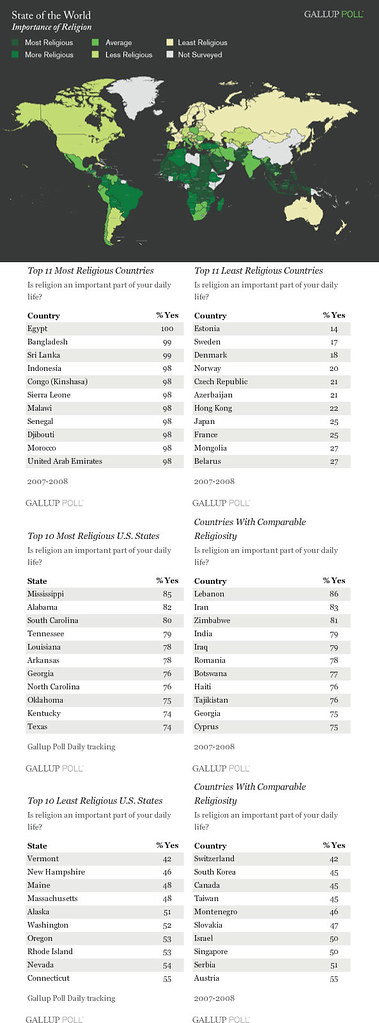
> >     >     > look at how religious they are. You will also be surprised.
> >     Again,
> >     >     your
> >     >     > argumentation against the importance of religions in this
> issue
> >     >     does not
> >     >     > stand. Take a look at this survey:
> >     >     >
> http://farm4.static.flickr.com/3423/3277768007_e06378be14_b.jpg
> >     >     >
> >     >     > What you are ignoring is the opposition between religion and
> >     >     education. Of
> >     >     > course education would and hopefully will solve the issue of
> >     >     overpopulation,
> >     >     > but it will do so by explaining the flat lies that religions
> >     >     carry, and
> >     >     > which  prevent women from enjoying their rights and freedom
> in
> >     >     terms of
> >     >     > birth control (and others). Therefore, you cannot deny the
> fact
> >     >     that, in
> >     >     > many cases (like in the one originally brought up by Nathan),
> >     >     there is a
> >     >     > link between religion (especially what you refer to as
> "Judaic
> >     >     religions")
> >     >     > and demography. You cannot fight one without fighting the
> other.
> >     >     >
> >     >     > Best regards,
> >     >     > Christian Vincenot
> >     >     >
> >     >     >
> >     >
> >     >
> >     >     --
> >     >     Christian Vincenot, PhD
> >     >     Biosphere Informatics Laboratory
> >     >     Department of Social Informatics
> >     >     Kyoto University, JAPAN
> >     >
> >     >     クリスティアン・ヴィンセノ
> >     >     博士後期課程
> >     >     グローバルCOE 研究助成
> >     >     社会情報学専攻 生物圏情報学講座
> >     >     京都大学 大学院情報学研究科
> >     >     〒606-8501 京都市左京区吉田本町
> >     >     Tel: 075-753-3136
> >     >     Fax: 075-753-3133
> >     >
> >     >
> >     >
> >     >
> >     > --
> >     > emilouanna.etsy.com <http://emilouanna.etsy.com>
> >     <http://emilouanna.etsy.com>
> >     >
> >
> >
>
>
>