I think the value of what you just mentioned is that most people don't know
that there is no issue with their own religion and evolution.
However, where I was coming from is a step different from that, because
most whose religion have no issue, end up having no issue.
However, there is a serious risk of the student thinking you are
criticizing their religion, which will literally cause tons of grief.  When
you say, plenty of religions have no problem with it, SOME (not all or even
most) will interpret that more like "other religions have no problem, so
what is wrong with yours?" or other sorts of imagined criticisms.  Its a
real tight rope with some of the extreme religious views.  Also, I suspect
that teh approach you take is going to be very dependent on the kind of
student you are dealing with.  I suspect that the students you get at Ole
Miss are significantly more prepared than a open (wide-open) enrollment
university. The approaches to students are completely different.  I learned
this going from LSUS to TAMUT to UMKC.  At UMKC students largely knew
exactly why they were in school ad how to be their.  They were more
prepared, but by NO MEANS were they on average smarter.  However, your
approach would have worked well with most of them, I suspect.  IF students
have poor academic backgrounds (in attainment or in exposure) their ability
to interpret your motives are also poorly developed.  At least that is my
experience.  I'm sure others have plenty of other views.

On Sun, Jul 5, 2015 at 2:32 PM, wresetar <[email protected]> wrote:

>  While care needs to be taken to avoid seeming confrontational, it may
> also be worth pointing out to students, if the issue arises, that even in
> this country a large majority of the populace belong to religions that do
> not consider their doctrine and the theory of evolution to be incompatible.
>  http://www.pewforum.org/2009/02/04/religious-groups-views-on-evolution/
>
>  This is true even among the Christian population – so not everyone
> considers religion and evolution at odds.  I doubt many of those who reject
> evolution are remotely aware of this.
>
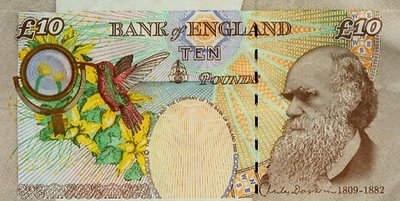
>  Then there is my personal favorite for mainstreaming evolution…  Sigh.
> http://3.bp.blogspot.com/-_U7QmAM2W0g/UVFm9wyrWSI/AAAAAAAAjFg/EzTKrMO7nOg/s1600/DarwinTenPoundNote.jpg
>
>  *William J. Resetarits, Jr.*
>  *Professor of Biology *and
> *Henry L. and Grace Doherty Chair in Freshwater Research*
> Department of Biology
> The University of Mississippi
> P.O. Box 1848
> University, MS 38677-1848
> Phone: (662) 915-5804
> Fax: (662) 915-6554
> http://www.olemiss.edu/resetaritslab
>
>  *Experiments are only experience carefully planned in advance. *  R. A.
> Fisher
>
>  *You can’t step twice in the same river. *  Heraclitus
>
>   From: Malcolm McCallum <[email protected]>
> Reply-To: Malcolm McCallum <[email protected]>
> Date: Sunday, July 5, 2015 at 12:07 PM
> To: "[email protected]" <[email protected]>
> Subject: Re: [ECOLOG-L] teaching evolution in ecology courses
>
>   I have no doubt that many who are from firm, literalistic religions
> have this problem.
>
> Early on when I was a student, I struggled with the conflict I thought
> existed between religion and evolution. After taking a pile of evolution
> coures I slowly transitioned.  IT was not a sudden lightbulb coming on.
>  I think everyone deals with it differently when confronted with the logic
> of evolution and how it sometimes conflicts with the dogma of some
> religions.  I concluded as an instructor that I was not going to change in
> a semester, a set of beliefs that this person has evolved over 18 or more
> years of life.  I also kinda believe that many of the most intelligent are
> the most stubborn to accept contrary views. So, my goal was not to
> challenge those beliefs, but avoid the entire issue via a cop out.  Rather,
> get the student to learn the facts they need to know and understand them.
> For the most part, I was able to do this.
>
>  1) Most of my classes are entrenched in evolutionary biology as I often
> bring it up even in A&P, but seldom ever have any problems, even though I
> have taught it in some very bible beltish areas.  However, when I teach
> ecology its there from day one, they know it is going to be there and I use
> an abbreviated version of my introduction from general bio shpeal.  IN
> general bio, I tell them, "I am not trying to change your beliefs, or turn
> you into an athiest.  You have a right to believe whatever you want, I'm
> not here to change what you believe.  I'm here to teach you biology, and
> evolution is central to biology.  Whether you believe in evolution or not,
> if you are in biology, you must understand it and you must know how it
> works.  Besides, learning what it is and what it is not can only
> strenghthen your beliefs because you are not blindly saying you don't
> believe in something, instead you know what it is you don't believe.
> Regardless, if you are going to be a biologist, MD, Nurse or dentist, you
> must be versed in evolution, period.  IF you don't, you will not make it
> through freshman biology.  This course is about learning what the science
> of biology is about, it is not about religion.  Evolution is biology.  If
> you do not learn it, your will be as successful in biology as someone who
> can't add would be in mathematics.  You can disbelieve the laws of addition
> all you want, but if you cannot follow their rules, you are not going to
> make it through math.  Likewise, you must know the rules of evolution or
> you will not make it."
>
>  This is in a lot of ways a cop out for both the instructor and the
> student.  It allows the instructor to approach the issue without
> challenging student beliefs, and it allows students who do not want to
> believe, the opportunity to learn without the conflicting underlying moral
> and emotional conflicts getting in the way. They are not being asked to
> believe anything, they are being asked to repeat what they don't believe.
> That is basically how I approach it.  THe commentary is not exactly worded
> like that everytime, but that is pretty darn close.  It might not work for
> every instructor, but it has for me (I think).
>
>  2) Of course, the first thing I do after this in freshman biology class
> is tell them the downright basic idea of evolution is "things change over
> time." I state that exact phrase everytime I teach it.  then, "A major
> question in biology is why did they change?"
>
>  I then insert a simple example with dogs or cows or something very
> familiar, "for example, we have tons of breeds of dogs.  They are all
> different breeds, but they are all actually wolves, right? We know they are
> wolves.  This is not new.  But, why have the breeds of dogs changed so much
> over time?
>
>  Well, because a bunch of people chose to select some traits over others
> while breeding them.  Some people wanted great sheep herders, others wanted
> dogs that could run fast, or could rip your arm off.  So, they kept
> breeding teh ones with the most muscular jaws or fastest speed or best
> herding ability. Over time, this selective breeding led to pit bulls,
> border collies, and greyhounds....all wolves!
>
>  In some cases, we have selected dogs so extremely that they are largely
> incompatable for breeding.  For example, there is nothing stopping a Saint
> Bernard sperm from fertilizing a chiuahua's egg (usually some giggles from
> the class), but if it did, the resulting embryo may grow too big to pass
> thorugh the birth canal, resulting in the death of the pup and mother.
> Also, there are mechanical problems here that transcend that minor problem.
>  (almost always there are giggles here by the class).  Obviously, the two
> dogs cannot breed naturally anymore.
>
>  This same thing can happen in nature too.  For a ficticous example, you
> can have one forest where dogs that are bigger survive better than little
> dogs because the available prey are really big making it easier for big
> dogs to get food.  In a nearby forest the opposite thing is hapening.
> THere are only a few prey species available, and the dogs must live off of
> these measley little animals.  OVer time, smaller dogs do better and the
> smaller they are the better they do in that forest, so the food supply
> continues to select smaller and smaller dogs among the litters of pups.
> The smaller dog requires less food, so it can live off of these prey very
> easily, and the bigger the dog the more food it needs, so the larger the
> dog, the worse it does in that forest. Over time, teh selection due to the
> kinds of available prey cause big dogs to largely disappear from the second
> forest leaving smaller dogs.  The forests for some reason get re-connected
> after a long time (centuries or millenia) and the two groups of dogs
> intermingle, one bigger than a saint bernard, teh other smaller than a
> chihuahua.   They won't interbreed due to mechanical reasons so largely,
> you will have the start of two groups of animals changing over time or
> evolving to form tow different and increasingly more divergent organsims.
> Over thousands of years, they may easily become so different as to be two
> separate species, one a mouse-sized dog, the other a elephant-sized dog.
>
> The only difference between the artifical selection that resulted in two
> different dogs, and the natural selection that resulted in the same outcome
> is the cause, or why the dogs changed over time or evolved.  That is how
> evolution works, and it is pretty easy to understand how it works."
>
>   3)  I've used this basic strategy since I first taught a college
> biology class in 1995 (before I went back for a phd), and I have never had
> more than an inquiry about evolution-religion conflicts.  They complain
> about tests being too hard or having to read the book, like in anyone
> else's class, but seldom ever about the evolution-religion issue.
>
>  In the very few times a student talked to me about the conflict, I just
> tell him or her that its good that they have well-formed beliefs and I am
> not asking you to believe anything.  In fact, you should not just blankly
> accept what I tell you just because I or anyone else said it.  You should
> require proof something is right or wrong. But, for this class you need to
> be able to repeat what I tell you and what you read in class about
> evolution and understand what it means.  I will say that I believe 90% of
> telling them this is body language and manerisms that ensure them that I am
> just wanting them to learn what they need to know.  It certainly defuses
> nearly all conflicts.  YOu are just helping them learn what they need to
> know for the tests.
>
>  Frankly, I don't see how someone can learn what evolution and natural
> selection are and not conclude some level of acceptance, but everyone is
> different, I am not going to change 20 years of religious learning, but I
> can at least end up with an informed student walking out of my door at the
> end of the semester.  Maybe that attitude has more to do with it than
> anything?  Heck if I know.  All I know is that this has worked for me and
> if it helps a student learn the material without moral conflicts to get in
> the way, all the better.
>
> On Sun, Jul 5, 2015 at 10:09 AM, David Inouye <[email protected]> wrote:
>
>> It would be interesting to preface discussions of evolution in ecology
>> courses with a few minutes about the cognitive differences considered in
>> the paper mentioned in this NPR story:
>>
>>
>> http://www.npr.org/sections/13.7/2015/06/29/418289762/don-t-believe-in-evolution-try-thinking-harder?utm_source=npr_newsletter&utm_medium=email&utm_content=20150705&utm_campaign=mostemailed&utm_term=nprnews
>>
>> I wonder whether some of the students I taught in introductory
>> ecology/evolution who were resistant to the idea of evolution might have
>> been influenced by this.
>>
>> David Inouye
>>
>>
>> Dr. David W. Inouye, Professor Emeritus
>> Department of Biology
>> University of Maryland
>> College Park, MD 20742-4415
>>
>> 2014-15: President, Ecological Society of America
>>
>> Principal Investigator
>> Rocky Mtn. Biological Laboratory
>> PO Box 519
>> Crested Butte, CO 81224
>>
>> [email protected]
>> 301-405-6946
>
>
>
>
>  --
>   Malcolm L. McCallum, PHD, REP
> Environmental Studies Program
> Green Mountain College
> Poultney, Vermont
> Link to online CV and portfolio :
> https://www.visualcv.com/malcolm-mc-callum?access=18A9RYkDGxO
>
>  “Nothing is more priceless and worthy of preservation than the rich array
> of animal life with which our country has been blessed. It is a
> many-faceted treasure, of value to scholars, scientists, and nature lovers
> alike, and it forms a vital part of the heritage we all share as Americans.”
> -President Richard Nixon upon signing the Endangered Species Act of 1973
> into law.
>
> "Peer pressure is designed to contain anyone with a sense of drive" -
> Allan Nation
>
> 1880's: "There's lots of good fish in the sea"  W.S. Gilbert
> 1990's:  Many fish stocks depleted due to overfishing, habitat loss,
>             and pollution.
> 2000:  Marine reserves, ecosystem restoration, and pollution reduction
>           MAY help restore populations.
> 2022: Soylent Green is People!
>
> The Seven Blunders of the World (Mohandas Gandhi)
> Wealth w/o work
> Pleasure w/o conscience
> Knowledge w/o character
> Commerce w/o morality
> Science w/o humanity
> Worship w/o sacrifice
> Politics w/o principle
>
> Confidentiality Notice: This e-mail message, including any
> attachments, is for the sole use of the intended recipient(s) and may
> contain confidential and privileged information.  Any unauthorized
> review, use, disclosure or distribution is prohibited.  If you are not
> the intended recipient, please contact the sender by reply e-mail and
> destroy all copies of the original message.
>


--
Malcolm L. McCallum, PHD, REP
Link to online CV and portfolio :
https://www.visualcv.com/malcolm-mc-callum?access=18A9RYkDGxO

 “Nothing is more priceless and worthy of preservation than the rich array
of animal life with which our country has been blessed. It is a
many-faceted treasure, of value to scholars, scientists, and nature lovers
alike, and it forms a vital part of the heritage we all share as Americans.”
-President Richard Nixon upon signing the Endangered Species Act of 1973
into law.

"Peer pressure is designed to contain anyone with a sense of drive" - Allan
Nation

1880's: "There's lots of good fish in the sea"  W.S. Gilbert
1990's:  Many fish stocks depleted due to overfishing, habitat loss,
            and pollution.
2000:  Marine reserves, ecosystem restoration, and pollution reduction
          MAY help restore populations.
2022: Soylent Green is People!

The Seven Blunders of the World (Mohandas Gandhi)
Wealth w/o work
Pleasure w/o conscience
Knowledge w/o character
Commerce w/o morality
Science w/o humanity
Worship w/o sacrifice
Politics w/o principle

Confidentiality Notice: This e-mail message, including any
attachments, is for the sole use of the intended recipient(s) and may
contain confidential and privileged information.  Any unauthorized
review, use, disclosure or distribution is prohibited.  If you are not
the intended recipient, please contact the sender by reply e-mail and
destroy all copies of the original message.