Dear Ecolog-Listers:

These links may be pertinent:
1. Cultural Cognition project - http://www.culturalcognition.net/kahan/ ,
http://www.evolutionnews.org/2014/07/yale_law_school087601.html

2. NOVA Video - *Intelligent Design on Trial* -
http://www.pbs.org/wgbh/nova/evolution/intelligent-design-trial.html

3.
https://blaypublishers.files.wordpress.com/2015/04/leb-31santiago-blay-et-al-pp-33-56-sencerizing.pdf
<-- Note least of resources (not comprehensive) towards the end of the
paper.

Cheers,

Jorge

On Mon, Jul 6, 2015 at 2:36 AM, Warren Aney <[email protected]> wrote:

> Good discussion!  My first encounter with this religious/evolution
> conflict was in high school many decades ago.  I was very intrigued by
> science class descriptions of dinosaurs and fossils.  During a Sunday
> evening youth gathering led by our conservative Presbyterian pastor I asked
> him about the difference between the biblical story he was teaching us that
> describes creation as a fairly recent event with no mention of much older
> dinosaurs and other fossils.  His answer:  “Those were previous creations
> that failed.”  My unspoken reaction: “So God made mistakes!”   It took me a
> long time to recover a religious perspective.  Now I am still Presbyterian
> and have no trouble talking about evolution with my progressive church
> friends.
>
> I’ve led tours and nature walks and taught church classes that included
> evolution-related features.  If I thought that an audience might not all
> accept evolution, I’ll just use the preface “scientists say…” rather than
> disturb them by implying that I was promoting rather than just describing a
> viewpoint. And, as described in some of the previous posts, the task of a
> class instructor is not to change student beliefs but rather to teach them
> the information they need to understand (but not necessarily accept)
> scientific principles.
>
> And evolution is not a “belief”  -- it’s a little weak to say “I believe
> in evolution” when evolution is a scientific theory that explains,
> describes and predicts biological development.  We don’t say “I believe in
> calculus” but, even if we don’t fully comprehend it, we know that it
> provides useful tools and methods for turning numerical information into
> reliable facts.
>
>
>
>
>
>
> Warren W. Aney
>
> Senior Wildlife Ecologist
>
> 9403 SW 74th Ave.
>
> Tigard, OR  97223
>
> (503) 539-1009
>
> [email protected]
>
>
>
>
>
>
>
> *From:* Ecological Society of America: grants, jobs, news [mailto:
> [email protected]] *On Behalf Of *wresetar
> *Sent:* 05 July, 2015 12:51
> *To:* [email protected]
>
> *Subject:* Re: [ECOLOG-L] teaching evolution in ecology courses
>
>
>
> You are absolutely correct – it is a sticky wicket.   But to the extent
> that Christianity as a whole is viewed as a religion, albeit with many
> denominations, it is (perhaps –  always context dependent) worth at least
> dispelling the widespread notion that opposition to evolution is a
> universal Christian thing.  This is certainly the impression one gets from
> many elements of mainstream media, even those that know better.
>
>
>
> *William J. Resetarits, Jr.*
>
> *Professor of Biology *and
>
> *Henry L. and Grace Doherty Chair in Freshwater Research*
>
> Department of Biology
>
> The University of Mississippi
>
> P.O. Box 1848
> University, MS 38677-1848
>
> Phone: (662) 915-5804
>
> Fax: (662) 915-6554
>
> http://www.olemiss.edu/resetaritslab
>
>
>
> *Experiments are only experience carefully planned in advance. *  R. A.
> Fisher
>
>
>
> *You can’t step twice in the same river. *  Heraclitus
>
>
>
> *From: *Malcolm McCallum <[email protected]>
> *Date: *Sunday, July 5, 2015 at 2:40 PM
> *To: *William Resetarits <[email protected]>
> *Cc: *"[email protected]" <[email protected]>
> *Subject: *Re: [ECOLOG-L] teaching evolution in ecology courses
>
>
>
> I think the value of what you just mentioned is that most people don't
> know that there is no issue with their own religion and evolution.
>
>
>
> However, where I was coming from is a step different from that, because
> most whose religion have no issue, end up having no issue.
>
> However, there is a serious risk of the student thinking you are
> criticizing their religion, which will literally cause tons of grief.  When
> you say, plenty of religions have no problem with it, SOME (not all or even
> most) will interpret that more like "other religions have no problem, so
> what is wrong with yours?" or other sorts of imagined criticisms.  Its a
> real tight rope with some of the extreme religious views.  Also, I suspect
> that teh approach you take is going to be very dependent on the kind of
> student you are dealing with.  I suspect that the students you get at Ole
> Miss are significantly more prepared than a open (wide-open) enrollment
> university. The approaches to students are completely different.  I learned
> this going from LSUS to TAMUT to UMKC.  At UMKC students largely knew
> exactly why they were in school ad how to be their.  They were more
> prepared, but by NO MEANS were they on average smarter.  However, your
> approach would have worked well with most of them, I suspect.  IF students
> have poor academic backgrounds (in attainment or in exposure) their ability
> to interpret your motives are also poorly developed.  At least that is my
> experience.  I'm sure others have plenty of other views.
>
>
>
> On Sun, Jul 5, 2015 at 2:32 PM, wresetar <[email protected]> wrote:
>
> While care needs to be taken to avoid seeming confrontational, it may also
> be worth pointing out to students, if the issue arises, that even in this
> country a large majority of the populace belong to religions that do not
> consider their doctrine and the theory of evolution to be incompatible.
> http://www.pewforum.org/2009/02/04/religious-groups-views-on-evolution/
>
>
>
> This is true even among the Christian population – so not everyone
> considers religion and evolution at odds.  I doubt many of those who reject
> evolution are remotely aware of this.
>
>
>
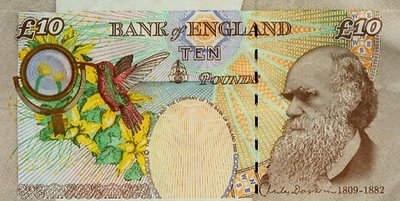
> Then there is my personal favorite for mainstreaming evolution…  Sigh.
> http://3.bp.blogspot.com/-_U7QmAM2W0g/UVFm9wyrWSI/AAAAAAAAjFg/EzTKrMO7nOg/s1600/DarwinTenPoundNote.jpg
>
>
>
> *William J. Resetarits, Jr.*
>
> *Professor of Biology *and
>
> *Henry L. and Grace Doherty Chair in Freshwater Research*
>
> Department of Biology
>
> The University of Mississippi
>
> P.O. Box 1848
> University, MS 38677-1848
>
> Phone: (662) 915-5804
>
> Fax: (662) 915-6554
>
> http://www.olemiss.edu/resetaritslab
>
>
>
> *Experiments are only experience carefully planned in advance. *  R. A.
> Fisher
>
>
>
> *You can’t step twice in the same river. *  Heraclitus
>
>
>
> *From: *Malcolm McCallum <[email protected]>
> *Reply-To: *Malcolm McCallum <[email protected]>
> *Date: *Sunday, July 5, 2015 at 12:07 PM
> *To: *"[email protected]" <[email protected]>
> *Subject: *Re: [ECOLOG-L] teaching evolution in ecology courses
>
>
>
> I have no doubt that many who are from firm, literalistic religions have
> this problem.
>
> Early on when I was a student, I struggled with the conflict I thought
> existed between religion and evolution. After taking a pile of evolution
> coures I slowly transitioned.  IT was not a sudden lightbulb coming on.
>  I think everyone deals with it differently when confronted with the logic
> of evolution and how it sometimes conflicts with the dogma of some
> religions.  I concluded as an instructor that I was not going to change in
> a semester, a set of beliefs that this person has evolved over 18 or more
> years of life.  I also kinda believe that many of the most intelligent are
> the most stubborn to accept contrary views. So, my goal was not to
> challenge those beliefs, but avoid the entire issue via a cop out.  Rather,
> get the student to learn the facts they need to know and understand them.
> For the most part, I was able to do this.
>
>
>
> 1) Most of my classes are entrenched in evolutionary biology as I often
> bring it up even in A&P, but seldom ever have any problems, even though I
> have taught it in some very bible beltish areas.  However, when I teach
> ecology its there from day one, they know it is going to be there and I use
> an abbreviated version of my introduction from general bio shpeal.  IN
> general bio, I tell them, "I am not trying to change your beliefs, or turn
> you into an athiest.  You have a right to believe whatever you want, I'm
> not here to change what you believe.  I'm here to teach you biology, and
> evolution is central to biology.  Whether you believe in evolution or not,
> if you are in biology, you must understand it and you must know how it
> works.  Besides, learning what it is and what it is not can only
> strenghthen your beliefs because you are not blindly saying you don't
> believe in something, instead you know what it is you don't believe.
> Regardless, if you are going to be a biologist, MD, Nurse or dentist, you
> must be versed in evolution, period.  IF you don't, you will not make it
> through freshman biology.  This course is about learning what the science
> of biology is about, it is not about religion.  Evolution is biology.  If
> you do not learn it, your will be as successful in biology as someone who
> can't add would be in mathematics.  You can disbelieve the laws of addition
> all you want, but if you cannot follow their rules, you are not going to
> make it through math.  Likewise, you must know the rules of evolution or
> you will not make it."
>
>
>
> This is in a lot of ways a cop out for both the instructor and the
> student.  It allows the instructor to approach the issue without
> challenging student beliefs, and it allows students who do not want to
> believe, the opportunity to learn without the conflicting underlying moral
> and emotional conflicts getting in the way. They are not being asked to
> believe anything, they are being asked to repeat what they don't believe.
> That is basically how I approach it.  THe commentary is not exactly worded
> like that everytime, but that is pretty darn close.  It might not work for
> every instructor, but it has for me (I think).
>
>
>
> 2) Of course, the first thing I do after this in freshman biology class is
> tell them the downright basic idea of evolution is "things change over
> time." I state that exact phrase everytime I teach it.  then, "A major
> question in biology is why did they change?"
>
>
>
> I then insert a simple example with dogs or cows or something very
> familiar, "for example, we have tons of breeds of dogs.  They are all
> different breeds, but they are all actually wolves, right? We know they are
> wolves.  This is not new.  But, why have the breeds of dogs changed so much
> over time?
>
>
>
> Well, because a bunch of people chose to select some traits over others
> while breeding them.  Some people wanted great sheep herders, others wanted
> dogs that could run fast, or could rip your arm off.  So, they kept
> breeding teh ones with the most muscular jaws or fastest speed or best
> herding ability. Over time, this selective breeding led to pit bulls,
> border collies, and greyhounds....all wolves!
>
>
>
> In some cases, we have selected dogs so extremely that they are largely
> incompatable for breeding.  For example, there is nothing stopping a Saint
> Bernard sperm from fertilizing a chiuahua's egg (usually some giggles from
> the class), but if it did, the resulting embryo may grow too big to pass
> thorugh the birth canal, resulting in the death of the pup and mother.
> Also, there are mechanical problems here that transcend that minor problem.
>  (almost always there are giggles here by the class).  Obviously, the two
> dogs cannot breed naturally anymore.
>
>
>
> This same thing can happen in nature too.  For a ficticous example, you
> can have one forest where dogs that are bigger survive better than little
> dogs because the available prey are really big making it easier for big
> dogs to get food.  In a nearby forest the opposite thing is hapening.
> THere are only a few prey species available, and the dogs must live off of
> these measley little animals.  OVer time, smaller dogs do better and the
> smaller they are the better they do in that forest, so the food supply
> continues to select smaller and smaller dogs among the litters of pups.
> The smaller dog requires less food, so it can live off of these prey very
> easily, and the bigger the dog the more food it needs, so the larger the
> dog, the worse it does in that forest. Over time, teh selection due to the
> kinds of available prey cause big dogs to largely disappear from the second
> forest leaving smaller dogs.  The forests for some reason get re-connected
> after a long time (centuries or millenia) and the two groups of dogs
> intermingle, one bigger than a saint bernard, teh other smaller than a
> chihuahua.   They won't interbreed due to mechanical reasons so largely,
> you will have the start of two groups of animals changing over time or
> evolving to form tow different and increasingly more divergent organsims.
> Over thousands of years, they may easily become so different as to be two
> separate species, one a mouse-sized dog, the other a elephant-sized dog.
>
>
>
> The only difference between the artifical selection that resulted in two
> different dogs, and the natural selection that resulted in the same outcome
> is the cause, or why the dogs changed over time or evolved.  That is how
> evolution works, and it is pretty easy to understand how it works."
>
>
>
>  3)  I've used this basic strategy since I first taught a college biology
> class in 1995 (before I went back for a phd), and I have never had more
> than an inquiry about evolution-religion conflicts.  They complain about
> tests being too hard or having to read the book, like in anyone else's
> class, but seldom ever about the evolution-religion issue.
>
>
>
> In the very few times a student talked to me about the conflict, I just
> tell him or her that its good that they have well-formed beliefs and I am
> not asking you to believe anything.  In fact, you should not just blankly
> accept what I tell you just because I or anyone else said it.  You should
> require proof something is right or wrong. But, for this class you need to
> be able to repeat what I tell you and what you read in class about
> evolution and understand what it means.  I will say that I believe 90% of
> telling them this is body language and manerisms that ensure them that I am
> just wanting them to learn what they need to know.  It certainly defuses
> nearly all conflicts.  YOu are just helping them learn what they need to
> know for the tests.
>
>
>
> Frankly, I don't see how someone can learn what evolution and natural
> selection are and not conclude some level of acceptance, but everyone is
> different, I am not going to change 20 years of religious learning, but I
> can at least end up with an informed student walking out of my door at the
> end of the semester.  Maybe that attitude has more to do with it than
> anything?  Heck if I know.  All I know is that this has worked for me and
> if it helps a student learn the material without moral conflicts to get in
> the way, all the better.
>
>
>
> On Sun, Jul 5, 2015 at 10:09 AM, David Inouye <[email protected]> wrote:
>
> It would be interesting to preface discussions of evolution in ecology
> courses with a few minutes about the cognitive differences considered in
> the paper mentioned in this NPR story:
>
>
> http://www.npr.org/sections/13.7/2015/06/29/418289762/don-t-believe-in-evolution-try-thinking-harder?utm_source=npr_newsletter&utm_medium=email&utm_content=20150705&utm_campaign=mostemailed&utm_term=nprnews
>
> I wonder whether some of the students I taught in introductory
> ecology/evolution who were resistant to the idea of evolution might have
> been influenced by this.
>
> David Inouye
>
>
> Dr. David W. Inouye, Professor Emeritus
> Department of Biology
> University of Maryland
> College Park, MD 20742-4415
>
> 2014-15: President, Ecological Society of America
>
> Principal Investigator
> Rocky Mtn. Biological Laboratory
> PO Box 519
> Crested Butte, CO 81224
>
> [email protected]
> 301-405-6946
>
>
>
>
>
> --
>
> Malcolm L. McCallum, PHD, REP
>
> Environmental Studies Program
>
> Green Mountain College
>
> Poultney, Vermont
>
> Link to online CV and portfolio :
> https://www.visualcv.com/malcolm-mc-callum?access=18A9RYkDGxO
>
>  “Nothing is more priceless and worthy of preservation than the rich array
> of animal life with which our country has been blessed. It is a
> many-faceted treasure, of value to scholars, scientists, and nature lovers
> alike, and it forms a vital part of the heritage we all share as Americans.”
> -President Richard Nixon upon signing the Endangered Species Act of 1973
> into law.
>
> "Peer pressure is designed to contain anyone with a sense of drive" -
> Allan Nation
>
> 1880's: "There's lots of good fish in the sea"  W.S. Gilbert
> 1990's:  Many fish stocks depleted due to overfishing, habitat loss,
>             and pollution.
> 2000:  Marine reserves, ecosystem restoration, and pollution reduction
>           MAY help restore populations.
> 2022: Soylent Green is People!
>
> The Seven Blunders of the World (Mohandas Gandhi)
> Wealth w/o work
> Pleasure w/o conscience
> Knowledge w/o character
> Commerce w/o morality
> Science w/o humanity
> Worship w/o sacrifice
> Politics w/o principle
>
> Confidentiality Notice: This e-mail message, including any
> attachments, is for the sole use of the intended recipient(s) and may
> contain confidential and privileged information.  Any unauthorized
> review, use, disclosure or distribution is prohibited.  If you are not
> the intended recipient, please contact the sender by reply e-mail and
> destroy all copies of the original message.
>
>
>
>
>
> --
>
> Malcolm L. McCallum, PHD, REP
>
> Link to online CV and portfolio :
> https://www.visualcv.com/malcolm-mc-callum?access=18A9RYkDGxO
>
>
>  “Nothing is more priceless and worthy of preservation than the rich array
> of animal life with which our country has been blessed. It is a
> many-faceted treasure, of value to scholars, scientists, and nature lovers
> alike, and it forms a vital part of the heritage we all share as Americans.”
> -President Richard Nixon upon signing the Endangered Species Act of 1973
> into law.
>
> "Peer pressure is designed to contain anyone with a sense of drive" -
> Allan Nation
>
> 1880's: "There's lots of good fish in the sea"  W.S. Gilbert
> 1990's:  Many fish stocks depleted due to overfishing, habitat loss,
>             and pollution.
> 2000:  Marine reserves, ecosystem restoration, and pollution reduction
>           MAY help restore populations.
> 2022: Soylent Green is People!
>
> The Seven Blunders of the World (Mohandas Gandhi)
> Wealth w/o work
> Pleasure w/o conscience
> Knowledge w/o character
> Commerce w/o morality
> Science w/o humanity
> Worship w/o sacrifice
> Politics w/o principle
>
> Confidentiality Notice: This e-mail message, including any
> attachments, is for the sole use of the intended recipient(s) and may
> contain confidential and privileged information.  Any unauthorized
> review, use, disclosure or distribution is prohibited.  If you are not
> the intended recipient, please contact the sender by reply e-mail and
> destroy all copies of the original message.
>


--
Jorge A. Santiago-Blay, PhD
blaypublishers.com

1. Positive experiences for authors of papers published in *LEB*
http://blaypublishers.com/testimonials/

2. Free examples of papers published in *LEB*:
http://blaypublishers.com/category/previous-issues/.

3. *Guidelines for Authors* and page charges of *LEB*:
http://blaypublishers.com/archives/ *.*

4. Want to subscribe to *LEB*? http://blaypublishers.com/subscriptions/


http://blayjorge.wordpress.com/
http://paleobiology.si.edu/staff/individuals/santiagoblay.cfm