I was trying to visit http://rangevoting.org/ to see if there was
anything about an automated strategy to convert Range votes into
Approval votes (just to move strategy from a hit-or-miss process on the
part of certain savvy voters to something applied universally), and it
looks like the web page is down. It resolves in an nslookup to
Name:    rangevoting.org
Address:  128.2.209.176
and tracert'ing to it gives (after it leaves my ISP's domain):

Tracing route to rangevoting.org [128.2.209.176]
over a maximum of 30 hops:
  ...
  9    90 ms    91 ms    90 ms  sl-bb25-chi-5-0.sprintlink.net
[144.232.20.84]
 10    91 ms    90 ms    90 ms  sl-bb24-chi-14-0.sprintlink.net
[144.232.26.82]
 11   113 ms   113 ms   113 ms  sl-bb25-nyc-5-0.sprintlink.net
[144.232.9.157]
 12   128 ms   129 ms   129 ms  144.232.13.148
 13   129 ms   129 ms   129 ms  63.160.2.10
 14   130 ms   130 ms   129 ms
g0-1-0-440.car1.pitc.pitbpa.e-xpedient.com [206.210.75.241]
 15   131 ms   130 ms   131 ms  cmu-gw.cust.e-xpedient.com [208.40.161.235]
 16   130 ms   130 ms   131 ms  CORE0-VL986.GW.CMU.NET [128.2.0.249]
 17   130 ms   130 ms   130 ms  POD-A-CYH-VL914.GW.CMU.NET [128.2.0.156]
 18   131 ms   130 ms   130 ms  GIGROUTER-POD-A-CYH.GW.CMU.NET
[128.2.35.194]
 19   130 ms   131 ms   130 ms  BOOJUM.LINK.CS.CMU.EDU [128.2.209.176]

I hope it's just a temporary glitch, I like reference pages like this. :)

**************

Anyway, it's probably something I've asked in the past (I had a computer
crash awhile back so I don't have all my notes or E-M emails), but has
someone proposed a method to convert Range votes to maximal strategy
Approval votes? I was just wondering what the properties of such a
system might be (including cool-looking graphs, if available), and any
paradoxes or problems that might arise.

For example, would it be possible to convert Range ballots into the
equivalent of Approval ballots where every voter has the equivalent of
perfectly accurate polling data?

Also, I'm curious how it would act with the Gibbard-Satterthwaite
theorem where (from Wikipedia) it states:

3. The rule is susceptible to tactical voting, in the sense that there
are conditions under which a voter with full knowledge of how the other
voters are to vote and of the rule being used would have an incentive to
vote in a manner that does not reflect his preferences.

since every vote has the equivalent information. Are there weird
Approval cycles -- like you have with Condorcet "rock-paper-scissors"
ties -- or areas where the strategy is indeterminate?

On a tangential topic, the definition for Nanson's method is given as this:

Eliminate those choices from a Borda count tally that are at or below
the average Borda count score, then retally the ballots as if the
remaining candidates were exclusively on the ballot. Repeat the process
until a single winner remains.

Is this correct, or would it actually be something like the
linearly-interpolated median (henceforth called LIM) score? While this
may seem like a trivial distinction, since with Borda it's the same
thing (well, at least if I didn't do a dumb mistake, which is entirely
possible), I was thinking about a possible extension of Nanson's method
to Range voting, where you drop the candidates whose LIM value is less
than the LIM for all the candidates.

I was also looking into making Range voting "Range-ier" for the purpose
of determining the median -- if you had a single vote for a single
candidate at a single value, it would just be that value, two votes for
a candidate at a single value would be considered -0.25 and +0.25 from
that value, three votes would be -0.333, 0, and +0.333, four would be
-0.375, -0.125, +0.125, +0.375, and so on.

To show the difference, let's say Candidate A has the following
distribution of points:

0 1 2 3 4 (value)
2 4 5 2 3 (number of votes)

Borda and Range value is:
2*0 + 4*1 + 5*2 + 2*3 + 3*4 = 32

Candidate B has the following:

0 1 2 3 4 (value)
3 2 5 4 2 (number of votes)

Borda and Range value is:
3*0 + 2*1 + 5*2 + 4*3 + 2*4 = 32

The median value for both is 2.

However, let's distribute the range in both:

First, A:
0 1 2 3 4
2 4 5 2 3 -->
(-0.25 0.25)(0.625 0.875 1.125 1.375)(1.6 1.8 2.0 2.2 2.4)(2.625 2.875
3.125 3.375)(3.75 4.25)

The median value in this example is between 1.8 and 2.0, so let's take
the LIM and say 1.9.

Now B:
0 1 2 3 4
3 2 5 4 2 -->
(-0.333 0 0.333) (0.75 1.25)(1.6 1.8 2.0 2.2 2.4)(2.625 2.875 3.125
3.375)(3.75 4.25)

The media value in this example is between 2.0 and 2.2, so let's say 2.1.

In a contest between A and B where the LIM is used to determine the
winner, B wins over A.

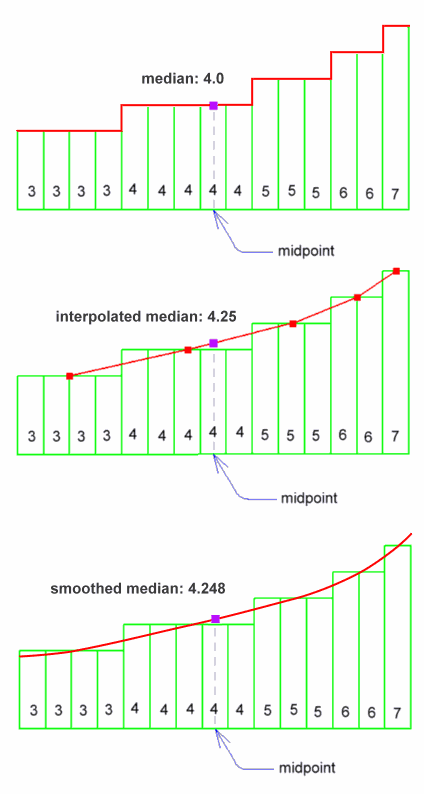
Since I can never seem to keep these things brief anyway,  Rob Brown had
something similar a couple of years ago at
http://karmatics.com/stuff/median.gif

He had the values for 15 elements  (3,3,3,3,4,4,4,4,4,5,5,5,6,6,7) and
gave an interpolated median (calculated from the midpoint of one group
to the next) of 4.25, and a smoothed median of 4.248. With my method
above, the interpolated median would be the eighth element in the set,
or 4.2 (the "4's" are symmetrically distributed as 3.6, 3.8, 4.0, 4.2,
4.4, and the second to the highest element in that set is 4.2). It would
be interesting to see what resulted from the different ways of
calculating it (Rob Brown considered values immediately above and/or
below the median -- between the 4's and  5's in this case -- while I
just considered the 4's.)

I'll leave that there, since I've drifted rather far afield from my
question about what happened to rangevoting.org. :)

Michael Rouse

----
Election-Methods mailing list - see http://electorama.com/em for list info