On 04/17/2014 07:25 AM, Kirk Wallace wrote:
> On 04/17/2014 06:56 AM, Viesturs Lācis wrote:
>> Hello!
>>
>> I have three chinese servo drives in the waterjet machine and they are
>> constantly faulting with "overvoltage" error. Since I have not yet added
>> any braking resistors, it seems obvious that I should do so.
>> The question is: how do I determine appropriate resistance and rated power
>> values for the resistor?
>> Motor parameters are here:
>> http://www.cutting.lv/fileadmin/user_upload/tg-motor.pdf
>>
>> Currently max current in motors is set to 1,4A, which makes me think that
>> actual motor power is 500W.
>> Experienced guy suggested braking resistor with 100-150 ohm resistance. But
>> how do I determine correct rated power? Or is it that I just take the
>> biggest power available as it cannot be too high?
>>
>> Viesturs
>
> Some VFD manuals have sections covering braking resistors. Some resistor
> modules have sensors or protection devices of some type.
>
> The Ohms and voltage values will set the current going through the
> resistor.
>
> V = I * R
> or
> V / R = I,
>
> let's say 240V / 100 Ohms = 2.4 Amps.
>
> Watts = V * I or 240 * 2.4 Amps = 576 Watts.
>
> If you go higher in Ohms, you will get less braking. The VFD's braking
> circuit will likely have a maximum current rating as well as the motor.
>
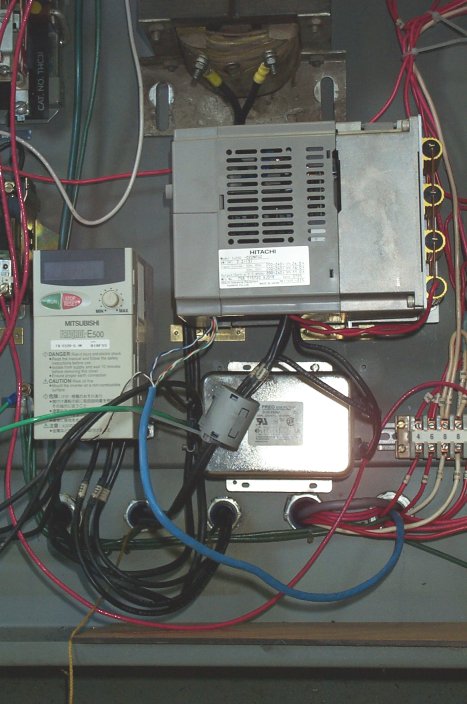
> One of my shop-made braking modules (four gold colored resistors) is
> bolted to the back of my VFD here:
> http://www.wallacecompany.com/cnc_lathe/HNC/00024-1a.jpg
Another thing that comes to mind, without a braking resistor, you
essentially have a resistor of very high Ohms. When you call for braking
the motor turns into a generator and the generated voltage goes into the
VFD's braking circuit which at this point presents no load, so the
voltage goes too high. If you configure the VFD settings to slow down
over a longer time, less voltage goes to the braking circuit and you can
avoid the over voltage alarm.

If you want faster braking, set the VFD to a shorter braking time, but
also add some braking load by reducing the braking resistance. Since we
are starting with nearly infinite Ohms, any reduction will help quite a
bit. You can reduce Ohms and braking time up until the current limit of
the braking circuit and motor. Once you have the Ohms value, you can
calculate the Watt rating for the resistor. If the resistor gets hot,
increase the braking time or add a heat sink.


--
Kirk Wallace
http://www.wallacecompany.com/machine_shop/
http://www.wallacecompany.com/E45/

------------------------------------------------------------------------------
Learn Graph Databases - Download FREE O'Reilly Book
"Graph Databases" is the definitive new guide to graph databases and their
applications. Written by three acclaimed leaders in the field,
this first edition is now available. Download your free book today!
http://p.sf.net/sfu/NeoTech
_______________________________________________
Emc-users mailing list
[email protected]
https://lists.sourceforge.net/lists/listinfo/emc-users