EV Digest 3434

Topics covered in this issue include:
  1) RE: EVLN(Ford to sell hybrid Escape SUV at a loss)
        by Shawn Rutledge <[EMAIL PROTECTED]>
  2) Re: Battery telemetry thought, take one.
        by Christopher Zach <[EMAIL PROTECTED]>
  3) RE: EVLN(Ford to sell hybrid Escape SUV at a loss)
        by Roger Stockton <[EMAIL PROTECTED]>
  4) RE: Battery telemetry thought, take one.
        by David Brandt <[EMAIL PROTECTED]>
  5) RE: New Car or Not (Was Tom Hanks = Big EV Fan)
        by "James Jarrett" <[EMAIL PROTECTED]>
  6) RE: EVLN(Ford to sell hybrid Escape SUV at a loss)
        by Shawn Rutledge <[EMAIL PROTECTED]>
  7) Re: Battery telemetry thought, take one.
        by Christopher Zach <[EMAIL PROTECTED]>
  8) RE: EVLN(Ford to sell hybrid Escape SUV at a loss)
        by Edward Ang <[EMAIL PROTECTED]>
  9) Evercel
        by fred whitridge <[EMAIL PROTECTED]>
 10) Re: AMP connectors
        by Victor Tikhonov <[EMAIL PROTECTED]>
 11) Re: Evercel
        by Derrick J Brashear <[EMAIL PROTECTED]>
 12) RE: EVLN(Ford to sell hybrid Escape SUV at a loss)
        by Roger Stockton <[EMAIL PROTECTED]>
 13) Fw: 12v sealed lead acid
        by "Lawrence Rhodes" <[EMAIL PROTECTED]>
 14) RE: alternate fuel vehicle day
        by "T Humphrey" <[EMAIL PROTECTED]>
 15) Re: EVLN(Ford to sell hybrid Escape SUV at a loss)
        by Victor Tikhonov <[EMAIL PROTECTED]>
 16) RE: Battery telemetry thought, take one.
        by David Brandt <[EMAIL PROTECTED]>
 17) RE: 12v sealed lead acid
        by David Brandt <[EMAIL PROTECTED]>
 18) S10 adaptor plate
        by Rod Hower <[EMAIL PROTECTED]>
 19) Re: New Car or Not (Was Tom Hanks = Big EV Fan)
        by Lee Hart <[EMAIL PROTECTED]>
 20) Re: AMP connectors
        by Chris Zach <[EMAIL PROTECTED]>
 21) RE: 12v sealed lead acid
        by Rod Hower <[EMAIL PROTECTED]>
 22) Re: Battery telemetry thought, take one.
        by "David Chapman" <[EMAIL PROTECTED]>
--- Begin Message ---
--- Roger Stockton <[EMAIL PROTECTED]> wrote:
> At EVS-20 ultracap (and most advanced battery manufacturers) stated
> they had no intention of developing batteries suitable for normal EV
> use (i.e. high capacity).  Their sole focus is on high(ish) power,
> low capacity batteries/capacitors that will be subject to lots of
> very shallow cycles, not highish capacity batteries suitable for
> deeper cycles.

Ultracaps are that way, sure; but can they actually accomplish that
with NiMH or LiIon?  The main complaint against the existing ones has
been their low current capabilities.  And AFAIK NiMH batteries _like_
deep discharges, just like NiCads, and maximum range is maintained by
discharging them fully each time.  How could they change this basic
feature of that chemistry?

Somebody a few days ago mentioned the idea of using high-capacity
low-current batteries together with AGMs.  I think that's a great idea;
and maybe it would be even better to have 3 stages - LiIon or NiMH for
long-term storage, small AGMs for the longer bursts of power necessary
to climb hills, and ultracaps just to absorb regen power and for quick
acceleration.  The design rules for the controller would be: above a
certain speed, the ultracaps are not charged, so that their capacity is
available to absorb regen power as efficiently as possible (in
comparison to the less efficient process of charging an AGM with this
power).  When you slow down, regen power goes first into the caps; then
when they are fully charged any excess goes into the AGMs.  When you
are stopped, the ultracaps are charged to full capacity from the LiIon
pack (slowly) so you have as much power available as you can get for a
quick launch.  When you accelerate, the ultracaps are used up first and
AGMs provide the longer-term power needs.  Regardless what you are
doing, the controller should always try to keep the AGMs charged from
the LiIon pack (or maybe just to 95%, so that some capacity is reserved
for excess regen power beyond what the caps cannot absorb), charging at
a maximum rate that is completely safe for the main pack and which
optimizes its life.  There could be a neat bargraph display on the dash
showing all 3 power levels.  The AGMs should last longer in this kind
of use than they do alone in an EV, because their depth of discharge
could be kept above 50% (or higher) all the time.  But their
high-current capability could help to ensure the main pack never sees
excessive currents.  (But if you climb a hill for more than a few
minutes you might eventually be forced to slow down when the AGMs are
discharged too far.)

=====
. _______  Shawn T. Rutledge / KB7PWD [EMAIL PROTECTED]
 (_  | |_)    http://ecloud.org/  [EMAIL PROTECTED]
 __) | | \______________________________________________

__________________________________
Do you Yahoo!?
Yahoo! Finance Tax Center - File online. File on time.
http://taxes.yahoo.com/filing.html
--- End Message ---
--- Begin Message ---
Right, parallel with the resistor; my boo. The idea is to have the
resistor network hot all the time so I can hook up a voltmeter without
being barbequeued, and engage the contactors when I have a nice safe
charger attached (and am standing far away)
Chris
David Brandt wrote:
Wouldn't you want the relay in parallel with the resistor to switch it in
and out of the circuit?  If you also want the wire to be cold (unenergized)
at some point, then you now need 2 relays per wire.
Putting it in series as you say would switch the wire between hot and cold,
but would not switch the resistor in and out of the circuit.
-----Original Message-----
From: Christopher Zach [mailto:[EMAIL PROTECTED]
Sent: Wednesday, March 31, 2004 11:16 AM
To: [EMAIL PROTECTED]
Subject: Battery telemetry thought, take one.
Ok, I have a thought here for a basic battery telemetry interface on my
Prizm.
My problem is twofold: First, I want to not have anything that comes out
of the pack which can kill me by default. Given this is a 300 volt pack
that means I need a default-off interlock on any wiring solution that
exits the pack. Like the contactors that are in place now; no wires will
be hot at a fatal voltage unless I command them to be hot.
Second: I need to monitor 50 batteries. I should be able to charge them
if needed with up to 5 amps of current, and monitor their voltages with
whatever tool I might want.
First thought: I run a wire from each battery to a common
interconnector. Use two AMP screw-in type interconnectors to provide the
interface. Each wire will be rated to carry a max of 2-4 amps, and can
be fuse-protected at the battery. I limit the current by putting a
33kOhm resistor in series with the wire to keep the current down to a
safe level in the event I am ever stupid enough to touch two wires at
once.
In series with the resistor is a small SPST relay. These 50 relays will
have their coils connected in parallel. When energized by a 5 or 12 volt
signal, the resistor will be bypassed, allowing things like diodes,
external regulators, and even low-power chargers to be connected to the
batteries.
Does this sound like a good idea? This way I can put the battery monitor
brains outside of the 1,000+ pound pack where I don't have to worry
about it failing or changing.
Chris
--- End Message ---
--- Begin Message ---
On Wednesday, March 31, 2004 11:25 AM, Shawn Rutledge
[SMTP:[EMAIL PROTECTED] wrote:
>
> --- Roger Stockton <[EMAIL PROTECTED]> wrote:
> > At EVS-20 ultracap (and most advanced battery manufacturers)
> > stated they had no intention of developing batteries suitable
> > for normal EV use (i.e. high capacity).

> Ultracaps are that way, sure; but can they actually accomplish that
> with NiMH or LiIon?

Dunno; I'm just reporting what the manufacturers said.  It certainly
is common knowledge that batteries can typically be optimised for
high power (at the expense of capacity) or for high capacity (at the
expense of power capability), and I have no reason to believe that
this is chemistry specific.

>  The main complaint against the existing ones has
> been their low current capabilities.

>  And AFAIK NiMH batteries _like_ deep discharges, just like
> NiCads,

AFAIK, *no* battery 'likes' deep cycling; cycle life always decreases
as DOD increases.  NiMH and NiCds may tolerate deep cycling better
than some other chemistries (such as PbA), but it still takes its
toll.

> and maximum range is maintained by discharging them
> fully each time.

Maximum range is maintained by proper charging; completely
discharging NiCds or NiMH is a kludge to compensate for improper
charging (or to allow a really stupid charger to be used without
murdering the batteries quite as fast as it would otherwise).

> Somebody a few days ago mentioned the idea of using high-capacity
> low-current batteries together with AGMs.  I think that's a great
> idea; and maybe it would be even better to have 3 stages - LiIon
> or NiMH for long-term storage, small AGMs for the longer bursts
> of power necessary to climb hills, and ultracaps just to absorb
> regen power and for quick acceleration.

If you use a big enough hammer you can certainly force a square peg
into a round hole, but that doesn't make it a good solution. ;^>

The main reason anyone would consider such a complicated system is
because suitable batteries are not available, not because such a
system is a 'good' idea on its own.

Ed pointed out that small batteries/cells suitable for hybrid use
could be (massively) paralleled to build usable EV packs, and while
this may be true in the sense that it is theoretically possible, it
is also not a particularly desirable solution (for reasons discussed
in past threads).  Besides, if one wants to go this route, there is
no need to wait/hope for hybrid development since small capacity,
high-power cells NiCd, NiMH, and Li-ion cells are already available
(and in high volume production) - what is missing is the mandatory
cell-level management/protection systems for series strings of such
paralleled cells.  Don't hold your breath waiting for that to fall
into our laps as a result of hybrid development (especially not by
the Big 3).

Cheers,

Roger.
--- End Message ---
--- Begin Message ---
Well, it sounds good.  The "guts" of the system would be located elsewhere
(could even be stationary), and could consist of whatever you want.  From
what I understand, what you need right now is to design and implement a safe
interface point into the battery box.  It sounds to me like this is the
ticket.  Of course, now you need to make a connector for all of the relay
coil wires, too.

A good model for an interface that is designed to keep dust and dirt out,
and ensure alignment and good contact with manual insertion of the interface
item is a game cartridge from an old Atari 2600.  Remember those?  There was
a plastic door that was spring loaded on the stationary side, covering where
the circuit board portion of the cartridge would insert.  There were two
slots on either side of the slot with the door.  The cartridge had two
plastic prongs which went into the slots and pushed open the door.  And the
whole mechanical assembly was sleeved on the cartridge side.  The guts of
the cartridge were just as Lee described - extra thick fiberglass PC board
with contacts on the sides.

For the opposite side of the system, you will probably want two setups - a
small, light on-board one with limited capability (monitoring system,
datalogging, whatever), but with flexibility to add more functions or change
them over time, and a stationary one which could do active regulating and
balancing during charge and afterwards.

> -----Original Message-----
> From: Christopher Zach [mailto:[EMAIL PROTECTED]
> Sent: Wednesday, March 31, 2004 2:42 PM
> To: [EMAIL PROTECTED]
> Subject: Re: Battery telemetry thought, take one.
>
> Right, parallel with the resistor; my boo. The idea is to have the
> resistor network hot all the time so I can hook up a voltmeter without
> being barbequeued, and engage the contactors when I have a nice safe
> charger attached (and am standing far away)
>
> Chris
>
>
> David Brandt wrote:
>
> > Wouldn't you want the relay in parallel with the resistor to switch it
> in
> > and out of the circuit?  If you also want the wire to be cold
> (unenergized)
> > at some point, then you now need 2 relays per wire.
> >
> > Putting it in series as you say would switch the wire between hot and
> cold,
> > but would not switch the resistor in and out of the circuit.
> >
> >
> >>-----Original Message-----
> >>From: Christopher Zach [mailto:[EMAIL PROTECTED]
> >>Sent: Wednesday, March 31, 2004 11:16 AM
> >>To: [EMAIL PROTECTED]
> >>Subject: Battery telemetry thought, take one.
> >>
> >>Ok, I have a thought here for a basic battery telemetry interface on my
> >>Prizm.
> >>
> >>My problem is twofold: First, I want to not have anything that comes out
> >>of the pack which can kill me by default. Given this is a 300 volt pack
> >>that means I need a default-off interlock on any wiring solution that
> >>exits the pack. Like the contactors that are in place now; no wires will
> >>be hot at a fatal voltage unless I command them to be hot.
> >>
> >>Second: I need to monitor 50 batteries. I should be able to charge them
> >>if needed with up to 5 amps of current, and monitor their voltages with
> >>whatever tool I might want.
> >>
> >>First thought: I run a wire from each battery to a common
> >>interconnector. Use two AMP screw-in type interconnectors to provide the
> >>interface. Each wire will be rated to carry a max of 2-4 amps, and can
> >>be fuse-protected at the battery. I limit the current by putting a
> >>33kOhm resistor in series with the wire to keep the current down to a
> >>safe level in the event I am ever stupid enough to touch two wires at
> >>once.
> >>
> >>In series with the resistor is a small SPST relay. These 50 relays will
> >>have their coils connected in parallel. When energized by a 5 or 12 volt
> >>signal, the resistor will be bypassed, allowing things like diodes,
> >>external regulators, and even low-power chargers to be connected to the
> >>batteries.
> >>
> >>Does this sound like a good idea? This way I can put the battery monitor
> >>brains outside of the 1,000+ pound pack where I don't have to worry
> >>about it failing or changing.
> >>
> >>Chris
> >
> >
> >
> >
--- End Message ---
--- Begin Message ---
>
> >> That's true, but not entirely. If you have a car with 75,000
> >> (arbitrary) miles on it then it's obviously not new, however if
> >> you convert it to electric and then apply for a new title as
> >> a "new" electric vehicle, then by the IRS rules it is new and
> you
> >> can take the credit.

*SNIP*

This is true, but let me give you one caveat, it's also now a new vehicle
for TAX purposes.  The original title to my Henney Kilowatt was lost
sometime back in it's ownership, so in 2000 the current owner (or would be
owner) had the car Re-titled.  No problem, it's all legal.  But when I got
my first tax statement from the county I live in they taxed me on a year
2000 "custom" car.  To the tune of about $230.00 (purchase value of about
$25,000) when I was used to being taxed $30-$40.00 per car.

Well I raised Cain and sent them pictures of the car and a copy of the bill
of sale where I bought it.  They finally re-issued the tax bill for $37.00
but it COULD have gotten messy.

James

James F. Jarrett
Information Systems Associate
Charlotte Country Day School
(704)943-4562
http://www.ccds.charlotte.nc.us/~jarrett
http://www.ccds.charlotte.nc.us/~jarrett/EV

If you understand, things are as they are. If you do not understand, things
are as they are. - Gensha, Zen Master
--- End Message ---
--- Begin Message ---
--- Roger Stockton <[EMAIL PROTECTED]> wrote:
> > Somebody a few days ago mentioned the idea of using high-capacity
> > low-current batteries together with AGMs.  I think that's a great
> > idea; and maybe it would be even better to have 3 stages - LiIon
> > or NiMH for long-term storage, small AGMs for the longer bursts
> > of power necessary to climb hills, and ultracaps just to absorb
> > regen power and for quick acceleration.
>
> If you use a big enough hammer you can certainly force a square peg
> into a round hole, but that doesn't make it a good solution. ;^>

That's awfully harsh.  More suited to the hybrid designs, I think.
>
> The main reason anyone would consider such a complicated system is
> because suitable batteries are not available, not because such a
> system is a 'good' idea on its own.

I agree, but where are the suitable batteries available, which can
supply enough current without being massively paralleled and still
provide range > 100 miles?

Anyway I think using ultracaps along with batteries will always be a
good idea, because no battery can charge or discharge as efficiently.

> (and in high volume production) - what is missing is the mandatory
> cell-level management/protection systems for series strings of such
> paralleled cells.  Don't hold your breath waiting for that to fall
> into our laps as a result of hybrid development (especially not by
> the Big 3).

At least that's mere electrical engineering.  Designing new kinds of
batteries is more daunting for amateurs.


=====
. _______  Shawn T. Rutledge / KB7PWD [EMAIL PROTECTED]
 (_  | |_)    http://ecloud.org/  [EMAIL PROTECTED]
 __) | | \______________________________________________

__________________________________
Do you Yahoo!?
Yahoo! Finance Tax Center - File online. File on time.
http://taxes.yahoo.com/filing.html
--- End Message ---
--- Begin Message ---
Well, all 50 of the relays can share a common power/return. One could
wire them to pack -, with the power on being jumper these two plugs, but
that could cause an accidental connection. Better to just have them
activated by an external source.
The key is flexability. If I put as resistor in there, do I still use a
normal voltmeter to read voltage? Or do I have to read it as "current"
then convert on the fly?
Chris
David Brandt wrote:
Well, it sounds good.  The "guts" of the system would be located elsewhere
(could even be stationary), and could consist of whatever you want.  From
what I understand, what you need right now is to design and implement a safe
interface point into the battery box.  It sounds to me like this is the
ticket.  Of course, now you need to make a connector for all of the relay
coil wires, too.
A good model for an interface that is designed to keep dust and dirt out,
and ensure alignment and good contact with manual insertion of the interface
item is a game cartridge from an old Atari 2600.  Remember those?  There was
a plastic door that was spring loaded on the stationary side, covering where
the circuit board portion of the cartridge would insert.  There were two
slots on either side of the slot with the door.  The cartridge had two
plastic prongs which went into the slots and pushed open the door.  And the
whole mechanical assembly was sleeved on the cartridge side.  The guts of
the cartridge were just as Lee described - extra thick fiberglass PC board
with contacts on the sides.
For the opposite side of the system, you will probably want two setups - a
small, light on-board one with limited capability (monitoring system,
datalogging, whatever), but with flexibility to add more functions or change
them over time, and a stationary one which could do active regulating and
balancing during charge and afterwards.
--- End Message ---
--- Begin Message ---
NiCad and Nimh are very hard to use correctly in
parallel.  Charging is likely have to be done
separately for each string.  LiIon is a different
story.  Most notebook computer batteries nowadays are
paralleled LiIon 18650's.

The major problem with current LiIon cells is their
power density and cell capacity.  Most mass produced
cells like the 18650 are 1.3-2Ah with a max 1C
discharge rate.  You really need a massively
paralleled pack like the tZero.

But, if a 6.5-13Ah LiIon cell with 5-10C discharge
rate is developed and mass produced for HEV.  It will
only take 5-8 paralleled pack to equal the capacity of
YTs or Orbitals.  And, chances are they would come
with a pretty complete cell monitoring circuit for
safety reasons.  I could see quite of few on this list
to start using these in their EVs.  This pack would
only weight 20% of your current PbA pack.

Ed Ang


--- Roger Stockton <[EMAIL PROTECTED]> wrote:
> Ed pointed out that small batteries/cells suitable
> for hybrid use
> could be (massively) paralleled to build usable EV
> packs, and while
> this may be true in the sense that it is
> theoretically possible, it
> is also not a particularly desirable solution (for
> reasons discussed
> in past threads).  Besides, if one wants to go this
> route, there is
> no need to wait/hope for hybrid development since
> small capacity,
> high-power cells NiCd, NiMH, and Li-ion cells are
> already available
> (and in high volume production) - what is missing is
> the mandatory
> cell-level management/protection systems for series
> strings of such
> paralleled cells.  Don't hold your breath waiting
> for that to fall
> into our laps as a result of hybrid development
> (especially not by
> the Big 3).
>
> Cheers,
>
> Roger.
>


__________________________________
Do you Yahoo!?
Yahoo! Finance Tax Center - File online. File on time.
http://taxes.yahoo.com/filing.html
--- End Message ---
--- Begin Message ---
I spoke with one of the few current employees of Evercel today and they
aren't bankrupt and are still producing batteries in China, principally
MB80's I believe.
I am still struggling to get the second string of 10 MB80's in my VW
Cabrio along with the first. MB80's use a threaded metric hole instead
of a stud. In the process of changing out an interconnect which was
loose and getting hot, I managed to strip the threaded hole. Off to
Grainger to get a tap. now its back together and I'mslaving away on my
own spin of Lee Hart's balancer. Then rip out the front battery racks.
Figure out a way to fit 10 MB80's and the controller under the hood. And
presto! I'll be ready for summer driving and will need to hook up my
cooling system.
As Sheer and others trying out advanced batteries have discovered, being
a pioneer is lonely and a way to get arrows in your back.
--- End Message ---
--- Begin Message ---
Lee Hart wrote:
Victor Tikhonov wrote:
Will these work?
http://www.amphenol-aerospace.com/catalogs/12-020/lo/3.pdf
It's a reasonable series; very rugged and well-made. I have a number of
them in smaller sizes. But the insertion/withdrawl force is around 8
ounces per pin; the pressure needed for a 50-pin version is going to be
staggering!
My understanding is he's not going to insert mating part to it
ever, just use the connector as convenient collection of test
points to touch with meter probe and check voltages.
--
Victor
'91 ACRX - something different
--- End Message ---
--- Begin Message ---
On Wed, 31 Mar 2004, fred whitridge wrote:

> I spoke with one of the few current employees of Evercel today and they
> aren't bankrupt and are still producing batteries in China, principally
> MB80's I believe.

if the story about electricab being unable to get m100s is true, though,
that's only slightly less annoying; i wanted the higher Ah batteries.
--- End Message ---
--- Begin Message ---
On Wednesday, March 31, 2004 1:36 PM, Shawn Rutledge
[SMTP:[EMAIL PROTECTED] wrote:
>
> --- Roger Stockton <[EMAIL PROTECTED]> wrote:

> > If you use a big enough hammer you can certainly force a square
> > peg into a round hole, but that doesn't make it a good
> > solution. ;^>
>
> That's awfully harsh.

Perhaps (I did include a mischevious emoticon to temper it though).
 It is only my opinion, after all.

>  More suited to the hybrid designs, I think.

Actually, I think the exact opposite.  If the hybrids (those actually
available, like the Prius and Insight), are intended to be gasoline
vehicles with unusually good fuel economy without undily sacrificing
performance, then they succeed admirably and, at least in my opinion,
represent a pretty decent solution.  Not the only solution, perhaps,
but certainly not an unreasonable one.

The Ford hybrid SUV that started this thread is a bit harder to
defend, however, as has been pointed out it does still represent a
significant improvement in city mileage/fuel economy over the
comparable V6 model that it would displace.

> > The main reason anyone would consider such a complicated system
is
> > because suitable batteries are not available, not because such a
> > system is a 'good' idea on its own.
>
> I agree, but where are the suitable batteries available, which can
> supply enough current without being massively paralleled and still
> provide range > 100 miles?

Well, define 'enough' current ;^>  The ThunderSky Li-Ions (for
instance) are available in large capacities and when used in a
sufficiently high voltage string appear to be quite capable of
allowing decent performance and range.  No, you can't do a 156V/100mi
range pack and have spirited performance from a single string, but
them's the breaks.

> Anyway I think using ultracaps along with batteries will always be
> a good idea, because no battery can charge or discharge as
> efficiently.

I think this is a myth; didn't Lee recently post something to that
effect?

Consider that a 12V PbA AGM can have an internal resistance of about
2.5 milli-ohms and that it takes about 6 ultracaps in series to
accomodate a similar voltage (at ~2.5V/cap).  What is the equivalent
internal resistance of the 5-6 series connected ultracaps?  Does it
really end up being significantly better, or are we looking at a
single-digit % improvement?  Now compare them to something like the
Bolder cells (yeah, they are no longer available, but they are an
example of what even good ol' boring lead acid can do in this
regard).

> At least that's mere electrical engineering.  Designing new kinds
> of batteries is more daunting for amateurs.

Ah, well that explains why there are so many suitable battery
management systems available for us to choose from ;^>

Remember, high-power smallish-capacity cells have been around for
quite a while, yet they are not in widespread use in on-road EVs and
appropriate battery management systems have not yet been developed.

It isn't a trivial problem, nor inexpensive to solve, but I do agree
that it is the sort of problem that 'amateurs' are more likely to be
able to successfully address than designing an appropriate battery.

Cheers,

Roger.
--- End Message ---
--- Begin Message ---
We should be on this.  Lawrence Rhodes...........
----- Original Message -----
From: <[EMAIL PROTECTED]>
To: "Lawrence Rhodes" <[EMAIL PROTECTED]>
Sent: Wednesday, March 31, 2004 2:20 PM
Subject: Re: 12v sealed lead acid


> Dear Lawrence,
>
> There are 60 batteries to a pallet. Uncharged and not tested the
> price will be $30 per battery for a total of $1800. If you want them
> charged and load tested the cost will be $35 per battery for a total
> of $2100. If you buy four or more pallets we will drop the price to
> $25 per battery. Each pallet weighs approx. 2850 lbs. The cost for
> smaller quantities 20+ is $35 charged and tested.
>
> Thanks,
>
> Ron Cisco
> Extreme Power Solutions Inc
> http://www.extremepowersolutions.com
> 1-888-866-3137
> fax: 928-337-3003
>
> On Wed, 31 Mar 2004 01:27:26 -0800, "Lawrence Rhodes"
> <[EMAIL PROTECTED]> wrote :
>
> > I am using the Delphi of the same size except they are 8v.  I sure
> would
> > like 6 of these for my motorcycle.  I have a Curtis that would take
> 72v.  I
> > have a Ford Aspire that holds 30 of the 8volters.  If I had 20 plus
> 6 would
> > that be a whole  pallet?  I could reduce my weight by one third and
> keep the
> > same range.  I am willing to buy a pallet at your prices..Thanks..
> Lawrence
> > Rhodes....
> >
> >
> >
> >
--- End Message ---
--- Begin Message ---
After reading Bob's post I checked into this....

They are doing one in Syracuse too, so I called them up.

Long story -- short, I will be displaying my Elec-Trak at the
Syracuse show.

Now here is where these lists really shine...

I need some display documentation to go with it.
I have the sales brochures for the ET's.
I have David Brandt's PPT Presentation

Both of those will be in a flip through binder at "my" table.

What I need is a one-pager sort of thing that can be handed out.
I'm thinking something with lots of basic FAQ's, and a real quick
answer, but a website for more thorough response.

I would like the handout ot be EV related and not just ET
specific, because sadly, my ET will be the only EV there. The rest
are all going to be Propane, CNG, Hydrogen, Hybrid's etc. Well
except for the university's GEM.

For example:

Isn't it true that EV's just move the pollution to the powerplant?
ANS; No! (include link to Chip's paper)

Don't you have to charge all night, just to go a short distance.
ANS; Not neccesarily. (Link to fast charging info).

Aren't EV's slow?
ANS: Some are but they don't have to be. URL to NEDRA, URL to AC
Propulsion

I know that these answers don't really say much but I'd like to
keep it to one page for handout purposes This approach I believe
will pique most peoples interest enough to actually get on the web
and do a little research, and believe me there is more Pro-EV
stuff on the web than Anti-EV. It's that Give a fish, Teach to
fish thing.


I could probably put something like this together, but I know that
there are people out there whose skill in this area far outpaces
mine. Besides I am putting on a presentation Thursday night with
my B*E*S*T class and won't have time to prepare both (and clean my
ET). And if my suspicions are correct, somebody has this done
already and just needs to send it to me.

Stay Charged!
Hump


>
>
>-----Original Message-----
>From: [EMAIL PROTECTED] [mailto:owner-
[EMAIL PROTECTED] On
>Behalf Of bobrice
>Sent: Tuesday, March 30, 2004 12:10 PM
>To: [EMAIL PROTECTED]
>Subject: Re: alternate fuel vehicle day
>
>
>
>----- Original Message -----
>From: <[EMAIL PROTECTED]>
>To: <[EMAIL PROTECTED]>
>Sent: Tuesday, March 30, 2004 11:05 AM
>Subject: alternate fuel vehicle day
>
>
>>      Check out  www.nationalafvdayodyssey.org     It is held on
April2nd.
>It
>> has 85 locations across the US.
>>
>   Hi EVerybody;
>
>    Just opened this one up, Gees! In New Haven EVen, wrote them
at Gateway
>Tech that I drive by, electrically, the place on my way to the
train. Soooo
>we'll see what happens?? Thanks for the link!
>
>   Bob
>
--- End Message ---
--- Begin Message ---
Roger Stockton wrote:
...
Well, define 'enough' current ;^> The ThunderSky Li-Ions (for
instance) are available in large capacities and when used in a
sufficiently high voltage string appear to be quite capable of
allowing decent performance and range. No, you can't do a 156V/100mi
range pack and have spirited performance from a single string, but
them's the breaks.
Well, define "spirited" now :-)
If you pick 500Ah cells you sure get good performance with
156V system: they're rated at 150A continuous (so cruising)
discharge and 1000A peak. 4 cells about represent one 12V
battery (voltage wise) and will weigh 60 kg.
43 cells are 645 kg (1419 lb).
This isn't t-zero but it will be 78 kWh pack! 260 miles
at 300 Wh/mile. Practical honest limit - perhaps half of it.
Anyway I think using ultracaps along with batteries will always be
a good idea, because no battery can charge or discharge as
efficiently.
I think this is a myth; didn't Lee recently post something to that
effect?
Consider that a 12V PbA AGM can have an internal resistance of about
2.5 milli-ohms and that it takes about 6 ultracaps in series to
...
Ultracaps will have minimal effect with low resistance
PbA batteries *if connected directly parallel to them*.
(It will have drastic improving effect with high internal
resistance battery like TS LiIons). BUT,
It will have positive effect with any battery if capacitor
bank is connected to the pack through DC-DC converter.
Technically it is doable, but is not economical; i.e.
low resistance many PbA batteries may still be better off
than LiIon pack AND ultracaps bank AND DC-DC converter
(capable of sustaining peak battery current)
It isn't a trivial problem, nor inexpensive to solve,
...
That's for sure.
Cheers,
Roger.
--
Victor
'91 ACRX - something different
--- End Message ---
--- Begin Message ---
A voltmeter draws very little current.  If you want to be sure you are
reading correctly, read a battery both with and without a resistor, using a
very accurate meter.  Add the delta between the two values to any readings
made after that to compensate.  I guarantee it won't be very much, but it
can be added to any measuring software easily to get a little closer to
actual values.

> -----Original Message-----
> From: Christopher Zach [mailto:[EMAIL PROTECTED]
> Sent: Wednesday, March 31, 2004 3:46 PM
> To: [EMAIL PROTECTED]
> Subject: Re: Battery telemetry thought, take one.
>
> Well, all 50 of the relays can share a common power/return. One could
> wire them to pack -, with the power on being jumper these two plugs, but
> that could cause an accidental connection. Better to just have them
> activated by an external source.
>
> The key is flexability. If I put as resistor in there, do I still use a
> normal voltmeter to read voltage? Or do I have to read it as "current"
> then convert on the fly?
>
> Chris
>
>
> David Brandt wrote:
>
> > Well, it sounds good.  The "guts" of the system would be located
> elsewhere
> > (could even be stationary), and could consist of whatever you want.
> From
> > what I understand, what you need right now is to design and implement a
> safe
> > interface point into the battery box.  It sounds to me like this is the
> > ticket.  Of course, now you need to make a connector for all of the
> relay
> > coil wires, too.
> >
> > A good model for an interface that is designed to keep dust and dirt
> out,
> > and ensure alignment and good contact with manual insertion of the
> interface
> > item is a game cartridge from an old Atari 2600.  Remember those?  There
> was
> > a plastic door that was spring loaded on the stationary side, covering
> where
> > the circuit board portion of the cartridge would insert.  There were two
> > slots on either side of the slot with the door.  The cartridge had two
> > plastic prongs which went into the slots and pushed open the door.  And
> the
> > whole mechanical assembly was sleeved on the cartridge side.  The guts
> of
> > the cartridge were just as Lee described - extra thick fiberglass PC
> board
> > with contacts on the sides.
> >
> > For the opposite side of the system, you will probably want two setups -
> a
> > small, light on-board one with limited capability (monitoring system,
> > datalogging, whatever), but with flexibility to add more functions or
> change
> > them over time, and a stationary one which could do active regulating
> and
> > balancing during charge and afterwards.
> >
--- End Message ---
--- Begin Message ---
What are the specs on the battery in question?

> -----Original Message-----
> From: Lawrence Rhodes [mailto:[EMAIL PROTECTED]
> Sent: Wednesday, March 31, 2004 4:48 PM
> To: Electric Vehicle Discussion List
> Subject: Fw: 12v sealed lead acid
>
> We should be on this.  Lawrence Rhodes...........
> ----- Original Message -----
> From: <[EMAIL PROTECTED]>
> To: "Lawrence Rhodes" <[EMAIL PROTECTED]>
> Sent: Wednesday, March 31, 2004 2:20 PM
> Subject: Re: 12v sealed lead acid
>
>
> > Dear Lawrence,
> >
> > There are 60 batteries to a pallet. Uncharged and not tested the
> > price will be $30 per battery for a total of $1800. If you want them
> > charged and load tested the cost will be $35 per battery for a total
> > of $2100. If you buy four or more pallets we will drop the price to
> > $25 per battery. Each pallet weighs approx. 2850 lbs. The cost for
> > smaller quantities 20+ is $35 charged and tested.
> >
> > Thanks,
> >
> > Ron Cisco
> > Extreme Power Solutions Inc
> > http://www.extremepowersolutions.com
> > 1-888-866-3137
> > fax: 928-337-3003
> >
> > On Wed, 31 Mar 2004 01:27:26 -0800, "Lawrence Rhodes"
> > <[EMAIL PROTECTED]> wrote :
> >
> > > I am using the Delphi of the same size except they are 8v.  I sure
> > would
> > > like 6 of these for my motorcycle.  I have a Curtis that would take
> > 72v.  I
> > > have a Ford Aspire that holds 30 of the 8volters.  If I had 20 plus
> > 6 would
> > > that be a whole  pallet?  I could reduce my weight by one third and
> > keep the
> > > same range.  I am willing to buy a pallet at your prices..Thanks..
> > Lawrence
> > > Rhodes....
> > >
> > >
> > >
> > >
--- End Message ---
--- Begin Message ---
For those that replied to this posting;
The adaptor plate fits a 1986 Chevy S10 Automatic
transmission.  I don't know if this is the same bolt
configuration as the manual.
I also have a shaft adaptor that fits the automatic
transmission to a GE 9" series wound motor (the same
motor used on many 90's era EV motors.
The GE motor mechanical drawing is shown here,
http://www.qsl.net/w8rnh/motormech.pdf
I can get a drawing of the adaptor plate and coupling
if somebody is interested.
Rod
--- End Message ---
--- Begin Message ---
James Jarrett wrote:
>
> >
> > >> That's true, but not entirely. If you have a car with 75,000
> > >> (arbitrary) miles on it then it's obviously not new, however if
> > >> you convert it to electric and then apply for a new title as
> > >> a "new" electric vehicle, then by the IRS rules it is new and
> > you
> > >> can take the credit.
>
> *SNIP*
>
> This is true, but let me give you one caveat, it's also now a new vehicle
> for TAX purposes.  The original title to my Henney Kilowatt was lost
> sometime back in it's ownership, so in 2000 the current owner (or would be
> owner) had the car Re-titled.  No problem, it's all legal.  But when I got
> my first tax statement from the county I live in they taxed me on a year
> 2000 "custom" car.  To the tune of about $230.00 (purchase value of about
> $25,000) when I was used to being taxed $30-$40.00 per car.
>
> Well I raised Cain and sent them pictures of the car and a copy of the bill
> of sale where I bought it.  They finally re-issued the tax bill for $37.00
> but it COULD have gotten messy.

Yes! I had exactly this situation when I re-titled my ComutaVan. It
became a "1994 Assembled (the make) Electric (the model)" car. And, the
state of Michigan, and later Minnesota, cheerfully taxed it for vehicle
registration as a "new" car! Complaints were to no avail. But, I paid it
anyway. After all, if I were to get in a car accident, this would be
further proof that it was a highly valuable new car, not some old
clunker rescued from a junkyard (which it was :-)

--
"Never doubt that a small group of committed people can change the
world. Indeed, it's the only thing that ever has!" -- Margaret Meade
--
Lee A. Hart  814 8th Ave N  Sartell MN 56377  leeahart_at_earthlink.net
--- End Message ---
--- Begin Message ---
My understanding is he's not going to insert mating part to it
ever, just use the connector as convenient collection of test
points to touch with meter probe and check voltages.
Pretty much. I need a connection point between the pack clamshell and
the frame. A point which is rather weatherproof (it's on the bottom of
the pack, in the rain and crud) and can be disconnected from the main
body when needed.
Now I just need 50 really small relays that can handle a 5 amp current.
Or somewhere around there. And fifty small fuses; what kind of fuses
should I be using? And fifty little breadboards; does anyone know of any
simple software to make a board and somewhere to have 50 of them cut and
drilled for me?
Chris
--- End Message ---
--- Begin Message ---
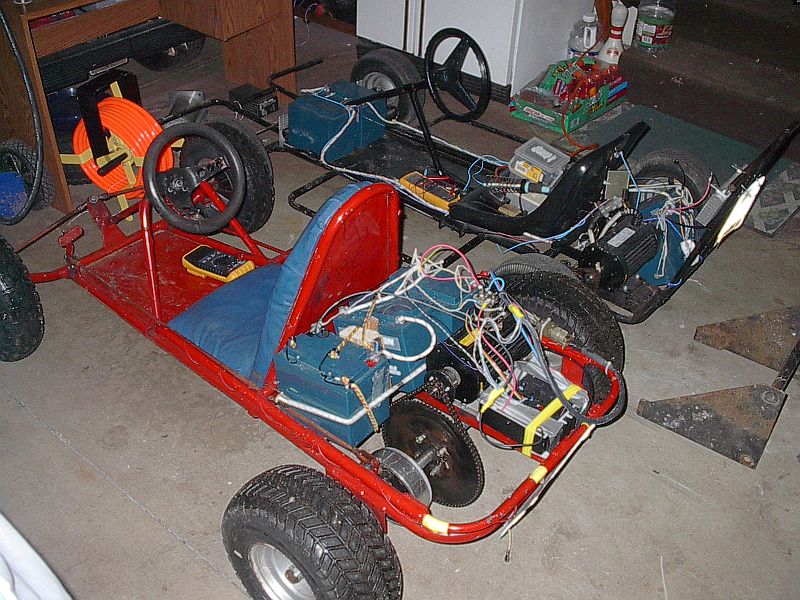
This is a response to a question posted on Ebay,
Dear Rod,

About the credentials........
We are a company called Extreme Power Solutions Inc.
Incorporated in
Arizona. We have over 30 years experiance in the RE
and electrical
fields. You can visit our website at
http://www.extremepowersolutions.com to learn more
about our company.
We decided to try Ebay to sell these batteries because
of the vast
uses for them and the simple fact that search engines
do not produce
the results we would like to see. If you would like to
talk over the
phone call toll free 1-888-866-3137.  The dimensions
on the batteries
are 7" Tall X 15 1/2" Long X 4 1.2" Wide.

Thanks,

Ron Cisco
Extreme Power Solutions inc
http://www.extremepowersolutions.com
1-888-866-3137
fax: 928-337-3003


On Tue, 30 Mar 2004 18:26:41 -0800,
[EMAIL PROTECTED] wrote :

> Dear extremepowersolutions,
>
> What are the dimensions?
> These might be usefull for
> my kids EV go carts,
> http://www.qsl.net/w8rnh/gocart/gocart4.jpg
> Thanks,
> Rod
> P.S. Your a new seller, I'm somewhat skeptical, do
> you have any credentials?
>
> To view the item, go to:
http://cgi.ebay.com/ws/ebayISAPI.dll?
ViewItem&item=2470853805
>
> Thank you,
> evdesigner
>
--------------------------------------------------------------------


--- David Brandt <[EMAIL PROTECTED]> wrote:
> What are the specs on the battery in question?
>
> > -----Original Message-----
> > From: Lawrence Rhodes [mailto:[EMAIL PROTECTED]
> > Sent: Wednesday, March 31, 2004 4:48 PM
> > To: Electric Vehicle Discussion List
> > Subject: Fw: 12v sealed lead acid
> >
> > We should be on this.  Lawrence Rhodes...........
> > ----- Original Message -----
> > From: <[EMAIL PROTECTED]>
> > To: "Lawrence Rhodes" <[EMAIL PROTECTED]>
> > Sent: Wednesday, March 31, 2004 2:20 PM
> > Subject: Re: 12v sealed lead acid
> >
> >
> > > Dear Lawrence,
> > >
> > > There are 60 batteries to a pallet. Uncharged
> and not tested the
> > > price will be $30 per battery for a total of
> $1800. If you want them
> > > charged and load tested the cost will be $35 per
> battery for a total
> > > of $2100. If you buy four or more pallets we
> will drop the price to
> > > $25 per battery. Each pallet weighs approx. 2850
> lbs. The cost for
> > > smaller quantities 20+ is $35 charged and
> tested.
> > >
> > > Thanks,
> > >
> > > Ron Cisco
> > > Extreme Power Solutions Inc
> > > http://www.extremepowersolutions.com
> > > 1-888-866-3137
> > > fax: 928-337-3003
> > >
> > > On Wed, 31 Mar 2004 01:27:26 -0800, "Lawrence
> Rhodes"
> > > <[EMAIL PROTECTED]> wrote :
> > >
> > > > I am using the Delphi of the same size except
> they are 8v.  I sure
> > > would
> > > > like 6 of these for my motorcycle.  I have a
> Curtis that would take
> > > 72v.  I
> > > > have a Ford Aspire that holds 30 of the
> 8volters.  If I had 20 plus
> > > 6 would
> > > > that be a whole  pallet?  I could reduce my
> weight by one third and
> > > keep the
> > > > same range.  I am willing to buy a pallet at
> your prices..Thanks..
> > > Lawrence
> > > > Rhodes....
> > > >
> > > >
> > > >
> > > >
>
--- End Message ---
--- Begin Message ---
Chris, maybe I'm missing something but why are you worried about individual
wires carrying like 12 V being dangerous? It would seem to me to keep things
simple you could just fuse a wire of the right size that ran between the
connector and the battery and no one wire or term on the connector would
have more than one batterys worth of voltage and current on it. If you used
just the right size of wire it would act like a fuse/current limiter from
the battery to the connector. BTW I carry 5/8" bulk clear PVC insultube and
probably have some aircraft connectors like you are looking for if you don't
mind used. Regards, David Chapman.
----- Original Message -----
From: "Christopher Zach" <[EMAIL PROTECTED]>
To: <[EMAIL PROTECTED]>
Sent: Wednesday, March 31, 2004 10:16 AM
Subject: Battery telemetry thought, take one.


> Ok, I have a thought here for a basic battery telemetry interface on my
> Prizm.
>
> My problem is twofold: First, I want to not have anything that comes out
> of the pack which can kill me by default. Given this is a 300 volt pack
> that means I need a default-off interlock on any wiring solution that
> exits the pack. Like the contactors that are in place now; no wires will
> be hot at a fatal voltage unless I command them to be hot.
>
> Second: I need to monitor 50 batteries. I should be able to charge them
> if needed with up to 5 amps of current, and monitor their voltages with
> whatever tool I might want.
>
> First thought: I run a wire from each battery to a common
> interconnector. Use two AMP screw-in type interconnectors to provide the
> interface. Each wire will be rated to carry a max of 2-4 amps, and can
> be fuse-protected at the battery. I limit the current by putting a
> 33kOhm resistor in series with the wire to keep the current down to a
> safe level in the event I am ever stupid enough to touch two wires at
once.
>
> In series with the resistor is a small SPST relay. These 50 relays will
> have their coils connected in parallel. When energized by a 5 or 12 volt
> signal, the resistor will be bypassed, allowing things like diodes,
> external regulators, and even low-power chargers to be connected to the
> batteries.
>
> Does this sound like a good idea? This way I can put the battery monitor
> brains outside of the 1,000+ pound pack where I don't have to worry
> about it failing or changing.
>
> Chris
>
--- End Message ---