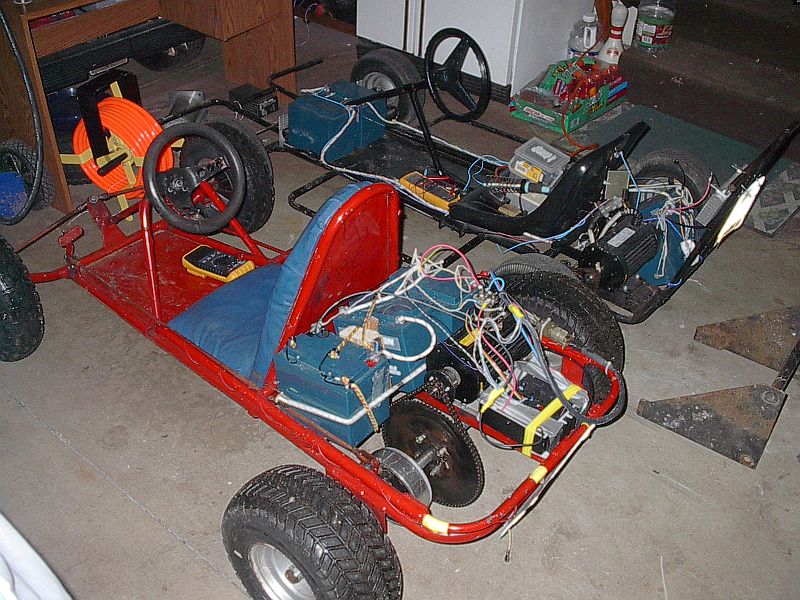
EV Digest 3435

Topics covered in this issue include:
  1) Re: Seeking Concorde AGM advice
        by Green VW <[EMAIL PROTECTED]>
  2) Relay questions:
        by Chris Zach <[EMAIL PROTECTED]>
  3) Re: Battery telemetry thought, take one.
        by Chris Zach <[EMAIL PROTECTED]>
  4) Motor isolation for safety
        by David Dymaxion <[EMAIL PROTECTED]>
  5) Re: New Car or Not (Was Tom Hanks = Big EV Fan)
        by Peter VanDerWal <[EMAIL PROTECTED]>
  6) RE: Power lines under roads
        by "Jamie Marshall \(GAMES\)" <[EMAIL PROTECTED]>
  7) Re: Possible donor car
        by "David McAlister" <[EMAIL PROTECTED]>
  8) Re: Brush timing for Hondas
        by "1sclunn" <[EMAIL PROTECTED]>
  9) Re: Battery telemetry thought, take one.
        by Lee Hart <[EMAIL PROTECTED]>
 10) Re: ACPropulsion combo on eBay
        by "1sclunn" <[EMAIL PROTECTED]>
 11) Re: Relay questions:
        by "Roland Wiench" <[EMAIL PROTECTED]>
 12) Re: Battery telemetry thought, take one.
        by Chris Zach <[EMAIL PROTECTED]>
 13) prices on 34XCD
        by Jeff Shanab <[EMAIL PROTECTED]>
 14) RE: EVLN(Ford to sell hybrid Escape SUV at a loss)
        by Roger Stockton <[EMAIL PROTECTED]>
 15) 1 charger 2 packs ?
        by Danny Ames <[EMAIL PROTECTED]>
 16) Re: Brush timing for Hondas
        by Jude Anthony <[EMAIL PROTECTED]>
 17) Re: Seeking Concorde AGM advice
        by Lee Hart <[EMAIL PROTECTED]>
 18) Re: Relay questions:
        by Lee Hart <[EMAIL PROTECTED]>
 19) Re: OTish: Re: EVLN(h2 Prius) - no ethanol, yes gridable
        by Lightning Ryan <[EMAIL PROTECTED]>
 20) Re: 1 charger 2 packs ?
        by "Joe Smalley" <[EMAIL PROTECTED]>
 21) Fw: S10 adaptor plate
        by "1sclunn" <[EMAIL PROTECTED]>
 22) change zivan from 220 to 110 input?
        by elaine chiu <[EMAIL PROTECTED]>
 23) Re: EVLN(Ford to sell hybrid Escape SUV at a loss)
        by [EMAIL PROTECTED]
 24) Bypass or replace?
        by [EMAIL PROTECTED]
 25) Re: 12v sealed lead acid
        by cristin <[EMAIL PROTECTED]>
 26) Re: step up transformer and zivans?
        by Mike Chancey <[EMAIL PROTECTED]>
 27) Re: EVLN, now Nimh & Nicd Self Discharge Rates
        by "Mark Hanson" <[EMAIL PROTECTED]>
 28) RE: Bypass or replace?
        by "ben" <[EMAIL PROTECTED]>
 29) RE: OTish: Re: EVLN(h2 Prius) - no ethanol, yes gridable
        by "ben" <[EMAIL PROTECTED]>
--- Begin Message ---
on 3/31/04 1:07 PM, Lee Hart at [EMAIL PROTECTED] wrote:

>
> The Concordes are not good high-current batteries. They will die soon if
> you pull 400-500 amps for more than a few seconds at a time. Even your
> 160-210 amp cruising current is rather high for them (assuming you have
> something similar to mine, 12v at 95amphours). To pull your currents
> with Concordes, you should have two parallel strings of 12v, or use the
> 6v.
>  I'll have to turn down my current limit as well.  I am using 210 amp hour
4D's

>
> 80% state of charge on a 120v pack would be more like 140 volts at 17-18
> amps.
>
Anybody know how to get 140v bulk charge out of a Russco?
>
>
>
> How are you determining 60% or 80% DOD? With an E-meter, or voltmeter?
>
> If it's an E-meter, remember that it needs to be set for the *actual*
> amphour capacity and Peukert exponent of your batteries; not just the
> published data (which they barely meet when new, and certainly don't
> now).
>
> If a voltmeter, it would help us to know the voltage that you read at
> various load currents. Hopefully, you are not pulling your 120v pack
> below 105v under load, and that when you remove the load, they always
> come right back above 120v no-load.

A voltmeter.  I don't pull it below 115 v and yes it springs back to 120+
>
>
Thanks to everyone for the advice
--- End Message ---
--- Begin Message ---
Two questions:
1) If a relay has contacts rated at 5 amps, do they have to be DC rated
to be used safely on a 12 volt circuit (can they clear a DC load)?
2) Can one double up a DPDT relay to get 10 amps out of the two contacts
if each is rated for 5 amps?
Thanks!
Chris
--- End Message ---
--- Begin Message ---
Well, it's not the individual wire that bothers me. It's what happens if
I touch wire from battery 1 and the other wire from battery 25. You now
have a voltage potential of 300 volts (well, 390 under full charge)
between the end two wires.
That could be a problem. Same thought exists with the fuses; they would
have to be able to clear a 300 volt short. *That* could be non-reachable
goal, in which case the wires would have to vaporize which would be a
problem if I want to use wire that can handle a 5 amp draw (if I decide
to plug regs or charge using these wires)
Chris
David Chapman wrote:
Chris, maybe I'm missing something but why are you worried about individual
wires carrying like 12 V being dangerous? It would seem to me to keep things
simple you could just fuse a wire of the right size that ran between the
connector and the battery and no one wire or term on the connector would
have more than one batterys worth of voltage and current on it. If you used
just the right size of wire it would act like a fuse/current limiter from
the battery to the connector. BTW I carry 5/8" bulk clear PVC insultube and
probably have some aircraft connectors like you are looking for if you don't
mind used. Regards, David Chapman.
--- End Message ---
--- Begin Message ---
The Porsche setup looks like it might do this for you. The engine and
tranny sit on a frame that hooks to the car via 4 rubber mounts.
Preliminary look is it looks like no metal-to-metal contact, but I'll
have to look more closely to be sure. You would just then need to
isolate the backup light (switch is in transmission)... and the
shifter... and the axles... Hmmm, maybe I should reconsider and do
eight 36 volt systems to be safe... That would be alot of redundancy
for reliability, too!

--- David Brandt <[EMAIL PROTECTED]> wrote:
> Another way might be to mount the motor above the transmission on
> insulated
> mounts, put pulleys on the motor and transmission, and use a belt
> drive.  I
> think Richard Bebbington mounted his motor on "mellow yellow" in a
> similar
> fashion due to the difficulty in mounting it in the usual position.
>  He
> didn't have to deal with insulating it, though.


=====


__________________________________
Do you Yahoo!?
Yahoo! Finance Tax Center - File online. File on time.
http://taxes.yahoo.com/filing.html
--- End Message ---
--- Begin Message ---
On Wed, 2004-03-31 at 09:09, Lee Hart wrote:
> Peter VanDerWal wrote:
> >> If you convert it to electric and then apply for a new title as
> >> a "new" electric vehicle, then by the IRS rules it is new and you
> >> can take the credit.
>
> > Can you point to an IRS source for this "rule"?
>
> I don't think the IRS has any say in the matter. The title is the
> primary document that identifies the make, model, and age of a car. When
> you apply for a new title, it becomes a new car in the eyes of the law.
> That includes the IRS. They *have* to go by the title.

The IRS ALWAYS as final say on tax matters.  The publications I've read
all say something slightly different about the "Qualified" electric
vehicle credit (the key word here is qualified).
Some say they vehicle has to be new ad some say it can not have been
previously put in use.  That second one is the kicker.  If the IRS
decided (for example) that 50% of the original vehicle is still intact
and that therefor it HAS previously been in use, yo won't win the
argument with them.  If they decide that NEW means ALL parts must be NEW
(using some internal definition of new), you won't win the argument with
them.

My point is, if IRS hasn't ruled on this, then it's all just supposition
by members of this list.  For example many people (even a few on this
list I believe) claimed the EV credit when they purchased a Prius or
Insight because they felt they qualified.  The IRS disagrees, and it's
THEIR opinion that counts.

As an example of Government bureaucracy, a certain fellow went to jail
because the ATF decided that a chunk of metal he was selling was a
firearm.  As sold the chunk of metal he was incapable of firing a round,
however the ATF took it back to their machine shop and spent a couple
hours working on it and managed to make it fire a single round (that
meets "their" definition of a firearm).
If I spent a couple hours in a machine shop I could make socket wrench
fire a bullet, but that doesn't cange the fact that this guy went to
jail for selling "firearms" without a license.

--
+++++++++++++++++++++++++++++++++++++++++++++++++++++++++++++++++++++
The problem with the world is stupidity. Not saying there should be a
capital punishment for stupidity, but why don't we just take the
safety labels off of everything and let the problem solve itself?
--- End Message ---
--- Begin Message ---
The best scheme is just to replace the bus catenary wires in a city with
a mesh, and all cars can have a tall pole with a wiper on the top that
picks up power from the mesh.  Ground through a simliar system on the
road.  I'm sure I've seen that before...

Oh, yeah.  Bumper cars.  I'd also want the big rubber bumper around the
car.

;-)  Maybe I should have waited until tommorow and posted this
straight-faced.

-Jamie

> -----Original Message-----
> From: [EMAIL PROTECTED] [mailto:[EMAIL PROTECTED]
On
> Behalf Of Ryan Bohm
> Sent: Tuesday, March 30, 2004 11:15 PM
> To: Electric Vehicle Discussion List
> Subject: Power lines under roads
>
> Hi!
>
> This is somewhat of a wacky question, but I've heard of farmers that
> have stole power by inducing a current in large coils under the power
> lines.  Could a similar concept be put in place by sticking a
> high-voltage, high current line under a road, and having the coils
> (somewhere) in an EV?  It would never happen, but the concept
intrigues
> me.
>
> -Ryan
> --
> For the best price on Zillas, visit http://www.evsource.com
--- End Message ---
--- Begin Message ---
I drove an Alfetta converted to EV last summer.  It is a different
mechanical layout.  If I remember correctly, the transmission and
differential are one unit.  The shifter is cable activated.  I considered
buying it but backed out.


----- Original Message -----
From: "T Humphrey" <[EMAIL PROTECTED]>
To: <[EMAIL PROTECTED]>
Sent: Thursday, March 25, 2004 11:41 AM
Subject: Possible donor car


> Is anyone here familiar with the Alfa Romeo, Alfetta GT. I found
> one in the weeds (literally, during the summer, you cannot see
> this car, so the interior may be shot). I really like the exterior
> styling of it, and may consider it a donor car for an EV project.
>
> I haven't taken a real close look at it yet, if anyone on the list
> has any first hand knowledge of these and can say go for it, or
> forget it, I would appreciate the advise.
>
> Thanks,
>
> Stay Charged!
> Hump
>
>
>
>
>
--- End Message ---
--- Begin Message ---
Hi Jude , I'm doing a Honda right now also , , Have you taken off the end of
the motor that holds the brush's , there are 4 bolts and its easy to do .
mark the bell housing and the motor so you know where they where , and just
( after taking out the 4 bolts ) turn the bell housing so you can see where
the bolt holes are.  If your lucky there will be 3 holes close together. If
your looking at the bell housing and you want the motor to turn to the left
then use the left hole , . I tried Rich's way of finding neutral by passing
30 amps ac through the field and measuring the output from the armature with
ac volt meter . neutral will be where the output is 0 and it seemed to work
, so you can test to see that the middle hole is really neutral if you like
( I plugged my welder into 120v and turned it down to get the 30 amps ac)
.If there are only 1 or 2 holes than I think drilling will be the next step
,
steve clunn
----- Original Message -----
From: "Jude Anthony" <[EMAIL PROTECTED]>
To: <[EMAIL PROTECTED]>
Sent: Tuesday, March 30, 2004 10:41 PM
Subject: Brush timing for Hondas


> I can honestly say I've checked all the FAQs, archives, and wikis.  I've
> got an Advanced DC 9" (FB1-4001A) that I'm about to move from an
> Oldsmobile to a Honda.  I know I have to reverse the timing advance of
> the brushes (because the Honda engine spins in the opposite direction).
> But *how*?  Do I need to drill my own holes?  Just rotate the brush bell
> housing?  Send it somewhere, and if so, where?
>
> Is there an easy way I could make this manually modifiable?  Like a
> manual choke?
>
> Enough questions.  Thanks in advance for the help.
> Judebert
> EVirgin
>
--- End Message ---
--- Begin Message ---
> The key is flexability. If I put as resistor in there, do I still
> use a normal voltmeter to read voltage? Or do I have to read it
> as "current" then convert on the fly?

I would use a meter set to read 'current' instead of 'voltage'. (It's
really the same meter; but it is reading the voltage across some
low-value resistor as a shunt).

Here's why. If you want to use a voltmeter, the series protection
resistor has to be a low value or it will cause errors in your voltage
readings. Yes, you could 'calibrate' the error out.

The other drawback of a voltmeter is that now the connector where all
your voltages come out has high voltage on it. More risk of shocks or
shorts.

If instead, your meter measures current, then you can use a high-value
series resistor for protection. For example, a 1 megohm resistor limits
curent to 12 microamps per 12v. Your meter could be a 0-20 microamp
meter (actually, a voltmeter set on the 0-0.2v scale reading the voltage
across a 1k ohm shunt resistor). Now there is no calibration error. And,
if the 1k shunt resistor is installed in the car-side of the connector,
there is no high voltage between the pins even with the meter
unconnected.
--
"Never doubt that a small group of committed people can change the
world. Indeed, it's the only thing that ever has!" -- Margaret Meade
--
Lee A. Hart  814 8th Ave N  Sartell MN 56377  leeahart_at_earthlink.net
--- End Message ---
--- Begin Message ---
----- Original Message -----
From: "Lee Hart" <[EMAIL PROTECTED]>
> Most large motors (AC or DC) have a fairly large capacitance between
> their windings and their case. With the fast rise/fall times applied by
> the inverter, this capacitance creates a considerable amount of ground
> current. If you have a non-isolated charger (like AC Propulsion), this
> ground current makes it impossible to keep a GFCI from tripping.
so the motor being isolated is not a real issue in it working just in
keeping the GFCI from tripping.
which could be taken care of with a isolation transformer. that said , a lov
joy coupler would give the isolation on the coupler, could have two plates
with a rubber mat in-between , plastic spacers on the bolts , ect.
Steve Clunn
--- End Message ---
--- Begin Message ---
Hello Chris,

Yes, you can used a AC rated relay on a DC circuit.  The amp rating of the
AC relay contacts should be about 5 times the rating of the DC current.

I am using a Square D glass plug in General Purpose Relay Class 8501, Type
KUD-12, Series C that has DPDT 10A @ 240 VAC with Coil 12 VDC on a 180 VDC
circuit controlling a 1 amp coils on my 600 amp safety contactors.

This relay has now been working in my EV for 30 years.


You also can parallel contacts together, if all the contacts are operated by
one coil or gang type units operated by one power unit.

We do this all the time with large magnetic starters or power contactors.
Normally a 3 phase contactor that has 3 poles are buss bar together for a
larger load.

I have tested Size 4 Contactors, which are 135 Amp at 240 VAC on 28 VDC at
100 Amps.  Connected to only one pole, I had to replace the contacts every 6
months.

Connecting all three poles together, is still running the 28 volt power
supply for 10 years.

Roland


----- Original Message -----
From: "Chris Zach" <[EMAIL PROTECTED]>
To: "Electric Vehicle Discussion List" <[EMAIL PROTECTED]>
Sent: Wednesday, March 31, 2004 5:28 PM
Subject: Relay questions:


> Two questions:
>
> 1) If a relay has contacts rated at 5 amps, do they have to be DC rated
> to be used safely on a 12 volt circuit (can they clear a DC load)?
>
> 2) Can one double up a DPDT relay to get 10 amps out of the two contacts
> if each is rated for 5 amps?
>
> Thanks!
> Chris
>
>
--- End Message ---
--- Begin Message ---
Hm. So if I went with a 1mohm (1 mho I think :-) resistor then I would
put the ammeter in *series* with this and simply read the current.
Clever, though I wonder if I can have the same type of flexibility if I
want to use something like an A/D converter to digitize the
current/voltage reading.
Things to think about. I did however realize that if I use DPST relays I
can cut the number of relays in half by simply sharing them between
battery pairs. Now to figure out a way to keep the wires from breaking
off the relays and mounting them in the *very* small space between
batteries and I am sort of set.
Chris
Lee Hart wrote:
The key is flexability. If I put as resistor in there, do I still
use a normal voltmeter to read voltage? Or do I have to read it
as "current" then convert on the fly?
I would use a meter set to read 'current' instead of 'voltage'. (It's
really the same meter; but it is reading the voltage across some
low-value resistor as a shunt).
Here's why. If you want to use a voltmeter, the series protection
resistor has to be a low value or it will cause errors in your voltage
readings. Yes, you could 'calibrate' the error out.
The other drawback of a voltmeter is that now the connector where all
your voltages come out has high voltage on it. More risk of shocks or
shorts.
If instead, your meter measures current, then you can use a high-value
series resistor for protection. For example, a 1 megohm resistor limits
curent to 12 microamps per 12v. Your meter could be a 0-20 microamp
meter (actually, a voltmeter set on the 0-0.2v scale reading the voltage
across a 1k ohm shunt resistor). Now there is no calibration error. And,
if the 1k shunt resistor is installed in the car-side of the connector,
there is no high voltage between the pins even with the meter
unconnected.
--- End Message ---
--- Begin Message ---
Someone on the list mentioned a group buy on exides a little while ago.
I was interesting in finding out what kind of prices the group might be
able to get on the exide batteries. I stopped by the exide warehouse
today after work and found out my local situation and borrowed a demo
unit so I can make measurements.
From what I overheard $62 is distributer cost and $69 is the cost to
the local dealers who are "customers"
The prearranged price for me to buy them through the local dealers is
then $90 each.
other Questions
Are the side posts removable?
If we do a group buy, will I have to pay shipping or drive to a
common pickup point?
When do you think the purchase will be?
--- End Message ---
--- Begin Message ---
On Wednesday, March 31, 2004 3:15 PM, Victor Tikhonov
[SMTP:[EMAIL PROTECTED] wrote:

> Roger Stockton wrote:
>
> > No, you can't do a 156V/100mi range pack and have spirited
> > performance from a single string, but them's the breaks.
>
> Well, define "spirited" now :-)
>
> If you pick 500Ah cells you sure get good performance with
> 156V system: they're rated at 150A continuous (so cruising)
> discharge and 1000A peak. 4 cells about represent one 12V
> battery (voltage wise) and will weigh 60 kg.
> 43 cells are 645 kg (1419 lb).
>
> This isn't t-zero but it will be 78 kWh pack! 260 miles
> at 300 Wh/mile. Practical honest limit - perhaps half of it.

OK, you got me Victor! ;^>

I am somewhat skeptical of what the actual peak power of a 156V
string of the 500Ah cells would be at 1000A load due to voltage
sag... perhaps 50-70kW?  In a vehicle with a 1400lb pack I'm not sure
how spirited this would be, but your point is taken.

> Ultracaps will have minimal effect with low resistance
> PbA batteries *if connected directly parallel to them*.
> (It will have drastic improving effect with high internal
> resistance battery like TS LiIons). BUT,
> It will have positive effect with any battery if capacitor
> bank is connected to the pack through DC-DC converter.

Can you explain why you think the addition of a DC/DC would cause the
capacitors to be beneficial even with low resistance batteries?

I appreciate that the addition of a DC/DC allows more usable energy
to be stored/retrieved from the capacitor bank, and allows the use of
a capacitor bank with fewer capacitors in series, however, the DC/DC
itself represents an additional resistance and source of inefficiency
in the capacitor bank system.

Cheers,

Roger.
--- End Message ---
--- Begin Message ---
My original plan is one big charger feeding 2 strings in parallel
(144 VDC each) but the problem I see is one string may have a lower
resistance and hog all the amps and burn up early in life.

So is there any simple or known way to do this with a single charger ?

Perhaps it is better to have separate chargers feeding each string
separately.

I like the idea of a one single charger ideally but I don't know if one
can use it this way.

Danny Ames
--- End Message ---
--- Begin Message ---
Bob Bath wrote:
Hey Jude,
CivicWithACord here. What year and model is your
rig? I have a ton of notes on my Civic. if it is 5th
gen. (92-95) I have a video and notes that could help
IMMENSELY.
'88 Civic Wagon. Currently a 4WD model; we'll be removing most of that
gear, although we may be keeping the tranny after all. I've heard
people talk about Honda "generation" before; does this make me a 3rd or
4th gen?
I may even take you up on the video and notes. We're busy trying to
figure out battery placement. We'd like to stuff them under the rear
seat. But that's a topic for a different thread.
Thanks for the brush info; we'll definitely be using it.
If you want a half-a---d diagram, get one from ADC,
or Ken Koch, but IMHO, it was only partially helpful
to a novice.
I'd like to, but I can't find their web page. The motor is used, so I
don't have a vendor to contact.
--- Joe Smalley <[EMAIL PROTECTED]> wrote:
Rich Rudman has a mechanism to do that. There are
photos at
http://www.manzanitamicro.com/advanced.jpg
http://www.manzanitamicro.com/retard.jpg
Thanks. Looks like this replaces the entire bell housing. Rich, was
this hideously expensive?
Judebert
EVirgin
--- End Message ---
--- Begin Message ---
Lee Hart wrote:
>> [my Concordes are 12v at 95amphours). To pull your currents
>> with Concordes, you should have two parallel strings of 12v,
>> or use the 6v.

Green VW wrote:
> I'll have to turn down my current limit as well. I am using 210 amp
> hour 4D's

Good; that's equivalent to two strings of my 12v 95ah Concordes. So,
your 160-200 amp cruising currents will be fine. With a Curtis 1231C
controller, your peak current will also probably be fine.

>> 80% state of charge on a 120v pack would be more like 140 volts
>> at 17-18 amps.

> Anybody know how to get 140v bulk charge out of a Russco?

The ads for it say it goes up to 144vdc; still low, but better. You can
probably use a boost transformer ahead of it to get a little more. Russ
Kaufmann would know; are you monitoring the EV list, Russ?

>> How are you determining 60% or 80% DOD?

> A voltmeter. I don't pull it below 115 v and yes it springs back to
> 120+.

Ok, that's good. It sounds like you haven't done the batteries any harm.
They are probably just lazy from lack of exercise, perhaps cold, and
have been getting undercharged. They will come back to life once you can
fully charge, and exercise them.
--
"Never doubt that a small group of committed people can change the
world. Indeed, it's the only thing that ever has!" -- Margaret Meade
--
Lee A. Hart  814 8th Ave N  Sartell MN 56377  leeahart_at_earthlink.net
--- End Message ---
--- Begin Message ---
Chris Zach wrote:
> 1) If a relay has contacts rated at 5 amps, do they have to be
>    DC rated to be used safely on a 12 volt circuit (can they
>    clear a DC load)?

Relays and switches have separate ratings for AC and DC. Unless
specially designed and marked for DC, assume that the DC voltage ratings
are about 1/4th of the DC voltage ratings. I.e. a 120vac contact is also
good for 30vdc.

You can add the voltage ratings of contacts in series on the SAME switch
or relay. I.e. a double-pole switch with each contact rated 120vac/30vdc
can switch 240vac/60vdc with the contacts in series.

> 2) Can one double up a DPDT relay to get 10 amps out of the two
>    contacts if each is rated for 5 amps?

No. Two contacts in parallel do NOT handle double the current. That's
because contact resistance is highly variable, so the current won't
divide equally between them. It's not unusual to get 90% of the current
flowing thru one and 10% thru the other; and the next time it closes
they will reverse!
--
"Never doubt that a small group of committed people can change the
world. Indeed, it's the only thing that ever has!" -- Margaret Meade
--
Lee A. Hart  814 8th Ave N  Sartell MN 56377  leeahart_at_earthlink.net
--- End Message ---
--- Begin Message ---
no no no,
Why does everyone always seem to quote the wrong part of my posts?
I knew I should have left that part out, but I like to tell the
whole story, just covering all of the bases....
The point was that:
H2 Conversions is Just Plain BAD Idea....
Ethanol Conversion, better than H2, but not as good as ...
Gridable Conversion, which is the obvious winner!
Anyway, to be perfectly clear, I'm not interested in an Ethanol
burning Prius, or a LPG, CNG, or H2 burning Prius.  But I AM
interested in being able to charge the Prius with electricity!
L8r
 Ryan
PS. It's not to far off, extra battery capacity is already
successfull, and there are "plans" for non-invasive charging.
--- End Message ---
--- Begin Message ---
Yes, you can use a single charger for doing this. The two strings need have
similar end voltages so both of them top off properly.

If they are the same type and age, then they should play well together.

Joe Smalley
Rural Kitsap County WA
Fiesta 48 volts
NEDRA 48 volt street conversion record holder
[EMAIL PROTECTED]


----- Original Message -----
From: "Danny Ames" <[EMAIL PROTECTED]>
To: "EV SEND MSG" <[EMAIL PROTECTED]>
Sent: Wednesday, March 31, 2004 4:36 PM
Subject: 1 charger 2 packs ?


>
> My original plan is one big charger feeding 2 strings in parallel
> (144 VDC each) but the problem I see is one string may have a lower
> resistance and hog all the amps and burn up early in life.
>
> So is there any simple or known way to do this with a single charger ?
>
> Perhaps it is better to have separate chargers feeding each string
> separately.
>
> I like the idea of a one single charger ideally but I don't know if one
> can use it this way.
>
> Danny Ames
>
--- End Message ---
--- Begin Message ---
" that's not for me "
"that's not going in one of my cars"
" I'm going to get paid for that later but I have to pay for it now"
I don't  know about " I got the money for that from selling windmill hood
ornaments"

Rod don't you Need to buy some EV parts for those go carts your making for
the kids :-)  .

Do you have a hub with that plate ?

Speaking of windmill H.O's , I took a picture of one running on the hood,
which can be seen in the evalbum's 10 latest "steve's Mazda" , . the camera
stopped the action and it looks like everything is standing still except you
can see 2 blurs or streaks of yellow light (and one red in-between) , The
penne's which are the propellers and the leds , all seem to be  standing
still ( they where spinning when the picture was shoot)  .  when seen live
there appears to be 8 streaks of yellow and 8 of red , the camera stops the
action of the propeller but for some reason picks up the light form when the
led was on almost 1/4 of a turn back.
Steve Clunn


From: "Rod Hower" <[EMAIL PROTECTED]>
To: <Sent: Tuesday, March 30, 2004 10:03 PM
Subject: S10 adaptor plate


> After reading Jim Coate's response I realized
> I have a S10 adapter plate in the basement.
> If anybody is interested I'll sell.
> I need to finance more EV projects, and the wife
> is not real happy about this money coming from the
> main account!!  (I think Steve Clunn is familiar
> with this!, maybe I need to sell some windmills :-)
> Rod
>
--- End Message ---
--- Begin Message ---
is it possible to change the zivan input myself, or does the dealer
have to do this, too?
ideally, I'd like to be able to switch it back and forth. Is that too
difficult?
elaine
(still plotting for charging at work on my next EV.)
--- End Message ---
--- Begin Message ---
>> If you pick 500Ah cells you sure get good performance with
>> 156V system: they're rated at 150A continuous (so cruising)
>> discharge and 1000A peak. 4 cells about represent one 12V
>> battery (voltage wise) and will weigh 60 kg.
>> 43 cells are 645 kg (1419 lb).
>>
>> This isn't t-zero but it will be 78 kWh pack! 260 miles
>> at 300 Wh/mile. Practical honest limit - perhaps half of it.

>OK, you got me Victor! ;^>

>I am somewhat skeptical of what the actual peak power of a 156V
>string of the 500Ah cells would be at 1000A load due to voltage
>sag... perhaps 50-70kW? In a vehicle with a 1400lb pack I'm not sure
>how spirited this would be, but your point is taken.>>>

Unless I misinterpret the data -
http://www.edan.com.tw/Product-2002515153759.html - Edan's 100Ah cells have a
peak current of 500A for a maximum of 12 seconds, with a 2mOhm internal
resistance; the 20Ah cells have the same IR, but only 200A peak. Thus, 2 of the
100Ah cells (6.2kg) or 5 of the 20Ah cells (3.625kg) parallel for 1000A peak
currents.

Wouldn't even hazard a guess at the cost of soldering and controlling 6800 of
the tzero's 18650 cells, but a near-equivalent, 100 of Edan's 100Ah cells, cost
$17,500 before shipping - any idea what voltage drop ACP has to deal with?
--- End Message ---
--- Begin Message ---
I know this has been discussed before for larger EVs, but I have a question
about bypassing the controller on a 2-wheeled EV. I just got my wife a
Vespa-like scooter for around town, and while the 48V pack will get it to 30
mph (the max for mopeds anyway), it is slow-Slow-SLOW getting there. I can see
the controller under the plastic-work, but I can't guess at its peak rating. I
could install a beefier controller in there, but I have too many thumbs to
trust it will work right and wondered if it might be OK if I just wire in a
bypass contactor - would I have to have the throttle fully on when the byass is
released, or could I just use it to get past the sluggish first 15mph of the
hubmotor's torque curve and not worry about the controller or the motor itself?
--- End Message ---
--- Begin Message ---
whatever you do, do NOT have the volume turned up on your computer when
visiting their website.
On Mar 31, 2004, at 4:05 PM, Rod Hower wrote:
This is a response to a question posted on Ebay,
Dear Rod,
About the credentials........
We are a company called Extreme Power Solutions Inc.
Incorporated in
Arizona. We have over 30 years experiance in the RE
and electrical
fields. You can visit our website at
http://www.extremepowersolutions.com to learn more
about our company.
We decided to try Ebay to sell these batteries because
of the vast
uses for them and the simple fact that search engines
do not produce
the results we would like to see. If you would like to
talk over the
phone call toll free 1-888-866-3137.  The dimensions
on the batteries
are 7" Tall X 15 1/2" Long X 4 1.2" Wide.
Thanks,
Ron Cisco
Extreme Power Solutions inc
http://www.extremepowersolutions.com
1-888-866-3137
fax: 928-337-3003
On Tue, 30 Mar 2004 18:26:41 -0800,
[EMAIL PROTECTED] wrote :
Dear extremepowersolutions,
What are the dimensions?
These might be usefull for
my kids EV go carts,
http://www.qsl.net/w8rnh/gocart/gocart4.jpg
Thanks,
Rod
P.S. Your a new seller, I'm somewhat skeptical, do
you have any credentials?
To view the item, go to:
http://cgi.ebay.com/ws/ebayISAPI.dll?
ViewItem&item=2470853805
Thank you,
evdesigner
--------------------------------------------------------------------
--- David Brandt <[EMAIL PROTECTED]> wrote:
What are the specs on the battery in question?
-----Original Message-----
From: Lawrence Rhodes [mailto:[EMAIL PROTECTED]
Sent: Wednesday, March 31, 2004 4:48 PM
To: Electric Vehicle Discussion List
Subject: Fw: 12v sealed lead acid
We should be on this.  Lawrence Rhodes...........
----- Original Message -----
From: <[EMAIL PROTECTED]>
To: "Lawrence Rhodes" <[EMAIL PROTECTED]>
Sent: Wednesday, March 31, 2004 2:20 PM
Subject: Re: 12v sealed lead acid
Dear Lawrence,
There are 60 batteries to a pallet. Uncharged
and not tested the
price will be $30 per battery for a total of
$1800. If you want them
charged and load tested the cost will be $35 per
battery for a total
of $2100. If you buy four or more pallets we
will drop the price to
$25 per battery. Each pallet weighs approx. 2850
lbs. The cost for
smaller quantities 20+ is $35 charged and
tested.
Thanks,
Ron Cisco
Extreme Power Solutions Inc
http://www.extremepowersolutions.com
1-888-866-3137
fax: 928-337-3003
On Wed, 31 Mar 2004 01:27:26 -0800, "Lawrence
Rhodes"
<[EMAIL PROTECTED]> wrote :
I am using the Delphi of the same size except
they are 8v. I sure
would
like 6 of these for my motorcycle. I have a
Curtis that would take
72v. I
have a Ford Aspire that holds 30 of the
8volters. If I had 20 plus
6 would
that be a whole pallet? I could reduce my
weight by one third and
keep the
same range. I am willing to buy a pallet at
your prices..Thanks..
Lawrence
Rhodes....
--- End Message ---
--- Begin Message ---
Hi Elaine and all,
According to the EV Album, your Citicar has a Zivan NG1. The Zivan website
says that maxes out about 1840 watts input. I would think a 2000 watt 120
to 220 step up transformer should be sufficient to allow you to charge from
a standard 120 volt outlet, though you will be running right at the limits
of the outlet when the batteries are way down.
It might be easier to add a used 48 volt golf cart charger for 120 volt
charging. Two chargers means increased weight, but it does allow
redundancy in case of a charger failure.
Thanks,
Mike Chancey,
'88 Civic EV
'95 Solectria Force (almost there)
Kansas City, Missouri
EV List Photo Album at: http://evalbum.com
My Electric Car at: http://www.geocities.com/electric_honda
Mid-America EAA chapter at: http://maeaa.org
Join the EV List at: http://www.madkatz.com/ev/evlist.html
At 12:25 AM 3/31/2004, you wrote:
Is there any problem with using a step up transformer with a zivan to
enable charging at work?
elaine
--- End Message ---
--- Begin Message ---
Hi Guys,
Does anyone know what the self discharge rate is for the three chemistries
is, Lead, Nimh and Nicd? I know from my Trojan charger days that a 220ah
lead acid battery is 30ma and I heard the others are worse but by how much?
                                                        Thanks, Mark
----- Original Message -----
From: "Shawn Rutledge" <[EMAIL PROTECTED]>
To: <[EMAIL PROTECTED]>
Sent: Wednesday, March 31, 2004 2:25 PM
Subject: RE: EVLN(Ford to sell hybrid Escape SUV at a loss)


>
> --- Roger Stockton <[EMAIL PROTECTED]> wrote:
> > At EVS-20 ultracap (and most advanced battery manufacturers) stated
> > they had no intention of developing batteries suitable for normal EV
> > use (i.e. high capacity).  Their sole focus is on high(ish) power,
> > low capacity batteries/capacitors that will be subject to lots of
> > very shallow cycles, not highish capacity batteries suitable for
> > deeper cycles.
>
> Ultracaps are that way, sure; but can they actually accomplish that
> with NiMH or LiIon?  The main complaint against the existing ones has
> been their low current capabilities.  And AFAIK NiMH batteries _like_
> deep discharges, just like NiCads, and maximum range is maintained by
> discharging them fully each time.  How could they change this basic
> feature of that chemistry?
>
> Somebody a few days ago mentioned the idea of using high-capacity
> low-current batteries together with AGMs.  I think that's a great idea;
> and maybe it would be even better to have 3 stages - LiIon or NiMH for
> long-term storage, small AGMs for the longer bursts of power necessary
> to climb hills, and ultracaps just to absorb regen power and for quick
> acceleration.  The design rules for the controller would be: above a
> certain speed, the ultracaps are not charged, so that their capacity is
> available to absorb regen power as efficiently as possible (in
> comparison to the less efficient process of charging an AGM with this
> power).  When you slow down, regen power goes first into the caps; then
> when they are fully charged any excess goes into the AGMs.  When you
> are stopped, the ultracaps are charged to full capacity from the LiIon
> pack (slowly) so you have as much power available as you can get for a
> quick launch.  When you accelerate, the ultracaps are used up first and
> AGMs provide the longer-term power needs.  Regardless what you are
> doing, the controller should always try to keep the AGMs charged from
> the LiIon pack (or maybe just to 95%, so that some capacity is reserved
> for excess regen power beyond what the caps cannot absorb), charging at
> a maximum rate that is completely safe for the main pack and which
> optimizes its life.  There could be a neat bargraph display on the dash
> showing all 3 power levels.  The AGMs should last longer in this kind
> of use than they do alone in an EV, because their depth of discharge
> could be kept above 50% (or higher) all the time.  But their
> high-current capability could help to ensure the main pack never sees
> excessive currents.  (But if you climb a hill for more than a few
> minutes you might eventually be forced to slow down when the AGMs are
> discharged too far.)
>
> =====
> . _______  Shawn T. Rutledge / KB7PWD [EMAIL PROTECTED]
>  (_  | |_)    http://ecloud.org/  [EMAIL PROTECTED]
>  __) | | \______________________________________________
>
> __________________________________
> Do you Yahoo!?
> Yahoo! Finance Tax Center - File online. File on time.
> http://taxes.yahoo.com/filing.html
>
--- End Message ---
--- Begin Message ---
What about the maximum current rating of the motor?? Torque is
proportional to the current you put through the motor and to get the
torque you are after. I think you might run into trouble burning out the
motor.

It won't be just as simple and bypassing the controller.

        Ben

====================================================
From: Ben Haines                    BE ( Electrical Engineering) UNSW

Phone: 0419 919 383
Phone: (02) 93412611
email: [EMAIL PROTECTED]
email: [EMAIL PROTECTED]


-----Original Message-----
From: [EMAIL PROTECTED] [mailto:[EMAIL PROTECTED] On
Behalf Of [EMAIL PROTECTED]
Sent: Thursday, 1 April 2004 5:33 PM
To: EV Discussion List; EV Discussion List
Subject: Bypass or replace?


I know this has been discussed before for larger EVs, but I have a
question about bypassing the controller on a 2-wheeled EV. I just got my
wife a Vespa-like scooter for around town, and while the 48V pack will
get it to 30 mph (the max for mopeds anyway), it is slow-Slow-SLOW
getting there. I can see the controller under the plastic-work, but I
can't guess at its peak rating. I could install a beefier controller in
there, but I have too many thumbs to trust it will work right and
wondered if it might be OK if I just wire in a bypass contactor - would
I have to have the throttle fully on when the byass is released, or
could I just use it to get past the sluggish first 15mph of the
hubmotor's torque curve and not worry about the controller or the motor
itself?
--- End Message ---
--- Begin Message ---
The problem is where is all this electricity going to come from ?? Coal
fired power plants:)

        Ben

====================================================
From: Ben Haines                    BE ( Electrical Engineering) UNSW

Phone: 0419 919 383
Phone: (02) 93412611
email: [EMAIL PROTECTED]
email: [EMAIL PROTECTED]


-----Original Message-----
From: [EMAIL PROTECTED] [mailto:[EMAIL PROTECTED] On
Behalf Of Lightning Ryan
Sent: Thursday, 1 April 2004 2:08 PM
To: [EMAIL PROTECTED]
Subject: Re: OTish: Re: EVLN(h2 Prius) - no ethanol, yes gridable


no no no,
Why does everyone always seem to quote the wrong part of my posts? I
knew I should have left that part out, but I like to tell the whole
story, just covering all of the bases....

The point was that:
H2 Conversions is Just Plain BAD Idea....
Ethanol Conversion, better than H2, but not as good as ... Gridable
Conversion, which is the obvious winner!

Anyway, to be perfectly clear, I'm not interested in an Ethanol burning
Prius, or a LPG, CNG, or H2 burning Prius.  But I AM interested in being
able to charge the Prius with electricity!

L8r
  Ryan

PS. It's not to far off, extra battery capacity is already successfull,
and there are "plans" for non-invasive charging.
--- End Message ---