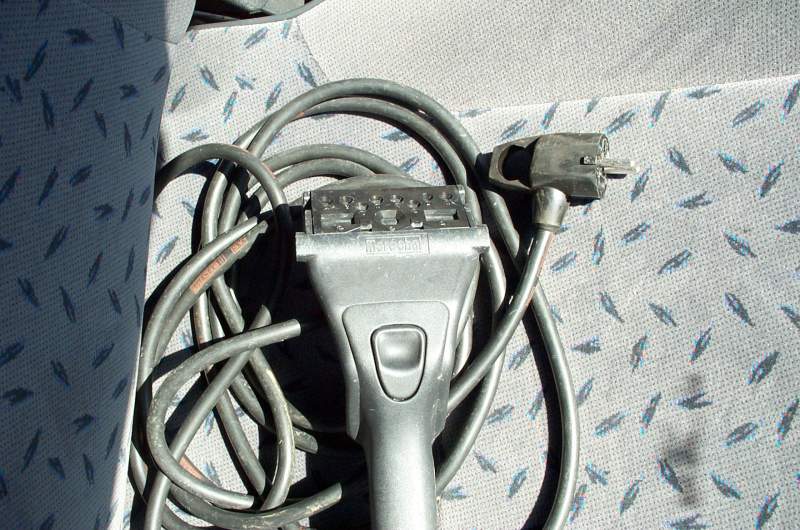
EV Digest 4321

Topics covered in this issue include:
  1) Avcon connector
        by Evan Tuer <[EMAIL PROTECTED]>
  2) Re: Avcon connector
        by Ralph Merwin <[EMAIL PROTECTED]>
  3) Re: Mechanical PWM Controllers
        by "Mark Thomasson" <[EMAIL PROTECTED]>
  4) Re: Avcon connector
        by Evan Tuer <[EMAIL PROTECTED]>
  5) Re: Is this possible?
        by Ken Trough <[EMAIL PROTECTED]>
  6) Re: Is this possible?
        by Matt Holthausen <[EMAIL PROTECTED]>
  7) Re: Fluke 77 Heaven
        by "Peter VanDerWal" <[EMAIL PROTECTED]>
  8) batteries and range
        by John Martin <[EMAIL PROTECTED]>
  9) Re: Is this possible?
        by Victor Tikhonov <[EMAIL PROTECTED]>
 10) Electric Meter Reader ( For ( Linux ) Geeks )
        by Lightning Ryan <[EMAIL PROTECTED]>
 11) Re: Avcon connector
        by "Philippe Borges" <[EMAIL PROTECTED]>
 12) Re: Is this possible and more.
        by Jeff Shanab <[EMAIL PROTECTED]>
 13) Apples to Oranges?
        by [EMAIL PROTECTED]
 14) Re: An AC style bypass
        by Jeff Shanab <[EMAIL PROTECTED]>
 15) Re: An AC style "bypass"?
        by "Jonathan \"Sheer\" Pullen" <[EMAIL PROTECTED]>
 16) RE: Is this possible?
        by "Stu or Jan" <[EMAIL PROTECTED]>
 17) Re: probably need new shocks/springs (struts) on the
  VoltsRabbit, also drilling polypro
        by "[EMAIL PROTECTED]" <[EMAIL PROTECTED]>
 18) Re: probably need new shocks/springs (struts) on the VoltsRabbit, also
drilling polypro
        by John Martin <[EMAIL PROTECTED]>
 19) Re: A few battery charger ideas
        by "Paul G." <[EMAIL PROTECTED]>
 20) Re: Apples to Oranges?
        by Lee Hart <[EMAIL PROTECTED]>
 21) Re: Forbes Magazine: GM Hydrogen article.
        by "David (Battery Boy) Hawkins" <[EMAIL PROTECTED]>
 22) RE: Tennant Etek was Motor/Controller combination
        by "Myles Twete" <[EMAIL PROTECTED]>
 23) Re: An AC style bypass
        by "Joe Smalley" <[EMAIL PROTECTED]>
 24) ATTN Australian EV'ers - EV on eBay Australia
        by "Dean Thompson" <[EMAIL PROTECTED]>
 25) Re: IRS Replacement
        by "Joe Smalley" <[EMAIL PROTECTED]>
 26) Re: Avcon connector
        by Evan Tuer <[EMAIL PROTECTED]>
 27) =?iso-8859-1?Q?Re:_Avcon_connector?=
        by "[EMAIL PROTECTED]" <[EMAIL PROTECTED]>
 28) Looking for help w/ a replacement contactor
        by Duncan Orthner <[EMAIL PROTECTED]>
 29) Re: Avcon connector
        by Evan Tuer <[EMAIL PROTECTED]>
 30) Re: probably need new shocks/springs (struts) on the VoltsRabbit, also
drilling polypro
        by "Bob Rice" <[EMAIL PROTECTED]>
 31) Re: Looking for help w/ a replacement contactor
        by "Roland Wiench" <[EMAIL PROTECTED]>
--- Begin Message ---
Hello all,
  Does anyone have a description of the wiring / pinout of the
*European* Avcon connector?
I can't find anything on the web.

Thanks
Evan
--- End Message ---
--- Begin Message ---
Evan,

>From www.partsonsale.com:

Inlet: http://www.partsonsale.com/avconschematcs1.html
Connector: http://www.partsonsale.com/avconschematics2.html

Ralph


Evan Tuer writes:
>
> Hello all,
>   Does anyone have a description of the wiring / pinout of the
> *European* Avcon connector?
> I can't find anything on the web.
>
> Thanks
> Evan
>
--- End Message ---
--- Begin Message ---
From: "Jeff Shanab" <[EMAIL PROTECTED]>
I need cheap :-(
  Lee, others. Could you fill in the chart for 1000A, 300V pack,  9" motor
 type :  mechanical, contactor&resistor
cost :
pro:   inexpensive, simple                               con:   not
smooth, noisey, ineffcient when in between steps, hard to make over 400
amps
Jeff,  Here's a cheap one that comes close to meeting your requirements.
252V and 1000A (if you don't stay there for long!), 7 voltage steps.  Uses 6
Czonka III contactors from EV Parts  for $97.50 each. I use a 48V variation
of this on my EM  http://www.austinev.org/evalbum/518.html.  Also a 36V
minibike version : http://www.austinev.org/evalbum/439.html.  Almost 1200
miles so far on the 48 volt system.  Batteries are loaded unequally, but
normal variation of around-town driving tends to keep them pretty close.
Modular charging corrects any imbalance.  Mark T.
view with fixed width font.
____
/ \
/ \ \
_____| Motor |____ \__
| \ / |
| \____/ Safety |
| Disconnect |
| --- Main
| --- Contactor
| | | |
|--||----||||------------|
| | | | |
| R1 | 36v |
| | ---
| |---------||---| --- R3
| | |
| R4 | |
| | | | |
|--||-----||||-----------|
| | | | |
| R2 | 72v |
| | ---
| |---------||---| --- R5
| | |
| R6 | |
| | | | |
|---------||||-----------|
| |
144v
Switch logic                      Batteries
                                  In use
Speed    R1 R2 R3 R4 R5 R6 Volts  36v 72v 144v
0                            0
1         x                 36     x
2            x  x           72         x
3            x    x        108     x   x
4               x    x     144             x
5                 x  x     180     x       x
6               x       x  216         x   x
7                 x     x  252     x   x   x
--- End Message ---
--- Begin Message ---
Thank you Ralph!

I'm slightly concerned about the connector that came with my van.  It
has the Avcon plug on one end of a cable, and the other end is a
standard outdoor 16A 230VAC connector (standard for Europe anyway).
The problem is, if you plug this connector into the mains, the Avcon
plug is live immediately.  No waiting to see what happened with the
pilot signal, because there's no control box.  The live and neutral
contacts are recessed about 4mm, so you can't "quite" reach it with
the tip of your finger, but with the slightest bit of moisture on the
plug you would certainly find out that it's live!

I'm pretty certain that this has been standard practice where these
vehicles are used in the UK, and I'm not sure that it is very clever.

Perhaps I'm missing something.  Is the plug meant to have a flip-open
cover or something, and mine is broken?  Am I being a safety freak?

Regards
Evan


On 4/28/05, Ralph Merwin <[EMAIL PROTECTED]> wrote:
>
> Evan,
>
> >From www.partsonsale.com:
>
> Inlet: http://www.partsonsale.com/avconschematcs1.html
> Connector: http://www.partsonsale.com/avconschematics2.html
>
> Ralph
>
>
> Evan Tuer writes:
> >
> > Hello all,
> >   Does anyone have a description of the wiring / pinout of the
> > *European* Avcon connector?
> > I can't find anything on the web.
> >
> > Thanks
> > Evan
> >
>
>


--

EVan
http://www.tuer.co.uk/evs2
--- End Message ---
--- Begin Message ---
In a conventional auto your alternator is charging as your electrical
system is discharging.
Not quite. Your alternator is both charging the battery and providing
the voltage for all your other power needs. The battery is not charging
and discharging at the same time.
-Ken Trough
Admin - V is for Voltage Magazine
http://visforvoltage.com
AIM/YM - ktrough
FAX/voice message - 206-339-VOLT (8658)
--- End Message ---
--- Begin Message ---
Forgive me if I'm wrong, but the battery doesn't necessarily have to be
both charging and discharging for it to share the power load with the
charger/generator. If the electrical system/controller is drawing more
current from the supply than the generator can provide, then it is my
understanding that both sources will act like two strings of batteries
tied in parallel might. If there is surplus current from the charging
system, then it will feed both the pack and the controller. There need
not be any worry about the impossibility of both raising and lowering
the battery SOC simultaneously at all.
The water analogy seems good in terms of functionality, but if one were
to be really nitpicky it might not be entirely accurate. A better
mental image would be a 'T' fitting between the water tank and a supply
valve (controller). If the valve is closed (no current used by
motor/controller), any pressure fed in through the T (i.e. from
generator/charger) will flow into the water tank. If, on the other
hand, the valve/controller is wide open and using all the power
available to it, water will flow from both legs of the T fitting
towards the valve.
<img
src="http://img.photobucket.com/albums/v737/strongreaction/
lamediag.gif" alt="Image hosted by Photobucket.com">
Maybe this will help visualize.
It seems like it would be a better idea to use a charger with a
generator rather than just rectified AC because if the generator is
capable of raising the SOC too high it might severly overcharge the
pack, and it would require constant monitoring or a homebrew regulator.
With a PFC you'll be able to let it Just Work, and you won't have to
worry about overcharge during periods of low motor/controller load.
This is the best understanding I have. I hope it helps.
Matt Holthausen
On Apr 28, 2005, at 4:29 PM, Ken Trough wrote:
In a conventional auto your alternator is charging as your
electrical system is discharging.
Not quite. Your alternator is both charging the battery and providing
the voltage for all your other power needs. The battery is not
charging and discharging at the same time.
-Ken Trough
Admin - V is for Voltage Magazine
http://visforvoltage.com
AIM/YM - ktrough
FAX/voice message - 206-339-VOLT (8658)
--- End Message ---
--- Begin Message ---
> I just came into possession of a used (and free!) Fluke 77 Series II
> multimeter.  Is this a good piece of equipment?  Can it be calibrated?
>

Flukes are EXCELLENT meters, I don't think they even build a bad one.  As
long as it works, I doubt it needs to be recalibrated.
--- End Message ---
--- Begin Message ---
Hi folks
I'm converting an 83 Rabbit GTI. I have an ADC 9 inch motor and I will
soon have a 1200 Raptor running about 156 volts.. I need a range of 30
miles or more. What and how many batteries can get me there.
Thanks in advance.
John Martin
JFM Digital Imaging
415-472-4482
www.jfmdigital.com
--- End Message ---
--- Begin Message ---
Guys,
The question was asked incorrectly, therefore you get different answers
depending on interpretation.
It is NOT possible to charge and discharge a battery at the same
instant, since the current can flow in the wire either one direction
*or* the other at any instant.
Now, it is definitely possible to use generator to substitute or
supplement battery - if generator is powerful enough to keep vehicle
moving AND charge its battery, it will do that. If it is weak,
it will contribute to the current consumed by controller but the battery
still being discharged, only less now. See generator as another string
of batteries in parallel to the first one.
Now, if generator is powerful enough to maintain steady speed AND
charge little but not much more, as soon as you accelerate you take
energy out of generator AND the battery, once you're cruising
you take energy only from generator and the battery also takes
surplus from the generator, so it is being charged AND discharged
but at different times. Same as my battery when I do regen while
driving in city. Yes, overall it is being charged and discharged
but either or at any given time.
If a battery is container for water and cable to it is a straw
you can either fill container or sip out - the water cannot flow
through the straw in both directions at the same instant.
in and out (the battery) many times per second - yes.
In and out at the same instant - no.
Hope this helps.
Victor
[EMAIL PROTECTED] wrote:
<< In a conventional auto your alternator is charging as your electrical system
is discharging.
BoyntonStu >>
If the alternator is functioning correctly, it puts out higher voltage than a
resting, charged 12v battery, so the battery in a modern car only puts *out*
power with the high current output needing in starting the ICE, then sits back
and gets charged (no electrons going "out") - you *can* have the battery
feeding the ignition process and everything else, but this only happens when
the alternator or voltage regulation equipment fails, and then you get less
"range" from your SLI battery than most EVs get from their pack!
--
Victor
'91 ACRX - something different
--- End Message ---
--- Begin Message ---
A friend of mine sent me this link to an interesting setup which
reads a standard rotary electric utility meter with a computer.
The then graphes the data with a utility that is normally used
to plot network traffic and other computer server vitals.
http://www.seanadams.com/pge/
Check out the MRTG plot.
Begin a Linux utility you can find the schematics
and source code for implamenting it yourself.
L8r
 Ryan
--- End Message ---
--- Begin Message ---
your connector is different than it should be, on mine contacts are not
accessible, there is a cover on them if it's not pluged to the car inlet.
 http://vehiculeselectriques.free.fr/images/Saxo13.jpg

Philippe

Et si le pot d'�chappement sortait au centre du volant ?
quel carburant choisiriez-vous ?
 http://vehiculeselectriques.free.fr
Forum de discussion sur les v�hicules �lectriques
http://vehiculeselectriques.free.fr/Forum/index.php


----- Original Message -----
From: "Evan Tuer" <[EMAIL PROTECTED]>
To: <[email protected]>
Sent: Friday, April 29, 2005 12:26 AM
Subject: Re: Avcon connector


> Thank you Ralph!
>
> I'm slightly concerned about the connector that came with my van.  It
> has the Avcon plug on one end of a cable, and the other end is a
> standard outdoor 16A 230VAC connector (standard for Europe anyway).
> The problem is, if you plug this connector into the mains, the Avcon
> plug is live immediately.  No waiting to see what happened with the
> pilot signal, because there's no control box.  The live and neutral
> contacts are recessed about 4mm, so you can't "quite" reach it with
> the tip of your finger, but with the slightest bit of moisture on the
> plug you would certainly find out that it's live!
>
> I'm pretty certain that this has been standard practice where these
> vehicles are used in the UK, and I'm not sure that it is very clever.
>
> Perhaps I'm missing something.  Is the plug meant to have a flip-open
> cover or something, and mine is broken?  Am I being a safety freak?
>
> Regards
> Evan
>
>
> On 4/28/05, Ralph Merwin <[EMAIL PROTECTED]> wrote:
> >
> > Evan,
> >
> > >From www.partsonsale.com:
> >
> > Inlet: http://www.partsonsale.com/avconschematcs1.html
> > Connector: http://www.partsonsale.com/avconschematics2.html
> >
> > Ralph
> >
> >
> > Evan Tuer writes:
> > >
> > > Hello all,
> > >   Does anyone have a description of the wiring / pinout of the
> > > *European* Avcon connector?
> > > I can't find anything on the web.
> > >
> > > Thanks
> > > Evan
> > >
> >
> >
>
>
> --
>
> EVan
> http://www.tuer.co.uk/evs2
>
--- End Message ---
--- Begin Message ---
c'mon guys, current(water ,electrons, PEZ) can only flow one way in a
conductor (pipe, wire, dispenser),( ignorring some eddy currents and
presence of freakishly high magnetic fields)
The glass with the siphon is just analogous to a battery with more than
one Positive post. The battery/motor/charger is a tee in the water pipe.
Here is a quote that should settle it : "current takes the path of least
resistance"
In a conventional alternator system if the alternator puts out less than
the system is drawing, the battery discharges. In the 70's when they put
real gauges in cars, our chevy PU had an ammeter that was labeled C and
D for charge and discharcge and no numbers, it didn't matter as long as
it was always towards the C side.
And brush commutated induction AC motors exists, just not in the USA.
--- End Message ---
--- Begin Message ---
I think that the following statement, though 95% true, glossed over significant
problems that were experienced with some major EV projects.
"When people have had a chance to drive well-made on-the-road EVs (like the
recent batch made by GM, Ford, Chrysler, Toyota, Honda, and Nissan for the
California ZEV program), the reaction has been overwhelmingly positive."
(donning fireman's helmet.)
Whenever I bring up the subject of EVs to my tree-hugging coworkers here at
Oregon DEQ, tarnished memories of the agency's batch of 1993 Geo Prism EVs by
CALECTRIC inEVitably come up.  Apparently those cars had charging problems, and
often were either 'not ready for use' after an overnight plug-in, or failed to
deliver the promised range.  These cars quickly washed out of the fleet.  We've
got plenty of hybrids and some CNG cars in the garage now, but pure EVs still
bring out the skeptics.
Case #2
In my previous position in Georgia government, the state got a small fleet of
Think EVs.  Even with a full charge, there were several incidents where the car
inexplicably shut down and stranded staffers in traffic.  There were also
software problems with the integrated reservation and keyless entry system,
which may have had nothing to do with EV hardware, but led to a general
shortage of EV Grins, and a very low usage rate on those cars.
Granted, neither of these cars had the full resources of a major automaker
behind them, but a number of early adopters got burned in the process, and are
much less likely to take the plunge again...
Jay Donnaway
--- End Message ---
--- Begin Message ---
Rich,
Wouldn't you love to try a wound rotor induction motor for EV drag
racing?
set line-lock
set rotor resistance to max external resistor in the bank with
the fan
set Hz to max
reduce resistance, and get a great launch
vary the resistance as rpm's climb maintinig a flat max torque
profile from 100 to 5000 rpm
Starting a standard induction motor at 100% slip is 5X amps and 1/2 torque
Starting a wound rotor at 100% slip could be 10x rated torque at 1/2 amps
Maybe a set frequency AC drive and a set of contactors on the resistor
bank would make an interesting controller.
Or better, since you could never make more slip energy than you use,
hook the throttle to the current control on a PFC50 regenerating the
slip energy back into the batteries, wouldn't it appear as big honking
variable resistor if you controlled the current knob like that ?
--- End Message ---
--- Begin Message ---
Jonathan "Sheer" Pullen wrote:
Ryan Stotts wrote:
Rod Hower wrote:
silicon devices.
serious silicon, which is not cheap.
So there is no way to make an inverter without using silicon parts?
Lots of ways. A mechanical switching inverter, otherwise known as a
commutator, is one popular solution. Mercury-arc inverters, while a
little bit beyond the vogue these days, are still quite usable. Then
there's lots of semiconductors that don't use silicon. I'll spare you
the list, since I'm guessing that's not what you're after. Rotary
converters, also sometimes called mechanical inverters, have been used
in wind and hydro micropower installations for years with varying levels
of success.
And, we've occasionally joked about making a inverter out of vacuum
tubes. With a custom-wound motor that played to the strengths of vac
tubes, it wouldn't necessarily be that much more inefficient than a
silicon inverter.
I'm guessing none of these are exactly what you had in mind, but they
are all non-silicon ways to generate AC out of DC. I'm betting the list
can find at least two or three more.
--- End Message ---
--- Begin Message ---
Victor,

Bravo!

BoyntonStu

-----Original Message-----
From: [EMAIL PROTECTED] [mailto:[EMAIL PROTECTED] On
Behalf Of Victor Tikhonov
Sent: Thursday, April 28, 2005 7:36 PM
To: [email protected]
Subject: Re: Is this possible?

Guys,

The question was asked incorrectly, therefore you get different answers
depending on interpretation.

It is NOT possible to charge and discharge a battery at the same
instant, since the current can flow in the wire either one direction
*or* the other at any instant.

Now, it is definitely possible to use generator to substitute or
supplement battery - if generator is powerful enough to keep vehicle
moving AND charge its battery, it will do that. If it is weak,
it will contribute to the current consumed by controller but the battery
still being discharged, only less now. See generator as another string
of batteries in parallel to the first one.

Now, if generator is powerful enough to maintain steady speed AND
charge little but not much more, as soon as you accelerate you take
energy out of generator AND the battery, once you're cruising
you take energy only from generator and the battery also takes
surplus from the generator, so it is being charged AND discharged
but at different times. Same as my battery when I do regen while
driving in city. Yes, overall it is being charged and discharged
but either or at any given time.

If a battery is container for water and cable to it is a straw
you can either fill container or sip out - the water cannot flow
through the straw in both directions at the same instant.

in and out (the battery) many times per second - yes.
In and out at the same instant - no.

Hope this helps.

Victor


[EMAIL PROTECTED] wrote:

> << In a conventional auto your alternator is charging as your electrical
system
> is discharging.
>
> BoyntonStu >>
>
> If the alternator is functioning correctly, it puts out higher voltage
than a
> resting, charged 12v battery, so the battery in a modern car only puts
*out*
> power with the high current output needing in starting the ICE, then sits
back
> and gets charged (no electrons going "out") - you *can* have the battery
> feeding the ignition process and everything else, but this only happens
when
> the alternator or voltage regulation equipment fails, and then you get
less
> "range" from your SLI battery than most EVs get from their pack!

--
Victor
'91 ACRX - something different
--- End Message ---
--- Begin Message ---
  I'm definitely
going to need part #s if I'm going to do a stock VoltsRabbit
spring/shock replacement.  It has also been suggested by others
to try air shocks to help me dial in a flat ride stance, but I'm
starting to gain the impression that air shocks are not going to
be available for this vehicle, since the rears are struts.  Any
thoughts out there in EVDL Land?
Audi 4000 rear springs are what you want. Go to the junk yard and
pick up a set. They will raise the rear about 2 inches higher than stock
springs. Thus, with the typical battery weight, they will restore the rear
to the stock height.
They typically cost less than $50 a set at the junk yard. Often
you can get them for as little as $25 a pair.
   _ /|        Bill "Wisenheimer" Dube'
  \'o.O'     <[EMAIL PROTECTED]>
=(___)=
       U
Check out the bike -> http://www.KillaCycle.com
--- End Message ---
--- Begin Message ---
The Audi 4000 springs are on my 83 volks GTI and work just fine.
Anybody have front springs?
John
On Apr 28, 2005, at 8:30 PM, [EMAIL PROTECTED] wrote:
  I'm definitely
going to need part #s if I'm going to do a stock VoltsRabbit
spring/shock replacement.  It has also been suggested by others
to try air shocks to help me dial in a flat ride stance, but I'm
starting to gain the impression that air shocks are not going to
be available for this vehicle, since the rears are struts.  Any
thoughts out there in EVDL Land?
Audi 4000 rear springs are what you want. Go to the junk yard
and pick up a set. They will raise the rear about 2 inches higher than
stock springs. Thus, with the typical battery weight, they will
restore the rear to the stock height.
They typically cost less than $50 a set at the junk yard.
Often you can get them for as little as $25 a pair.
   _ /|        Bill "Wisenheimer" Dube'
  \'o.O'     <[EMAIL PROTECTED]>
=(___)=
       U
Check out the bike -> http://www.KillaCycle.com
--- End Message ---
--- Begin Message ---
On Apr 27, 2005, at 9:19 AM, damon henry wrote:
If you want to have some real fun you can probably charge a 48V pack
with an appropriate sized diode and a long extension cord.
Large cooled diode, very long extension cord (not left wound up) and an
ammeter. That is "60 volts" but its really 0v half the time and up to
170 volts the other half! Peak current will be "fun".
Paul "neon" Gooch
--- End Message ---
--- Begin Message ---
Lee Hart wrote:
>> "When people have had a chance to drive well-made on-the-road EVs
>> (like the recent batch made by GM, Ford, Chrysler, Toyota, Honda,
>> and Nissan for the California ZEV program), the reaction has been
>> overwhelmingly positive."

Jay Donnaway wrote:
> I think that the [above] statement, though 95% true, glossed
> over significant problems that were experienced with some major
> EV projects. (donning fireman's helmet.)

Thank you; you provided some good examples of what happens when SMALL
companies do EV conversions. They are inexperienced, lack the resources
to test things thoroughly, and so make mistakes. There have been lots of
examples!

Nobody gets it right the first time. The way to get a successful EV is
to build lots of unsuccessful EVs first, test them, fix the problems,
and stick to it until you work the bugs out. Big companies are better
able to afford to do this.

Now, that's not to say that "little guys" can't do good work. They can!
It's just that it's much harder for them. It takes an unusual amount of
stamina and determination. Luckily, we *do* have a few people that have
done this! You see a lot of them as regular participants on the EV list.
--
If you would not be forgotten
When your body's dead and rotten
Then write of great deeds worth the reading
Or do the great deeds worth repeating
        -- Ben Franklin, Poor Richard's Almanac
--
Lee A. Hart  814 8th Ave N  Sartell MN 56377  leeahart_at_earthlink.net
--- End Message ---
--- Begin Message ---
>From: "Lawrence Rhodes" <[EMAIL PROTECTED]>
>Date: Thu, 28 Apr 2005 05:08:18 -0700
>
>http://www.forbes.com/home/forbes/2005/0425/078.html
>


  Hydrogen Gas
  Jonathan Fahey, 04.25.05

   General Motors is betting that hydrogen-powered vehicles will
   one day make you forget about those billion-dollar losses it's
   racking up.

   In March, the same month General Motors dropped the bombshell that it
  might lose $850 million in the first quarter, the company gathered a clutch
  of two dozen or so journalists and flew them, some on a GM company jet,
  to California, where it put them up at luxurious hotels in San Francisco
  and Santa Monica. Over the two-day trip they were treated to elaborate
  meals at hot spots like Geoffrey's in Malibu and Schatzi on Main in Los
  Angeles, owned formerly by Governor Arnold Schwarzenegger.

  Was the grand occasion a new car that might finally slay the imports?
  Nope, GM just wanted to talk about its research efforts to store hydrogen
  onboard fuel-cell vehicles within a solid substance. Never mind that the
  solid substance hasn't been discovered. Or that a container that might
  hold the mixture hasn't yet been engineered. Or that fuel cells running on
  hydrogen still cost way too much and last way too short a time. GM
  wanted to talk about the future.

  GM--its market share dropping like a heavy molecule, its bonds near junk,
  its vehicles piling up in dealer lots-is making its single biggest research
  bet on developing a hydrogen-powered car. Of the world's automakers,
General Motors is the most resolute champion of a future
  filled with vehicles powered by hydrogen fuel cells that emit only water
as exhaust.

  GM envisions that hydrogen could be its savior, disrupting the economic
  model that has strangled it for the last 40 years. It could eventually shut
  down engine and transmission factories around the world because one
  plant could make fuel cells for all types of vehicles. That would end the
  costly overcapacity problem. It would no longer have to respond to
  country-by-country environmental regulations. And fuel cells could free its
  designers to let loose with imaginative cars and small trucks.

  When will this happen? Remarkably soon, by GM's reckoning. The
  company has delivered a carefully worded pledge: GM will develop a
  hydrogen-fuel-cell vehicle that could compete on cost with traditional
  vehicles-if it were to be built in high volumes-by 2010. GM has a thousand
  people in government, university and private labs in 14 countries working
  toward the target, and it has spent $1 billion since 1996 on the project.
  That's just a down payment. To get a commercial vehicle will-if it ever
  happens-cost billions more in R&D, estimates Daniel Sperling, a
  University of California, Davis engineering professor and director of the
  school's fuel-cell-vehicle center.

  "We're deadly serious," says Larry D. Burns, GM's head of strategic
  planning and chief hydrogen cheerleader. "You can say Larry's a zealot,
  fueled by optimism and hype, but most people who talk about fuel cells
  coming 20 to 30 years from now don't have a clue about what we are
  doing."

  Nearly all of the world's carmakers are also developing fuel cells, but no
  one has as much riding on the technology as GM. DaimlerChrysler says
  it, too, has spent $1 billion on the technology; it even once promised a
  fuel-cell car by 2004. But these days it's leaning more toward clean diesel
  engines that get high mileage and can run on newly popular fuels like
  gas-to-liquid synthetic diesel or biodiesel.

  Ford is developing hydrogen combustion engines along with fuel cells.
  Toyota, with cash to burn (and nothing like GM's retired-worker liabilities),
  has a strong fuel-cell program but believes that 30 years from now all cars
  will run on hybrids-Toyota's technological strength. For GM the fuel cell is
  the one great hope of becoming competitive again. It is also the
  company's main environmental p.r. tool. If fuel cells flop, GM will find
it all
  the harder to defend its gas-guzzling SUVs.

  GM is in desperate need of a lift. Its share of the U.S. market has sunk
  from 50% in 1965 to 25% this year. New vehicles that are vast
  improvements over previous generations, such as the Buick LaCrosse and
  Pontiac G6, are nonetheless falling flat in dealer showrooms. Pension and
  health care costs running $7 billion per year are sapping the little
profit its
  underutilized factories generate. Will hydrogen come in time?

  Among outside experts there's a consensus that if hydrogen-fuel-cell cars
  ever make economic sense, it will be a long time from now. "GM's
  confidence is simply irrational," says Joseph Romm, a former Department
  of Energy official in the Clinton Administration and author of the book The
  Hype About Hydrogen. "Nobody in their right mind believes that hydrogen
  fuel cells could add to the bottom line in the next two decades. It would
  require like seven miracles, many outside the hands of GM."
--- End Message ---
--- Begin Message ---
Jeff Wilson asked:
> Can these little motors actually be used in an EV?  They
> don't seem to have the specs that all the Advanced DC motors and others
like
> these.  If they would work, why isn't anyone using them?

Hellooooo.....are you new to this list?
ETEKs have been used on boats, motorcycles, minibikes and all sorts of apps.
My favorite of course is my boat.
It's an 8HP motor.
It's highly efficient: 85-90% or so.
It's light weight: 20#.
It's cheap: under $400
It's rock hard with load.

What more could you want? (I'm being facetious here)

-Myles
--- End Message ---
--- Begin Message ---
Yes, the PFC-50 would do that. It also works over a wide frequency range and
could boost the slip energy back into the battery bank. When the slip drops,
you could short the rotor winding and get that desired 'bypass surge'.

All you need to do is figure out how to generate enough AC current to
accelerate the car.

Joe Smalley
Rural Kitsap County WA
Fiesta 48 volts
NEDRA 48 volt street conversion record holder
[EMAIL PROTECTED]

----- Original Message -----
From: "Jeff Shanab" <[EMAIL PROTECTED]>
To: "Electric Vehicle Discussion List" <[email protected]>
Sent: Thursday, April 28, 2005 5:38 PM
Subject: Re: An AC style bypass


> Or better, since you could never make more slip energy than you use,
> hook the throttle to the current control on a PFC50 regenerating the
> slip energy back into the batteries, wouldn't it appear as big honking
> variable resistor if you controlled the current knob like that ?
>
>
--- End Message ---
--- Begin Message ---
This isn't my car, but I spotted it on eBay and though I'd post the
link here in case someone was interested. Given the lack of EV
interest in Australia I was surprised to find this on eBay, it's the
first EV I've seen there.
<http://cgi.ebay.com.au/ws/eBayISAPI.dll?viewItem&category=88466&item=4544633654&rd=1>
--- End Message ---
--- Begin Message ---
So I was not being fooled. I had no idea Corvettes were designed that way.
Thanks for the opinion. I doubt that I would be comfortable with it either.

Joe Smalley
Rural Kitsap County WA
Fiesta 48 volts
NEDRA 48 volt street conversion record holder
[EMAIL PROTECTED]


----- Original Message -----
From: "Reverend Gadget" <[EMAIL PROTECTED]>
To: <[email protected]>
Sent: Thursday, April 28, 2005 9:25 AM
Subject: Re: IRS Replacement


> It looks like they are using the half shafts as one of
> the suspension links like the old corvette system. So
> the camber and toe in would be adjusted with the lower
> links. It's not a system I would feel comfortable at
> high speed with gobs of power. If you should break a
> half shaft, that wheel will do whatever it wants.
> These systems have worked well in vehicles were you
> have known amounts of power, but are not pretty when
> they fail.
>
>
>
>                            Gadget
--- End Message ---
--- Begin Message ---
Ah, that explains it.
  Well, if you have a spare one, I should be in france the week after next :)

Best regards
Evan

On 4/29/05, Philippe Borges <[EMAIL PROTECTED]> wrote:
> your connector is different than it should be, on mine contacts are not
> accessible, there is a cover on them if it's not pluged to the car inlet.
>  http://vehiculeselectriques.free.fr/images/Saxo13.jpg
--- End Message ---
--- Begin Message ---
I'l sorry to say if i had a spare one i would keep it reserve !!!
new price is more than 500 euros !

maybe you can open and fix it ?

Philippe


---------- Initial Header -----------

>From      : [EMAIL PROTECTED]
To          : [email protected]
Cc          :
Date      : Fri, 29 Apr 2005 09:45:58 +0100
Subject : Re: Avcon connector

Ah, that explains it.
  Well, if you have a spare one, I should be in france the week after next :)

Best regards
Evan

On 4/29/05, Philippe Borges <[EMAIL PROTECTED]> wrote:
> your connector is different than it should be, on mine contacts are not
> accessible, there is a cover on them if it's not pluged to the car inlet.
>  http://vehiculeselectriques.free.fr/images/Saxo13.jpg


************************ ADSL JUSQU'A 8 MEGA + 3 MOIS DE TELEPHONE GRATUIT
************************
L'ultra haut d�bit � 15EUR/mois seulement ! Et vous t�l�phonez gratuitement en
France vers les postes fixes,
hors num�ros sp�ciaux pendant 3 mois.
Pour profiter de cette offre exceptionnelle, cliquez ici :
http://register.tiscali.fr/adsl/  (voir conditions sur le site)
--- End Message ---
--- Begin Message ---
Hello all,
I'm repairing an EV that has decided it no longer wants to go
in reverse. I believe it's a sticky contactor and I'd like to replace the
pair of forward/reverse units. The markings are:
White-Rodgers/RBM
coil 36VDC cont.
type 586317111
My local (toronto) EV guy says that these are OEM models and he can't
source them directly.
A source for these or an alternative part would be much appreciated.
Best, Duncan
--- End Message ---
--- Begin Message ---
On 4/29/05, [EMAIL PROTECTED] <[EMAIL PROTECTED]> wrote:
> I'l sorry to say if i had a spare one i would keep it reserve !!!
> new price is more than 500 euros !

If you check the link that Ralph sent, apparently they are on sale for $69.
I guess it is surplus and not much use in the US.

http://www.partsonsale.com/evparts.html#anchor1319401

> maybe you can open and fix it ?

I will do that for now.  It's not such a hazard now that I know about it :)

Thanks
Evan
--- End Message ---
--- Begin Message ---
 Hi All;

   I used BMW 526 rears in my Rabbit, 82, the whole column, spring and shock
assy. Had to drill out the lower swing arm, to get the bigger Audi bolts
through. I like Bill's idea better, as there were/are more Audi 4000's
around for donars, and the Teutonic heratage of the cars, works well.

   As for the fronts, I lived with the droopy fronts for years until having
Spring Specialties in St Marys KS make me some new ones, giving me 300 lbs
more capacity. Cost about 120 bux I think? Forgot. Would the Audi FRONTS
fit, Bill? Or the whole thing, Shock, spindle, brake rotors etc? Sigh! I
gave AWAY a dead Audi 4000 that wouldn't run, and too rusty as a donar car!
Just never thought.

   Seeya

   Bob
----- Original Message -----
From: "John Martin" <[EMAIL PROTECTED]>
To: <[email protected]>
Sent: Friday, April 29, 2005 12:58 AM
Subject: Re: probably need new shocks/springs (struts) on the VoltsRabbit,
also drilling polypro


> The Audi 4000 springs are on my 83 volks GTI and work just fine.
> Anybody have front springs?
>
> John
>
>
> On Apr 28, 2005, at 8:30 PM, [EMAIL PROTECTED] wrote:
>
> >
> >>   I'm definitely
> >> going to need part #s if I'm going to do a stock VoltsRabbit
> >> spring/shock replacement.  It has also been suggested by others
> >> to try air shocks to help me dial in a flat ride stance, but I'm
> >> starting to gain the impression that air shocks are not going to
> >> be available for this vehicle, since the rears are struts.  Any
> >> thoughts out there in EVDL Land?
> >
> >         Audi 4000 rear springs are what you want. Go to the junk yard
> > and pick up a set. They will raise the rear about 2 inches higher than
> > stock springs. Thus, with the typical battery weight, they will
> > restore the rear to the stock height.
> >
> >         They typically cost less than $50 a set at the junk yard.
> > Often you can get them for as little as $25 a pair.
> >
> >
> >    _ /|        Bill "Wisenheimer" Dube'
> >   \'o.O'     <[EMAIL PROTECTED]>
> > =(___)=
> >        U
> > Check out the bike -> http://www.KillaCycle.com
> >
>
--- End Message ---
--- Begin Message ---
Hello Duncan,

If you want the best contactors there is, and don't have to worry about every
replacing it again, or if you do 50 years later, you still can get the exact
replacement to fit the same mountings.   My contactors are now 30 years olds
and I just order a spare unit with different coil voltages for some mods.

These contactors are a CableForm Industrial A1200 DC Contactors at 400 amp
continuous rating.  They are a open type with silver-cadmium contacts with
magnet blowouts and any other option you want to add to it.

The source is:

Cableform, Inc.
8845 Three Notch Road
Troy, Virginia 22974-9512

Tel: 804-589-8224

Email: [EMAIL PROTECTED]<mailto:[EMAIL PROTECTED]>


Roland
  ----- Original Message -----
  From: Duncan Orthner<mailto:[EMAIL PROTECTED]>
  To: [email protected]<mailto:[email protected]>
  Sent: Friday, April 29, 2005 4:39 AM
  Subject: Looking for help w/ a replacement contactor


  Hello all,

              I'm repairing an EV that has decided it no longer wants to go
  in reverse. I believe it's a sticky contactor and I'd like to replace the
  pair of forward/reverse units. The markings are:

  White-Rodgers/RBM
  coil 36VDC cont.
  type 586317111

  My local (toronto) EV guy says that these are OEM models and he can't
  source them directly.

  A source for these or an alternative part would be much appreciated.

  Best, Duncan
--- End Message ---