EV Digest 4327

Topics covered in this issue include:
  1) Todd DC/DC converter noise?
        by Nick Viera <[EMAIL PROTECTED]>
  2) Re: possible DCP controller issue - help
        by Seth Allen <[EMAIL PROTECTED]>
  3) Progress on my Hybrid Trike
        by "Stu and Jan" <[EMAIL PROTECTED]>
  4) Re: electric heater core questions
        by Christopher Zach <[EMAIL PROTECTED]>
  5) Re: electric heater core questions
        by Ryan Stotts <[EMAIL PROTECTED]>
  6) Ford econoline conversion
        by Randy <[EMAIL PROTECTED]>
  7) Re: possible DCP controller issue - help
        by Jim Coate <[EMAIL PROTECTED]>
  8) Re: 4 prong connector
        by "Lawrence Rhodes" <[EMAIL PROTECTED]>
  9) Re: concept question
        by Duncan Orthner <[EMAIL PROTECTED]>
 10) Re: 4 prong connector
        by "Lawrence Rhodes" <[EMAIL PROTECTED]>
 11) Re: 4 prong connector
        by Mike Chancey <[EMAIL PROTECTED]>
 12) BB600 battery pickup
        by Rod Hower <[EMAIL PROTECTED]>
 13) RE: Cheap DC/DC converters 600W Vicor Mega Mod $45
        by "Claudio Natoli" <[EMAIL PROTECTED]>
 14) RE: Transfer case as transmission
        by "J Sullivan" <[EMAIL PROTECTED]>
 15) Re: concept question
        by keith vansickle <[EMAIL PROTECTED]>
 16) Sim Math
        by David Dymaxion <[EMAIL PROTECTED]>
 17) Resting voltage vs state-of-charge
        by James Massey <[EMAIL PROTECTED]>
 18) Re: Ford econoline conversion
        by Ryan Stotts <[EMAIL PROTECTED]>
 19) Re: concept question
        by Seth Allen <[EMAIL PROTECTED]>
 20) Re: BB600 battery pickup
        by Seth Allen <[EMAIL PROTECTED]>
 21) Re: Resting voltage vs state-of-charge
        by "Dean Thompson" <[EMAIL PROTECTED]>
 22) Centering the Taperlock and Flywheel
        by David Dymaxion <[EMAIL PROTECTED]>
 23) Re: BB600 battery pickup
        by [EMAIL PROTECTED]
 24) Re: Progress on my Hybrid Trike
        by "Joe Smalley" <[EMAIL PROTECTED]>
 25) Re: Resting voltage vs state-of-charge
        by "Joe Smalley" <[EMAIL PROTECTED]>
 26) Re: Sim Math
        by "Joe Smalley" <[EMAIL PROTECTED]>
--- Begin Message ---
Hi,
I'm curious to know if it is normal for the Todd DC/DC converters to
make a (pretty noticeable) buzzing/hissing type sound while in
operation? The noise I'm hearing is loudest when the DC/DC is barely
loaded, and almost non-existent when the DC/DC is heavily loaded (i.e.
the intensity of the sound is inversely proportional to the electrical
load on the DC/DC's outputs).
My first guess is that the Todd converter uses a lower switching
frequency than my DCP unit does, and that I'm simply hearing the unit
switching (and varying duty cycle as the load changes)?
Or is something else going on hear :-)
Thanks,
--
-Nick
http://Go.DriveEV.com/
1988 Jeep Cherokee 4x4 EV
---------------------------
--- End Message ---
--- Begin Message ---
Since DCP isn't making these anymore, I will speak up about a thing I
noticed. When I looked at a Raptor, I thought the path from the bus
caps to the switches was longish and subject to
corrosion/epxansion/vibration, as I recall it was thru standoffs.
The best design I have seen (a SEMIKRON AIPM) has a huge film cap
almost on top of the IGBT dies, *inside* the EMI shield, and it will
tolerate low inductance high current loads better than anything elese I
have seen. Like single digit microhenry inductive loads with a 400V
bus.
A simple thing to try would be adding some fast capacitance across the
bus, maybe poor connections are making for noise? Some 400V film caps
as closely coupled as possible?
Just a suggestion, but maybe the toll of time has made the bus cap
connection worse, and the noise worse, with the result being a fault.
Seth
On May 1, 2005, at 6:37 PM, Steven Ciciora wrote:
I'm having a similar problem.  As a matter of fact, I
got the truck at a great price because of this
problem.  Both the previous owner and myself thought
it was a slipping clutch.  Between the both of us, we
replaced just about everything possible associated
with the cluth; no improvement.  Some notes on my
problem:
-Only happens when moving.  At a stop, with break
pressed (stalled motor), does not happen.  I take this
to mean that it requires the motor to be under load,
or the controller to be delivering power, not just
current.  The stalled motor (no back emf, but lots of
current) isn't delivering much power.
-Seems to (usually) go away when it warms up.   But
for all practical purposes, it is rendering the truck
unusable.
-I hooked a battery powered fluke sopemeter to the
motor voltage and battery voltage.  Battery voltage
goes up when this happens, motor voltage cuts out at
around a 60 Hz rate.
-I made a motor dummy load out of some _large_
inductors and some thin wall stainless tubing in a
tank of water.  While not quite the same, it cuts out
with the motor simulator.  So I don't believe it's the
motor at fault.  Bill Dube' lent me an old 'Zilla
controller; I'll probably put that in the truck while
I'm figuring out the DCP problem.
-I have taken the controller apart, and reversed a
good portion of the schematic of the controller board.
 I hope to figure more of it out, put the controller
mostly back together and probe around with the
controller under load to help figure out what's going
on.
Any thoughts/suggestions/past experiences would be
greatly appreciated!
Steven Ciciora
--- "Paul G." <[EMAIL PROTECTED]> wrote:
This message was from the current owner of the 1981
Rabbit Pickup EV
that I built. I know the Pickup has a 120 volt pack
of Trojan T-125
batteries that is about 6 months old and is running
a DCP 450
controller (a baby version of the 156 volt DCP 600.)
Lately when driving there are isolated times
when I have the
sensation of driving over a grate.  There is a rapid
vibration followed
by a brief power decrease.  There hasn't been any
voltage
irregularities that I can see until this
morning....  I was having that
vibration and a decrease in power that made me think
I might not make
it to work.  Then I checked the voltage and it was
dropping down into
the high 80's and 90's.  When I took my foot off the
accelator the
voltage jumped back up.  I pulled off the raod and
sat for a minute and
when I got back on the road I didn't have any more
problems.  Can you
enlighten me?<<<
If anyone on this list (that I know is full of DCP
users :-) has any
insight please let me know either on or off list. I
will forward the
information to the current owner who is not on the
list. I have again
reminded her to drive more by the volt meter and
less by the SOC
function of the e-meter, especially in cooler
weather. The batteries
should be staying pretty balanced - its a Lester
charger.
Paul "neon" G.
__________________________________________________
Do You Yahoo!?
Tired of spam?  Yahoo! Mail has the best spam protection around
http://mail.yahoo.com
--- End Message ---
--- Begin Message ---
Visit www.stulieberman.com <http://www.stulieberman.com/>   and view hybrid
trike folder.


Some details:


6-33 AH wheelchair batteries

6.5 HP B&S I/C engine powers left rear

8" 36V 80 Amp motor to be run at 48 V

12.5" wheels and frames from 2 scooters

Battery case and engine/motor mount from bed frames angle

Oxy/acet and oxy/propane brazing


Notice 2 headsets and 2 forks:  horizontal headset/fork  #1 for leaning in
turns, #2 fork

For steering.


Curtis 36-48 1204 Controller


Boyntonstu
--- End Message ---
--- Begin Message ---
Why not leave the stock heater core in place, and use a small water tank
and electric heater to provide hot water? Circulate it thru the heater
core and you should be all set.
Water heat is very nice (I have a 2kw system in the Prizm); the only
problem is it does take about 5-8 minutes to come up. I normally turn on
the car in the morning, then let it warm up for 30 mins before driving
it. Cost is a pretty light 4ah on a 300 volt pack.
Of course my range is toast in the cold anyway, so for the most part the
point is moot.
Chris
--- End Message ---
--- Begin Message ---
Here is an aftermarket heater that uses hot water:

http://www.flex-a-lite.com/auto/html/mojave-heater.html

$150:
http://www.jegs.com/cgi-bin/ncommerce3/ProductDisplay?prrfnbr=137942&prmenbr=361
--- End Message ---
--- Begin Message ---
Need parts and info to convert 89 ford e150 van to all electric with range of
75 miles and top speed of 50 mph. Used for delivery.  Cant wait to start.
Randy

________________________________________
PeoplePC Online
A better way to Internet
http://www.peoplepc.com
--- End Message ---
--- Begin Message ---
Probably different as I recall it as being a more violent sensation then
just driving over a grate, but...
once upon a time I discovered that if the DCP speed sensor gets dirty,
it produces erroneous speed readings which makes the controller briefly
shut down and then repeats. So on a miserable cold rainy day, drive
through muddy puddle; sensor gets splashed; controller thinks motor is
over-revving so cuts off; then thinks all is OK so turns back on
(suddenly), then back off, and so on; I get out, open hood (in the rain)
and unplug RJ11 sensor cable from the controller; all better.
Paul G. wrote:
This message was from the current owner of the 1981 Rabbit Pickup EV
that I built. I know the Pickup has a 120 volt pack of Trojan T-125
batteries that is about 6 months old and is running a DCP 450 controller
(a baby version of the 156 volt DCP 600.)
>>>Lately when driving there are isolated times when I have the
sensation of driving over a grate. There is a rapid vibration followed
by a brief power decrease. There hasn't been any voltage irregularities
that I can see until this morning.... I was having that vibration and a
decrease in power that made me think I might not make it to work. Then
I checked the voltage and it was dropping down into the high 80's and
90's. When I took my foot off the accelator the voltage jumped back
up. I pulled off the raod and sat for a minute and when I got back on
the road I didn't have any more problems. Can you enlighten me?<<<
If anyone on this list (that I know is full of DCP users :-) has any
insight please let me know either on or off list. I will forward the
information to the current owner who is not on the list. I have again
reminded her to drive more by the volt meter and less by the SOC
function of the e-meter, especially in cooler weather. The batteries
should be staying pretty balanced - its a Lester charger.
Paul "neon" G.
--
Jim Coate
1970's Elec-Trak's
1998 Chevy S-10 NiMH BEV
1997 Chevy S-10 NGV Bi-Fuel
http://www.eeevee.com
--- End Message ---
--- Begin Message ---
You have a point but if you pull out that cord while the charger is running
it will still run. Very dangerous. This thing has a cover maybe the thing
to do is use a standard 4 prong twist (or 5) drill out the center for the
safety switch circuit. Then put a lock on the cover. The car won't run
with that circuit open. That might be better. However the worst that could
happen is a burn. Unless you get a finger from each hand on it. Ewww. Bad
thought. Yes Lock the cover. LR............
----- Original Message -----
From: "Mike Chancey" <[EMAIL PROTECTED]>
To: <[email protected]>
Sent: Saturday, April 30, 2005 9:04 PM
Subject: Re: 4 prong connector
Lawrence, I would absolutely NOT put another male receptacle on that EV!
It is a serious safety hazard. Why on earth would you want to leave pins
live to your 120 VDC pack accessible to little fingers? All you need is a
curious child and you have a potential disaster. Think about it. When
the charger is not plugged into the EV its output connector is dead. That
is where the male connector should be. A male connector on the charger
output cord does not represent any hazard, but a male connector on the EV
inlet does.
Bottom line. Replace the connector on the EV with a FEMALE 5 pin
connector. Replace the charger output connector with the matching male
plug. A good choice would be something like an L21-30. Wire one blade to
pack positive (120 VDC), Wire the opposite to pack negative (120 VDC).
Wire the next blade to 12 Volt Positive, and wire the opposite to 12 Volt
Negative. Wire a jumper from the center pin to the 12 Volt negative pin
on the charger plug end. On the EV side, wire the center pin to the
ground connector on a 12 Volt relay. Wire the positive connector of the
relay to the "ignition circuit of the EV. Now wire the normally closed
relay contacts to interrupt the main contactor power circuit. This should
be the connections that went to the original switch mounted in the inlet.
This will insure that it is not possible to drive off in the EV with the
cord plugged in. The main contactor will not close and the EV will not
run.
FWIW I understand the connector used on the Jet conversions is not a NEMA
unit, but a unique connector made by mixing parts of NEMA connectors
together.
Thanks,
Mike Chancey,
'88 Civic EV
'95 Solectria Force
Kansas City, Missouri
EV List Photo Album at: http://evalbum.com
My Electric Car at: http://www.geocities.com/electric_honda
Mid-America EAA chapter at: http://maeaa.org
Join the EV List at: http://www.madkatz.com/ev/evlist.html
Wasting imported oil is not an act of patriotism, conserving it is.
--- End Message ---
--- Begin Message ---
At 06:30 PM 5/1/05 -0400, you wrote:
I spent afair bit of time talking to an importer of these. The controller
is a bit of a weak point, but they work, or so he says. Joint the yahoo
group for powerassists and ask around for opinions on these.
It is a shame that motors aren't more available. There seems to be an
opportunity here. I keep hearing about possible motors being made
available, but they never seem to materialize.
Seth
Thanks Seth that was really useful. I don't yet know how good they are but
there are certainly lots of people using them. There have been a few
delivery hiccups from china, it seems. If the controller is the weakest
link is it possible to get another (brushless) unit off the shelf?
Best, Duncan
On May 1, 2005, at 2:48 AM, Lee Hart wrote:
Duncan Orthner wrote:
Can some of you here take a look at this web site and tell me
what you think? These are small hub motors for scooters and
electric bicycles . . . but some of them go up to 2000 watts:
http://www.crystalyte.com/
I know nothing about these motors in particular. However, most appear to
be good for a few hundred watts, which is less than 1/2 HP. The small
physical size and lack of cooling means that while they could produce a
peak of 2000 watts, it's unlikely they could do so for more than a few
minutes.
I'm very interested in finding some low speed, high torque hub
motors for a small, golf cart sized vehicle.
Check with Unique Mobility. They have such motors, and have been in
business long enough to be less risky than a tiny startup company with
no track record. Be warned that they are expensive!
--
"The two most common elements in the universe
are hydrogen and stupidity."    -- Harlan Ellison
--
Lee A. Hart  814 8th Ave N  Sartell MN 56377  leeahart_at_earthlink.net
--- End Message ---
--- Begin Message ---
It is offboard. Here is the delema. If you pull the cord from the inlet
while charging you have the charger still working. I wouldn't want to take
a chance of shock from the charger either. The thing to do is lock the
cover. LR........
----- Original Message -----
From: "Mike Chancey" <[EMAIL PROTECTED]>
To: <[email protected]>
Sent: Sunday, May 01, 2005 7:34 AM
Subject: Re: 4 prong connector
Roland wrote:
Mike, The male plug on the battery charger is a male type, this is how
they come assemble. When the battery charger is mounted on-board than the
male plug is change to a male recepticle. There is no power on this cord
end while it is unplug.
The female connector is the one that comes from the AC power that plugs
into the on-board male plug or recepticle on the EV, made up like any
extension cord.
It sure be nice if the free end of the battery charger cord had AC power
on it all the time, would never have to plug it in.
I sometime get some things reversed too, looking at it too close, have to
stand back and look at it again.
I have to stand by my previous statements. While some Jet Industries did
build some EVs with on board chargers, I believe the ElectraVan 750 has an
off board charger just like my old Jet 007. While they included the
ability to carry the charger on board the charger was wired to output DC
to the vehicle. As originally shipped these off-board charger vehicles
had a male plug on the charger to access AC power from an outlet. They
then had a female plug to output DC power to the EV. The EV had a male
inlet feeding power to the pack. Those male terminals on the EV are live
to DC power at all times. This is the safety hazard.
Some Jet 007s (Omnis) and ElectraVan 600s (Subarus) had on-board chargers.
These used a male inlet as well, but as this inlet was to feed AC power
into the charger there was no hazard when it was disconnected. If I
recall correctly these EVs used a three prong inlet.
Lawrence, is your charger on board or off board? Does it include one male
plug to go to the wall outlet and one female plug to go to the EV?
Thanks,
Mike Chancey,
'88 Civic EV
'95 Solectria Force
Kansas City, Missouri
EV List Photo Album at: http://evalbum.com
My Electric Car at: http://www.geocities.com/electric_honda
Mid-America EAA chapter at: http://maeaa.org
Join the EV List at: http://www.madkatz.com/ev/evlist.html
Wasting imported oil is not an act of patriotism, conserving it is.
--- End Message ---
--- Begin Message ---
Lawrence wrote:
You have a point but if you pull out that cord while the charger is
running it will still run. Very dangerous.
Something is strange, because my Lester off-board charger with my Jet shut
down as soon as you unplugged it from the EV. This is getting
complicated. Both solutions are hazardous.
This thing has a cover maybe the thing to do is use a standard 4 prong
twist (or 5) drill out the center for the safety switch circuit. Then put
a lock on the cover. The car won't run with that circuit open. That
might be better. However the worst that could happen is a burn. Unless
you get a finger from each hand on it. Ewww. Bad thought. Yes Lock the
cover. LR............
Since it is truck and the additional weight probably isn't all that much a
factor, why not just mount the charger in the bed and switch to a three
prong male inlet and cord feeding AC into the truck? That would also open
things up to allow opportunity charging. An insane picture of equipping
your truck with an Avcon inlet comes to mind. A Lester boat anchor powered
from an Avcon? :P Of course switching to a more modern, light weight,
efficient and flexible on-board charger that could run on both 120 and 240
would be the best answer. Is the EV worth the investment?
Thanks,
Mike Chancey,
'88 Civic EV
'95 Solectria Force
Kansas City, Missouri
EV List Photo Album at: http://evalbum.com
My Electric Car at: http://www.geocities.com/electric_honda
Mid-America EAA chapter at: http://maeaa.org
Join the EV List at: http://www.madkatz.com/ev/evlist.html
Wasting imported oil is not an act of patriotism, conserving it is.
--- End Message ---
--- Begin Message ---
Just did a 900 mile round trip to Tim Humphreys place
to pick up 250 cells using the 1994 Saturn with a
Uhaul trailer.  22 MPG is all I averaged, but still
not to bad for a car with 135,000 miles.
I read all of the literature but did not see a good
recomendation for a commissioning charge.  Anybody
with BB600 cells have some advice?
I have an HP6269 supply that can put out 50 volts at
40 amps sitting in the basement, so current and
voltage is not a problem.
I'm thinking 15amps for 3 hours for an individual
cell?
Any advice on bringing these cells back to life is
appriciated.  Has anybody conditioned and tested these
cells?  If not I suppose I can give it a try and
report back to the list.  I plan on using mine in the
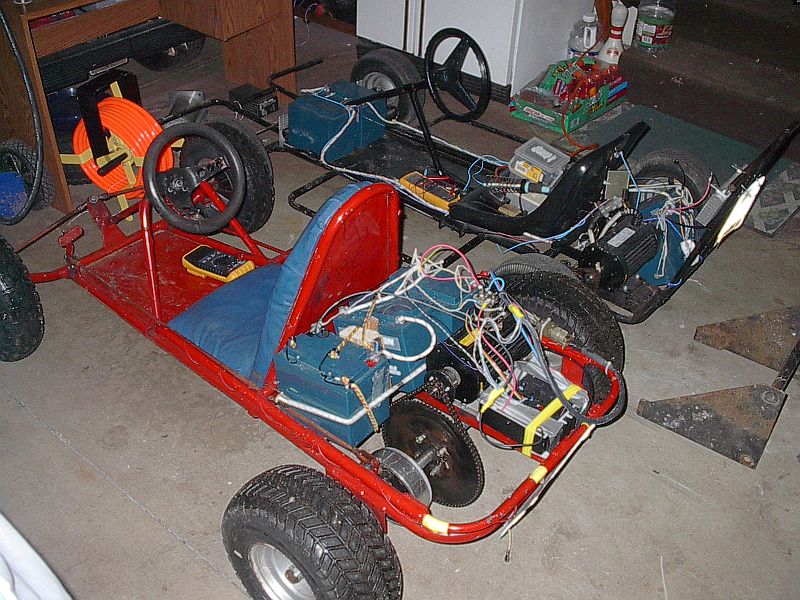
golf cart and gocarts (my kids gocarts with BLDC
controls)
http://www.qsl.net/w8rnh/gocart/gocart4.jpg
Thanks,
Rod
P.S. Tim has a really cool looking dragster that he
might bring to Maryland in June for the power of DC.
Hopefully he can get all of the electronics together
by then.
--- End Message ---
--- Begin Message ---
Peter VanDerWal wrote:
> I kow there are a few folks out there looking for affordable DC-DC
> converters.  While searching for something else, I came across this:
> http://www.halted.com/ccp11977-dc-dc-converter-150v-15v-600watt-vi-n52-em-19678.htm

Resurrecting an old thread. Just wondering if anyone picked up some of these
and whether they had luck with 'em?

Cheers,
Claudio
--- End Message ---
--- Begin Message ---
You could use a transfer case but it would have to have synchronized gears
inside to shift on the fly so an Atlas2 would work or the newer Jeeps may
have one but I think you can only shift at low speeds, ford has one out
there as well.

-----Original Message-----
From: Rush [mailto:[EMAIL PROTECTED]
Sent: Saturday, April 30, 2005 10:54 AM
To: [email protected]
Subject: Re: Transfer case as transmission


----- Original Message -----
From: "golubcu"
Sent: Saturday, April 30, 2005 7:23 AM
Subject: Re: Transfer case as transmission


> Is there an advantage to using this device?
> They are expensive, but wouldn't they increase your range?
> You'd still need the transmission?

Chris,

What I was going to do was take the transmisson out, reverse the rear axle,
attach the transfer case to it so that I would have 2 gears and then attach
the motor, all behind the rear axle. I was also think of putting in an
independant rear suspension. I would eliminate the weight of the
transmission/axle and make more room for the batteries behind the cab where
the axle was.

I could have picked one up here in the tucson junk yards for about $200, but
never got a good idea of the kind or gear ratio's that I would need.

In anycase for my first conversion it is too complicated and so I'm going to
keep the transmission, attach the motor to it like everybody else does.

Rush
Tucson AZ
converting an '86 Mitsubishi
www.ironandwood.org
--- End Message ---
--- Begin Message ---
Duncan'
don't know anything about this company but was refered
to this web site by cloude ev which are good people.
you might want to try them.
http://www.electricmotorsport.com/PARTS/EvtSpecs.htm

BTW
I have a motor that i got in LA before crystalite got
the distributership.  I have it on a schwinn road bike
with the standard battery pack and I have also used it
with a kiddie trailer and larger batteries. It is fine
but the controller has blown a couple of times.
particularly when i increased the battery size. the
heat sink was not large enough to dissapate the heat
and fried mosfets.  I use the bike fairly often and it
goes fast but I have the 409 motor which is the hi
speed low torque one
good luck
keith
--- Duncan Orthner <[EMAIL PROTECTED]>
wrote:
> At 06:30 PM 5/1/05 -0400, you wrote:
> >I spent afair bit of time talking to an importer of
> these. The controller
> >is a bit of a weak point, but they work, or so he
> says. Joint the yahoo
> >group for powerassists and ask around for opinions
> on these.
> >
> >It is a shame that motors aren't more available.
> There seems to be an
> >opportunity here. I keep hearing about possible
> motors being made
> >available, but they never seem to materialize.
> >
> >Seth
>
> Thanks Seth that was really useful. I don't yet know
> how good they are but
> there are certainly lots of people using them. There
> have been a few
> delivery hiccups from china, it seems. If the
> controller is the weakest
> link is it possible to get another (brushless) unit
> off the shelf?
>
> Best, Duncan
>
>
> >On May 1, 2005, at 2:48 AM, Lee Hart wrote:
> >
> >>Duncan Orthner wrote:
> >>>Can some of you here take a look at this web site
> and tell me
> >>>what you think? These are small hub motors for
> scooters and
> >>>electric bicycles . . . but some of them go up to
> 2000 watts:
> >>>
> >>>http://www.crystalyte.com/
> >>
> >>I know nothing about these motors in particular.
> However, most appear to
> >>be good for a few hundred watts, which is less
> than 1/2 HP. The small
> >>physical size and lack of cooling means that while
> they could produce a
> >>peak of 2000 watts, it's unlikely they could do so
> for more than a few
> >>minutes.
> >>
> >>>I'm very interested in finding some low speed,
> high torque hub
> >>>motors for a small, golf cart sized vehicle.
> >>
> >>Check with Unique Mobility. They have such motors,
> and have been in
> >>business long enough to be less risky than a tiny
> startup company with
> >>no track record. Be warned that they are
> expensive!
> >>--
> >>"The two most common elements in the universe
> >>are hydrogen and stupidity."    -- Harlan Ellison
> >>--
> >>Lee A. Hart  814 8th Ave N  Sartell MN 56377
> leeahart_at_earthlink.net
>
>

__________________________________________________
Do You Yahoo!?
Tired of spam?  Yahoo! Mail has the best spam protection around
http://mail.yahoo.com
--- End Message ---
--- Begin Message ---
Heavy duty math warning! Here's the math I use in my sim:

Force = mass * acceleration
v = velocity
t = time

     F = m*a = m * dv/dt

acceleration = acceleration from motor � rolling drag � aero drag
a_traction = max acceleration limited by tire traction
a_traction ~ 0.5 * 9.8 m/s^2 for front wheel drive
a_traction ~ 0.6 * 9.8 m/s^2 for front engine, rear wheel drive
a_traction ~ 0.8 * 9.8 m/s^2 for rear engine, rear wheel drive
a_traction ~ 1.0 * 9.8 m/s^2 for all wheel drive
u = coefficient of rolling resistance
u ~ 0.01, 0.006 for low rolling resistance tires
theta = ground slope angle
vw = wind velocity
P = power at driving wheels
a2 = aero drag constant, a2 = a2(frontal area, Cd, air density)
g = acceleration due to gravity = 9.8 m/s^2

     dv/dt = min(a_traction, P/(m*v�)) � ug cos(theta) � a2 *
(v-vw)^2 / m
     v� = {v_knee in current limit, v otherwise}

v_knee is the velocity at which the motor drops out of current limit.
This is around 1/2 max rpm for AC motors.

For racing you can often assume theta = 0 and vw = 0.

     dv/dt = min(a_traction, P/(m*v�)) � ug � a2 * v^2 / m

If no longer accelerating (the case at top speed), dv/dt = 0. If the
power at the top speed is known (often occurs at max motor power),
then a2 can be calculated:

     a2 = (P/v � umg) / v^2

Note that Cd and frontal area do not need to be known. Not necessary,
but if desired Cd*(frontal area) can be calculated from a2. Some
caution needs to be exercised from calculating a2 from manufacturer
Cd information � they�ll use the car�s max height times max width for
the frontal area to make the Cd seem as small as possible.

If you have a dyno chart, that is the best thing to use for P. If
not, here is a way to estimate it for AC and sepex motors. Series
motors have a different expression.

     P = I_max * (V_batt � I_max * R_batt) * N_batteries * 0.85
           * (eff_peak � (eff_peak � eff_ref) * ((f �
f_peakeff)/(f_ref � f_peakeff)))^2

I_max = max battery amps
V_batt = nominal voltage each battery
R_batt = internal resistance for one battery, ~3.5 mohm for an
Orbital or Optima
N_batteries = total number of batteries
0.85 = accounts for motor-to-wheels drivetrain losses
eff_peak = motor�s peak efficiency at I_max
f_peakeff = rpm for motor�s peak efficiency
eff_ref = efficiency at a 2nd rpm
f_ref = rpm for eff_ref efficiency point

Now everything has been defined, drop the 2nd equation into your
favorite differential equation solver (fixed step size Runge-Kutta
can be done pretty easily in a spreadsheet), and you have t, x, v,
and a to figure out 0-60, 1/4 mile times, top speed, etc.


__________________________________________________
Do You Yahoo!?
Tired of spam?  Yahoo! Mail has the best spam protection around
http://mail.yahoo.com
--- End Message ---
--- Begin Message ---
Hi all
I thought I had seen and saved a statement of the resting voltage for
lead-acid batteries, but I can't find it and a search turns up a million
hits or nothing.
Question 1) what is the resting voltage of a fully charged lead acid battery?
Question 2) what is the resting voltage of a fully discharged lead acid
battery?
Question 3) What is the temperature slope (mV reduced per degree C increase)?
Question 4) Is there any difference in these values for AGMs vs wet cells?
My Orbitals are now a year old, keeping them topped up with a car-type
charger every month or so, but not sure if this is a good thing. Need to
get them in the truck and going!
Thanks
James
--- End Message ---
--- Begin Message ---
Randy wrote:

>Need parts and info to convert 89 ford e150 van to all electric with
range of 75 >miles and top speed of 50 mph. Used for delivery.  Cant
wait to start.


Money, range, performance..

Spend a bit more or spend just a little?  Normal or "fast"?

I'd go with a 9" motor.

http://matchesmotors.com/_wsn/page2.html

Suppose could go with an 8" if the $200 is an issue..

Controller... Once again with the price..  About $300 price difference
between a 1000amp controller and a 500 amp controller..  Go with the
1000 if you can..

http://cafeelectric.com/products/zilla/index.html

http://www.electroauto.com/catalog/control.shtml

Charger:  http://www.manzanitamicro.com/chargers3.htm

Batteries...

Just depends..  For maximum range, least expense, go with 6 volt
flooded golf car batteries.  More bats, more range.  See what fits.
Try for upwards of a 144volt system.

Many options, many questions, many details.  Just have to ask one by
one till you know it all and have it built.  We're here to help so ask
away and start building.

Regards
--- End Message ---
--- Begin Message ---
There aren't many traction capable 48-72V BLDC drives out there that
are reasonably priced, IMO. Theirs is pretty cheap.
I knwo Rod Hower has been working on something.
I haev had mixed results from Transmag, although that was years ago, I
hear they are better now? Thunderstruck
(www.thunderstruck-ev.com) sells them.
Seth
On May 1, 2005, at 9:50 PM, Duncan Orthner wrote:
At 06:30 PM 5/1/05 -0400, you wrote:
I spent afair bit of time talking to an importer of these. The
controller is a bit of a weak point, but they work, or so he says.
Joint the yahoo group for powerassists and ask around for opinions on
these.
It is a shame that motors aren't more available. There seems to be an
opportunity here. I keep hearing about possible motors being made
available, but they never seem to materialize.
Seth
Thanks Seth that was really useful. I don't yet know how good they are
but there are certainly lots of people using them. There have been a
few delivery hiccups from china, it seems. If the controller is the
weakest link is it possible to get another (brushless) unit off the
shelf?
Best, Duncan
On May 1, 2005, at 2:48 AM, Lee Hart wrote:
Duncan Orthner wrote:
Can some of you here take a look at this web site and tell me
what you think? These are small hub motors for scooters and
electric bicycles . . . but some of them go up to 2000 watts:
http://www.crystalyte.com/
I know nothing about these motors in particular. However, most
appear to
be good for a few hundred watts, which is less than 1/2 HP. The small
physical size and lack of cooling means that while they could
produce a
peak of 2000 watts, it's unlikely they could do so for more than a
few
minutes.
I'm very interested in finding some low speed, high torque hub
motors for a small, golf cart sized vehicle.
Check with Unique Mobility. They have such motors, and have been in
business long enough to be less risky than a tiny startup company
with
no track record. Be warned that they are expensive!
--
"The two most common elements in the universe
are hydrogen and stupidity." -- Harlan Ellison
--
Lee A. Hart 814 8th Ave N Sartell MN 56377
leeahart_at_earthlink.net
--- End Message ---
--- Begin Message ---
I have. I did 9A. I think I extrapolated that from some literature I
had. I stopped at ~1.65VPC? They took nearly double their capacity 50Ah
for a 30Ah at 1C rated. They warmed to over 100F, maybe 110F?
I also did a test of my GE (not SAFT) BB600 batteries. Otmar hosts the
.xls file. Or e-mail me offlist if you want it.
Seth
On May 1, 2005, at 10:08 PM, Rod Hower wrote:
Just did a 900 mile round trip to Tim Humphreys place
to pick up 250 cells using the 1994 Saturn with a
Uhaul trailer.  22 MPG is all I averaged, but still
not to bad for a car with 135,000 miles.
I read all of the literature but did not see a good
recomendation for a commissioning charge.  Anybody
with BB600 cells have some advice?
I have an HP6269 supply that can put out 50 volts at
40 amps sitting in the basement, so current and
voltage is not a problem.
I'm thinking 15amps for 3 hours for an individual
cell?
Any advice on bringing these cells back to life is
appriciated.  Has anybody conditioned and tested these
cells?  If not I suppose I can give it a try and
report back to the list.  I plan on using mine in the
golf cart and gocarts (my kids gocarts with BLDC
controls)
http://www.qsl.net/w8rnh/gocart/gocart4.jpg
Thanks,
Rod
P.S. Tim has a really cool looking dragster that he
might bring to Maryland in June for the power of DC.
Hopefully he can get all of the electronics together
by then.
--- End Message ---
--- Begin Message ---
James Massey wrote:
Hi all
I thought I had seen and saved a statement of the resting voltage
for
lead-acid batteries, but I can't find it and a search turns up a
million hits or nothing.
Hi James,
You might find this link useful, I did!
http://www.uuhome.de/william.darden/
Is this what you're looking for:
http://www.uuhome.de/william.darden/carfaq4.htm#vrla_soc
Of course, there are only general numbers, I'm sure there would be
some specifics for the Orbitals out there somewhere?
Hope that helps,
Dean
--- End Message ---
--- Begin Message ---
I have been having ev-building fun today!

I put my taperlock hub back on. This time I kept spinning with a dial
indicator, and gently tapped with a hammer and tightened selected
bolts to try to eliminate high spots. I had better luck this time,
went from 4 thousandths off center to 1.5 thousands off center. Yay!

A shunt motor has many turns of fine wire for the armature and this
gets hooked to the power supply (controller). In contrast, a series
motor has a few turns of really heavy wire. All the current goes
through that to the armature. In the shunt/sepex, the armature is
powered directly by the controller.

I have a sepex shunt Kostov, so don't try this with a series motor!

I put the field winding on a battery charger, and the armature on a
lawn tractor battery. I found you have to put the battery clamps on
quickly to prevent sparks. It spun up quietly. Switching the charger
between 2 and 6 amps settings, and 6 and 12 volts settings, would get
me approx. 4, 5, 6 or 8 volts across the field winding. The motor
would turn faster as the field voltage went down. I estimate speeds
from roughly 1000 to 2000 rpm. Great fun! It's awesome to have
something moving at your command like that!

The flywheel is only 1.5 thousandths off center in the radial
direction, same as the hub -- looks good to me!

It has a 7 thousandths peak-to-peak wobble in the axial direction.
The face of the taperlock hub has a 2 thousandths wobble, high point
at the same point as the flywheel, and radius about 1/3 as far. So I
can conclude the taperlock face is a tiny bit off from being flat,
and the flywheel is OK.

Now for the big question: Is this a good idea and would it work?

I could spin up the motor, and hold a file or sandpaper to the face
of the taperlock hub. In theory this should knock down the high spots
and make it more level. In practice will this work? Thanks for any
advice.

Future tasks:

The motor with the flywheel on also vibrates slightly (just enough to
feel, and blur fine text). I plan to have it and the pressure plate
high speed balanced at a race machine shop. If that doesn't fix it
I'll do the Wayland travelling washer trick.

I also want to make or download a chart that has circles of 2
segments, 3 segments, 4 segments, etc. By attaching it to the
flywheel and viewing under flourescent lights I can figure out the
rpm things are turning.


__________________________________________________
Do You Yahoo!?
Tired of spam?  Yahoo! Mail has the best spam protection around
http://mail.yahoo.com
--- End Message ---
--- Begin Message ---
>From the 7658.pdf (TM 11-6140-203-14-4&P) page 5-3 in table 5-1 I hope the
formating comes out right.

Table 5-1. Constant Voltage charging Rate.

Ambient Temp    2-hour Charge   4-hour          8-hour
Degrees         Constant Voltage Constant Voltage Constant Voltage
F    C          Per             Per             Per
                Cell BB-693 A/U Cell BB-693 A/U Cell    BB-693 A/U
-40 -40         1.68    32.0    1.68    32.0    1.68    32.0
-20 -30         1.68    32.0    1.63    31.0    1.58    .0.0
  0 -18         1.68    32.0    1.63    31.0    1.53    29.0
 32   0         1.63    32.0    1.58    30.0    1.53    29.0
 50  10         1.63    32.0    1.53    29.0    1.53    29.0
 80  27         1.58    32.0    1.53    29.0    1.47    28.0
100  38         1.53    32.0    1.47    28.0    1.47    28.0
120  49         1.47    32.0    1.42    27.0    1.42    27.0


> I have. I did 9A. I think I extrapolated that from some literature I
> had. I stopped at ~1.65VPC? They took nearly double their capacity 50Ah
> for a 30Ah at 1C rated. They warmed to over 100F, maybe 110F?
>
> I also did a test of my GE (not SAFT) BB600 batteries. Otmar hosts the
> .xls file. Or e-mail me offlist if you want it.
>
> Seth
>
--- End Message ---
--- Begin Message ---
I thought the leaning bearing axis needed to be aligned with the tire patch
of the front tire.

It looks like it is parallel to the ground.

Are you sure this is right?

Where is that website and video of the tilting trike to show how they did
it?

Are the rear wheels rated to take the lateral force of a trike? It looks
like they were designed for a tilting two wheeler. Three wheelers need
stronger wheels than two wheelers because of the increased side load in
three wheeler applications.

Joe Smalley
Rural Kitsap County WA
Fiesta 48 volts
NEDRA 48 volt street conversion record holder
[EMAIL PROTECTED]


----- Original Message -----
From: "Stu and Jan" <[EMAIL PROTECTED]>
To: "EV LIST" <[email protected]>
Sent: Sunday, May 01, 2005 4:32 PM
Subject: Progress on my Hybrid Trike


> Visit www.stulieberman.com <http://www.stulieberman.com/>   and view
hybrid
> trike folder.
>
>
>
> Some details:
>
>
>
> 6-33 AH wheelchair batteries
>
> 6.5 HP B&S I/C engine powers left rear
>
> 8" 36V 80 Amp motor to be run at 48 V
>
> 12.5" wheels and frames from 2 scooters
>
> Battery case and engine/motor mount from bed frames angle
>
> Oxy/acet and oxy/propane brazing
>
>
>
> Notice 2 headsets and 2 forks:  horizontal headset/fork  #1 for leaning in
> turns, #2 fork
>
> For steering.
>
>
>
> Curtis 36-48 1204 Controller
>
>
>
>
>
> Boyntonstu
>
>
--- End Message ---
--- Begin Message ---
The referenced numbers are about right for flooded batteries.
The temperature compensation is about right as well.

A full and healthy Hawker, Optima or Orbital will be about 13.1 volts and a
discharged one will be about 12.1 volts making them about 0.3 volts higher
than listed in the referenced chart. As they age, the resting voltage drops.

Joe Smalley
Rural Kitsap County WA
Fiesta 48 volts
NEDRA 48 volt street conversion record holder
[EMAIL PROTECTED]


----- Original Message -----
From: "Dean Thompson" <[EMAIL PROTECTED]>
To: <[email protected]>
Sent: Sunday, May 01, 2005 8:28 PM
Subject: Re: Resting voltage vs state-of-charge


> James Massey wrote:
> > Hi all
> >
> > I thought I had seen and saved a statement of the resting voltage
> > for
> > lead-acid batteries, but I can't find it and a search turns up a
> > million hits or nothing.
>
> Hi James,
>
> You might find this link useful, I did!
> http://www.uuhome.de/william.darden/
>
> Is this what you're looking for:
> http://www.uuhome.de/william.darden/carfaq4.htm#vrla_soc
>
> Of course, there are only general numbers, I'm sure there would be
> some specifics for the Orbitals out there somewhere?
>
> Hope that helps,
> Dean
>
--- End Message ---
--- Begin Message ---
Your a_traction estimates are about 20% conservative.

Using % grade is more common and gets the trig function out of your
equations.

Rolling drag and Slope compensation should be separate terms.

Using m for mass and meters confuses me. They should be separate variables
with different names.

===========================================
I need to go off-line. I hope to comment more later.

Joe Smalley
Rural Kitsap County WA
Fiesta 48 volts
NEDRA 48 volt street conversion record holder
[EMAIL PROTECTED]


----- Original Message -----
From: "David Dymaxion" <[EMAIL PROTECTED]>
To: <[email protected]>
Sent: Sunday, May 01, 2005 8:11 PM
Subject: Sim Math


> Heavy duty math warning! Here's the math I use in my sim:
>
> Force = mass * acceleration
> v = velocity
> t = time
>
>      F = m*a = m * dv/dt
>
> acceleration = acceleration from motor - rolling drag - aero drag
> a_traction = max acceleration limited by tire traction
> a_traction ~ 0.5 * 9.8 m/s^2 for front wheel drive
> a_traction ~ 0.6 * 9.8 m/s^2 for front engine, rear wheel drive
> a_traction ~ 0.8 * 9.8 m/s^2 for rear engine, rear wheel drive
> a_traction ~ 1.0 * 9.8 m/s^2 for all wheel drive
> u = coefficient of rolling resistance
> u ~ 0.01, 0.006 for low rolling resistance tires
> theta = ground slope angle
> vw = wind velocity
> P = power at driving wheels
> a2 = aero drag constant, a2 = a2(frontal area, Cd, air density)
> g = acceleration due to gravity = 9.8 m/s^2
>
>      dv/dt = min(a_traction, P/(m*v')) - ug cos(theta) - a2 *
> (v-vw)^2 / m
>      v' = {v_knee in current limit, v otherwise}
>
> v_knee is the velocity at which the motor drops out of current limit.
> This is around 1/2 max rpm for AC motors.
>
> For racing you can often assume theta = 0 and vw = 0.
>
>      dv/dt = min(a_traction, P/(m*v')) - ug - a2 * v^2 / m
>
> If no longer accelerating (the case at top speed), dv/dt = 0. If the
> power at the top speed is known (often occurs at max motor power),
> then a2 can be calculated:
>
>      a2 = (P/v - umg) / v^2
>
> Note that Cd and frontal area do not need to be known. Not necessary,
> but if desired Cd*(frontal area) can be calculated from a2. Some
> caution needs to be exercised from calculating a2 from manufacturer
> Cd information - they'll use the car's max height times max width for
> the frontal area to make the Cd seem as small as possible.
>
> If you have a dyno chart, that is the best thing to use for P. If
> not, here is a way to estimate it for AC and sepex motors. Series
> motors have a different expression.
>
>      P = I_max * (V_batt - I_max * R_batt) * N_batteries * 0.85
>            * (eff_peak - (eff_peak - eff_ref) * ((f -
> f_peakeff)/(f_ref - f_peakeff)))^2
>
> I_max = max battery amps
> V_batt = nominal voltage each battery
> R_batt = internal resistance for one battery, ~3.5 mohm for an
> Orbital or Optima
> N_batteries = total number of batteries
> 0.85 = accounts for motor-to-wheels drivetrain losses
> eff_peak = motor's peak efficiency at I_max
> f_peakeff = rpm for motor's peak efficiency
> eff_ref = efficiency at a 2nd rpm
> f_ref = rpm for eff_ref efficiency point
>
> Now everything has been defined, drop the 2nd equation into your
> favorite differential equation solver (fixed step size Runge-Kutta
> can be done pretty easily in a spreadsheet), and you have t, x, v,
> and a to figure out 0-60, 1/4 mile times, top speed, etc.
>
>
>
>
> __________________________________________________
> Do You Yahoo!?
> Tired of spam?  Yahoo! Mail has the best spam protection around
> http://mail.yahoo.com
>
--- End Message ---