EV Digest 4517

Topics covered in this issue include:
  1) Re: Flooded battery advice, terminals
        by Electro Automotive <[EMAIL PROTECTED]>
  2) Re: Question about Peukert Exponent
        by Danny Miller <[EMAIL PROTECTED]>
  3) RE: One-way clutch (was Freewheel...)
        by "Chris Tromley" <[EMAIL PROTECTED]>
  4) Re: test
        by keith vansickle <[EMAIL PROTECTED]>
  5) Re: Question about Peukert Exponent
        by Victor Tikhonov <[EMAIL PROTECTED]>
  6) RE: One-way clutch (was Freewheel...)
        by "Roger Stockton" <[EMAIL PROTECTED]>
  7) OT Re: Not if you have EV's, Re: Exciting - No gasoline in Northwest
Florida
        by jerry dycus <[EMAIL PROTECTED]>
  8) RE: One-way clutch (was Freewheel...)
        by "Paschke, Stephen" <[EMAIL PROTECTED]>
  9) Re: A vehicle licensing idea
        by jerry dycus <[EMAIL PROTECTED]>
 10) Re: Aerodynamic drag causes,  Re: Dymaxion for hybrid RV , Aero, ground
effect and Van conversion
        by [EMAIL PROTECTED]
 11) Re: Question about Peukert Exponent
        by Danny Miller <[EMAIL PROTECTED]>
 12) Re: March race report up for Kokam powered Electric Imp
        by David Dymaxion <[EMAIL PROTECTED]>
 13) Desulfators (desulphators?)
        by Danny Miller <[EMAIL PROTECTED]>
 14) Re: Aerodynamic drag causes,  Re: Dymaxion for hybrid RV , Aero, ground
effect and Van conversion
        by Ken Trough <[EMAIL PROTECTED]>
 15) Re: Desulfators (desulphators?)
        by Ken Trough <[EMAIL PROTECTED]>
 16) Re: PFC Chargers...Let's hear the Positive Side!
        by "Rich Rudman" <[EMAIL PROTECTED]>
 17) Ranger EV Pre-Owned Purchase Lottery Announcement
        by bruce parmenter <[EMAIL PROTECTED]>
 18) Re: Desulfators (desulphators?)
        by Danny Miller <[EMAIL PROTECTED]>
 19) Re: Desulfators (desulphators?)
        by "David Roden (Akron OH USA)" <[EMAIL PROTECTED]>
 20) 2 batt. questions: black terminals, and why the short spark on reconnect?
        by Bob Bath <[EMAIL PROTECTED]>
 21) Capacitance Energy Question
        by "Bill Dennis" <[EMAIL PROTECTED]>
 22) The shunt location (was: Question about Peukert Exponent)
        by Victor Tikhonov <[EMAIL PROTECTED]>
 23) Dodge Neon conversion.
        by canev <[EMAIL PROTECTED]>
 24) RE: Capacitance Energy Question
        by "djsharpe" <[EMAIL PROTECTED]>
 25) Re: Capacitance Energy Question
        by Victor Tikhonov <[EMAIL PROTECTED]>
 26) Flooded battery advice, terminals
        by "David (Battery Boy) Hawkins" <[EMAIL PROTECTED]>
 27) Re: Desulfators (desulphators?)
        by Lee Hart <[EMAIL PROTECTED]>
--- Begin Message ---
> Looking at battery notes from my last purchase (18,000 miles ago 08/03),
> yes US batteries would have been cheaper than Trojan ($54 each at 24), but
> shipping would have been $300 or $1596 for a pack. Dave Mason with U.S.
> mentioned that although they would still sell directly to EV'ers, they no
> longer liked doing that as it undercuts their local representatives.
Try contacting Jim Ramos at American Battery. He is in California, but he
arranges delivery for US Batteries all over the world, and does pretty good
on freight. He is VERY EV friendly and experienced, and will get you the
right stuff, including "L" posts if you want them. For reference, a US-125
from him right now is going for about $66 before shipping. You can reach
him at 510-259-1150 or by email at [EMAIL PROTECTED] Be
aware, however, that he checks his email religiously about every week and a
half or so, so phone will be much faster. Fax is 510-259-1160.
Shari Prange
Electro Automotive POB 1113 Felton CA 95018-1113 Telephone 831-429-1989
http://www.electroauto.com [EMAIL PROTECTED]
Electric Car Conversion Kits * Components * Books * Videos * Since 1979
--- End Message ---
--- Begin Message ---
Thank you for your responses. Now I read them and am not completely
clear which concept you're saying "yes" to. If we do a high discharge
and only realize 75% of the battery's AH capacity before it is
"discharged", if we allow a bit of time for the electrolyte to diffuse
back into the plates is there still 25% of low current capacity remaining?
Perhaps I should go into my background. Some time ago I designed an
energy monitor for deep cycle batteries. It has a shunt on the high
side (can't believe some people make a $$$ system and still use low side
shunts), measures quite accurately from a few mA to 5kA (the shunt only
has a 200A continuous rating however), and is based on a 240x64
graphical LCD so in addition to huge numbers I gave it a nice graphical
display of energy usage over the last 24 hrs, very relevant since the
refrigerator is the primary power hog and its consumption varies over
the day due to variations in temp. It experienced significant offset
errors as the temp changed- and it changes a lot- so I later included an
auto-zero where every few minutes it switches off the shunt and shorts
the Vsh+/Vsh- together and recalibrates. I did not include Peukert's,
discharge rarely exceeds the C/20 rate much for an extended period but
it would be nice to include if relevant.
Actually, due to my high current alternator, I would also be interested
in how much high charging currents (C/1 happens initially, soon tapering
off) are affecting the charge efficiency. The alternator is regulating
the voltage as normal for a deep cycle flooded plate. Does the
depletion of electrolyte simply automatically result in the tapering off
of charge current consumed, or does this have a strong effect on charge
efficiency as well? I have seen it reported that charge efficiency is
around 80% or 85%-95% for deep cycles but I wonder if I should adjust
that based on the rate of charge.
John, how would a controller use Peukert's to get more power out of a
battery? It could use it to determine that a battery is not entirely
out of capacity even though it reached 10.5v while under heavy load.
But even if it knew there were 25 ah left, they would be delivered at a
low voltage which may not be useful. Also for systems such as lead-acid
which are damaged by discharging to zero, that zero charge condition
might occur locally on a stratified plate as high currents are delivered
and voltage drops below the minimum cell voltage. Just a theory, I have
nothing to back that up.
Regards,
Danny Miller

Neon John wrote:
yes. What Peukert does is try to model the cumulative effects of

polarization, electrolyte starvation, depletion of active material on
the surface of the paste(s), ohmic loss and probably a few other
things.

I'd like to see a controller that does Peukert (or some other, more
conforming algorithm) internally and manages the battery draw to get
the max power from the pack.  As the Peukert limit is approached at a
given amp draw, back the draw down as appropriate and supply whatever
power is available to the traction motor.  This is similar in concept
to the constant power solar controllers.

Instead of the precipitous drop that a conventional pack experiences
at the end of Peukert, with this type of controller, the power would
gradually but controllably drop off. One might only be able to creep
home but one probably could get home and do so without damaging the
pack.
John
--- End Message ---
--- Begin Message ---
Peter VanDerWal wrote:

> Quite right.  However just one could easily handle the power from
> something like an Etek as long as you used it on the low torque (motor)
> side of the power train.

Umm, well yeah.

All I'm saying is to pay attention to what you're doing.  Taking a very
broad swipe at this, let's say a racing cyclist is cranking at 100 rpm for a
speed of 30 mph.  An Etek will be at spinning what, 2000 rpm at the same
speed?  Whatever the gear ratios turn out to be, the total reduction for the
Etek will be very roughly 20 times greater than for the human.  Looking just
at the gearing, the Etek powered vehicle has 20X the torque multiplication
at the wheel (where the freewheel is) than the human powered vehicle.

So yeah, you'd better put the freewheel on the motor side rather than on the
wheel side.  (Assuming it can take 20X the rpm of a human.)  Or keep it in
the wheel and limit the power through it.  Or verify that it can withstand
3X the power a cyclist could dish out.  Or learn the hard way that the chain
is actually the "fuse" in the system.  Or, or, or....

I bow to your superior knowledge of bicycle componentry, but as soon as you
take a component out of its intended application, you are starting from
square one.  Whether you realize it or not.

Chris
--- End Message ---
--- Begin Message ---
your test worked
keith
--- [EMAIL PROTECTED] wrote:

> test
>
>


__________________________________________________
Do You Yahoo!?
Tired of spam?  Yahoo! Mail has the best spam protection around
http://mail.yahoo.com
--- End Message ---
--- Begin Message ---
Danny Miller wrote:
Thank you for your responses. Now I read them and am not completely
clear which concept you're saying "yes" to. If we do a high discharge
and only realize 75% of the battery's AH capacity before it is
"discharged", if we allow a bit of time for the electrolyte to diffuse
back into the plates is there still 25% of low current capacity remaining?
Ignoring heating losses, yes.

See it as a voltage sag limit: if you load the battery heavily,
it sags a lot and will reach 10.5V minimum sooner, allowing
to spend only 75Ah by then.

In extreme, load it with 1000+ A, and it fully charged battery will
sag to 10.5V right away after few seconds, having a chance to deliver
only, say 10Ah to you. So it is it's capacity *at that rate*.

Yes, remaining 90Ah (almost, since you had losses during fast
discharge) are still there if that's your question.
But if your application *demands* 1000+ A current, for you it is
like not there - you can't get it out at that rate. So *your*
capacity is 10Ah.

It is not terribly accurate way to explain it, but I hope visualizes
it. The Peukert exponent then is just a numerical representation
of the degree of that phenomena [degree of of loss of *your* capacity vs
20Ah rate capacity).
It has a shunt on the high
side (can't believe some people make a $$$ system and still use low side
shunts),
I use low side shunts very successfully. Electrically it makes no
difference where in the loop the shunt is.
Can you explain what do you think the problem with low side
shunt topology is (interfacing of your stuff *to* that shunt aside)?

--
Victor
'91 ACRX - something different
--- End Message ---
--- Begin Message ---
Chris Tromley [mailto:[EMAIL PROTECTED] wrote:

> Taking a very broad swipe at this, let's say a racing cyclist
> is cranking at 100 rpm for a speed of 30 mph.  An Etek will
> be at spinning what, 2000 rpm at the same speed?

Out of curiousity, what is the concern with RPM at the freewheel?  My,
perhaps overly simplistic, view is that the freewheel operates in one of
two modes: freewheeling or locked.  Once locked, there is no frictional
losses within it, so no heat generated, so the RPM (hp) seems irrelevant
until one reaches the limit where the freewheel flys apart.  It seems
that is is really only the torque that should matter.

>  Whatever
> the gear ratios turn out to be, the total reduction for the
> Etek will be very roughly 20 times greater than for the
> human.  Looking just at the gearing, the Etek powered vehicle
> has 20X the torque multiplication at the wheel (where the
> freewheel is) than the human powered vehicle.

Bear in mind that the Etek only produces 32ft-lbs when run at its 1min
rating of 330A, and a bicycle freewheel is built into the wheel, not the
pedal cranks.  At 30mph (50kph), a 27" tall bicycle wheel is spinning at
about 387RPM, not 100RPM.  Assuming the Etek vehicle is geared for a
similar 30mph top speed, the motor will be spinning between
3000-4000RPM, so about a 10:1 reduction, not 20:1.

Now, 320ft-lbs is still significant, however it is still on the same
order as the torque that a heavy rider could generate in granny gear.

> So yeah, you'd better put the freewheel on the motor side
> rather than on the wheel side.  (Assuming it can take 20X the
> rpm of a human.)

It can.  Our Electrathon car (like most of them) uses a bicycle
freewheel at the wheel (a 20" wheel, BTW, which is spinning at about
[EMAIL PROTECTED]/50kph and [EMAIL PROTECTED]/80kph), however, I have also used
a
bicycle freewheel on the motor shaft in a bicycle conversion.  In this
case, the freewheel was directly mounted on the shaft of a 2HP motor and
had no problems with the RPM.

> Or keep it in the wheel and limit the power
> through it.  Or verify that it can withstand 3X the power a
> cyclist could dish out.

Again, I don't understand the concern with "power" through the freewheel
rather than simply the torque.  For instance, roller clutches seem to
specify only a max torque, not a max power:

<http://www.qbcbearings.com/B610/HTML/B610P139_1.html>

With all of this said, one of the pains with using a bicycle freewheel
is that they thread onto a 1.370" x 24tpi "shaft", which is something
that you need to have custom machined onto your adapter if you install
the freewheel on the motor shaft (or basically anywhere other than onto
a bicycle hub/cassette).  An industrial roller clutch is almost
certainly going to be easier to work with, although the torque that can
be transmitted will depend on how tightly the clutch is pressed onto the
shaft and into the other bit of the mechanism.

Cheers,

Roger.
--- End Message ---
--- Begin Message ---
     Hi John and All,

--- Neon John <[EMAIL PROTECTED]> wrote:

> On Wed, 20 Jul 2005 19:19:37 -0700 (PDT), jerry
> dycus
> <[EMAIL PROTECTED]> wrote:
>
>
> >    In 3 days I used a gal of gas and had AC,
> >microwave, shower and all the convinences of home
> >since I was at home, not hiding somewhere!!
>
> OK, I'll bite.  I want to know how you had AC on 1/3

   Can't figure it out huh?


> gal of gas a day.
> "Real" AC, you know, 70 degrees, 50% humidity and

    Anyone ACing down that low isn't real smart on
several fronts. It wastes energy, money, and makes it
much worse when you go outside than if you ACed down
to about 78F to take out the humidity and cool down to
where with a small fan, is quite comfortable. And if
you had to go outside, it was a much easier
adjustment, more comfortable.
    And I have heat related medical problems that
cause easy heat stroke.
    1-2 showers a day does wonders too.
    So if saving power, one would run the AC only a
short time to lower the humidity and cool things off
then using a small pesonal fan the rest of the time.
    It wasn't until the 3rd day I even cranked up the
DC gen to pump 60 amps at 36vdc back into my packs.
     Altogether I had 6 t105's, 6 12v/130 amphr
dynasties and a pile of 14amphr SAFT ni cad cells. All
charged as I new what was coming.
      Plus the local 7-11 allowed me to charge but by
the time that was done late in the 3rd day, the
electricity was back on though I was ready for another
2.5 days or more.
                 HTH's,
                   Jerry Dycus


> all that, and not
> 460 AC (4 windows down, 60 mph.) That sounds pretty
> close to perpetual
> motion.
> ---
> John De Armond
> See my website for my current email address
> http://www.johngsbbq.com
> Cleveland, Occupied TN
>
>


____________________________________________________
Start your day with Yahoo! - make it your home page
http://www.yahoo.com/r/hs
--- End Message ---
--- Begin Message ---
More specifically it is the torque being supplied to the 2-4 ratcheting pawls
inside the freewheel.  The harder and more often they are slammed from the
freewheel state to the locked state, the shorter their life.

> APPS Support
> Stephen Paschke
> Senior Consultant
> Keane, Inc.
> Office 303-607-2993
Cell    303-204-9280


-----Original Message-----
From: [EMAIL PROTECTED] [mailto:[EMAIL PROTECTED]
Behalf Of Roger Stockton
Sent: Thursday, July 21, 2005 12:59 PM
To: [email protected]
Subject: RE: One-way clutch (was Freewheel...)


Chris Tromley [mailto:[EMAIL PROTECTED] wrote:

> Taking a very broad swipe at this, let's say a racing cyclist
> is cranking at 100 rpm for a speed of 30 mph.  An Etek will
> be at spinning what, 2000 rpm at the same speed?

Out of curiousity, what is the concern with RPM at the freewheel?  My,
perhaps overly simplistic, view is that the freewheel operates in one of
two modes: freewheeling or locked.  Once locked, there is no frictional
losses within it, so no heat generated, so the RPM (hp) seems irrelevant
until one reaches the limit where the freewheel flys apart.  It seems
that is is really only the torque that should matter.

>  Whatever
> the gear ratios turn out to be, the total reduction for the
> Etek will be very roughly 20 times greater than for the
> human.  Looking just at the gearing, the Etek powered vehicle
> has 20X the torque multiplication at the wheel (where the
> freewheel is) than the human powered vehicle.

Bear in mind that the Etek only produces 32ft-lbs when run at its 1min
rating of 330A, and a bicycle freewheel is built into the wheel, not the
pedal cranks.  At 30mph (50kph), a 27" tall bicycle wheel is spinning at
about 387RPM, not 100RPM.  Assuming the Etek vehicle is geared for a
similar 30mph top speed, the motor will be spinning between
3000-4000RPM, so about a 10:1 reduction, not 20:1.

Now, 320ft-lbs is still significant, however it is still on the same
order as the torque that a heavy rider could generate in granny gear.

> So yeah, you'd better put the freewheel on the motor side
> rather than on the wheel side.  (Assuming it can take 20X the
> rpm of a human.)

It can.  Our Electrathon car (like most of them) uses a bicycle
freewheel at the wheel (a 20" wheel, BTW, which is spinning at about
[EMAIL PROTECTED]/50kph and [EMAIL PROTECTED]/80kph), however, I have also used
a
bicycle freewheel on the motor shaft in a bicycle conversion.  In this
case, the freewheel was directly mounted on the shaft of a 2HP motor and
had no problems with the RPM.

> Or keep it in the wheel and limit the power
> through it.  Or verify that it can withstand 3X the power a
> cyclist could dish out.

Again, I don't understand the concern with "power" through the freewheel
rather than simply the torque.  For instance, roller clutches seem to
specify only a max torque, not a max power:

<http://www.qbcbearings.com/B610/HTML/B610P139_1.html>

With all of this said, one of the pains with using a bicycle freewheel
is that they thread onto a 1.370" x 24tpi "shaft", which is something
that you need to have custom machined onto your adapter if you install
the freewheel on the motor shaft (or basically anywhere other than onto
a bicycle hub/cassette).  An industrial roller clutch is almost
certainly going to be easier to work with, although the torque that can
be transmitted will depend on how tightly the clutch is pressed onto the
shaft and into the other bit of the mechanism.

Cheers,

Roger.


**************************************************************
This message, including any attachments, contains confidential information
intended for a specific individual and purpose, and is protected by law.  If
you are not the intended recipient, please contact sender immediately by reply
e-mail and destroy all copies.  You are hereby notified that any disclosure,
copying, or distribution of this message, or the taking of any action based on
it, is strictly prohibited.
TIAA-CREF
**************************************************************
--- End Message ---
--- Begin Message ---
      Hi Stu and All,


--- Stu or Jan <[EMAIL PROTECTED]> wrote:

> A vehicle licensing idea
>
> In the state of Florida, all 3 wheel vehicles are
> considered motorcycles.
> There are fewer fees, insurance, and other
> requirements.
> Almost anything goes.

    Now you know why my E woody and Freedom EV are
3wheelers!!


>
> Doesn't it follow logically that if one removed the
> 2 wheels from a 'car'
> and replaced them with a single rear wheel, we would
> have a 'motorcycle'?

    Yes, in Fla. Other states?
    If I was to find a Rabbit diesel, I'd do it to
it!!
              HTH's,
                  Jerry Dycus


>
>
> BoyntonStu
>
>


__________________________________
Yahoo! Mail for Mobile
Take Yahoo! Mail with you! Check email on your mobile phone.
http://mobile.yahoo.com/learn/mail
--- End Message ---
--- Begin Message ---
But the Corvette is a Corvette!

-------------- Original message --------------

>
> Hi E_vette and All,
>
> --- [EMAIL PROTECTED] wrote:
>
> > Why so much more than the Lumina (0.30)? Or is it
>
> Besides shape, intersection and parasitic drag, not
> much ;-))
> I just saw a Chevy APV and was impressed with low
> frontal area, smooth shape with no extra
> intersections, flush windows, probly a smooth bottom,
> low wheel well drag it looks like. I'd bet with a
> little work it could drop several more pounts too.
> For those who don't know, anywhere two surfaces
> meet like upper side to the lower body where there is
> a 90 or so degree intersections and the Corvette has
> more of them and the APV doesn't, causes air to slow
> down compared to the car, speed up compared to the
> land, and drag in those corners and when flowing over
> outside corners so best to avoid both when ever
> possible. So do mirrors, wheel well flares, ect.
> The larger radius' in these areas the better if
> you have to have them.
> Except on the rear where you want a sharpe cut off
> just after a gently curve starts bring the air back
> towards the center behind the car allowing the air to
> converge a ways behind it lessening drag.
> If you don't, the curve becomes too much for the
> air to follow it at around 17deg angle, it breaks
> into oscolating vortexes that diverge into an outward
> shaped cone, draging much air behind it, thus more
> drag.
> Air drag equals the air the vehicle moves,
> accelerates. If it just parts it and returns t back to
> where it started, little drag happens. If it pulls a
> lot of air with it because of wrong shape, ect, higher
> drag.
>
>
> > the Cd x Area that matters?
>
> Yes! The Corvette has slightly less frontal area
> but more drag, CD of that area so in overall drag they
> are about the same but you can carry much more in the
> APV.
> HTH's
> Jerry Dycus
>
> >
> > -------------- Original message --------------
> >
> > > > What type of CD would you expect for a Corvette
> > (C3s/'68-'82)?
> > >
> > > 0.350
> > >
> > >
> > > http://www.mayfco.com/chevy.htm
> > >
> >
> >
>
>
>
>
> ____________________________________________________
> Start your day with Yahoo! - make it your home page
> http://www.yahoo.com/r/hs
>
>
--- End Message ---
--- Begin Message ---
Electrically it's the same of course. Logisitically the interfacing of
stuff becomes a bit more complicated. It's cleaner to just be able to
ground the battery. For one, you can put the shunt, fuse, and positive
distribution block together in one assembly. A lot of people get
confused trying to hook up things when you have the "-" post and ground
as two different things. You still have to run the shunt voltage as a
differential signal to the ADC anyways.
Danny

Victor Tikhonov wrote:
I use low side shunts very successfully. Electrically it makes no
difference where in the loop the shunt is.
Can you explain what do you think the problem with low side
shunt topology is (interfacing of your stuff *to* that shunt aside)?
--- End Message ---
--- Begin Message ---
Awesome, thanks for posting them! I loved the "wrong way" like on car
video games for the spin.

--- ProEV <[EMAIL PROTECTED]> wrote:
> I don't think I have posted here that we have added a race report
> from our
> weekend at Moroso in March to our website www.ProEV.com. We
> finished second
> in class. It took a bit of 'tortoise and hare' strategy and a lot
> of luck to
> beat 3 out the other 4 cars. There is lots of pictures and a graph
> with our
> data on watt-hours per racing mile and how much regen helps.
>
> Also up is the April Autocross. Another victory, keeping us
> undefeated in
> class but we almost threw it away. Watch the videos to see what
> happens when
> you run too tall tires on a very low car.


____________________________________________________
Start your day with Yahoo! - make it your home page
http://www.yahoo.com/r/hs
--- End Message ---
--- Begin Message ---
So are there established opinions out there on whether desulfators can
undo sulfation in flooded plate lead acid or not? I saw the patents on
that but I also know that a patent doesn't in any way mean something
does anything useful.
I was thinking of building one. The schematics out there are kind of
wacky though, I might want to design my own.
Danny
--- End Message ---
--- Begin Message ---
But the Corvette is a Corvette!
Amen brother! With a name like Evette, it sounds like you might have a
finished conversion. Care to share details?
I'm in process on converting a 79 Stingray myself and would love to hear
what you've accomplished. I know of one electric C4 conversion that was
done by a university, but I've never seen a C3, hence my own project.
-Ken Trough
Admin - V is for Voltage Magazine
http://visforvoltage.com
AIM - ktrough
FAX/voice message - 206-339-VOLT (8658)
--- End Message ---
--- Begin Message ---
So are there established opinions out there on whether desulfators can
undo sulfation in flooded plate lead acid or not?
Many have tested these and the results are in the archive. Clearly, they
do work.
Some people insist that they don't accomplish anything more than a
series of vigorous charging/discharging cycles will, but Neon John did
some testing recently that indicates that they really do accomplish what
they are supposed to and he revived some very old batteries to usable
capacities again.
Your mileage may vary. Some desufation products are undoubtedly better
than others.
Hope this helps!

-Ken Trough
Admin - V is for Voltage Magazine
http://visforvoltage.com
AIM - ktrough
FAX/voice message - 206-339-VOLT (8658)
--- End Message ---
--- Begin Message ---
Hey Cliff..
I found a voice message on my Cell... have we covered it on the list???

Last couple of weeks has been...wedding central here.
I am back to digging through E-mail and responding in depth...

I actually got to drive Goldie today... Ah... feels nice... tire smoke No
Petroguilt.


> Cliff
>
> www.ProEV.com
>
>
>
--- End Message ---
--- Begin Message ---
I got my email stating their will be a lottery for former Ranger EV
owners. See original message below.
I replied stating I do not qualify, but if they change their
qualification rules I am still interested. They responded stating
if any Ranger EVs were left over after the Lottery, Blue Sky Motors
would be selling them.
-
Ford Motor Company
Electric Ranger Pre-Owned Purchase Lottery Announcement
Ford Motor Company invites you to read this information and, if you
are interested in purchasing a pre-owned Electric Ranger and meet
the eligibility requirements, to enter the Electric Ranger
Pre-Owned
Purchase Lottery.
Background: Pre-owned Electric Rangers will be refurbished by Blue
Sky Motors (BSM), an independent and unaffi liated company, to such
a level of operability and performance that these vehicles will be
fully compliant with all applicable federal and state laws
governing
motor vehicle operation.
Cost: Each vehicle will be sold directly by BSM for $6,000.00 (six
thousand dollars) per vehicle excluding taxes and final
transportation to customers location or a PCS charging station.
Eligibility Requirements: To enter, you must be a former Ford
Electric Ranger lease holder and supply the vehicle identification
number for verification. Maximum of one entry per former Ford
Electric Ranger lease holder or company. Entries should be
submitted
on a standard size postcard and include former lease holders name,
current address, telephone number and the vehicle identification
number from the expired lease contract.
This information should be mailed to Ford Motor Company Electric
Ranger Lottery, 15050 Commerce Drive North, Dearborn, MI 48120.
Entries will be verifi ed for accuracy and must be postmarked no
later than August 31, 2005.
Lottery Rules: Winners will be chosen in a random drawing from all
entries. The drawing will be held September 23, 2005, and
participants will be notifi ed in writing as vehicles become
available. Vehicles will be provided on an availability basis, as
is. Participants will have 15 days from notifi cation to complete
the EV purchase. This lottery is set to expire December 31, 2006.
For additional EV Lottery information please visit
www.RangerEVLottery.com.
Legal Disclaimer and Advisory: Entering this lottery does not
assure
you a vehicle. Odds of winning will depend on the number of entries
received and vehicle availability. Applicants are strongly
encouraged to live within 100 miles of an approved Ford electric
vehicle service center. Ford will not be a party to the contract of
sale between BSM and winners of the lottery drawing. Vehicles will
be sold as-is, with no warranty from either Ford or BSM. Payment
in full is expected at time of purchase. Lottery winners must
obtain
own financing if necessary.
-
Bruce {EVangel} Parmenter
' ____
~/__|o\__
'@----- @'---(=
. http://geocities.com/brucedp/
. EV List Editor, RE & AFV newswires
. (originator of the above ASCII art)
===== Undo Petroleum Everywhere
____________________________________________________
Start your day with Yahoo! - make it your home page
http://www.yahoo.com/r/hs
--- End Message ---
--- Begin Message ---
I didn't like the schematics I saw. I was thinking maybe an inductor
that charges up to 5 or 10 amps, perhaps even higher, and inverts so it
drives back into the battery. Though some plans do this the one I drew
up schematics for would not be as roundabout as the plans and should run
much cooler, more efficiently, and can be pulsed at a fairly high
frequency. It would be assisted by a trickle charger of course for long
term desulfating. Anyways the one question I had was do you think that
a strong discharge pulse immediately followed by a strong charge pulse
is better than simply a strong charge pulse with it otherwise being
idle? To me the sharp transition would be much better at giving the
plates a shakedown, but it's only a feeling with no theory or data to
back it up.
The liability of such a pulser being powered off the battery seems to be
that if the battery isn't able to put out high currents to charge the
inductor in the first place then we have a problem.
I wonder if the pulsing action, if very strong enough, could be used to
defy the Peukert effect and allow a battery to be discharged more
completely at high currents? It seems to me that might be plausible to
have a beneficial effect if the pulser could source enough current to
temporarily reverse the net flow from the battery, which would require
some huge inductances to fight a load of 100 amps. Perhaps it would be
more realistic to pulse a battery only when there is little load
(cruising at low speed, idling) in an attempt to speed up the recovery
of partially discharged cells so they can supply high current again
sooner than simply being left alone to recover.
Danny

Ken Trough wrote:
So are there established opinions out there on whether desulfators
can undo sulfation in flooded plate lead acid or not?
Many have tested these and the results are in the archive. Clearly,
they do work.
Some people insist that they don't accomplish anything more than a
series of vigorous charging/discharging cycles will, but Neon John did
some testing recently that indicates that they really do accomplish
what they are supposed to and he revived some very old batteries to
usable capacities again.
Your mileage may vary. Some desufation products are undoubtedly better
than others.
Hope this helps!

-Ken Trough
Admin - V is for Voltage Magazine
http://visforvoltage.com
AIM - ktrough
FAX/voice message - 206-339-VOLT (8658)
--- End Message ---
--- Begin Message ---
Every linear charger is a pulse charger.

"Desulfators" do have their proponents, including some highly respected
names in the EV and AE worlds.  However, AFAIK, to date all the evidence
presented that they really work is purely anecdotal.  I have yet to see anyone
actually demonstrate in a double-blind test that any of them works any better
than an equivalent conventional battery charger.

Besides, the principles of operation usually cited sound suspiciously like
technobabble.

But who knows?  Build one and try it.  Then, try an ordinary charger in a
similar way on another similarly impared battery.  Let us know whether you
can tell the difference.
--- End Message ---
--- Begin Message ---
The batteries in question are USGC8V, and I'm
wondering if it has to do with temperature.  Only some
of them (about 10 terminals out of 27) have done it.

RE: the short spark, I was just curious why they do
this, when my circuit breaker has been thrown.  In
theory, there should be no voltage potential to make
electrons jump the gap, but my guess would be that
there is a small potential due to copper and lead
having different potentials?

Thanks!

--- Steve Gaarder <[EMAIL PROTECTED]>
wrote:

> [EMAIL PROTECTED] writes about a Prius
> plug-in upgrade:
>
>  ...a 250 pound, 9 kiloWatt-hour Valence Saphion
> lithium ion battery
>  system, with our own EnergyCS control system on top
> of it.  EnergyCS is
>  working with a company in Los Angles called Clean
> Tech to start a new
>  company called EDrive Systems which will
> commercialize this system.  We
>  expect that by early 2006 we will have a upgrade
> option for sale, between
>  $10,000 to $12,000.  Right now the batteries alone
> cost more than that.
>  But we are working on ways to integrate it and
> repackage it, and Valence
>  is working on new chemistries and packaging methods
> for the battery cells
>  and modules, to bring it down to that price
> point...
>
> Very cool.  One of these packs would work nicely for
> a small short-range
> conversion, too.  At 250 lbs all the weight and
> suspension headaches go
> away!  Hopefully they can be persuaded to make a
> general-purpose version
> of the system.
>
> Steve Gaarder
>
>
>
>
>


'92 Honda Civic sedan, 144V
                                   ____
                     __/__|__\ __
           =D-------/   -  -     \
                     'O'-----'O'-'
Would you still drive your car if the tailpipe came out of the steering wheel?
Are you saving any gas for your kids?


__________________________________
Do you Yahoo!?
Yahoo! Mail - You care about security. So do we.
http://promotions.yahoo.com/new_mail
--- End Message ---
--- Begin Message ---
I know that when you hook two capacitors in series, the capacitance goes
down, but it doesn't seem like the actual energy content of the two
capacitors changes.  Is that correct or not?  For example, you charge first
capacitor to 5V, then disconnect from battery. Hook second capacitor to
battery and charge it to 5V, then remove from battery.  Now hook the minus
of first capacitor to plus of second capacitor.  If you discharged the
capacitors this way (at 10V) would you get the same amount of energy out of
them as if you discharged them each separately at 5V?

Thanks.

Bill Dennis
--- End Message ---
--- Begin Message ---
Not sure what the complication is. Where you put the shunt and fuses is
rther a function of your vehicle layout, how many battery boxes and
their location. In my case it was the most convenient to put the shunt
in the midle of the pack (about 1/3 from tyhe low side) and the fuse -
in avout 2/3 - these are the points where the jumper cables go to and
from rear battery box.
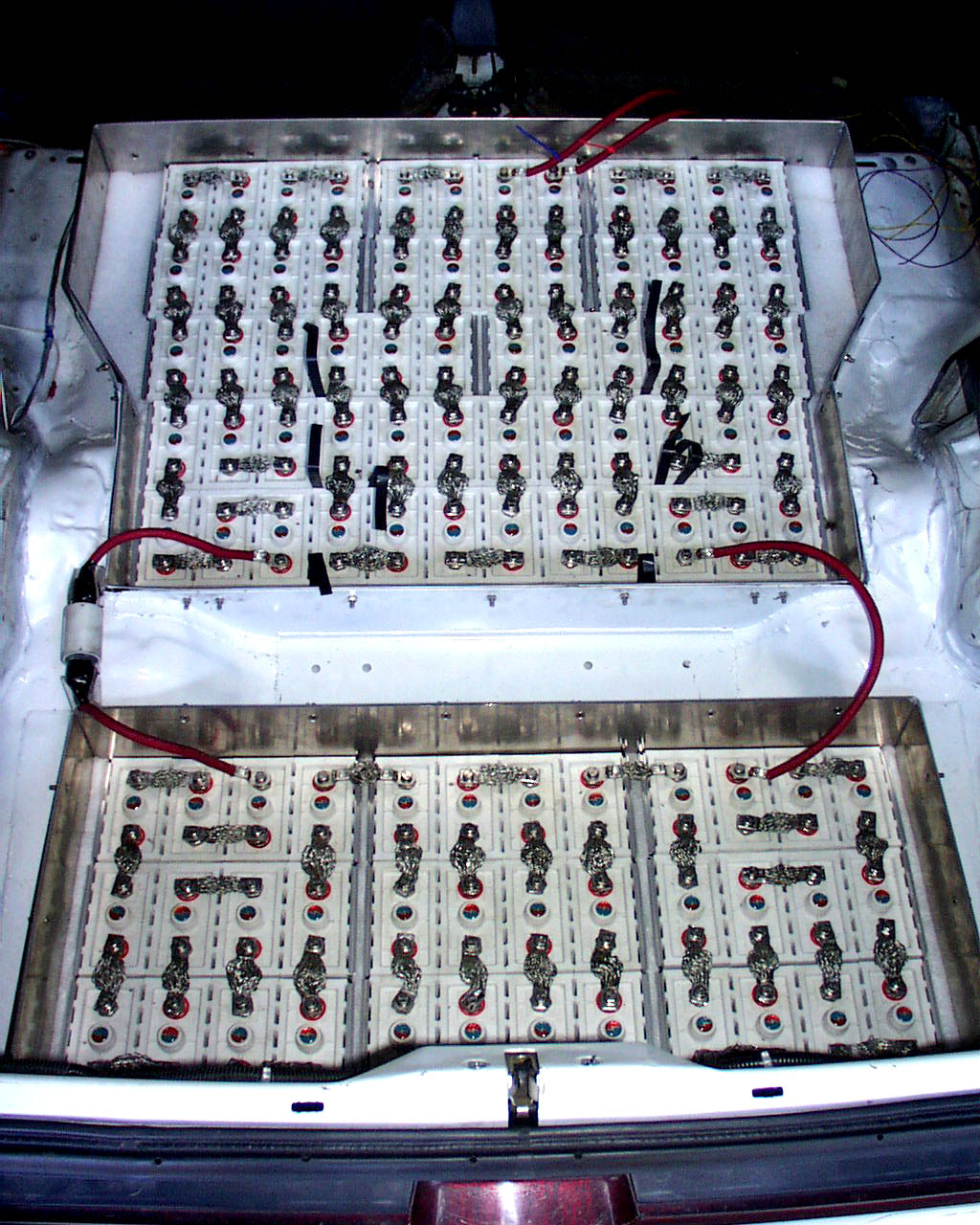
Here is earlier photo of the trial fit, you can see
where the jumpers are:

http://www.metricmind.com/ac_honda/images/bat_full.jpg

In my case the shunt voltage gets digitized and DC isolated right
there; the conversion PCB sits right on top of the shunt so I
don't deal with long wires carrying differential signals:

http://www.metricmind.com/ac_honda/images/cnt-shunt.jpg

But of corse everyone's situation is unique and there are many
solutions for the same problem.

--
Victor
'91 ACRX - something different


Danny Miller wrote:
Electrically it's the same of course.  Logisitically the interfacing
of stuff becomes a bit more complicated.  It's cleaner to just be
able to ground the battery.   For one, you can put the shunt, fuse,
and positive distribution block together in one assembly.  A lot of
people get confused trying to hook up things when you have the "-"
post and ground as two different things.  You still have to run the
shunt voltage as a differential signal to the ADC anyways.

Danny

Victor Tikhonov wrote:
I use low side shunts very successfully. Electrically it makes no
difference where in the loop the shunt is.
Can you explain what do you think the problem with low side shunt
topology is (interfacing of your stuff *to* that shunt aside)?
--- End Message ---
--- Begin Message ---
We are just starting a 1999 Dodge Neon conversion and wondered if anyone
else had done one?
I have a ADC 9" for it so far but have not decided on voltage or
batteries. Just was curios if anyone had figured out what worked the best.
Thanks
Randy

--
Canadian Electric Vehicles Ltd.
PO, Box 616, 1184 Middlegate Rd.
Errington, British Columbia,
Canada, V0R 1V0
Phone: (250) 954-2230
Fax: (250) 954-2235
Website: http://www.canev.com
Email: [EMAIL PROTECTED]
Manufactures of: "Might-E Truck"
EV conversion Kits and components
--- End Message ---
--- Begin Message ---
Ce=C1*C2/(C1+C2)
Same energy is available either way

-----Original Message-----
From: [EMAIL PROTECTED] [mailto:[EMAIL PROTECTED] On
Behalf Of Bill Dennis
Sent: Friday, 22 July 2005 8:59 AM
To: [email protected]
Subject: Capacitance Energy Question

I know that when you hook two capacitors in series, the capacitance goes
down, but it doesn't seem like the actual energy content of the two
capacitors changes.  Is that correct or not?  For example, you charge
first
capacitor to 5V, then disconnect from battery. Hook second capacitor to
battery and charge it to 5V, then remove from battery.  Now hook the
minus
of first capacitor to plus of second capacitor.  If you discharged the
capacitors this way (at 10V) would you get the same amount of energy out
of
them as if you discharged them each separately at 5V?

Thanks.

Bill Dennis
--- End Message ---
--- Begin Message ---
Bill,

Of course the energy is the same, it's like charging
in in paralleled strings so many Wh, reconnect in series
and ask if they still possess the same Wh. You didn't spend
any energy by re-arranging the bats, so it's the same.

To check:

The energy stored in the capacitor is (C*V^2)/2.

If you charge one 1F cap to 5V it will possess (1*5^2)=12.5J.
So will the other one, or 25J total.

If you connect them in series, you get 0.5F cap charged to 10V.

So, (0.5*10^2)/2=25J.

Hope this helps.

--
Victor
'91 ACRX - something different


Bill Dennis wrote:
I know that when you hook two capacitors in series, the capacitance goes
down, but it doesn't seem like the actual energy content of the two
capacitors changes.  Is that correct or not?  For example, you charge first
capacitor to 5V, then disconnect from battery. Hook second capacitor to
battery and charge it to 5V, then remove from battery.  Now hook the minus
of first capacitor to plus of second capacitor.  If you discharged the
capacitors this way (at 10V) would you get the same amount of energy out of
them as if you discharged them each separately at 5V?

Thanks.

Bill Dennis
--- End Message ---
--- Begin Message ---
Mark and All,
Problem is that on the T-145, Trojan has standardized on a "low profile"
marine  with a stud as you describe, but there isn't enough tapered section
to be an automotive post anymore, like maybe 1/3 of a normal post.
BB

>From: "Mark Hanson" <[EMAIL PROTECTED]>
>Date: Thu, 21 Jul 2005 09:33:05 -0400
>
>No need to order special terminals on floodeds for the proper automotive
>clamps, just zing off the battery post studs with a SawZall (reciprocating
>jig-saw).  If I have the height, I'll put a nut, washer and lock washer on
>top to keep the automotive terminal clamp from coming loose.
>Mark
--- End Message ---
--- Begin Message ---
Danny Miller wrote:
> So are there established opinions out there on whether desulfators
> can undo sulfation in flooded plate lead acid or not? I saw the
> patents on that but I also know that a patent doesn't in any way
> mean something does anything useful. I was thinking of building one.
> The schematics out there are kind of wacky though, I might want to
> design my own.

Basically, I don't think they work. I did a lot of playing with them,
and could not find any benefits. But you're welcome to try it anyway.
Maybe you can prove me wrong. It would be great if there *were* a magic
cure for bad batteries.

If you do try it, take careful data. Almost all the data on these things
is marketing hyperbole ("Revolutionary breakthrough!"), anecdotal (Clem
Kadiddlehopper says, "Dis here thang is a miracle!" or the results of
naive or rigged tests ("I put this device and a battery charger on, and
the battery charged!" Of course it charged; it would have charged
without it, too).
--
Ring the bells that you can ring
Forget your perfect offering
There is a crack in everything
That's how the light gets in
        -- Leonard Cohen, from "Anthem"
--
Lee A. Hart, 814 8th Ave N, Sartell MN 56377, leeahart_at_earthlink.net
--- End Message ---