EV Digest 6185

Topics covered in this issue include:
  1) Re: Clutchless gearbox CVT Warning
        by Tehben Dean <[EMAIL PROTECTED]>
  2) Re: cvt's, power transmission, I love this stuff!
        by Lee Hart <[EMAIL PROTECTED]>
  3) Re: Some newbie questions
        by Lee Hart <[EMAIL PROTECTED]>
  4) RPM match (was Re: Geo Metros)
        by Victor Tikhonov <[EMAIL PROTECTED]>
  5) Re: [EV] [EV] RE: [EV] RE: Some newbie questions
        by Eduardo Kaftanski <[EMAIL PROTECTED]>
  6) DC converter wiring and safety contactors
        by John <[EMAIL PROTECTED]>
  7) All Hybrid Cars Have CVT (barring Insight)?
        by John Wayland <[EMAIL PROTECTED]>
  8) RE: Clutchless CVT with Reverse using 2 motors and differential
        by Cor van de Water <[EMAIL PROTECTED]>
  9) Re: Source for bolts Help please!
        by Jeff Shanab <[EMAIL PROTECTED]>
 10) Re: DC converter wiring and safety contactors
        by "Roland Wiench" <[EMAIL PROTECTED]>
 11) Re: Direct Drive
        by Jeff Shanab <[EMAIL PROTECTED]>
 12) Transmission noise
        by "Fred Hartsell" <[EMAIL PROTECTED]>
 13) Re: Tesla Motors battery , comments
        by "Michaela Merz" <[EMAIL PROTECTED]>
 14) Re: All Hybrid Cars Have CVT (barring Insight)?
        by Tehben Dean <[EMAIL PROTECTED]>
 15) Re: Source for bolts Help please!
        by "Roy LeMeur" <[EMAIL PROTECTED]>
 16) http://slkelectronics.com/DeWalt/index.htm
        by Jeff Shanab <[EMAIL PROTECTED]>
 17) Re: All Hybrid Cars Have CVT (barring Insight)?
        by John Wayland <[EMAIL PROTECTED]>
--- Begin Message ---
Pretty much all of the hybrid cars out there barring the Insight have
CVT transmissions I believe.
On Dec 2, 2006, at 3:21 AM, Bruce Weisenberger wrote:
CVT on ICE's have a disengage ranging from 800 to 1500
rpm. This is to allows the ICE engine to idle.
This is true of all CVT's. I am not sure if you can
adjust the idle out of a CVT. As to AC Drives, they do
not require a transmission per say. But use a fixed
ratio single speed gearbox. See Electro Automotive for
a description. Imagine a CVT engaged while trying to
pull start that Polaris. Honda Scooters (Elite,
Silverwings [2000 era]) have CVT transmissions. Some
of the Toyota and Honda cars had CVT transmission.

I am not saying using a CVT is impossible, I am just
saying to be aware of the CVT limitation.

--- Jack Murray <[EMAIL PROTECTED]> wrote:
There is an EV ('48 Anglia) that uses a
transmission-less setup with a
Polaris CVT that gave it a 1:4 to 1:1 gearing range.
I've tried to track down more info on this CVT, but
haven't found much.
The ATV's its used in have up to 200hp.  I talked to
a Polaris dealer,
he said the CVT is more like a clutch and they have
a separate
transmission, told me the two pulleys and belt would
be roughly $800.
That isn't too expensive really, it would weigh A
LOT LESS than a
regular car transmission.  Note a car transmission
gives you reverse
without needing to use reversing contactors for a
serial DC motor.

Personally I think an AC motor with a CVT setup is
the way to go.. :)

Jack

[EMAIL PROTECTED] wrote:
I'm looking into this right now Tony, perhaps
there is a manufacturer who 'got clever' in some way
and electrified their autobax, which takes the
hydraulic change aspect out of the equation.
Also under investigation is hte possibility of
modifying one of the several types of CVT fitted in
the past 15 years or so...For fitted one to the
'Fiesta' in the UK over 12 years ago and they're
cheap from scrapyards.
As well as that I'm also looking out for an
overdrive unit fitted to the older sports cars, and
also the newer and older 4x4's
GKN make an electric overdrive with a 28% ratio
reduction, which can be engaged on the run, it could
be helpful, but I'ld sooner look into the CVT idea
first, if anyone has any input on CVT's I'ld love to
hear from you....it seems Toyota and Honda both do
electrically operated CVT's, but you need to buy a
hybrid first to get one....
Cheers
Chris

 Date: Thu, 30 Nov 2006 14:39:43 -0800 (PST)
From: Tony Hwang <[EMAIL PROTECTED]>
Subject: Re: Geo Metros
To: [email protected]
MIME-Version: 1.0
Content-Type: text/plain; charset=iso-8859-1
Content-Transfer-Encoding: 8bit
Message-ID:
<[EMAIL PROTECTED]>
Content-Disposition: inline

I think he meant swap the auto with someone else's
manual, but I could be wrong.
:)

With an auto though, you'd get rid of the torque
converter, right? This is a big
source of inefficiency, and is needed just cause
the ICE can't stop at idle, I
believe.

                             - Tony
______________________________________________________________________
______________
Do you Yahoo!?
Everyone is raving about the all-new Yahoo! Mail beta.
http://new.mail.yahoo.com
--- End Message ---
--- Begin Message ---
[EMAIL PROTECTED] wrote:
found on howstuffworks.com- hydrostatic transmissions... has anyone
ever done a study of power loss/efficiency of different types of
torque multipliers and power transmissions?
Hydraulic drives are common in large industrial vehicles, earth movers,
and even home garden tractors. They are small, light, and strong; but
not usually optimized for efficiency (as witnessed by the cooling fins
and oil coolers you see on them). But properly designed, they can be
very efficient. Professor Ernie Parker and his students at the Hennepin
Technical College in Minneapolis MN have built many high-efficiency
hydraulic vehicles.
Every form of transmission involves some loss. Gears and chains can be
very good, when you pay attention to the details. Chains can be enclosed
and lubricated to be virtually silent and maintenance free (think of the
timing chain in an ICE).
Belts have more loss, but sometimes the extra loss is compensated for by
being lighter, cheaper, or allowing continuously variable ratios, which
might allow a higher efficiency motor or controller.
I'm sure many people have done comparative studies of various drive
systems in depth. I know Bob McKee did so on his Sundancer cars in the
1970's. You might be able to find similar studies by the various solar
car teams, for example.
--
Ring the bells that still can ring
Forget the perfect offering
There is a crack in everything
That's how the light gets in    --    Leonard Cohen
--
Lee A. Hart, 814 8th Ave N, Sartell MN 56377, leeahart_at_earthlink.net
--- End Message ---
--- Begin Message ---
Peter VanDerWal wrote:
I said that IDLING the main drive motor has poor efficiency. With nothing
connected to it, an idling traction motor can draw 500 watts or more.
That would be unusually high. My Advanced DC L91 6.7" motor draws 0.5
amps from the 132vdc pack at 600 rpm no-load -- that's only 66 watts.
Your efficiency when just powering the accessories could be 50% or less.
This is pretty poor efficiency.
Yes, that's true. However, the total amount of power being used is also
low. You could leave the EV idling continuously for a couple days before
it ran down the propulsion pack.
--
Ring the bells that still can ring
Forget the perfect offering
There is a crack in everything
That's how the light gets in    --    Leonard Cohen
--
Lee A. Hart, 814 8th Ave N, Sartell MN 56377, leeahart_at_earthlink.net
--- End Message ---
--- Begin Message ---
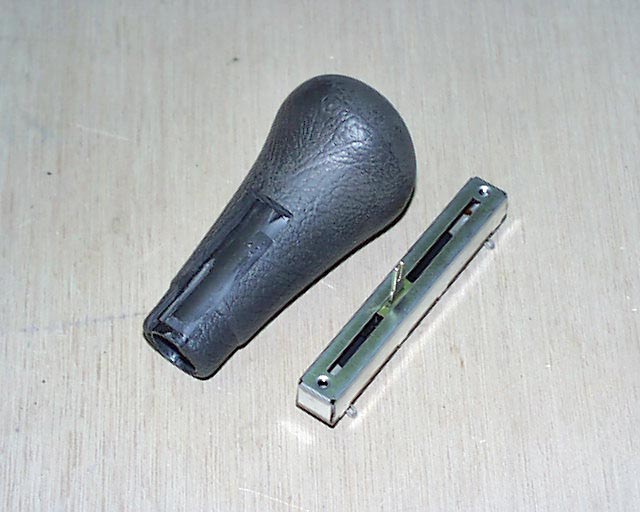
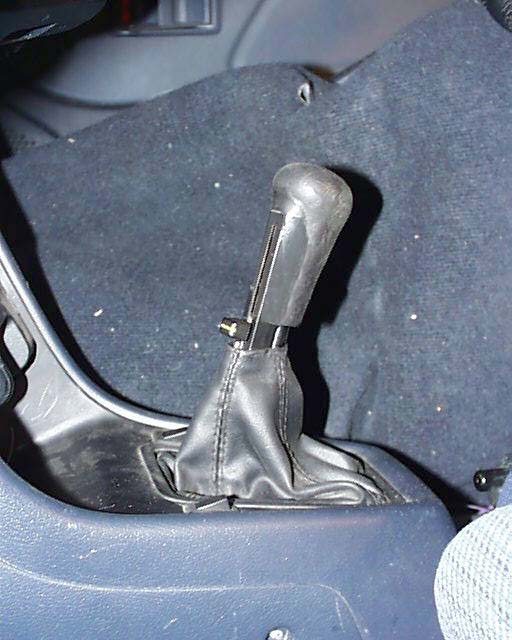
Good point Jeff, and regen ability of an AC drive shines here again.
In a rare occasion I wanted to shift up I pop the shift stick to neutral
and slide my linear pot controlling regen just enough to slow down
free spinning motor so RPM about match taller gear's engagement ratio.
With little practice it became easy, especially because regen pot
installed tight on the shifter:
http://www.metricmind.com/ac_honda/images/br_pot1.jpg
http://www.metricmind.com/ac_honda/images/br_pot7.jpg

Pulling regen lever up while pushing shifter toward the gear
position "always" allow it to slip right in at the moment of
matching RPMs. If I slow down too aggressively and miss this point,
tap on accelerator fixes it right away.

My next EV will be clutchless but retain all gears in case I
choose to use them. And this control arrangement works well
for me.

But, there is one inconvenience though: if I steer with left
hand (which I do) and drink soda or coffee or talk on a cell
(without bluetooth ear piece), right hand is busy and I can't
use regen lever in that moment. 'Course normal brakes are
always there for that. I still prefer this to having regen
pot on the brake pedal, because you don't have to take your
foot off throttle to brake. You don't even have to release
accelerator - regen is programmed as priorirty over acceleration,
so as soon as linear pot is touched, accelerator is disabled.
After finishing braking acceleration resumes up to the speed
that was before braking, sort of cruise control "resume"
function.

Victor


Jeff Shanab wrote:
I hate to slightly disagree with the experts but if a vehicle shifts up
without the clutch as an ICE well it will not automagically be better
with the electric motor and the light flywheel. The reduced spinning
mass helps the missmatch in rpms come in faster once you shove it in,
but there is no compression to bring the rpms down initially so you
spend more time against the syncros or you engage with a larger
difference. The RPM drop between 2 gear ratios does make a difference also.

if I am accelerating in second (1.902 * 3.7 = 7.037 OA ratio) at 30mph
and a 24" OD tire, I am spinning the wheels 840 rotations per
mile,840rpm at 60mph or 420rpm at 30mph. Multiply by 7.037 and the warp
9 is spinning 2956RPM.

if I am in third at 30 mph then the ratio of (1.308*3.7 = 4.8396). Same
wheel rpm of 420 gives me a motor rpm of 2033rpm

2956-2033 is a 923rpm drop

If you watch the tach on an Ice that takes fractions of a second
If you watch the tach on the electric, it takes seconds.

So perhaps the clutch pedal should be left in the vehicle and activate
the field of an alternator tied to the aux shaft when pressed. This will
bring in the rpms faster and help charge the aux battery. (you would
only use this during up shifts! )
--- End Message ---
--- Begin Message ---
On Sat, Dec 02, 2006 at 12:08:08PM -0800, Cor van de Water wrote:
> Eduardo,
>
> 40 minutes to go 5 miles?
> Wow - you need a bicycle.
> That should take you there in 20 to 25 min every day.

Yep. I used to drive a small motorcycle, but selling it
was in the pre-nup :)

>
> Don't know where you live though,

Santiago de Chile.


> bicycling is not always a good (weather) option
> or some locations have no decent bicycle
> facilities, for example crossing a freeway
> is sometimes only possible miles away from
> the shortest >car< route, because many traffic
> engineers only think in terms of their own
> car and freeway building is then the best
> option for a lot of problems.
>
> The same issue as a NEV faces to get around town.
>

We have now a huge public transportation problem tipical
of southamerica. In the 70s transport was liberalized and
privatized and the result was 20.000 tiny busses making all
kind of highly inefficient routes and we have been
trying to make it right for the last 20 years. Next february
(middle of the summer) we'll cut over to a system of feeders
and trunk routes that should greatly easy this caotic city's
traffic.

Commuting in a bicycle today would be suicidal. I'd be dead
in a week.


--
Eduardo K.            |
http://www.carfun.cl  | Freedom's just another word
http://e.nn.cl        | for nothing left to lose.
                      |
--- End Message ---
--- Begin Message ---
Converter wiring:
What are the benefits and drawbacks of wiring a DC-DC converter to be
always on versus switched on by the key switch? My planned vehicle
usage is a daily commute of about 1.25 hrs total drive time (about 40
min each way).
If I want to wire it up so it is switched on with the key switch, (and
don't install the safety contactor(s) inquired about below) would I
need a relay on both the positive and negative leads from the traction
pack to the DCDC?
(The converter is a CC power 400watt converter that has a 20amp fuse
that looks to be on the input side)
Would the relay or relays need a snubber circuit as is recommended for
ceramic heater relays?
Safety contactors:
In response to my post requesting input on my draft circuit diagram
Roland recommended adding safety contactors in both the positive and
negative leads off the traction pack (an added benefit is a switched HV
power source for DC/DC and heater).
Do I get any benefits from adding a single safety contactor? If yes, in
positive or negative lead?
The appropriate sized contactors are not cheap I don't recall hearing
of others conversion that include them.
I respect (and appreciate) Roland's input, however I believe another
respected list member once commented that Rolands EV has back-up safety
contingencies that NASA would be proud of.
--- End Message ---
--- Begin Message ---
Hello to All,

Tehben Dean wrote:
Pretty much all of the hybrid cars out there barring the Insight have
CVT transmissions I believe.
That's incorrect info. You should probably research things more
carefully before making such statements.
Not only did the Insight come as either a 5 speed or CVT model (all
seven years of production for the 5 speed and the last 6 years of
production as a CVT), it was in fact, the very 1st hybrid to be offered
with a CVT! Excluding the Insight as having a CVT when it was the first
hybrid to ever have one, is a pretty big error.
Though Honda Civic Hybrid does come with a CVT, it is also offered
without one and a with a 5 speed tranny instead. Toyota doesn't give its
hybrid consumers a transmission choice...Honda does.
The high powered V6 hybrid Honda Accord has a conventional 5 speed
automatic, and is not even offered with a CVT.
I've just listed three hybrids that are sold without CVTs, one of which
was arguably the most famous and was the very 1st hybrid ever offered to
the US market, the Insight. Another is based on a best-selling compact,
the Civic, and the another is one of the quickest and fastest hybrids
offered, the 5 speed V6 hybrid Accord.
The Prius and its licensed spin-offs like the Escape Hybrid and the
Lexus RX 400 Hybrid use a sun-planetary arrangement between a traction
motor, a starter-generator, and the ICE, called an ECVT. In the first
several years the Prius was explicitly described as 'not having a CVT'.
The classic CVT is a tranny with near infinite gear ratios accomplished
with conical sliding pulleys and metalized belts, that like regular
manual and automatic transmissions, multiplies engine torque. The Prius
sun-planetary arrangement ECVT has only one gear ratio, does not
multiply engine torque, and though a fascinating and creative design,
isn't anything close to a real CVT. There's a great site with a full
description and illustrations here:
http://www.cleangreencar.co.nz/page/prius-transmission
Now that CVT is a acronym-buzzword gaining popularity however, and since
in reality the Prius does have a continuously variable 'transmission of
power' to the wheels, the Prius is now being described as having a
CVT...interesting. The above site says,"ECVT in the Prius works in a
completely different manner from any other CVT put into a production
car. It is so different, that calling it a CVT is misleading." I
couldn't agree more.
Technically speaking, the Prius, the 5 speed Civic Hybrid, the Lexus RX
400 Hybrid, the 5 speed Insight, the Escape Hybrid, and the 5 speed
automatic Accord Hybrid all do not have CVTs. Ironically, in reference
to Dean's post, the only hybrid that 'does' have a true CVT is (was) the
Insight!
See Ya....John Wayland
--- End Message ---
--- Begin Message ---
The remark to look at the Toyota (Prius) setup for CVT
formed an idea in my head, an answer to several of the
issues that I have been thinking about of solving for
the design of an EV, as several of these have come up
and were discussed here, but this gives a new solution:

Add a differential as CVT, driven by 2 electric motors at
the half-shaft outputs, while the driveshaft input is now
the output.

This resembles the Prius continuous variable gears without
clutch and it allows you to multiply torque while varying
the gear ratio from zero to twice the differential gearing.
(The diff gearing will need to be changed as standard
gearing will cause the motors to rotate near the speed of
the wheel rpm, way too low for efficiency, OR you can keep
the gearbox and feed the diff output shaft into the box
which can be fixed into low gear.

Just like the Prius, it may be beneficial to dedicate one
motor to act mainly as generator, although you would also
want to drive this motor and have extra power toi the
wheels (and use the higher gearing from the addition of
the two motors RPM) for high speed travel.
For ease of terms, I will now name the motors M1 and M2,
with M2 mainly operating as generator (spinning with
negative rpm).
To start from zero, M1 starts spinning near its most
efficient point, causing M2 to spin just as fast in the
opposite direction. To start moving, you need to increase
the current delivered by M2 (also increasing the load on
M1 and therefor its current) to create the torque that
starts the wheels moving slowly (the difference in speed
between M1 and M2)
The operation of the differential connecting M1 and M2
will allow approx half maximum speed with M2 acting as a
generator, for higher speeds M2 needs to change direction
and help propel the vehicle with the *addition* of the
speeds of the two motors, instead of the difference.

I can imagine this setup with 2 shunt wound motors
(for easy DC control) where M1 has a fixed field (no
field weakening necessary) and you control the motor
current with a regular powerful DC controller as used
for series motors, while M2 can have a contactor to
connect the armature to the pack and can either use a
small controller for the field to create the proper
speed and load that gives the torque to drive the car
at lower speed and to control the speed when used as
motor in reverse for high speed operation, or M2 can
be simply hooked to the pack as shunt motor through
a set of contactors and the control comes from M1.
A low-power reversing contactor is needed to switch
the shunt winding of M2 from generator to motor.

The most tricky part is how to do this switch-over,
you would need a kind of Hairball controller to do
this, or have a button or switch for the driver to
switch between the two directions of M2, as in
having an electronic gear switch.

The reason that M2 does not need control even when
acting as a motor is that it takes over from M1 when
M1 is redlining at the highest low speed gear, so M1 can
go back to low RPM while they both push the vehicle.

Note that in the Prius the gearing between the motors
is not equal to match their characteristics curves to
the different states and speeds of driving.
An example will clarify:
 0 to 40 mph: M1 goes from 1000 to 5000 rpm while
              M2 stays at a constant -1000 rpm
40 to 80 mph: M2 switched to motor at 3000 rpm while
              M1 again covers the 1000 to 5000 rpm.

You can see that it actually makes sense to use
different gearing for the two motors as one is
redlining at 5000 while the other never goes above
3000 rpm in the example.
You can vary the speed of M2 if you want, when both
M1 and M2 are redlining at 5000 rpm you get a whopping
10,000 rmp (multiplied by the diff gearing, so its
output may be over 30,000 rpm!) as the addition of
the two speeds into the diff. You probably want to
get a diff that has about 1 as gear ratio to avoid
these extreme speeds.

Note also that at standstill with throttle, both
motors are spinning and so you won't burn up your
motor when holding the car on a ramp by throttle.

Battery currents are low in low gears, due to M2
generating electricity, which feeds M1's controller.
That means that battery currents are low, while
current (and thus wheel torque) can be high by this
looping around of energy in the form of current
from M1's controller into M1, as mechanic energy
from one side of the diff to the other, into M2
and as electric energy from M2 back to M1's controller
so the battery current is only the difference caused
by the losses in the system and the energy that goes
to the wheels

Regeneration is also easy to achieve, but requires
that the small controller for the M2 field is used
to regulate how much deceleration is created and
M1 to be controlled in a way to reduce spinning
(create negative torque) otherwise all that
happens is that M1 will spin freely and can overrev.
If a contactor can short M1 or the controller can
make M1 slow down, then either M2 alone or the
combination of M1 and M2 can generate electricity.

Reversing the car is comparable to regeneration in
that M1 needs to be kept down in rpm by either
shorting it or allowing it to feed power (also
act as a generator in reverse) and M2 acting as
motor with the field switched as generator, so it
turns backwards while acting as motor.

Note that with AC motors, the direction of M2 can be
controlled without sudden changes, it can simply
modify the speed of M1 and M2 gradually and control
the current flow in or out (motor or generator).
The only restriction is to try and keep any motor
away from zero RPM by increasing or reducing the
opposite motor's speed. This will avoid overheating
the motor.
Even the Prius avoids some motor speeds, you will
notice this when driving that the engine when
slowly pushing the accelerator more and more will
suddenly jump up about 1000 rpm, this is where
the difference between wheel speed and engine
speed would cause the electric motor be near zero
rpm. The other motor however is often at zero speed,
as that is fixed connected to the engine, so as long
as the Prius is moving under electric power alone,
that motor is not moving and keeping the engine
from spinning by giving counter-torque against the
torque delivered by the first motor. The second
motor also doubles as a starter/generator although
both motors can at times become generators.
Real fascinating technology in the Prius.

Just some food for thought....

Cor van de Water
Systems Architect
Email: [EMAIL PROTECTED]   Private: http://www.cvandewater.com
Skype: cor_van_de_water    IM: [EMAIL PROTECTED]
Tel:   +1 408 542 5225     VoIP: +31 20 3987567 FWD# 25925
Fax:   +1 408 731 3675     eFAX: +31-87-784-1130
Proxim Wireless Networks   eFAX: +1-610-423-5743
Take your network further  http://www.proxim.com


-----Original Message-----
From: [EMAIL PROTECTED] [mailto:[EMAIL PROTECTED]
Behalf Of Bruce Weisenberger
Sent: Saturday, December 02, 2006 4:21 AM
To: [email protected]
Subject: Re: Clutchless gearbox CVT Warning


CVT on ICE's have a disengage ranging from 800 to 1500
rpm. This is to allows the ICE engine to idle.
This is true of all CVT's. I am not sure if you can
adjust the idle out of a CVT. As to AC Drives, they do
not require a transmission per say. But use a fixed
ratio single speed gearbox. See Electro Automotive for
a description. Imagine a CVT engaged while trying to
pull start that Polaris. Honda Scooters (Elite,
Silverwings [2000 era]) have CVT transmissions. Some
of the Toyota and Honda cars had CVT transmission.

I am not saying using a CVT is impossible, I am just
saying to be aware of the CVT limitation.

--- Jack Murray <[EMAIL PROTECTED]> wrote:

> There is an EV ('48 Anglia) that uses a
> transmission-less setup with a
> Polaris CVT that gave it a 1:4 to 1:1 gearing range.
> I've tried to track down more info on this CVT, but
> haven't found much.
> The ATV's its used in have up to 200hp.  I talked to
> a Polaris dealer,
> he said the CVT is more like a clutch and they have
> a separate
> transmission, told me the two pulleys and belt would
> be roughly $800.
> That isn't too expensive really, it would weigh A
> LOT LESS than a
> regular car transmission.  Note a car transmission
> gives you reverse
> without needing to use reversing contactors for a
> serial DC motor.
>
> Personally I think an AC motor with a CVT setup is
> the way to go.. :)
>
> Jack
>
> [EMAIL PROTECTED] wrote:
> > I'm looking into this right now Tony, perhaps
> there is a manufacturer who 'got clever' in some way
> and electrified their autobax, which takes the
> hydraulic change aspect out of the equation.
> > Also under investigation is hte possibility of
> modifying one of the several types of CVT fitted in
> the past 15 years or so...For fitted one to the
> 'Fiesta' in the UK over 12 years ago and they're
> cheap from scrapyards.
> > As well as that I'm also looking out for an
> overdrive unit fitted to the older sports cars, and
> also the newer and older 4x4's
> > GKN make an electric overdrive with a 28% ratio
> reduction, which can be engaged on the run, it could
> be helpful, but I'ld sooner look into the CVT idea
> first, if anyone has any input on CVT's I'ld love to
> hear from you....it seems Toyota and Honda both do
> electrically operated CVT's, but you need to buy a
> hybrid first to get one....
> >
> > Cheers
> > Chris
> >
> >  Date: Thu, 30 Nov 2006 14:39:43 -0800 (PST)
> > From: Tony Hwang <[EMAIL PROTECTED]>
> > Subject: Re: Geo Metros
> > To: [email protected]
> > MIME-Version: 1.0
> > Content-Type: text/plain; charset=iso-8859-1
> > Content-Transfer-Encoding: 8bit
> > Message-ID:
> <[EMAIL PROTECTED]>
> > Content-Disposition: inline
> >
> > I think he meant swap the auto with someone else's
> manual, but I could be wrong.
> > :)
> >
> > With an auto though, you'd get rid of the torque
> converter, right? This is a big
> > source of inefficiency, and is needed just cause
> the ICE can't stop at idle, I
> > believe.
> >
> >                              - Tony
> >
> >
> >
> >
> >
>
>


____________________________________________________________________________
________
Do you Yahoo!?
Everyone is raving about the all-new Yahoo! Mail beta.
http://new.mail.yahoo.com
--- End Message ---
--- Begin Message ---
Bob eludes to a good point, Forgive if this is off topic.

The cheap Chinese product symptom is really the greedy American
distributer syndrome. Some have dictated price regardless of quality and
the Chinese are happy to provide.  If it wasn't for American
distributors who have decided junk is the way to make the most profit,
the Chinese probably wouldn't get such a bad rep.

AKA the Walmart syndrome, Caveat emptor, "give the people what they
want, if they don't know tell them what they want"
--- End Message ---
--- Begin Message ---
Hello John,

Here is a test you can do:

Install the electrical systems without the safety contactors, ground the
vehicle frame with the input AC lines, turn on the charger and take a
reading from any battery terminal to the EV frame working down to the main
contactor on one dc line and to the controller with the other dc line.

Then  read at the motor terminals to the motor frame.  You will normally not
read any voltage at this time.  But as time goes on, the motor builds up in
brush dust and the battery surfaces, battery enclosure start to become more
conductive no matter how much you clean it.

This cause arc over which I can only see with the lights off, at the
batteries, motor and DC-DC converter which took that out.

In the past, the electrical systems were two bare wires on insulators with
no grounds.  The electrical code always get updated when something blows up
or burn downs.  Then we added a insulated wire in a jacket and use the
neutral wire as a ground conductor too in a two wire cable.

It was found that this did not work, because a short circuit cause it to run
through metal enclosure and electrocute someone.  Then we add a separated
ground wire that connected to the neutral bar in the circuit breaker panel.
Still that cause problems if a neutral wire open up in the circuit, so we
connect the ground wire in side a meter base and to a ground rod and which
the neutral is cross connected at the ground rod.

Now some states, require a electrical ground to the neutral at the
transformer and a separated lightning arrestor ground wire connect to its
own ground rod.

Every time something happens they change the electrical wiring in a system.

You can also wait until any of these voltages indication show up and fix
them later.

Roland


----- Original Message -----
From: "John" <[EMAIL PROTECTED]>
To: <[email protected]>
Sent: Saturday, December 02, 2006 4:00 PM
Subject: DC converter wiring and safety contactors


> Converter wiring:
> What are the benefits and drawbacks of wiring a DC-DC converter to be
> always on versus switched on by the key switch? My planned vehicle
> usage is a daily commute of about 1.25 hrs total drive time (about 40
> min each way).
>
> If I want to wire it up so it is switched on with the key switch, (and
> don't install the safety contactor(s) inquired about below) would I
> need a relay on both the positive and negative leads from the traction
> pack to the DCDC?
> (The converter is a CC power 400watt converter that has a 20amp fuse
> that looks to be on the input side)
>
> Would the relay or relays need a snubber circuit as is recommended for
> ceramic heater relays?
>
> Safety contactors:
> In response to my post requesting input on my draft circuit diagram
> Roland recommended adding safety contactors in both the positive and
> negative leads off the traction pack (an added benefit is a switched HV
> power source for DC/DC and heater).
>
> Do I get any benefits from adding a single safety contactor? If yes, in
> positive or negative lead?
>
> The appropriate sized contactors are not cheap I don't recall hearing
> of others conversion that include them.
>
> I respect (and appreciate) Roland's input, however I believe another
> respected list member once commented that Rolands EV has back-up safety
> contingencies that NASA would be proud of.
>
>
--- End Message ---
--- Begin Message ---
What about a locking torque converter. There are units specifically for
this isolated type design but maybe som enterprising converter can
figure out how to use a stock one.

It would allow idleing.
It would provide a CVT like change in gear ratio pulling away from the
light then we can lock it in.
Perhaps releaseing and re-engageing the lock could be done during a
shift if the manual tranny is still kept, to soften the shift and
viscously pull down the rpms.

http://bankspower.com/Tech_understandtorqueconver.cfm
Just reading some general info, it looks like a torque converter from a
diesal and some adapter that would let us presurize the oil to select
lock-up.

Maybe modifying an automatic into a semi-automatic would be interesting
like manually blocking the bands in and letting the clutches and pump
and torque converter still function. But then why not just use an
automatic with an external pressure pump. or accumulator.? :-)
--- End Message ---
--- Begin Message ---
Well I have just completed my first trial run with the DakotaEV but the EV
grin was short lived.  I first drove the EV to my church for Sunday services
and it was a big hit with my friends at church.  Then my son-in-law and
granddaughter wanted me to give them a ride in it so I did.  Each of the
trips was about a two mile round trip.  Near the end of the second two mile
round trip, I noticed that there was a noise coming from somewhere around
the transmission.  It was not a loud noise but it seemed to be a grinding
type of sound.  I was not sure if something was actually wrong or if I was
just hearing noises that would not be heard under normal ICE motor
conditions.  But I went on and pulled the transmission anyway, just to be
safe.  I did not find anything loose on the clutch/flywheel assembly.  I did
find that the front shaft on the transmission was a little loose.  I was
concerned about that being the source of the noise.  The gears in the
transmission looked very new as if someone had rebuilt the transmission
recently.  My question is to all of the EV'ers out there that uses
transmissions.  Does the fact that the electric motor being so much quieter
than a standard ICE motor cause you to hear more common noises than you
would normally not hear with the ICE motor?  I am not a good enough
transmission expert to tell if there are problems with the transmission.  I
can only tell what my eyes see when I inspect it.   The transmission looks
ok to me with the exception of the front shaft being loose.  Also I did not
measure the lube when I drained it out but I did notice that when I remove
the side plug to check the level, I did not see or feel any fluid level in
the transmission which leads me to believe that the transmission may have
been low on lube.  I would appreciate any advice as I would like to get this
problem fixed so that I can get the EV back on the road.  It was fun driving
it until I started hearing the noise.
--- End Message ---
--- Begin Message ---
It's not about building. Its about making a business out of it. It's easy
to burn tons of money with nice looking R&D projects. The question is: Who
is going to be able to make the R&D stuff ready to the marketing people.
And if it is ready, will it sell?

Sure, I'd like to have a TZERO or a Tesla in my garage. But am I willing
to put 100,000 hard earned bucks on the table? One could get a brand
spanking new Porsche with all the bells and whistles for that kind of
money. And a great proven technology as well as professional customer
service just around the corner. Sooner or later our 'serious' car (the one
with the air conditioning, all wheel drive, air bags, ABS etc.) will have
to be replaced. Will the new car be an EV? Only if it goes about 200
Miles, has some sort of service in a 100 Miles radius and cost not more
than 1.5 times a comparable midsize sedan. But .. I guess I am dreaming.

Michaela


> Don't forget Phoenix Motors David.
>
> I don't get all of you skeptics??? Could you please tell me what you
> are so skeptical about; you are EV owners and builders, right?
> Surely 'you' could build something similar with hundreds of thousands
> of $$$.
> Am I missing something?
>
> Tehben
>
>
> On Dec 2, 2006, at 10:01 AM, David Dymaxion wrote:
>
>> It's not like it has never been done before. http://
>> www.acpropulsion.com made the Tzero with 6800 Li batteries and put
>> many miles on it. They sell the BMSes for Li on their web site.
>> Since Tesla is working with AC Propulsion already, maybe they are
>> just buying or licensing the BMS?
>>
>> On a related note, ACP says they will be selling Scion conversions
>> soon, for about $55k over the cost of the donor car. Might be some
>> competition for Tesla.
>>
>> ----- Original Message ----
>> From: Michael Perry <[EMAIL PROTECTED]>
>> To: [email protected]
>> Sent: Friday, December 1, 2006 9:40:43 PM
>> Subject: Re: Tesla Motors battery , comments
>>
>> OK... I'm a total skeptic. Show me a car that works, at any price,
>> and I'll
>> be impressed. Turn over a single unit, at any price, with any
>> supervision,
>> and let this car do its job... in the hands of an average ICE
>> driver... a
>> total novice. I don't care if the car has to have the unit cost of a
>> helicopter per mile... just show me that it can function, on any
>> basis, in
>> the real world. (BTW, helicopters in the VN era took hours of
>> maintenance
>> per hour of operation. Some required 12 hours of maintenance for a
>> single
>> hour of operation.) I can only assume this car will take similar
>> maintenance... hours of work to get a few spectacular minutes of
>> operation... until they prove us wrong.
>>
>> In the meantime, I can not see a single way that one can overcome
>> all those
>> connections and batt failure points, to deliver a product that will
>> work.
>> It'd be much like building your computer from discrete
>> components... all
>> those thousands of switching circuits (currently on the processor)
>> from
>> individual units. This car isn't quite that extreme, but it gives a
>> picture.
>>
>>
>>
>>
>>
>>
>>
>> ______________________________________________________________________
>> ______________
>> Need a quick answer? Get one in minutes from people who know.
>> Ask your question on www.Answers.yahoo.com
>>
>
--- End Message ---
--- Begin Message ---
Sorry, My bad.
I should have done more research on Honda before posting. I was not
aware that that the insight was available with a CVT.
I did say "pretty much" and "I believe".
As far as I was/am aware (from reading their websites) all Toyota
hybrids, the Ford Escape and Lexus all have CVT trannies. Toyota,
Ford and Lexus all state "electronicaly controlled continuously
variable transmission", they are "continuously variable
transmissions" CVT's that are electronically controlled. I am sorry
but I did not see a difference.
So that is 5 hybrids with CVTs, 1 without (Accord) and 2 with the
option (Insight and Civic).
I could also argue that the Escape is not a licensed spin off from
Toyota and was partially developed independently.
I believe that the hybrid idea used by Ford and Toyota was originally
being developed by a third party which was working for Toyota. Toyota
decided to move on on its own and the third party company was bought
by Volvo, I think, then Ford merged or whatever with Volvo and so now
owns the original hybrid developer.
They have subsequently licensed "Some stuff" from Toyota to avoid
lawsuits (this is common in the automotive industry when two
companies develop things independently that are the same).
If anyone can find any flaw I what I have said please let me know. : )

-Tehben


On Dec 2, 2006, at 1:41 PM, John Wayland wrote:
Hello to All,

Tehben Dean wrote:
Pretty much all of the hybrid cars out there barring the Insight
have CVT transmissions I believe.
That's incorrect info. You should probably research things more
carefully before making such statements.
Not only did the Insight come as either a 5 speed or CVT model (all
seven years of production for the 5 speed and the last 6 years of
production as a CVT), it was in fact, the very 1st hybrid to be
offered with a CVT! Excluding the Insight as having a CVT when it
was the first hybrid to ever have one, is a pretty big error.
Though Honda Civic Hybrid does come with a CVT, it is also offered
without one and a with a 5 speed tranny instead. Toyota doesn't
give its hybrid consumers a transmission choice...Honda does.
The high powered V6 hybrid Honda Accord has a conventional 5 speed
automatic, and is not even offered with a CVT.
I've just listed three hybrids that are sold without CVTs, one of
which was arguably the most famous and was the very 1st hybrid ever
offered to the US market, the Insight. Another is based on a best-
selling compact, the Civic, and the another is one of the quickest
and fastest hybrids offered, the 5 speed V6 hybrid Accord.
The Prius and its licensed spin-offs like the Escape Hybrid and the
Lexus RX 400 Hybrid use a sun-planetary arrangement between a
traction motor, a starter-generator, and the ICE, called an ECVT.
In the first several years the Prius was explicitly described as
'not having a CVT'. The classic CVT is a tranny with near infinite
gear ratios accomplished with conical sliding pulleys and metalized
belts, that like regular manual and automatic transmissions,
multiplies engine torque. The Prius sun-planetary arrangement ECVT
has only one gear ratio, does not multiply engine torque, and
though a fascinating and creative design, isn't anything close to a
real CVT. There's a great site with a full description and
illustrations here:
http://www.cleangreencar.co.nz/page/prius-transmission
Now that CVT is a acronym-buzzword gaining popularity however, and
since in reality the Prius does have a continuously variable
'transmission of power' to the wheels, the Prius is now being
described as having a CVT...interesting. The above site says,"ECVT
in the Prius works in a completely different manner from any other
CVT put into a production car. It is so different, that calling it
a CVT is misleading." I couldn't agree more.
Technically speaking, the Prius, the 5 speed Civic Hybrid, the
Lexus RX 400 Hybrid, the 5 speed Insight, the Escape Hybrid, and
the 5 speed automatic Accord Hybrid all do not have CVTs.
Ironically, in reference to Dean's post, the only hybrid that
'does' have a true CVT is (was) the Insight!
See Ya....John Wayland
--- End Message ---
--- Begin Message ---
Please let us all know when you find a source of 1/4" diameter bolts that
can be tightened to 108 ft. lbs. :^D
On 12/1/06, Mark Ward <[EMAIL PROTECTED]> wrote:
I need a recommendation on a supply source.  Some of you guys I am sure can
tell me.
I ran into a problem yesterday when I found out that some 1/4 20 allen
bolts
I purchased appear to be case hardened and not machined Grade 8's the way
they were presented to me. I believe the problem to be is the bolts I
purchased from a local vendor are made in Taiwan and are soft on the
inside.
I managed to break two of them off installing my taperlock on my motor at
about 30 pounds of torque.  The specs call for 108 foot pounds, and I have
double checked this both in the machinist's handbook (regarding bolt types
and torques) and the data that came with the taperlock bushing.   The bolts
shipped with the taperlocks all appear to Grade 5 and apparently work ok
(but are for front mount), so I am betting it is just a cheap bolt. This
was
apparent when I had a lot of difficulty fishing the broken piece out.  The
visegrips were able to chew it up, so they are soft on the inside and snap
with a sickening "clink".

Does anyone know of a vendor where I can get good quality Allen or other US
made bolts?   I need some of the 1/4 20 cap screws 3" long.

No more chinese bolts for me!!!!!

Mark Ward
95 Saab 900SE "Saabrina"
www.saabrina.blogspot.com
Roy LeMeur

_________________________________________________________________
Get free, personalized commercial-free online radio with MSN Radio powered
by Pandora http://radio.msn.com/?icid=T002MSN03A07001
--- End Message ---
--- Begin Message ---
I thought this may be of interest to some on the list.
disecting the M1 dewalt packs.

I have been looking at this as a economical way of getting into the M!
cells as the packs are made in such quantity that already we can get
pricing better than small qty pricing from A123.
--- End Message ---
--- Begin Message ---
Hello Tehben and All.

Tehben Dean wrote:
Sorry, My bad.
I should have done more research on Honda before posting. I was not
aware that that the insight was available with a CVT.
That's OK, the thing that really got me was your exclusion of the only
hybrid that truly has (had) a CVT, the Insight. None of the other
hybrids have a CVT, a special tranny with cone-like pulleys and metal
belts that provides near infinite ratios.
As far as I was/am aware (from reading their websites) all Toyota
hybrids, the Ford Escape and Lexus all have CVT trannies. Toyota,
Ford and Lexus all state "electronicaly controlled continuously
variable transmission", they are "continuously variable
transmissions" CVT's that are electronically controlled. I am sorry
but I did not see a difference.
You have to be able to discern marketing hype from fact. The
sun-planetary system is a single gear and is not by any stretch,
continuously variable, as is a true CVT. It never changes ratios and it
doesn't multiply torque, it simply distributes torque. The net effect of
using the sun-planetary with an electric motor, generator, and ICE
however, gives a continuously variable 'drive system'. If the
manufacturers want to 'sell' them as CVTs, fine, but they are not.
So that is 5 hybrids with CVTs, 1 without (Accord) and 2 with the
option (Insight and Civic).
Again, incorrect. There is only one hybrid that ever had a CVT...the
Insight. The others have a variable drive system based on a
sun-planetary system that never changes gear ratios as does a true CVT.
I would amend your statement to say....5 of the mentioned hybrids have a
variable drive automatic system, one has a standard 5 speed automatic,
and two can be had with either 5 speed manual or CVT transmissions.
Either way, your original comment about all hybrids except the Insight
having CVTs, was incorrect. The current crop of hybrids offer a variety
of drive systems, some with manual 'you-shift-it' trannys, some with
CVTs, and some without a transmission at all.
See Ya....John Wayland
--- End Message ---