Hi Peri,

Indeed - if you design the device for the same efficiency then in theory  it
does not matter if you recharge at 1kW, 100kW or MegaWatts, the wasted energy
will still be the same percentage of the delivered energy and you are
essentially only varying time and cost.
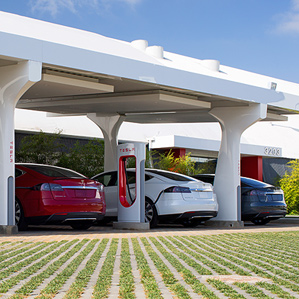
Note that at high power, also the internal resistance of the battery becomes important so it is not only a design of the charger, but of the whole system, battery and car-side circuits included. Also, at such high power levels you want to design for efficiency as it costs considerable effort and money to remove large amounts of heat, so at MegaWatt power levels, you should be tempted to design for *higher* efficiency then at 1kW level (I know of EV that lose almost half the supplied grid power in magnetization losses from the motor-used-as-inductor when charging slow from 120V, this would be unthinkable at high power). Cor van de Water Chief Scientist Proxim Wireless Corporation http://www.proxim.com Email: [email protected] Private: http://www.cvandewater.info Skype: cor_van_de_water Tel: +1 408 383 7626 -----Original Message----- From: [email protected] [mailto:[email protected]] On Behalf Of Peri Hartman Sent: Monday, July 22, 2013 12:11 PM To: 'Electric Vehicle Discussion List' Subject: Re: [EVDL] EVLN: Tesla Aims to Charge their EVs in Five Minutes I was just using the original word "efficiency". True, if you are rating by resistance, losses will be I^2*R and vary enormously. In the original post, efficiency was claimed to be 90%. So, if you charge at 1MW at 90% efficiency versus 20KW at 90% efficiency, your losses should be exactly the same, right? Peri -----Original Message----- From: [email protected] [mailto:[email protected]] On Behalf Of Cor van de Water Sent: 22 July, 2013 12:03 PM To: Electric Vehicle Discussion List Subject: Re: [EVDL] EVLN: Tesla Aims to Charge their EVs in Five Minutes Peri, Not sure what you intended to say, but the way you stated it is incorrect. Run twice the current through the same wire and you get 4x loss, because both current and voltage drop double. That is also why extension cords (and any recharging cord) runs much hotter if your charger is not have a good Power Factor, but draws all its power in a short period of the sine wave, which is typical for uncompensated, simple chargers that rectify the incoming AC into a capacitor or into the pack. Even though the average current is the same, the peaks cause much more heating than the average current would, so using PCF (Power Factor Correction) is not only playing nice for the utilities, it actually allows you to draw more power and cause less heating in your wiring. Regards, Cor van de Water Chief Scientist Proxim Wireless Corporation http://www.proxim.com Email: [email protected] Private: http://www.cvandewater.info Skype: cor_van_de_water Tel: +1 408 383 7626 -----Original Message----- From: [email protected] [mailto:[email protected]] On Behalf Of Peri Hartman Sent: Monday, July 22, 2013 10:12 AM To: 'Electric Vehicle Discussion List' Subject: Re: [EVDL] EVLN: Tesla Aims to Charge their EVs in Five Minutes Assuming an efficiency that is linear with respect to current, the amount of wasted power is the same whether you charge with 60 MW or 10KW. Peri -----Original Message----- From: [email protected] [mailto:[email protected]] On Behalf Of Ed Blackmond Sent: 22 July, 2013 9:35 AM To: Electric Vehicle Discussion List Subject: Re: [EVDL] EVLN: Tesla Aims to Charge their EVs in Five Minutes Recharging an 85KWH battery pack in 5 minutes will require a 60 megawatt power source (assuming no losses). At 90% efficiency there will be 6 megawats of wasted power. It will be very important to disconnect from the grid while the connectors are still in their liquid state, or the car will have a very short range. Ed On Mon, 22 Jul 2013, brucedp5 wrote: > http://www.technologyreview.com/news/516876/forget-battery-swapping-tesla-aims-to-charge-electric-cars-in-five-minutes/ Forget Battery Swapping: Tesla Aims to Charge Electric Cars in Five Minutes By Kevin Bullis July 16, 2013 [image http://www.technologyreview.com/sites/default/files/images/tesla.5min.chargex299.jpg ] Tesla Motors is pushing the limits of charging technology to make electric vehicles as practical as gas-powered cars. Electric vehicles take too long to recharge. To charge a Tesla Model S just halfway takes five hours at a typical home or public charging station. But in its effort to make electric vehicles more practical, Tesla Motors is quickly reducing the charging times. Last September, it unveiled a network of “supercharging†stations—designed exclusively for its Model S and future electric vehicles—that could charge a battery halfway in 30 minutes. In May, it announced an upgrade that cut that time to 20 minutes. Now Tesla’s chief technology officer, JB Straubel, says the company eventually could cut the time it takes to fully charge the battery to just five minutes—or not much longer than it takes to fill a gas tank. Straubel isn’t referring to the battery swap technology Tesla recently unveiled ... He’s talking about what might be a more appealing option for drivers: recharging the battery in your car while you wait. “It’s not going to happen in a year from now. It’s going to be hard. But I think we can get down to five to 10 minutes,†Straubel said in an interview with MIT Technology Review. He noted that the current superchargers, which deliver 120 kilowatts of electricity, “seemed pretty crazy even 10 years ago.†Conventional public charging stations deliver well under 10 kilowatts. Tesla is far ahead of its competition with its supercharging technology. For example, the most popular fast-charging technology today is based on the Japanese Chademo standard, which enables 50-kilowatt charging. Even SAE International’s brand-new fast-charging standard, which was finalized in October and is being adopted by major automakers such as GM, tops out at 100 kilowatts. One reason Tesla has pushed the technology so aggressively is that its battery packs store more than three times the energy of its competitors’ electric-car batteries. As a result, they require more power to charge quickly, says Arindam Maitra, a senior project manager at the Electric Power Research Institute. Straubel says Tesla has been able to rapidly improve charging because it designs and builds all of the key components itself, including the chargers, the electronics for monitoring the battery pack, and a cooling system for the battery. They’re all optimized to work together in a way that’s not easy for systems built to accommodate many different models of electric vehicles. If an electric car is plugged directly into a wall socket, on-board chargers take AC power from the wall, convert it to DC, and regulate the power delivered to the battery. Fast charging or supercharging bypasses the onboard charger; the AC-to-DC conversion happens outside the vehicle. One challenge of fast charging is that delivering power to a battery very rapidly can cause it to overheat. To avoid damaging the battery, the outside charger needs to communicate with the electronics that monitor the state of the batteries, including their voltage and temperature, and quickly adjust charging rates accordingly. “To do that kind of charging, everything has to be designed and working in perfect synchrony,†Straubel says. Achieving five-minute charges will require not only further improving the charging system, but also improving the interface with the electrical grid. As it is, only some places on the grid can handle 120-kilowatt charging. Drawing large amounts of power from the grid also incurs demand charges from the utility, increasing the cost of the system. But Straubel says that Tesla plans to get around these problems by equipping supercharging stations with solar panels and batteries. Storing solar power in batteries in the charging station could also be helpful to operators of the power grid (see “Wind Turbines, Battery Included, Can Keep Power Supplies Stableâ€). They could provide utilities a way to moderate fluctuations on the grid, something that’s becoming more important as more intermittent sources of power, such as solar and wind, are added. Tesla plans to test such a system soon in California. It could charge utilities for this service, which, Straubel says, could help offset the cost of the stations. Even though these fast-charging breakthroughs would be useful only on Tesla’s cars, they still could be important for expanding the EV market. Tesla plans to introduce cars in the $30,000 to $35,000 range in the next few years. [© 2013 technologyreview.com] http://www.technologyreview.com/news/516876/forget-battery-swapping-tesla-aims-to-charge-electric-cars-in-five-minutes/ Forget Battery Swapping: Tesla Aims to Charge Electric Cars in Five Minutes Tesla Motors is pushing the limits of charging technology to make electric vehicles as practical as gas-powered cars. http://www.dailytech.com/Tesla+Building+Tech+to+Fully+Charge+EVs+in+Just+5+Minutes/article31990.htm Tesla Building Tech to Fully Charge EVs in Just 5 Minutes Tiffany Kaiser - July 17, 2013 Tesla Chief Technology Officer JB Straubel recently said that the automaker is working on a charging system that would get drivers out of the Supercharger stations and back on the road with a full charge in just 5 minutes ... For all EVLN posts use: http://electric-vehicle-discussion-list.413529.n4.nabble.com/template/NamlServlet.jtp?macro=search_page&node=413529&query=evln&sort=date Here are today's archive-only EV posts: EVLN: Mercedes SLS AMG Electric Drive on BBC-America Top Gear EVLN: Europe-made 12m BYD Electric Bus Contract EVLN: EVs Will Become the Workhorses of Commercial Fleets EVLN: Renault Study Shows EVs Far Greener Than Gasoline--In France EVLN: Car buyers shouldn't have to go through a middleman + EVLN: Mountain Limo's iMiev taxi service {brucedp.150m.com} -- View this message in context: http://electric-vehicle-discussion-list.413529.n4.nabble.com/EVLN-Tesla-Aims-to-Charge-their-EVs-in-Five-Minutes-tp4664358.html Sent from the Electric Vehicle Discussion List mailing list archive at Nabble.com. _______________________________________________ UNSUBSCRIBE: http://www.evdl.org/help/index.html#usub http://lists.evdl.org/listinfo.cgi/ev-evdl.org For EV drag racing discussion, please use NEDRA (http://groups.yahoo.com/group/NEDRA) _______________________________________________ UNSUBSCRIBE: http://www.evdl.org/help/index.html#usub http://lists.evdl.org/listinfo.cgi/ev-evdl.org For EV drag racing discussion, please use NEDRA (http://groups.yahoo.com/group/NEDRA) _______________________________________________ UNSUBSCRIBE: http://www.evdl.org/help/index.html#usub http://lists.evdl.org/listinfo.cgi/ev-evdl.org For EV drag racing discussion, please use NEDRA (http://groups.yahoo.com/group/NEDRA) _______________________________________________ UNSUBSCRIBE: http://www.evdl.org/help/index.html#usub http://lists.evdl.org/listinfo.cgi/ev-evdl.org For EV drag racing discussion, please use NEDRA (http://groups.yahoo.com/group/NEDRA) _______________________________________________ UNSUBSCRIBE: http://www.evdl.org/help/index.html#usub http://lists.evdl.org/listinfo.cgi/ev-evdl.org For EV drag racing discussion, please use NEDRA (http://groups.yahoo.com/group/NEDRA) _______________________________________________ UNSUBSCRIBE: http://www.evdl.org/help/index.html#usub http://lists.evdl.org/listinfo.cgi/ev-evdl.org For EV drag racing discussion, please use NEDRA (http://groups.yahoo.com/group/NEDRA)