'Harvest energy that until now has been largely wasted'

http://www.technologyreview.com/view/521651/graphene-supercapacitors-ready-for-electric-vehicle-energy-storage-say-korean-engineers/
Graphene Supercapacitors Ready For Electric Vehicle Energy Storage, Say
Korean Engineers
November 12, 2013
[image
https://www.technologyreview.com/sites/default/files/images/Graphene%20supercapacitor.png
]

Conventional batteries take so long to charge that they cannot efficiently
store braking energy. But now graphene supercapacitors that store almost as
much but charge in just 16 seconds could do the job instead.

Electric vehicles are coming, ready or not. And one of the enabling
technologies that is making them more driver friendly is the humble battery,
particularly lithium-ion versions which can store enough energy to give
these cars a reasonable range for city driving.

Of course, car makers are always searching for ways to improve the
efficiency, and therefore the range, of these vehicles. And one way to do
this is to recover and reuse the energy that would normally be wasted when
the brakes slow down a vehicle.

There is a problem doing this with conventional batteries, however. Braking
occurs over timescales measured in seconds but that’s much too fast for
batteries which generally take many hours to charge. So car makers have to
find other ways to store this energy.

One of the more promising is to use supercapacitors because they can charge
quickly and then discharge the energy just as fast. Indeed, many car makers
are experimenting with just this technology.

But supercapacitors are not yet ready for the open road. That’s because,
although they charge and discharge quickly, they do not store much energy.

What’s more, they tend to wear out with repeated use as the materials inside
them break down with the constant flow of charge in and out of their
structure. That’s is a significant drawback in a device that would have to
be used many millions of times over a car’s life time.

Now Santhakumar Kannappan at the Gwangju Institute of Science and Technology
in Korea and a few pals say they have a solution based on the wonder
material of the moment–graphene. These guys have built high-performance
supercapacitors out of graphene that store almost as much energy as a
lithium-ion battery, can charge and discharge in seconds and maintain all
this over many tens of thousands of charging cycles.

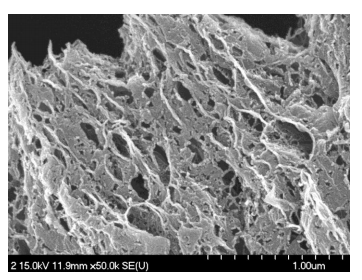
The trick these guys have perfected is to make a highly porous form of
graphene that has a huge internal surface area. They create this graphene by
reducing graphene oxide particles with hydrazine in water agitated with
ultrasound.

The graphene powder is then packed into a coin-shaped cell, and dried at 140
degrees C and at a pressure of 300/kg/cm for five hours.

The resulting graphene electrode is highly porous. A single gram of this
stuff has a surface area bigger than a basketball court. That’s important
because it allows the electrode to accomodate much more electrolyte (an
ionic liquid called EBIMF 1 M). And this ultimately determines the amount of
charge the supercapacitor can hold.

Kannappan and co have measured the performance of their supercapacitor and
are clearly impressed with the results. They say it has a specific
capacitance of over 150 Farrads per gram can store energy at a density of
more than 64 Watt hours per kilogram at a current density of 5 Amps per
gram.

That’s almost comparable with lithium-ion batteries which have an energy
density of between 100 and 200 Watt hours per kilogram.

These supercapacitors have other advantages too. Kannappan and co say they
can fully charge them in just 16 seconds and have repeated this some ten
thousand times without a significant reduction in capacitance. “These values
are the highest so far reported in the literature,” they say.

That’s an impressive set of performance figures, which may well justify the
conclusion of the authors that these “supercapacitor energy storage
devices…can be scaled up for manufacturing in the near future for electric
vehicle applications.”

If they’re right, we may soon see ordinary road-going electric vehicles that
can efficiently harvest energy that until now has been largely wasted.

Ref: arxiv.org/abs/1311.1548 : Graphene based Supercapacitors with Improved
Specific Capacitance and Fast Charging Time at High Current Density
[© technologyreview.com]


http://www.gizmodo.in/news/These-New-Graphene-Supercapacitors-Could-Finally-Power-An-Electric-Car/articleshow/25665932.cms
These New Graphene Supercapacitors Could Finally Power An Electric Car
Nov 13, 2013 - This makes it an ideal material to store braking energy and
could be exactly what the electric car industry needs. Scientists from
Gwangju Institute of Science and ...


For all EVLN posts use:
http://electric-vehicle-discussion-list.413529.n4.nabble.com/template/NamlServlet.jtp?macro=search_page&node=413529&query=evln&sort=date

Here are today's archive-only EV posts:

EVLN: Electric AgriRover for precision agriculture
EVLN: Taiwan’s TECO eyes electric jeeps
EVLN: Open-standards, making all public EVSE accessible to all drivers
EVLN: Some but not all Texans can get $2.5k EV rebates, Teslas exempt
EVLN: Crotchety captious Clooney slights Tesla for former roadster woes
+
EVLN: Patent war concerns as plugins go hi-tech


{brucedp.150m.com}


--
View this message in context:
http://electric-vehicle-discussion-list.413529.n4.nabble.com/EVLN-Graphene-Supercapacitors-Ready-For-EVs-tp4666224.html
Sent from the Electric Vehicle Discussion List mailing list archive at
Nabble.com.
_______________________________________________
UNSUBSCRIBE: http://www.evdl.org/help/index.html#usub
http://lists.evdl.org/listinfo.cgi/ev-evdl.org
For EV drag racing discussion, please use NEDRA
(http://groups.yahoo.com/group/NEDRA)