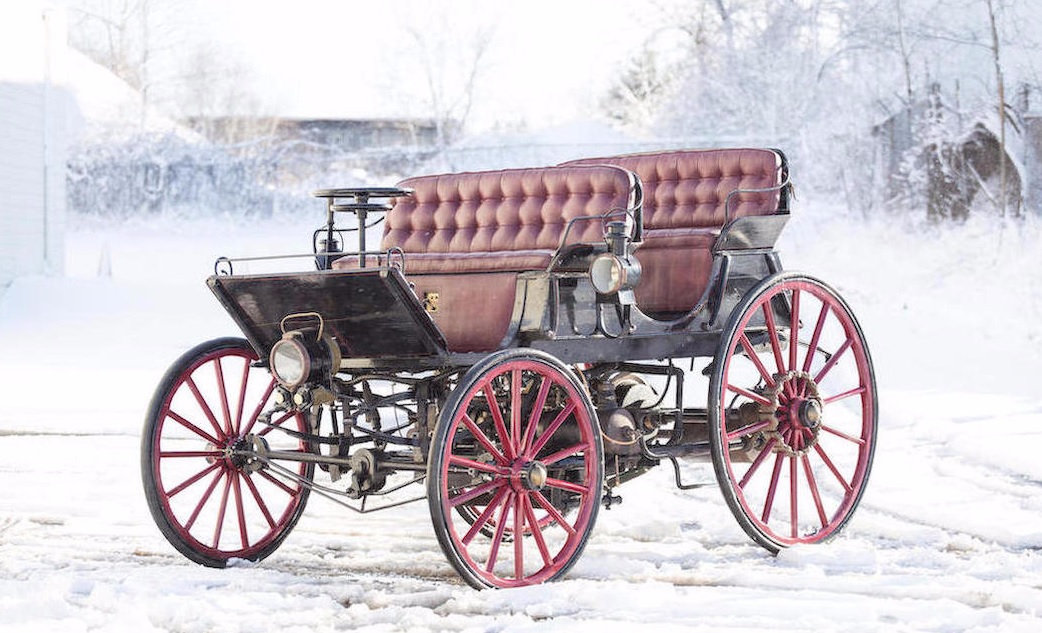
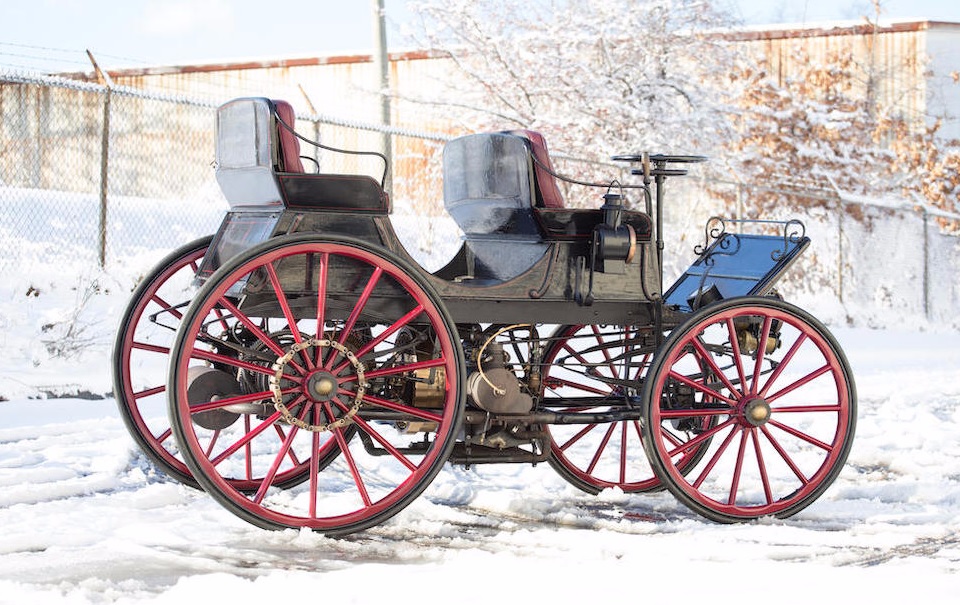
In 1896, a hybrid would have been a bridge technology... from BEV to ICE.

Sent from my iPhone
> On Mar 12, 2016, at 1:41 AM, brucedp5 via EV <[email protected]> wrote:
>
>
>
> % Leno bait %
>
> 'Audi CEO sez hybrids only a "bridging technology" to EVs'
>
> http://www.ibtimes.co.uk/worlds-first-hybrid-car-1896-expected-reach-190000-auction-1548230
> World's first hybrid car from 1896 expected to reach £190,000 at auction
> March 8, 2016  Alistair Charlton
>
> [images   / Bonhams
> https://d.ibtimes.co.uk/en/full/1496952/armstrong-phaeton-first-hybrid-car.jpg
> Armstrong Phaeton first hybrid car  Built in 1896, the Armstrong Phaeton is
> the world's first hybrid car to use a petrol engine and electric motor
>
> https://d.ibtimes.co.uk/en/full/1496954/armstrong-phaeton-first-hybrid-car.jpg
> Armstrong Phaeton first hybrid car  The Phaeton is expected to reach between
> £120,000 and £190,000 at auction on 10 March
> ]
>
> You would be forgiven for thinking that hybrid cars are a relatively new
> invention. The Toyota Prius arrived in 1997 and now cars like the BMW i8 and
> McLaren P1 are the hybrid flagbearers. But the very first hybrid car, the
> Armstrong Phaeton, was built back in 1896 and is about to go up for auction.
>
> The Phaeton uses a 6.5-litre, two-cylinder petrol engine, an onboard battery
> and a dynamo flywheel to not only start itself using electricity (16 years
> before Cadillac invented the starter motor), but it could be driven for
> short distances as a fully electric car. It is claimed the car's electric
> drivetrain produced so much torque that it split its wooden carriage wheels.
>
> It even uses regenerative braking to slow the back wheels, a technology not
> dissimilar to how today's Formula One cars recharge their hybrid power
> systems. Regenerative braking also features in Tesla's electric cars as a
> way of topping up the battery pack and increasing range.
>
> Electricity generated by the engine was also used to power the rest of the
> car's electrics, including the lamps and engine ignition system. As well as
> a hybrid system a century ahead of its time, the Phaeton also features a
> magnetic clutch and semi-automatic three-speed gearbox, removing the need
> for a clutch pedal.
>
> The car will go under the hammer at Fernandina Beach Golf Club, Florida on
> 10 March and is expected to make between £120,000 and £190,000 (plus a 10%
> buyer's premium). Fully functional, the car is eligible for entry in the
> famous London to Brighton vintage car rally, shou
>
> % Leno bait %
>
> 'Audi CEO sez hybrids only a "bridging technology" to EVs'
>
> http://www.ibtimes.co.uk/worlds-first-hybrid-car-1896-expected-reach-190000-auction-1548230
> World's first hybrid car from 1896 expected to reach £190,000 at auction
> March 8, 2016  Alistair Charlton
>
> [images   / Bonhams
> https://d.ibtimes.co.uk/en/full/1496952/armstrong-phaeton-first-hybrid-car.jpg
> Armstrong Phaeton first hybrid car  Built in 1896, the Armstrong Phaeton is
> the world's first hybrid car to use a petrol engine and electric motor
>
> https://d.ibtimes.co.uk/en/full/1496954/armstrong-phaeton-first-hybrid-car.jpg
> Armstrong Phaeton first hybrid car  The Phaeton is expected to reach between
> £120,000 and £190,000 at auction on 10 March
> ]
>
> You would be forgiven for thinking that hybrid cars are a relatively new
> invention. The Toyota Prius arrived in 1997 and now cars like the BMW i8 and
> McLaren P1 are the hybrid flagbearers. But the very first hybrid car, the
> Armstrong Phaeton, was built back in 1896 and is about to go up for auction.
>
> The Phaeton uses a 6.5-litre, two-cylinder petrol engine, an onboard battery
> and a dynamo flywheel to not only start itself using electricity (16 years
> before Cadillac invented the starter motor), but it could be driven for
> short distances as a fully electric car. It is claimed the car's electric
> drivetrain produced so much torque that it split its wooden carriage wheels.
>
> It even uses regenerative braking to slow the back wheels, a technology not
> dissimilar to how today's Formula One cars recharge their hybrid power
> systems. Regenerative braking also features in Tesla's electric cars as a
> way of topping up the battery pack and increasing range.
>
> Electricity generated by the engine was also used to power the rest of the
> car's electrics, including the lamps and engine ignition system. As well as
> a hybrid system a century ahead of its time, the Phaeton also features a
> magnetic clutch and semi-automatic three-speed gearbox, removing the need
> for a clutch pedal.
>
> The car will go under the hammer at Fernandina Beach Golf Club, Florida on
> 10 March and is expected to make between £120,000 and £190,000 (plus a 10%
> buyer's premium). Fully functional, the car is eligible for entry in the
> famous London to Brighton vintage car rally, should its new owner want to
> ship it to the UK.
> [© 2016 IBTimes]
>
>
>
> http://www.rmsothebys.com/hf14/hershey/lots/1896-armstrong-phaeton/1070547
> Lot 152  1896 Armstrong Phaeton  Chassis no. LX1  $550,000 - $700,000
> [images
> http://www.rmsothebys.com/images/lots/medium/HF14/HF14_r248_002.jpg
>
> http://www.rmsothebys.com/images/lots/medium/HF14/HF14_r248_004.jpg
> ]
> 367 cu. in. air-cooled horizontally opposed two-cylinder engine, three-speed
> transmission with variable-speed magnetic drive, full-elliptic leaf-spring
> front and rear suspension, and a rear differential brake. Wheelbase: 74 in.
> Fascinating known history from new
> Equipped with charming, advanced features
> Dated by the Veteran Car Club of Great Britain
> Eminently eligible for the London to Brighton Veteran Car Run
>
> “From Out A Dark Corner Came These Industrial Ghosts”
> So read the headline published in The Hartford Courant on September 22,
> 1963, when the Capewell Manufacturing Company made some unexpected
> discoveries during a cleaning of their old horseshoe nail plant in Hartford.
> Aside from about 20 circa-1880s bicycles, commonly referred to as
> “penny-farthings,” there was a four-wheeled horseless carriage that was
> built by one of Capewell’s predecessors, the Armstrong Manufacturing
> Company, of Bridgeport, Connecticut.
>
> It is believed that the Armstrong was built over a period spanning
> 1894–1845; thus, it existed a year before England would repeal its infamous
> Red Flag Act. After its completion in Bridgeport, the car was one of six
> entrants in a race hosted by Cosmopolitan magazine, which ran from the
> Manhattan Post Office in New York City to the Cosmopolitan offices in
> Irvington, New York. As was quoted in an extensive piece written about the
> car by noted English automotive author and historian Michael
> Worthington-Williams, “The race came off like a Barnum and Bailey circus,
> with competitors rattling and careening over treacherous cobblestone
> pavements in a desperate effort to avoid collisions with horse-drawn
> carriages, cable cars, and (war) veterans dispersing after a parade.”
>
> Shortly thereafter, the car was placed on the market by The American
> Carriage Motor Company, of New York, likely as a litmus test to help the
> principals of Armstrong determine the commercial viability of their
> prototype. After receiving a lukewarm response, it was returned to
> Armstrong’s Bridgeport factory, where it remained until around 1950, when
> the firm was purchased by Capewell. The contents of the factory, including
> the penny-farthings and the Armstrong, were moved to Hartford.
>
> The Armstrong would lay dormant for another 13 years, until newly minted
> Capewell Vice President Henry C. White would discover the Armstrong during
> the cleaning he initiated during the slow summer months of 1963. From there,
> the car was moved into a Capewell employee’s garage in Harwinton,
> Connecticut, which would be its home until 1995. The existence of the
> Armstrong was then brought to the attention of the Magee brothers by Dennis
> David, a local automotive historian. The car spent several years in their
> collection before being exported to England by Robin Loder, an enthusiastic
> member of the Veteran Car Club of Great Britain. Loder entrusted the car to
> restorer Robert Steer, one of the foremost restorers of Veteran cars, who
> set about restoring the cosmetics of the car, as well as preserving a
> majority of the bodywork. Steer would also sort all of the intricate
> electromechanical workings that were devised by the estimated half-dozen
> Armstrong employees involved in its manufacture.
>
> The Armstrong is a display of Yankee ingenuity throughout, and it bristles
> with features that would not be seen on other production vehicles for many
> years to come. These included a tubular chassis frame, electric lights, and
> electromagnetically controlled inlet valves. The car also features an early
> form of automatic spark control, which was managed by a flyweight governor
> mounted on the end of the crankshaft. In addition, the Armstrong features a
> silent electromagnetic starter within the flywheel; Armstrong called it a
> “commencer,” and it was also found much later on the Mercer Model 22-70 and
> the Owen Magnetic. The transmission is a three-speed unit with additional
> variable magnetic drive, which is yet another wonder that preceded the
> similarly engineered unit found on the Owen Magnetic some 20 years later.
>
> Within the last several years, the car was imported back to the United
> States, where it was treated to a fresh round of sorting by well-known
> Brass- and Veteran-era specialist Stewart Laidlaw. This included work on the
> original electric starter, which is a critical element, as there is no means
> for hand-cranking, as well as an adjustment of the electrically controlled
> inlet valves. Most importantly, the Armstrong has been dated by the Veteran
> Car Club of Great Britain as being manufactured in 1896. This is typical of
> the conservatism of the VCC, given that contemporary sources indicate the
> date of completion to be 1895 or perhaps 1894. In any case, the dating
> certificate is extremely important for its eligibility for entry into
> Veteran car events around the world, including the revered London to
> Brighton Veteran Car Run.
>
> Having survived almost a dozen decades and now restored and made functional
> once again, the Armstrong remains a symbol of the manufacturing ingenuity
> and forethought in the New World. From a period when there was no “right”
> way to build a car, many who attempted this feat lost heart or ran out of
> money long before completion. Many manufactures managed to make crude copies
> of existing vehicles, and some even made them work…for a few yards.
>
> Even fewer enthusiasts started with a blank sheet of paper, proceeded with
> their own original design, finished the project, and then had their vehicle
> running on the highways. The Armstrong was one of these original few.
>
> Please note that this lot will be sold on a Bill of Sale.
> [© rmsothebys.com]
> ...
> https://www.bonhams.com/auctions/23133/lot/152/
> Bonhams  Lot 152
> 1896 ARMSTRONG PHAETON GASOLINE ELECTRIC HYBRID
> US$ 175,000 - 275,000  £120,000 - 190,000
> AUCTION 23133: THE AMELIA ISLAND AUCTION  10:30 EST
> [©  Bonhams 2016]
> ...
> http://sharrit.net/120-year-old-car-still-runs/
> 120-year-old car still runs
> MARCH 7, 2016
> ...
> [videos
> https://www.youtube.com/watch?v=0rJuAskI-Ao
>
> https://www.youtube.com/watch?v=0IsDqhcj3tE
> ]
>
>
>
> http://insideevs.com/audi-ceo-hybrids-are-only-a-bridging-technology-to-pure-electric-cars/
> Audi CEO: Hybrids Are Only A “Bridging Technology” To Pure Electric Cars
> [20160308]  Audi CEO Rupert Stadler is slowly but surely starting to
> discover what some automakers have already realized…electric cars are the
> future. According to Stadler ...
> ...
> http://www.autocar.co.uk/car-news/industry/audi-hybrids-only-bridging-technology-evs-says-ceo
> Audi hybrids only a "bridging technology" before EVs, says CEO
> 3 March 2016
>
>
>
>
> For EVLN EV-newswire posts use:
> http://evdl.org/evln/
>
>
> {brucedp.150m.com}
>
> --
> View this message in context:
> http://electric-vehicle-discussion-list.413529.n4.nabble.com/EVLN-190k-1896-hev-auction-so-much-torque-it-split-its-wooden-wheels-tp4680939.html
> Sent from the Electric Vehicle Discussion List mailing list archive at
> Nabble.com.
> _______________________________________________
> UNSUBSCRIBE: http://www.evdl.org/help/index.html#usub
> http://lists.evdl.org/listinfo.cgi/ev-evdl.org
> Read EVAngel's EV News at http://evdl.org/evln/
> Please discuss EV drag racing at NEDRA (http://groups.yahoo.com/group/NEDRA)
>
_______________________________________________
UNSUBSCRIBE: http://www.evdl.org/help/index.html#usub
http://lists.evdl.org/listinfo.cgi/ev-evdl.org
Read EVAngel's EV News at http://evdl.org/evln/
Please discuss EV drag racing at NEDRA (http://groups.yahoo.com/group/NEDRA)