'We had Pentagon admirals jumping in the water to see how it worked'
'Brought back after floating a year for a checkup & barnacle wipe'
http://www.energymatters.com.au/renewable-news/wave-glider-milestone-em5385/
Solar Assisted Wave Gliders Clock Up 1 Million Nautical Miles
March 16, 2016

[image
http://www.energymatters.com.au/wp-content/uploads/2016/03/solar-wave-glider.jpg
(Wave Glider)
]

Liquid Robotics recently announced its fleets of solar assisted Wave Gliders
have reached 1 million nautical miles at sea. That’s 1,852,000 kilometres to
us metric-talkin’ landlubbers.

Unmanned ocean vessels are increasingly being used to measure and monitor
conditions and on reconnaissance missions; collecting and communicating
environmental, security, weather and seismic data.

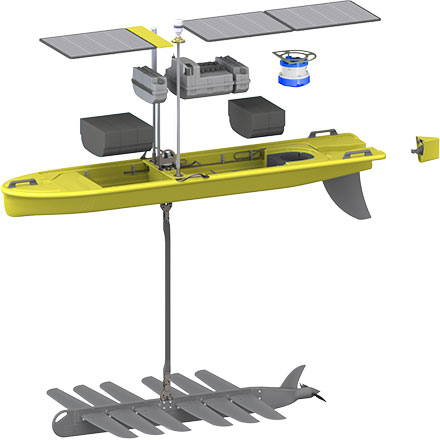
The Wave Glider is propelled with a two-part mechanism that exploits the
difference in wave motion at the water’s surface with that a short distance
beneath to provide thrust.

The deck of the Wave Glider is coated with solar panels, with the S V3 model
boasting 150W capacity. Electricity generated is stored in a battery that
can range from 0.9-4.5kWh capacity. While the energy is primarily used to
power instruments, in the S V3 the craft can get an added speed boost and
maneuverability from a propeller driven by an electric motor.

It hasn’t all been smooth sailing for the Wave Gliders – literally speaking
– but they’ve proven their mettle by enduring all sorts of inclement
weather; including 17 hurricanes.

Liquid Robotics says the Wave Glider holds the Guinness World Record for the
longest journey by an autonomous, unmanned surface vehicle on the planet. It
was also the first USV to complete missions from the Arctic to the Southern
Ocean. A couple of the robots first visited Australian waters in 2012.

The recent milestone is the equivalent of approximately 46 times around the
world.

“For the unmanned systems industry surpassing one million nautical miles is
a landmark event,” said Dr. James Bellingham, Director Center for Marine
Robotics, Woods Hole Oceanographic Institution.

“It clearly proves Wave Gliders (USVs) can sustain long duration operations
required for scientific and defense missions. They’re changing how we
explore and protect the ocean.”

It was recently announced Wave Gliders have joined the battle against
illegal fishing in the world’s largest, continuous marine reserve around the
Pitcairn Islands in the Pacific.

The Wave Gliders will be controlled via a satellite watch room; taking
photos of fishing vessels operating in restricted areas and pinpointing the
location of the rogue fishing operations.

Robotic craft like the Wave Glider aren’t just clean and green, they are
also cutting costs and reducing risks involved with surveillance activities.
[© Energy Matters]
...
http://liquid-robotics.com/technology/waveglider/sv3.html
Liquid Robotics SV3
http://liquid-robotics.com/images/img-architecture-sv3.jpg


https://www.yahoo.com/politics/meet-the-wave-glider-the-pentagons-secret-sea-117522309281.html
Meet the Wave Glider, the Pentagon’s secret sea drone
April 28, 2015  Alyssa Bereznak

[images  / Liquid Robotics
https://www.yahoo.com/sy/ny/api/res/1.2/UXt6780_6bvXSElWXbnDjg--/YXBwaWQ9aGlnaGxhbmRlcjtzbT0xO3c9ODAwO2lsPXBsYW5l/http://l.yimg.com/cd/resizer/2.0/FIT_TO_WIDTH-w1280/18892f235c76f934ab04876edda7bc97257da983.jpg
(Wave Glider)

https://s.yimg.com/ny/api/res/1.2/mNDwLVxOLK1ozRu9S1vqxg--/YXBwaWQ9aGlnaGxhbmRlcjtzbT0xO3c9NTQwO2g9MzYw/http://l.yimg.com/cd/resizer/2.0/FIT_TO_WIDTH-w540/5e3f91f6c46744eaee840759687e1f005621b473.jpg

https://s.yimg.com/ny/api/res/1.2/B11MUkjrcsikw7.rf7tE0Q--/YXBwaWQ9aGlnaGxhbmRlcjtzbT0xO3c9NTQwO2g9MzUy/http://l.yimg.com/cd/resizer/2.0/FIT_TO_WIDTH-w540/efffac7d8e54d62c555cbefdabb9fa683cc97050.jpg
Liquid Robotics employees monitoring the paths of Wave Gliders out in the
wild from their Sunnyvale headquarters

https://s.yimg.com/ny/api/res/1.2/Wm1uOaH7P_O6R1nd0MUxVg--/YXBwaWQ9aGlnaGxhbmRlcjtzbT0xO3c9NTQwO2g9MzYw/http://l.yimg.com/cd/resizer/2.0/FIT_TO_WIDTH-w540/a512f509a0d0f9b5878e1d21b588be0b0ea83f16.jpg
A few SV3 models waiting on their way to launch. The Liquid Robotics team is
made up of about 110 people, including employees on the East Coast and in
Asia and Europe

https://s.yimg.com/ny/api/res/1.2/DvlmXYUJYOLTq5zHj6d8Zg--/YXBwaWQ9aGlnaGxhbmRlcjtzbT0xO3c9NTQwO2g9MzUy/http://l.yimg.com/cd/resizer/2.0/FIT_TO_WIDTH-w540/a83541962523a1e51cbdb76f52d94e7768ca034f.jpg
A Wave Glider nicknamed Malia on the water before a hurricane-tracking
mission

https://s.yimg.com/ny/api/res/1.2/MTnmHi90mlngy4X1ej3THw--/YXBwaWQ9aGlnaGxhbmRlcjtzbT0xO3c9NTQwO2g9MzU5/http://l.yimg.com/cd/resizer/2.0/FIT_TO_WIDTH-w540/251c72275b90b1fdb792ffaff95a07c29d890cd2.jpg
A SV2 model predeployment

https://s.yimg.com/ny/api/res/1.2/K9VQ3lzEhtgkOHWt61u_MA--/YXBwaWQ9aGlnaGxhbmRlcjtzbT0xO3c9NTQwO2g9MzA0/http://l.yimg.com/cd/resizer/2.0/FIT_TO_WIDTH-w540/7a4c779923eb1df55653f0e7a7333aa0e76c16bc.jpg
A Wave Glider in the workshop at Liquid Robotics’ Sunnyvale headquarters.
Research-based models are typically yellow, while those used for
surveillance are black
]

In 2003, Joe Rizzi had a rich man’s dilemma. He’d often swim in the ocean
outside his home on the coast of Hawaii’s Big Island and hear humpback
whales singing in the ocean. He loved the sound, and wanted to hear it while
he was at home looking out at the ocean. So, with the help of a neighbor, he
crafted a flotation device from a kayak, a pickle jar, a long cable, and a
hydrophone to live-stream the haunting songs into his living room speakers.

That device was an early prototype of the Wave Glider, a programmable
surfboard that was later perfected in a bathtub by Liquid Robotics
co-founder and CTO Roger Hine. Today’s version is outfitted with
customizable sensors and floats along the water’s surface collecting
information, guided by a patented rudder/thruster hybrid that harnesses wave
power for propulsion. After Hine successfully tested a finished version of
his invention off the Kona coast of Hawaii, a nearby Naval base caught wind
of his project and thought it could be useful for missions.

“They said, ‘Do you have any idea how much money the Navy has spent in the
last 40 years trying to build something that could operate independently out
in the water?’” Rizzi told Yahoo News. “The next thing we know we had
admirals flying out from the Pentagon to jump in the water and see how this
thing operated.”

Ten years later, what started as a hobby is now the centerpiece of the
world’s go-to water drone supplier — used by oil companies and scientists
and, most notably, in classified missions for the Department of Defense.

The latest version of the Wave Glider, dubbed the SV3, during a beta test
run in Hawaii. The company has a test facility there

Liquid Robotics is one of the many Silicon Valley startups being tapped by
the Pentagon in its scramble to stay on the cutting edge of innovation.
Earlier this year, Deputy Assistant Secretary of Defense Stephen Welby
dropped by its Sunnyvale headquarters while on a tour of Silicon Valley
startups. And just last week, both the Department of Homeland Security and
the Pentagon announced that they would open satellite offices in the Bay
Area.

Both agencies hope that being present in the nation’s unofficial tech
capital will allow them to strengthen the government’s relationships with
tech companies and, as DHS Secretary Jeh Johnson said at a San Francisco
conference last week, “convince some of the talented workforce here in
Silicon Valley to come to Washington.” Specifically, the Pentagon plans for
its office — due to open next month in Moffett Field — to function somewhat
like a venture capital firm, funding promising startups in the areas of
security and surveillance.

Among the 3D printing, big data and machine learning companies these
agencies plan to target, Liquid Robotics serves an overlooked need to
monitor sometimes nefarious activities that take place in murky ocean
waters. On land, surveillance cameras are everywhere — on the outside of
buildings and the smartphones of most bystanders. But as last year’s
disappearance of Malaysian Airlines Flight MH370 proved, the same does not
apply in the oceans. When something happens in the middle of the sea —
whether it’s a plane crash, an oil spill or a drug deal — chances are no one
will be watching.

“The ocean is really underserved,” Liquid Robotics CEO Gary Gysin told me
when I visited the company’s homey Sunnyvale headquarters in March. A mug
that read “Keep Calm and Wave Glide On” sat perched on the windowsill next
to the native Californian’s desk. “It’s expensive, it’s hard to put sensors
out to figure out what’s happening, it’s dangerous with a manned ship, and
it’s also a lot of area to cover.”

Ocean surveillance systems have been around for decades in the form of
satellites, submarines and buoys. But none are as truly autonomous and
cost-efficient as the Wave Glider. It resembles an oversize boogie board,
barely visible from the top of the water save for a few knobs and rods.
Because it can covertly float atop the sea, it’s able to collect information
both above and below the surface. And while other vehicles are immobile or
require manned ships to drag them through the ocean, the Wave Glider is
designed to propel itself by wave power alone, while solar panels power its
electronics. Each unit is programmed to follow a set of unique GPS
coordinates on a continuous loop and is either monitored from a small pilot
room at the Liquid Robotics headquarters or — in the case of top-secret
situations — by government agency officials executing the mission.

For an average price of about $225,000, anyone can purchase a sleuthing
robot to monitor a designated patch of water. But it costs more for Liquid
Robotics’ support in launching, monitoring and maintaining the vehicle. Wave
Gliders are also incredibly resilient and can float around for a year before
they’re brought back to the workshop for a checkup and a barnacle wipe.

Just as these unmanned water drones give you flexibility in how long you
want to spend at sea, they’re also easy to control without getting your
hands dirty. You can update your unit remotely if you want to change the
location of your surveillance site or adjust a Wave Glider’s movement in
response to weather. Last summer, for instance, Gysin was setting up a unit
in the Arctic and, mid-installation, its compass went haywire from the pull
of the magnetic pole. To compensate, chief software architect James Gosling
remotely loaded code into the vehicle, and the problem was instantly solved.
The latest version of the Wave Glider, a faster, heftier, longer model
called the SV3, is even programmed to recognize and autonomously avoid
objects that are coming its way — although that hasn’t prevented the
occasional shark bite or seal hitchhiker.

The real power of the invention, however, lies in its snooping abilities.
Each board can be outfitted with up to 51 different types of sensors. Those
additions are determined entirely by the needs of the client, whether
environmental, geophysical or military.

For example, Liquid Robotics works with Schlumberger, an oil and gas
services company that is required to monitor the environmental impact of its
driling. Its Wave Gliders are decked out with tools to measure seismic
activity, magnetic field and water quality. Then they’re set loose in
underwater drilling areas or areas traversed by its ships to look for leaks.

Barbara Block, a senior fellow at Stanford’s Woods Institute, outfits hers
with acoustic sensors to follow the migration of great white sharks off the
Pacific coast of Mexico. She and her team then use a small boat with a seal
decoy to lure sharks to the surface, attaching tags to their backs as they
emerge. Those tags contain acoustic transmitters, which communicate the
animal’s location to a sensor on the Wave Glider.

A large part of Liquid Robotics’ business is reconnaissance for both the
U.S. and foreign governments. Typically, security agencies outfit these
boards with hydrophones, photographic equipment and satellite communications
systems. Though Gysin can’t discuss specific missions, he confirmed that
Wave Gliders have been used to stop human trafficking and drug smuggling.
They’re also often used in highly contested waters like the South China Sea,
where the board is the first point of contact for a process called “tipping”
and “cuing.” After detecting activity, it alerts government officials of
whatever country is keeping watch, which can dispatch drones to attack the
intruder. Unlike the United States’ fleet of aerial drones, however, Wave
Gliders are not weaponized. Currently Liquid Robotics has no plans to lead
the company down that route.

The Wave Glider owes its extensive capabilities to its customizable guts.
Within the body of each board is a seven-unit server rack that runs on Linux
and has a JavaScript control system designed by Gosling, the inventor of the
Java programming language. This allows companies to develop their own
software applications for the board, as well as their own sensors. Gysin
likens it to the operations systems of common smartphones.

“You could think of us as the iPhone without apps,” he said. “We’re not
antisubmarine warfare experts or seismic experts or ship detection experts,
but we partner with people that are, who can add that on top of the
platform. And we make a darn good platform that can last for a year at sea.”

This ability to customize is especially attractive to those in the Pentagon
working to modernize the military. Since the 1970s, the U.S. military relied
on technologies developed in Silicon Valley to bolster its defense efforts.
It has traditionally operated on the 10-to-30-year product cycle of aircraft
carriers, submarines and fighter aircraft. That’s changing.

“They’re trying to figure out: How do we harness Silicon Valley and
everything that’s going on from a high-tech perspective in more rapid
terms?” Gysin said. “They’re not there yet, but all the leadership we deal
with are driving from the top down, saying, ‘We’ve got to reinvent ourselves
and reinvent how we engage with Silicon Valley.’”

Gysin recalled a “super-secret” conference he recently attended in Monterey,
California, that brought together 270 government employees, 170 venture
capitalists, and about 70 CEOs. The directors of both the CIA and the NSA
were in attendance.

“The message was all the same,” he said. “We’ve got to be able to harness
Silicon Valley to remain competitive, because other people are doing it,
other nations are moving fast. We’ve got to morph from this acquisition
model that’s 10 decades old to something new.”
[© yahoo.com]


For EVLN EV-newswire posts use:
http://evdl.org/evln/


{brucedp.150m.com}

--
View this message in context:
http://electric-vehicle-discussion-list.413529.n4.nabble.com/Solar-Electric-Wave-Gliders-collect-1M-miles-of-ocean-data-tp4681102.html
Sent from the Electric Vehicle Discussion List mailing list archive at
Nabble.com.
_______________________________________________
UNSUBSCRIBE: http://www.evdl.org/help/index.html#usub
http://lists.evdl.org/listinfo.cgi/ev-evdl.org
Read EVAngel's EV News at http://evdl.org/evln/
Please discuss EV drag racing at NEDRA (http://groups.yahoo.com/group/NEDRA)