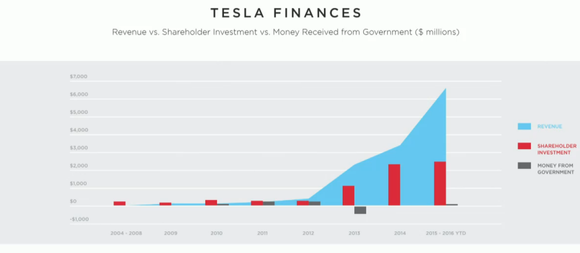
'TMC is the largest CA-ZEV credit purchaser, Tesla is the largest seller,
and Tesla receives little Fed support'
% If TMC had not been so adamantly, obstinately against EVs, instead of
paying Tesla for their CA-ZEV credits with Prius profits, TMC could have
outsourced an already crash-test approved, low-quantity RAV4-EV-gen1
production run to China. With annual minor body styling tweaks, and
infotainment additions/upgrades, a slightly more up-to-date-looking TMC.cn
EV could have been low-quantity-produced at a lower cost, and sold in states
to meet the ZEV requirements. %

http://www.fool.com/investing/2016/06/04/this-is-how-little-government-support-tesla-motors.aspx
This Is How Little Government Support Tesla Motors Actually Receives
Jun 4, 2016  Evan Niu

[images
https://g.foolcdn.com/editorial/images/207868/dest_charging_hero_large.jpg
(Tesla EV)  IMAGE SOURCE: TESLA

https://g.foolcdn.com/editorial/images/207868/tsla-funding-sources_large.png
(chart)  Tesla Funding Sources  IMAGE SOURCE: TESLA ANNUAL MEETING
]

The electric-car maker receives virtually no direct support from state or
federal governments.

One of the most prominent criticisms of Tesla is the idea that the company
relies heavily on government subsidies, incentives, and other forms of
support. This is a common bearish argument, since it stands to reason that
those incentives will eventually be phased out. Once that happens, Tesla is
doomed, according to the bears.

But Tesla doesn't actually receive much direct support from the government.

Show me the money
At Tesla's annual shareholder meeting last week, the company pointed out how
little it has received from state and federal governments over the years.
The vast majority of Tesla's funding has come from growing revenue and
external capital raises from investors.


By far the most prominent instance was the Department of Energy (DOE) loan
that Tesla received way back in 2010 as part of the government's Advanced
Technology Vehicle Manufacturing program, which was enacted during the Bush
administration in 2008. Tesla repaid the loan nine years early in 2013,
including a prepayment penalty.

Tesla used funds from a 2013 capital raise to pay back the loan, so
essentially the company refinanced the loan with public investors. Elon Musk
has framed this decision as a moral one, since he'd rather have Tesla
investors support the company instead of taxpayers. Additionally, it was a
loan, not a grant.

To be clear, the chart does not include indirect forms of support that do
benefit Tesla. There are two notable sources of indirect government support.

ZEV's not dead
First, Tesla earns zero-emission vehicle (ZEV) credits in states that have
adopted California's emissions regulations standards, and then sells those
credits to other OEMs who are either unwilling or unable to meet the
requirements on their own. Over the past four quarters, Tesla has generated
a total of $118 million from ZEV credit sales, or about 2.8% of total GAAP
revenue.

Within California (which is just one of many states where Tesla sells ZEV
credits), Tesla sold over 1,500 ZEV credits between Oct. 1, 2014 and Sept.
30, 2015, according to California Air Resources Board, or CARB [
http://www.arb.ca.gov/msprog/zevprog/zevcredits/2014zevcredits.htm
]. CARB doesn't break out specific company transfers, but Toyota was the
largest overall purchaser of ZEV credits in California for that time frame,
with Tesla being the largest overall seller by nearly a factor of two.

But the important thing here is that ZEV credit revenue comes from other
OEMs, and not any government entity. Tesla's ability to earn ZEV credit
revenue is a function of how seriously these OEMs take tightening emissions
regulations, since if they were able or willing to meet the requirements on
their own, they wouldn't need to purchase ZEV credits from Tesla.

While it appreciates the extra cash, Tesla doesn't need it and its business
is not predicated on these credits, which is why the company excludes ZEV
credit revenue from its non-GAAP metrics.


Consumer-based incentives
The other prominent incentive in the U.S. is the federal tax incentive of up
to $7,500. But that incentive is not specific to Tesla, and is available to
all OEMs (subject to volume limits). It's a categorical incentive designed
to support the burgeoning market for a wide range of alternative fuel
vehicles, including traditional hybrids. Toyota hit its limit for the Prius
many years ago, for instance. Tesla is expected to hit its limit in early
2018.

The incentive absolutely helps stimulate demand for EVs at large, which does
help Tesla sell more vehicles. But again, Tesla does not receive this money
directly -- it goes to the consumer. Various countries around the world, as
well as certain states in the U.S., may also have EV incentives.

It's also worth noting that Tesla does not attempt to capture any of these
incentives in the form of price increases. The company prices its products
based on its gross margin target of 20% to 25%, which then helps cover
operating expenses. Tesla vehicle prices are standardized worldwide (subject
to foreign currency fluctuations), and the company does not increase the
price in regions where incentives are present.

Relying on government support is yet another flawed bear argument.
[© 2016 The Motley Fool]


For EVLN EV-newswire posts use:
http://evdl.org/evln/


{brucedp.150m.com}

--
View this message in context:
http://electric-vehicle-discussion-list.413529.n4.nabble.com/EVLN-Toyota-is-supporting-Tesla-not-U-S-Gov-EV-myth-busting-tp4682488.html
Sent from the Electric Vehicle Discussion List mailing list archive at
Nabble.com.
_______________________________________________
UNSUBSCRIBE: http://www.evdl.org/help/index.html#usub
http://lists.evdl.org/listinfo.cgi/ev-evdl.org
Read EVAngel's EV News at http://evdl.org/evln/
Please discuss EV drag racing at NEDRA (http://groups.yahoo.com/group/NEDRA)