'Tesla automobiles are a good example to show how electric tractors would be
an improvement for farmers'
https://www.precisionfarmingdealer.com/articles/3039-semi-autonomy-a-more-realistic-solution-for-farming
Semi-Autonomy: A More Realistic Solution for Farming
October 12, 2017

[images
https://www.precisionfarmingdealer.com/ext/resources/ATC-Future-of-Ag.png?1507824352

https://www.precisionfarmingdealer.com/ext/resources/Fuel-Chart.png
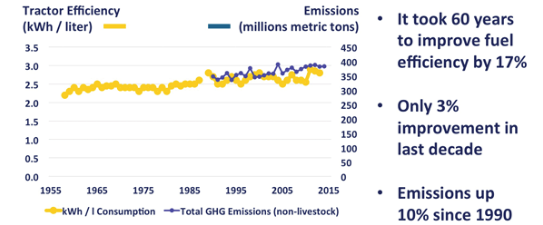
Fuel Chart  Fuel Improvement in the Last 60 Years  Fuel efficiency has only
improved 17% in the last 60 years, contributing to rising production costs
for farmers in the last 25 years. Source: Nebraska tractor Test Laboratory

https://www.precisionfarmingdealer.com/ext/resources/Battery-Costs.png
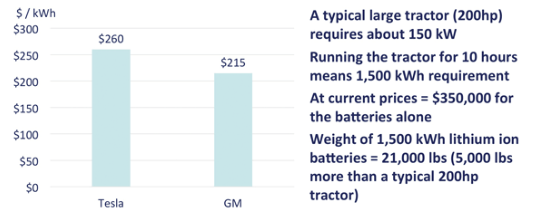
Battery Costs  Batteries are a challenge for electric tractors. For a 200
horsepower tractor they would cost about $350,000 and the battery pack would
weigh more than the tractor itself. Source: Green Car Reports 2015 L David
Roper Tractor Data

https://www.precisionfarmingdealer.com/ext/resources/Simplicity.png
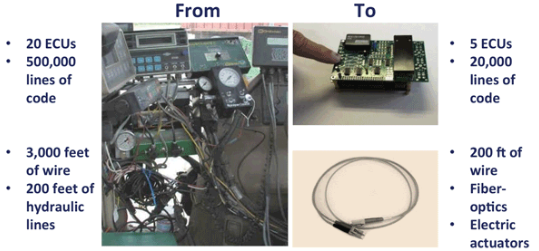
Simplicity  Electric vehicles have a fraction of the moving parts mechanical
and hydraulic vehicles do and electric systems are digitized, eliminating
hundreds of wire connections. Source: Rainer Hoffman, AGCO, 2006; ATC
Estimates

https://www.precisionfarmingdealer.com/ext/resources/Efficiency.png
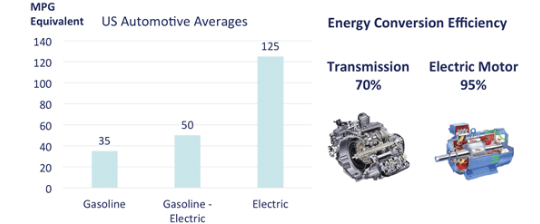
Efficiency  Moving to a hybrid gasoline and electric vehicle would increase
fuel efficiency by about 30%. A completely electric platform would increase
it even more. Source: U.S. Energy Information Administration
]

Variations in everyday farming and seasonal labor challenges are likely to
delay the introduction of completely autonomous farm equipment.

Editor’s Note: This article is a portion of what Kraig Schulz presented
during his keynote address at the 2017 Precision Farming Dealer Summit in
January. In this presentation he discussed the driving forces behind and
logistical hurdles to improving autonomy in agriculture.

What does the word autonomy really mean? A lot of people use it but I don’t
think most people would agree on a definition. In its broad definition of
self-sufficiency, we already see autonomy in the field. We have combines
that separate corn from the cob. We have vehicles that steer themselves.
According to some people in the industry, we’ve had autonomous vehicles in
the field for 20 years. But the question is “what level of autonomy do
farmers really need?”

Autonomy is a spectrum. Rudimentary autonomy that must be observed or
managed by someone in the vehicle is on one end, and more complex,
self-sufficient autonomy is on the other. Maybe down the road we will see
tractors that have already gone out and plowed the field and come back while
you’re still getting your second cup of coffee, but for now the autonomy we
see in farming still requires a certain level of supervision. Autonomy in
the truest sense is something that functions completely on its own —
something I don’t think we will see broadly adopted among row crop producers
any time soon. With that in mind, I suppose Autonomous Tractor Corp. might
not be the best name for my company. This is something I realized only after
5 years of working with autonomous agricultural vehicles for row-crop
producers. I have a more accurate name in mind, but let me first explain.

Challenge for Farmers

Row-crop farmers face a tough financial situation. I was shocked to find
that the average income per bushel of corn (average price minus average cost
of production) in the last 35 years was –$0.01. Costs were up 60% and prices
were only up 40% during that time period. During the good years we can make
more money, but during the bad years we have to rely on what we made in the
good years to keep going.

Unfortunately, most experts don’t see things getting better for farmers any
time soon. So we are going to have to learn to live in a world where our
margins are razor thin — or find ways to cut costs fairly dramatically.

Cutting Costs

Cutting costs is probably the surest way to combat thin margins since we
have less control over yield and almost no control over crop prices. Helping
farmers make more money, primarily by cutting costs, was the main goal in
starting Autonomous Tractor Corp. Farmers’ real on-farm income has been
declining for decades, but some innovations in agriculture could help
alleviate some of that financial pressure.

What are the big buckets of production costs? Labor makes up only about 5%
of production costs of corn in Iowa while equipment, seed and chemicals make
up nearly 20% of production costs each and land costs account for nearly
40%. So where should farmers be focused on cost savings? We think attacking
the biggest cost categories is probably the right place to start.

ATC is helping farmers cut one of the big cost areas today: equipment.
According to Iowa State data, the biggest equipment costs are the initial
purchase price, fuel and repair. Between 1975 and 2012, the purchase cost of
machinery and its repair have both about doubled. Fuel costs are largely
market-driven, but the industry has not made tremendous progress on
increasing fuel efficiency, which has only improved 17% over the last 60
years. These rising costs in equipment and maintenance and limited
improvement in fuel efficiency have led to almost continuously rising
production costs for farmers over the last 25 years.

It raises my ire when I look at the correlation between corn prices and the
costs of production. Why? The correlation shows how the suppliers of
production inputs (equipment, seed, chemicals, etc.) raise or lower prices
to maintain their “share” of farming income. From 1980 to 2015 the
correlation between last year’s corn price and this year’s cost of
production is 86%. This means that as suppliers see producers’ ability to
pay go up, so do input costs. You make a little more money on the farm and
your suppliers get ready to take a little more out of your pocket next year,
almost dollar for dollar.

Electric Farm Equipment

Electrification might be an answer to some of the problems in rising
equipment costs. Electric tractors would get better fuel economy, have an
increased longevity and reduced repair costs — all facts that have been
proven by the automotive world. Electric drive technology has been adopted
by the marine, locomotive and mining industries but not in ag. Isn’t it
about time our industry started moving to a more cost-effective solution
like electric drivetrains?

Tesla automobiles are a good example to show how electric tractors would be
an improvement for farmers. An electric vehicle has only a small fraction of
the moving parts of a mechanical or hydraulic vehicle. Since the whole
system becomes digitized, the communications systems can be dramatically
simplified, eliminating hundreds of wire connections. Using fiber optic
cables alone can reduce most of the wires in a tractor to just one cable.

These advances can translate into real dollars for producers. The
differences in value after roughly half the life of each type of vehicle
can’t be ignored. A Tesla retains better than 70% of its value after 50,000
miles while traditional cars lose 70% of their value. Part of the reason
(but not the only reason) for this disparity is the average expected
lifespan of an electric motor is 29 years, which is 2 times the average
lifespan of a traditional tractor. Farmers would benefit greatly from
equipment with longer lifespans and less frequent need for repair.

Fuel efficiency is also a benefit. A gasoline-powered vehicle gets roughly
35 miles per gallon. Moving that to a hybrid gasoline and electric platform
would increase efficiency by about 30%, and moving it to a completely
electric platform would increase it significantly more. Simply put,
transmissions aren’t that efficient and electricity is a much more efficient
way to transfer power.

So why hasn’t the ag industry adopted electric drive platforms? The main
problem is the vast majority of electric systems use batteries. This works
well for the Tesla design since most of the time a driver will only use the
Tesla at a fraction of its full horsepower and only a few hours each day.

Teslas today carry about 100-kilowatt hours of batteries, but even just a
200 horsepower electric tractor would need about 1,500 to work for a full
day. Batteries alone would cost farmers about $350,000 for this hypothetical
electric tractor, not to mention the battery pack would also weigh more than
the tractor.

Though electric tractors may seem unattainable in the near future, there is
already electrification in today’s farming equipment. An electric generator
can now power a John Deere 4930 self-propelled sprayer without batteries
that used to be powered by a hydraulic drivetrain. The world is moving to
electric vehicles. It might be more gradual, but it will make its way to
farms and change the industry.

Electrifying tractors, however, would change many facets of our industry and
would require adaptation by many players. For example, dealers would have to
re-think their economic model since electric tractors would require less
maintenance. How can we keep dealers profitable while their biggest economic
driver slowly erodes? A Tesla-type distribution model simply won’t work in
ag. But involving the dealers in the installation of electric drive systems
would allow them to charge for parts and labor and keep their economics
whole.

Problems with Labor

So what about labor costs? Considering labor only makes up about 5% of corn
production costs, it would seem that the COST of labor isn’t necessarily the
core problem. Instead what I hear time and again is producers’ inability to
get the right people on the farm when you need them. Finding experienced
seasonal labor can be a major problem for farmers.

There is simply too much work to get done during unpredictable, narrow
windows of opportunity — and it is unrealistic for a producer to hire a
full-time, year-round staff to meet their highest seasonal needs. Farmers I
speak to often say they could just use a “helping hand” — a piece of
equipment smart enough to supplement their own labor in the field when they
need it.

Trying to solve these labor issues through automation means replicating what
an operator would normally do in the field. The list of activities is long,
but one activity that has rapidly fallen off over the last 20 years is
“steering.” Great advances in GPS-based auto-steer systems have provided
tremendous benefits to producers: reduced fatigue, greater precision, less
waste, etc. But we still have someone in the cab.

Why? The equipment still requires someone to manage all of the complex
operations in the field to ensure the task is being performed in the way
that suits his or her needs. Muddy terrain, rocks, leaky hydraulic lines,
worn bearings, electrical shorts … if there is no driver, who is going to
manage these items in an environment that changes nearly every day? And it
isn’t just anyone who can do this. The operator needs to be qualified for
the task at hand or profits are lost.

Automation works well for repetitive tasks, but farming is inherently an
organic, non-repetitive activity. The conditions and requirements change
every day. If a computer has to “learn” all of the requirements under all of
the different conditions in order to be self-sufficient, is it efficient for
a producer to have to run back out to the field every 30 minutes and teach?

For the time being, it is likely that farmers will need to manage the
operations of the equipment. This is the idea behind “semi-autonomy:” a
machine smart enough to operate on its own while under the supervision of
the farmer who is going to be in the field anyway — a “helping hand.”

Having a machine that operates largely self-sufficiently (semi-autonomously)
in the field alongside the farmer could help reduce the need to swell the
labor ranks during the short periods of peak season labor demands and allow
producers to get more done, more quickly.

But the industry seems fascinated by full autonomy. So I pose the question:
even if we could get to full autonomy, how much would you pay to solve a 5%
problem? If we don’t change the cost of the underlying equipment and only
add cost and complexity to the solution is there really an economic benefit
to the producer?

There had better be some pretty spectacular benefits beyond labor cost
savings. Greg Peterson, widely known as Machinery Pete, observed that more
and more farmers are using older, simpler machines to avoid repairs that
involve more complex technologies that are driving the costs of repair up.
How does that view square with the drive to add more complex systems to
already-expensive tractors?

Semi-autonomous equipment seems to be the answer. Equipment that operates
independently enough that the farmer can be within reasonable distance to
intervene when a problem occurs is more realistic than fully autonomous
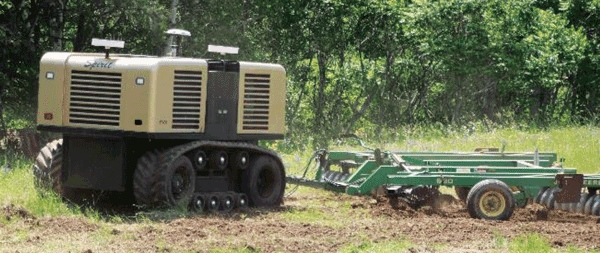
equipment. And if the equipment is semi-autonomous, why do we need a tractor
to pull it? It may not even need a cab. Why wouldn’t the power and mobility
be integrated into the implement itself in a modular fashion that can be
moved from implement to implement?

With an electric drive train this is possible — providing even better
control of the implement and driving down even further the cost of
equipment. Fully autonomous equipment might not be as necessary as we think
it is.

My point is that we need to stay focused on the problem: cutting costs out
wherever possible and focusing on the largest cost line items. The
thoughtful, practical application of new technology to farming operations
has the potential to cut many costs by 50% or more. But to get there we need
a dramatic re-thinking of our methods and tools ...
[© precisionfarmingdealer.com]


For EVLN EV-newswire posts use:
 http://evdl.org/archive/


{brucedp.neocities.org}

--
Sent from: http://electric-vehicle-discussion-list.413529.n4.nabble.com/
_______________________________________________
UNSUBSCRIBE: http://www.evdl.org/help/index.html#usub
http://lists.evdl.org/listinfo.cgi/ev-evdl.org
Please discuss EV drag racing at NEDRA (http://groups.yahoo.com/group/NEDRA)