https://www.automobilemag.com/news/electric-cars-explained-gearheads/
Learn to Speak EV: Electric Cars Explained for Gearheads
Jan 18, 2020  Nelson Ireson
[images
https://www.automobilemag.com/uploads/sites/11/2020/01/Understanding-Electric-Vehicle-Terms-Horsepower.png

https://www.automobilemag.com/uploads/sites/11/2020/01/Understanding-Electric-Vehicle-Terms-Torque.png

https://www.automobilemag.com/uploads/sites/11/2020/01/Understanding-Electric-Vehicle-Terms-Rotor.png

https://www.automobilemag.com/uploads/sites/11/2020/01/Understanding-Electric-Vehicle-Terms-Permanent-Magnet-Synchronous-Motor.png

https://www.automobilemag.com/uploads/sites/11/2020/01/Understanding-Electric-Vehicle-Terms-Induction-Aynchronous-Motor.png

https://www.automobilemag.com/uploads/sites/11/2020/01/Supercharger-Countryside-copy.jpg
 tesla EVs

https://www.automobilemag.com/uploads/sites/11/2019/09/2020-Porsche-Taycan-technical-graphics-8.jpg
 pack

https://www.automobilemag.com/uploads/sites/11/2019/09/2020-Porsche-Taycan-technical-graphics-23.jpg
 drivetrain

https://www.automobilemag.com/uploads/sites/11/2020/01/Understanding-Electric-Vehicle-Terms-Volts-AMps.png
]

Trading gas and bolts for amps and volts.

The time is upon us: The electric cars cometh. It's inexorable, so like it
or lump it, it's time to figure them out. First, though, we need to
understand a few terms and the basic concepts behind those terms before we
can get a bit deeper into the weeds. Have you been reading and hearing about
electric cars and wondering, "What does this all actually mean?" We're here
to help.

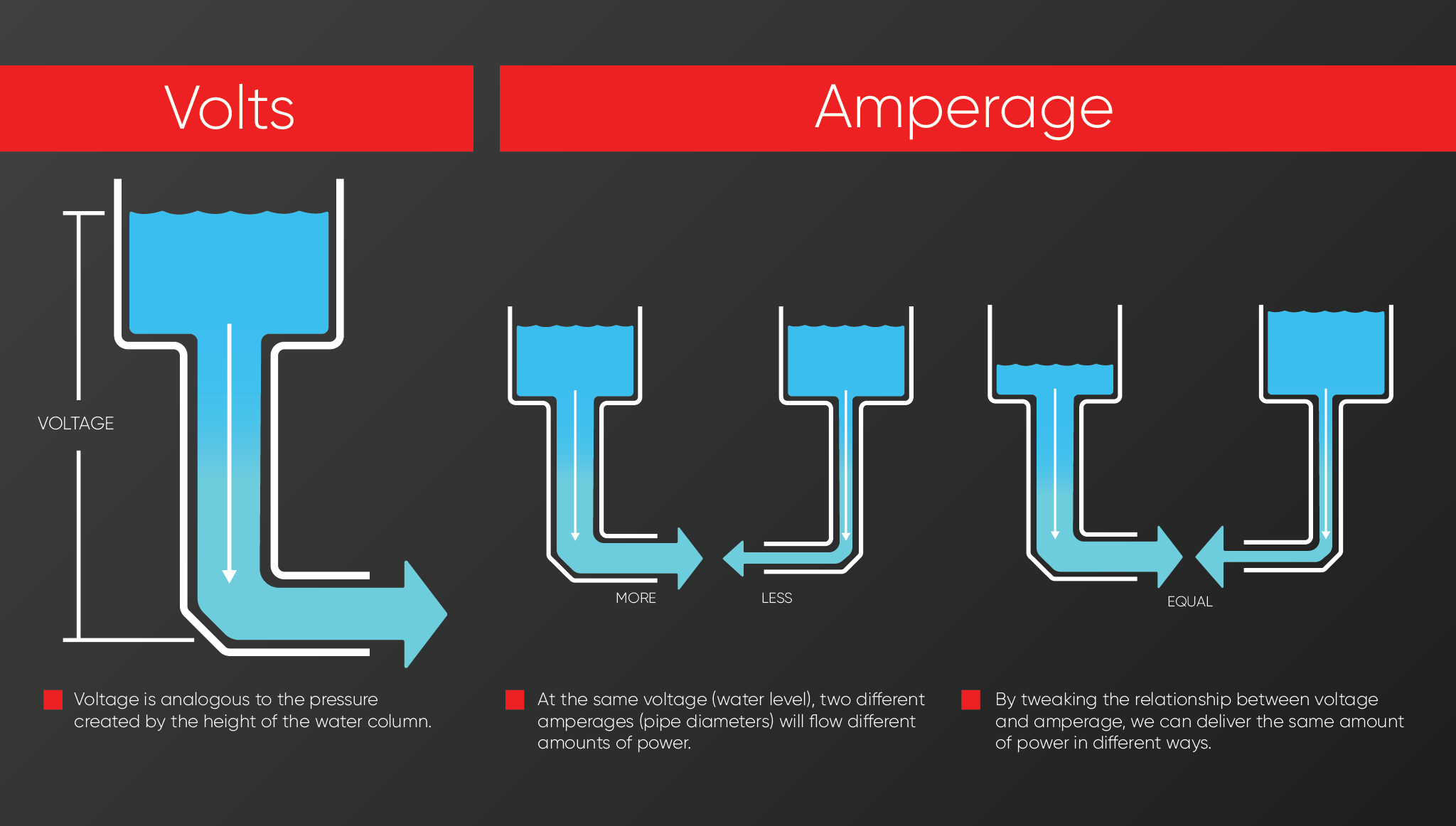
Volt:
Think of the volt as a measurement of electrical "pressure," like you'd find
in a common garden hose. For a given diameter of hose, turning up the
pressure moves more water. (Water is equivalent to power in this analogy.)

Ampere:
Continuing the garden hose analogy, think of the ampere (aka amp) as a
measurement of electrical "flow," with a larger-diameter hose—higher
amperage—flowing more water (electrical power) at any given pressure
(voltage).

Watt:
Named for James Watt, who also defined the term "horsepower," the watt is a
measure of the expenditure of energy over time. The particulars don't really
matter here; what does matter is that the watt measures the exact same thing
horsepower does. It's just a different unit. Like liters and gallons. One
horsepower is equal to 745.7 watts.

Kilowatt:
The kilowatt is just 1,000 watts. Watts are small, so a bunch of them need
to be grouped up to have meaning in the world of vehicle-level power: One
kilowatt is equal to 1.34 horsepower.

Horsepower:
A unit originally invented to aid in the sales and marketing of steam
engines, by measuring the output of the then-new machines in familiar,
easy-to-understand terms. Like the watt, the horsepower is a measure of the
delivery of energy over time.

Torque:
A measure of a force applied around an axis. In simple terms, it's how hard
something can twist a shaft. It's important to note that torque is
independent of movement or time; torque can be applied at zero rpm. To make
sense of that, think about turning a doorknob until it stops and then
holding it there. The force you used to turn it is torque, and so is the
force you're using to hold it, even though the doorknob is no longer
rotating.

Lithium-ion:
A blanket term covering many different formulations of battery. In the most
basic terms, a lithium-ion battery is any battery that uses a lithium-based
cathode (positive electrode). In the
charging process, negatively charged electrons are supplied to the anode
(negative electrode), drawing charged lithium particles (ions) through an
electrolyte from the cathode to the anode, where they are stored. When the
battery discharges, the ions move back to the lithium cathode, freeing the
stored electrons to move, generating electricity. A separator prevents
current from traveling within
the battery.

Rotor:
The rotor is, as the name implies, the rotating bit in an electric motor.
Think of it kind of like the crankshaft of a combustion engine; forces in
the motor cause the rotor to spin, and that spinning is the motor's output.

Stator:
The fixed parts surrounding the rotating part of an electric motor. The
stator causes the rotor to spin by creating a constantly rotating magnetic
field around its circumference. This rotating magnetic field interacts with
the rotor's magnetic field, causing it
to spin.

Permanent-magnet synchronous motor:
The rotor's magnetic field is supplied by permanent rare earth magnets, and
it rotates in sync with the stator's rotating magnetic field, hence the
"synchronous" part of the name.

Induction asynchronous motor:
Instead of permanent magnets, induction motors use electrical current to
induce a magnetic field in a cage of metal bars on the rotor, similar to how
an electromagnet works. In order for that electromagnetic induction process
to happen, there has to be some slight misalignment between the fields of
the stator and the metal bars on the rotor. This misalignment is known as
"slip," and it's also what makes the motor "asynchronous."

It might seem like electric vehicles are complicated and foreign, with their
wires and batteries and silent motors and computers laced throughout to
control the show. Worse, they're often measured in unfamiliar units and
labeled with unintuitive names. It's just about impossible for most car folk
to look at a spec sheet highlighting battery capacity, motor output in
kilowatts, and charging voltage and make heads or tails of what those specs
really mean, in a seat-of-the-pants sense.

But it doesn't have to stay that way. It is possible to have an intuitive
understanding of and feel for EVs on the numbers, or to at least get closer
to such an understanding. Just like most gearheads, perhaps especially the
old-school hot-rodders, know that 1 liter is just about 61 cubic inches,
there are handy back-of-the-envelope references for other conversions, too.

Take horsepower and kilowatts, for example. As noted in the cheat sheet at
the beginning, 1 horsepower is equal to 745.7 watts. That's great to know,
but what does it mean? Say you want to know how many kilowatts your
supercharged V-8 makes. Easy: To convert from horsepower to kilowatts, just
subtract one-quarter of the horsepower number (e.g., if your V-8 rates 800
hp, subtracting one-quarter yields 600 kW, a result within 1 percent of the
exact conversion). Want to figure out how many horsepower that new EV makes?
Just increase the kilowatts figure by one third; reversing the previous
example makes this obvious. Now you'll never be left without an easy way to
get a sense for just how much oomph you can expect out of 236 kW.

Then there's batteries and charging. Lots of news gets made in the EV world
when a carmaker or charging supplier opens a new set of charging stations,
typically of higher capacity and offering shorter recharge times than
before. Tesla, for example, has recently launched new super-fast 250-kW
charging stalls, and Porsche's fast charger network being rolled out for the
launch of the Taycan features 270-kW chargers. Although they share similar
maximum power output figures, they get there in different ways. That's where
volts and amps come in.

Tesla Model S and Model 3 batteries run at nominal voltages of about 375
volts and 350 volts, respectively. (Published figures vary slightly.) The
Porsche Taycan's batteries run at 800 volts nominal. So for Tesla to charge
its 350-volt Model 3 with 250 kW, it must send about 715 amps through its
cabling to the battery. That means it needs some rather large-diameter
pipes—or, in the real world, large-diameter cables. The Taycan, on the other
hand, needs only 312 amps to achieve a 250-kW charge rate at 800 volts.
(With the appropriate fast charger, the Taycan can charge at up to 270 kW,
which would require about 337 amps.) Higher voltages mean lower amperages,
and that means smaller power distribution cables, which means less weight.
More amperage can also mean more heat, though there are many variables.

The point, however, isn't the advantages of higher-voltage charging and
power delivery, but how volts and amps relate to each other. With the
"lower-pressure, larger pipe" Tesla fast charger, the same amount of
electricity is moved in the same amount of time as the Porsche with its
"higher-pressure, smaller pipe" system. Porsche and Tesla have taken two
different paths to a similar end point, but it's those differences that make
the brands—just like Ford and Chevy both make great small-block V-8s, but
they're as different as they are similar, and those differences matter. The
same goes for batteries.

Batteries, unlike most of an EV's systems, seem fairly familiar. We use
lithium batteries all the time, right? It's true, we do, and although
lithium-polymer batteries (like what you'd find in most smartphones and
laptops these days) are not quite the same as the lithium-ion batteries used
in EVs, they're close enough. But kilowatt-hours? Sounds like your power
bill. And aren't kilowatts like horsepower? Wouldn't that make kW-hr the
same as horsepower-hr then? Yes, yes, and, actually, yes—that's the point. A
battery's kW-hr rating is often analogized to the size of its gas tank, and
just like in a combustion engine vehicle, the harder you thrash it—the more
horsepower you use—the shorter the range you'll get.

Except, like many things with EVs, it's not so simple in the real world.
There are many factors that play into range, including battery pack size,
battery chemistry, and of course all the vehicle's efficiency- or
performance-leaning traits, like aerodynamics, rolling resistance, and more.

Take Tesla, for example. Its cars are the longest-range production EVs on
the road today, with up to 370 miles of range per the EPA's EV range rating
system; the Model S Performance rates 345 miles of range. Porsche's new
Taycan, on the other hand, hasn't yet secured an EPA rating but is likely to
end up around the 250-mile mark. The difference is larger than you might
expect given the relative sizes of their battery packs: Tesla's performance
Model S stores 100 kW-hr of energy, compared to the Porsche's 93.4 kW-hr. So
where does the difference in range come from?

It's easiest to think of it like the old horsepower-per-liter wars: The
battery's kW-hr rating is the liters, and the distance it can go (and/or the
performance it can deliver) is the horsepower. This is where brands
distinguish themselves, not just on technical capability but also in terms
of where each company places the balance of range, performance, and
efficiency for each car—things that establish the character of an EV.

In part because Tesla has had years working on its motor controller
algorithms, it can extract a greater degree of efficiency in the conversion
of electricity into motion. Also playing a role are gearing, motor
selection, and of course all of the standard factors for range, like
aerodynamics and rolling resistance. It's likely this latter factor that
produces one of the larger differences between the Tesla and the Porsche;
although the Tesla Model S wears 245-section-width tires designed for a
balance of performance and efficiency, the Taycan Turbo S' 305-section-width
tires are nearly 3 inches wider, and of a decidedly grippier rubber variety.
The Tesla, likewise, weighs about 300 pounds less than the Taycan Turbo S,
which makes for less mass to accelerate and, therefore, greater range.

The Model S' longer range in Performance guise is especially impressive
given the Tesla's similarity—and in some respects, superiority—on the
performance spec sheet. Maximum horsepower is a close race between the two,
with the Porsche's 760 peak hp (in boost mode) beating the Tesla Model S
Performance's max of 691 hp. Zero to 60 mph times are blazingly quick in
either car, with the Taycan Turbo S taking 2.6 seconds (according to
Porsche) to the Tesla Model S Performance's 2.4 seconds. Likewise, the Tesla
just edges the Porsche's top speed, at 163 mph versus the Taycan's 161 mph.

One significant difference between the Model S and the Taycan Turbo S,
however, is repeatability: Just a single launch or two can deplete the
Tesla's battery to the point that range is significantly reduced and further
performance runs are prohibited. The Porsche, on the other hand, is capable
of its rated performance essentially until the battery is flat. Why? In
part, it's about the character of each car, and the decisions their
respective brands made in service of that character. The Tesla, for example,
is meant to be a great all-arounder, whereas the Taycan, especially in Turbo
S form, is meant to be a serious sport sedan first and a smart, comfy
commuter second. Both cars achieve their goals, as disparate as they are—and
despite how similar they might seem on paper.

All of this battery power has to go somewhere, right? That's where the
motors come in. There are two main kinds of electric motors used in electric
cars, though there are many variations on those themes. Tesla, for example,
uses alternating current (AC) induction motors in the Model S but uses
permanent-magnet direct current (DC) motors in its Model 3. There are
upsides to both types of motor, but generally, induction motors are somewhat
less efficient than permanent-magnet motors at full load. Permanent-magnet
motors are also often smaller and lighter than their induction counterparts.
Although it's possible to get tremendous performance out of induction motors
(the top-performance Model S variants, for example), permanent-magnet motors
are often considered an upgrade. Check out the definitions section for a
reminder about the differences between the two types of electric motor and
their internal workings.

This is, of course, just the tip of the iceberg. But hopefully, you're a
little better equipped to put all of the new EVs hitting the market now and
in the near future into terms that are easier to understand, think, and
argue about.
[© automobilemag.com]


+
https://finance.yahoo.com/news/us-building-codes-every-home-190031848.html
New US building codes will make every home ready for ...
January 9, 2020 ... the International Code Council (ICC) approved changes to
building standards that preview a world in which every home has at least one
electric car ...
https://media.zenfs.com/en-US/quartz.com/07d7973b726e83379a9991ce792c1420


For EVLN EV-newswire posts use:
 http://www.evdl.org/archive/


{brucedp.neocities.org}

--
Sent from: http://electric-vehicle-discussion-list.413529.n4.nabble.com/
_______________________________________________
UNSUBSCRIBE: http://www.evdl.org/help/index.html#usub
ARCHIVE: http://www.evdl.org/archive/index.html
INFO: http://lists.evdl.org/listinfo.cgi/ev-evdl.org
Please discuss EV drag racing at NEDRA (http://groups.yahoo.com/group/NEDRA)