> On 15 May 2019, at 08:28, Philip Thrift <[email protected]> wrote:
>
>
>
> On Tuesday, May 14, 2019 at 7:29:07 PM UTC-5, Brent wrote:
>
>
> On 5/14/2019 9:49 AM, Jason Resch wrote:
>> What is truth? (Pontus Pilate). Arithmetical statements are true if they are
>> theorems derived from the axioms.
>>
>> This is false. In every consistent system of axioms there are statements
>> that are true but cannot be derived from the axioms.
>
> That's not true. There are axiomatic systems that are complete.
>
>> In other words truth =/= proof, truth is always greater that what can be
>> proved.
>
> That's because you have recourse to an idea of "true" that is outside of
> logical inference...such as "empirically true".
>
> Brent
>
>
>
> An axiom system A being complete just means that for every (syntactically
> well-formed) sentence s in the language of A, either s or ~s can be proved
> via the rules of deduction of A.
>
>
>
> BTW, while Church-Turing is not a useful "thesis”,
Honestly, that is non sense.


> Curry-Howard is.
>
>                           proofs = programs

That is a string philosophical claim. It makes some sense in intuitionist
logic, but is too much extensional in classical logic. It is something deep and
important, but it is not as rich and fertile as Church-Turing thesis.


>
> (The informal word "model" does not come up in programming language theory -
> PLT - that I can surmise, except in the context of a "model of
> computation/programming" - lambda calculus, pi calculus, functional,
> process-oriented. Its use in physics is a bit confusing. For example,
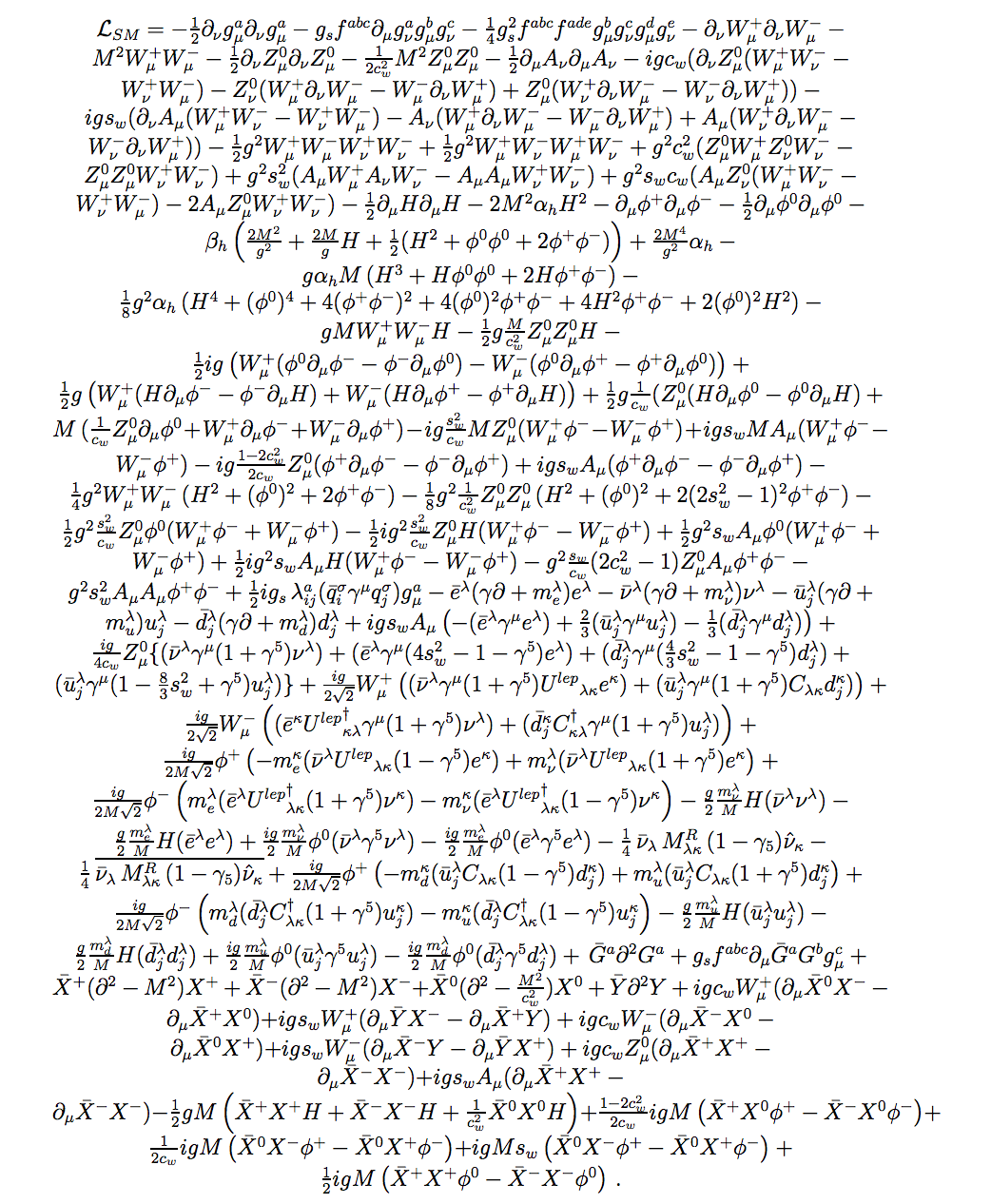
> regarding the equation of the Standard Model as written out by mathematical
> physicist Matilde Marcolli:
>
>
> https://www.sciencealert.com/images/Screen_Shot_2016-08-03_at_3.20.12_pm.png
> <https://www.sciencealert.com/images/Screen_Shot_2016-08-03_at_3.20.12_pm.png>
>
> is the equation itself of the Standard Model here a "model", or is the
> interpretation of this equation a "model”?)

A model is a very well defined notion in mathematical logic, and it has nothing
to do with “standard model of particles” which is a theory, and where the
intended model in the physical reality (fundamental or not, "really existing"
or not).

Careful: in "the standard model of arithmetic" and "the standard model of
particle physics”; model are used in quite different sense. In the logician
terming, the second one should be called the standard theory of particles.

Bruno


>
> @philipthrift
>
> --
> You received this message because you are subscribed to the Google Groups
> "Everything List" group.
> To unsubscribe from this group and stop receiving emails from it, send an
> email to [email protected]
> <mailto:[email protected]>.
> To view this discussion on the web visit
> https://groups.google.com/d/msgid/everything-list/e9d026a6-8100-492f-a141-09c6aee4c6f0%40googlegroups.com
>
> <https://groups.google.com/d/msgid/everything-list/e9d026a6-8100-492f-a141-09c6aee4c6f0%40googlegroups.com?utm_medium=email&utm_source=footer>.

--
You received this message because you are subscribed to the Google Groups
"Everything List" group.
To unsubscribe from this group and stop receiving emails from it, send an email
to [email protected].
To view this discussion on the web visit
https://groups.google.com/d/msgid/everything-list/36000C92-EC79-430E-B3F8-CB0FF52E81A0%40ulb.ac.be.