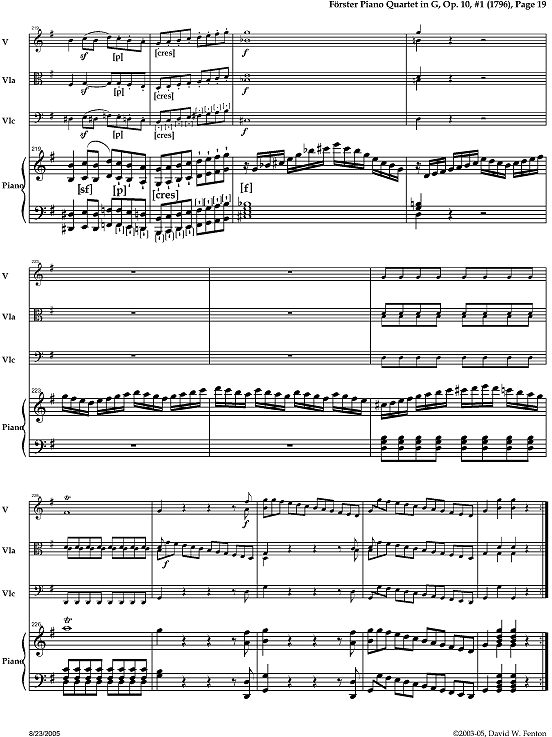
On 22 Feb 2006 at 9:28, Cecil Rigby wrote:

> If it's a scholarly edition in which you want credit for the edits
> then you could include the brackets (ugh!). An alternative is to
> asterisk them and include a note, which is much less obtrusive. The
> small addition to the marks' footprints probably wouldn't have a
> bearing on whatever regular rules for placement you use.
If Kim is still working on the same repertory he's been doing so much
work in, it's a scholarly edition of Baroque music (which looks like
that's what's in his illustration).

Brackets are *not* obtrusive at all.

And it's important to distinguish editorial dynamics so that an
interpreter can ignore them, if she chooses. They are editorial
suggestions and someone using an edition with brackets can
immediately see what can be omitted or altered.

A footnote makes that substantially harder to do.

Note also that many critical editions don't use brackets, but use non-
italic for original dynamics and italic for editorial additions. The
problem is that it's hard to remember which is which if you're not
careful. One could use italic for original dynamics using the Finale
fonts, and create non-italic dynamics for the editorial additions
without brackets, but I find that will cause them to not be noticed
as editorial, and would just look funny to many people, who'd wonder
why there are dynamics in two different fonts. Brackets make the
meaning completely clear, with no need for footnotes or explanation.

Tell me that this:

http://www.dfenton.com/Midi/Foerster10_1/Foerster10_1_019.png

is cluttered, in regard to dynamics. Certainly, I would agree that
the editorial strokes are cluttered, and haven't decided what I'm
going to do for the final edition (I may just change it so there's an
opening bracket on the first of a run of them and a closing editorial
bracket on the last; but I like having only a single definition for
the editorial stroke, and that would mean creating 2 different ones,
or using the non-editorial stroke and then not knowing except by
looking at context, which of the strokes is editorial; the advantage
of having a separate definition is that you can change them all at
once to make them obvious, and do things like replace them in parts
with a standard articulation, if you want), but I think the brackets
can be made to work just fine, at least for dynamics, if not for
articulations that are repeated.

--
David W. Fenton                    http://dfenton.com
David Fenton Associates       http://dfenton.com/DFA/

_______________________________________________
Finale mailing list
[email protected]
http://lists.shsu.edu/mailman/listinfo/finale