At 9:47 AM +0100 10/24/06, Ken Moore wrote:
"David W. Fenton" <[EMAIL PROTECTED]> wrote: On 23 Oct 2006
at 22:52, dc wrote:
> > The 3/1 sections use mostly double whole notes and whole notes,
 whereas the C sections use up to 16th notes.
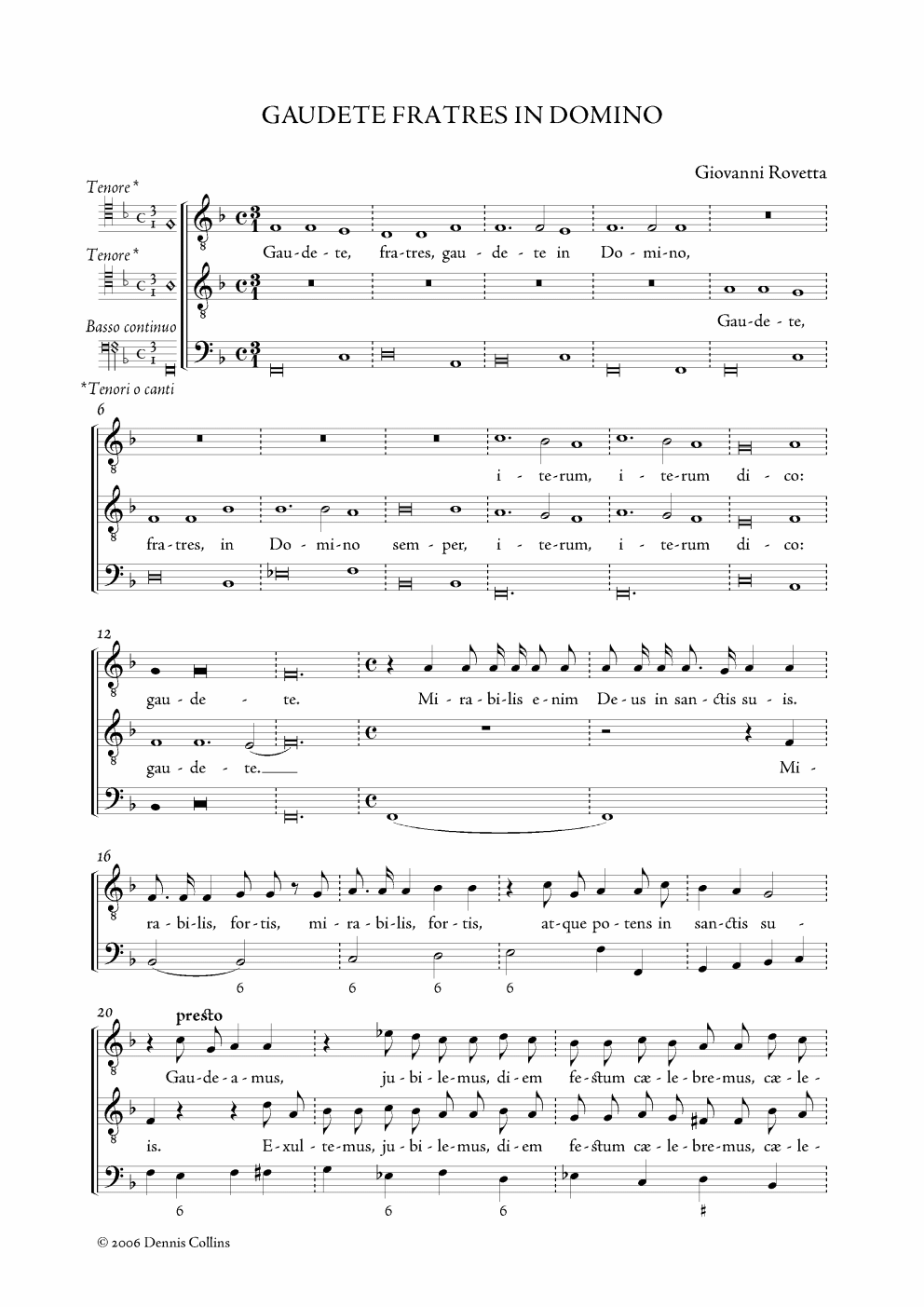
 > See for example
> <http://www.philomela.net/sp/rovetta_gaudete_fratres_in_domino.gif>
 > where I multiplied the "reference duration" by two for the 3/1
 sections.
I am puzzled by this. If the incipit is correct, and if the
statement that all note values are the same as the original, then
what is it, exactly, that has been "multiplied by two"? What, in
other words, is the "reference duration"?
DWF:
But haven't you created the problem for yourself by halving the 4/2
section and leaving the 3/1 section in its original meter? If you
were moving from 3/1 to 4/2 it would be the original ratios and you
wouldn't have the spacing problem.
[...]
But maybe I'm guessing wrong about the original mensuration sign
(which I assume was a C).
The example looks odd to me, because I would expect the 3/1 to be
one beat per measure and alternated with a 4/2 minim beat at the
same beat speed. If you try the C section with a minim beat, it has
to be at a different speed.
OK, what we have here is confusion between the use of old note names
and new ones, and between UK and US modern names. What I see in the
example is clear enough (assuming that it does keep original note
values). The tempus imperfectum mensuration seems to govern, with
the 3:1 clearly not a "meter" or "time" signature but a proportion in
the older style--3 semibreves in the time of 2 semibreves.
I admit that I am puzzled by the coloration in measure 12, since as
realized the black semibreve and breve have exactly the same value as
it they were normally white. But at measure 14 the restatement of
the original mensuration, cancelling the 3:1 proportion, would seem
to give a double-time result, since it calls for 2 semibreves in the
time of 3 semibreves under the 3:1. And that certainly seems to fast
for this parlando to go. So my question would be, is that C in
measure 14 actually a mensuration sign in the original or is it a
modern 4/4 indication? In other words, what is original and what is
not.
The "Presto" indication in measure 20 seems to have no justification
in the original, or at least none that is indicated in the edition.
I had some difficulty reading the example, because of my browser's
scaling of it, but Rovetta could have written it as late as 1662, by
which time there was greater notational variation than the 1590 +-
25 period with which I am most familiar, so my assumptions are not
necessarily appropriate, but I would still prefer the relationship
that David suggests.
--
Ken Moore
Oh, no question at all that his lifetime was one of transition in
many aspects of music, and not least in notation conventions.
As to the use of semibreves (modern whole notes) in a fast-moving
context, it doesn't bother me a bit, nor would it bother anyone used
to reading Monteverdi and others with original note values, but it
would certainly puzzle partially-trained choral conductors who do not
understand the mensuration/proportion conventions of the 15th and
16th centuries.
John


--
John & Susie Howell
Virginia Tech Department of Music
Blacksburg, Virginia, U.S.A 24061-0240
Vox (540) 231-8411  Fax (540) 231-5034
(mailto:[EMAIL PROTECTED])
http://www.music.vt.edu/faculty/howell/howell.html
_______________________________________________
Finale mailing list
[email protected]
http://lists.shsu.edu/mailman/listinfo/finale