Peter,

Perhaps I'm misunderstanding something, but surely the problem is that the
algorithm used to blend the anti-aliased text with the background doesn't
properly take into account the relevant properties of the human visual system.
It should be possible to develop a suitable blending algorithm that has a
(more) perceptually uniform effect. I've no idea whether anyone's done so
though.

David %^>


-----Original Message-----
From: [email protected]
[mailto:[email protected]] On Behalf Of Peter Grandi
Sent: 11 February 2012 20:05
To: Freetype users
Subject: [ft] changing the depth of gray for anti-aliasing

I have been for a long time rather unhappy with anti-aliasing
because of it makes text bolder and fuzzier than it should be,
at least on monitors with 100DPI or so, but I have recently
realized, as described here:

  http://www.sabi.co.uk/blog/12-two.html#120206

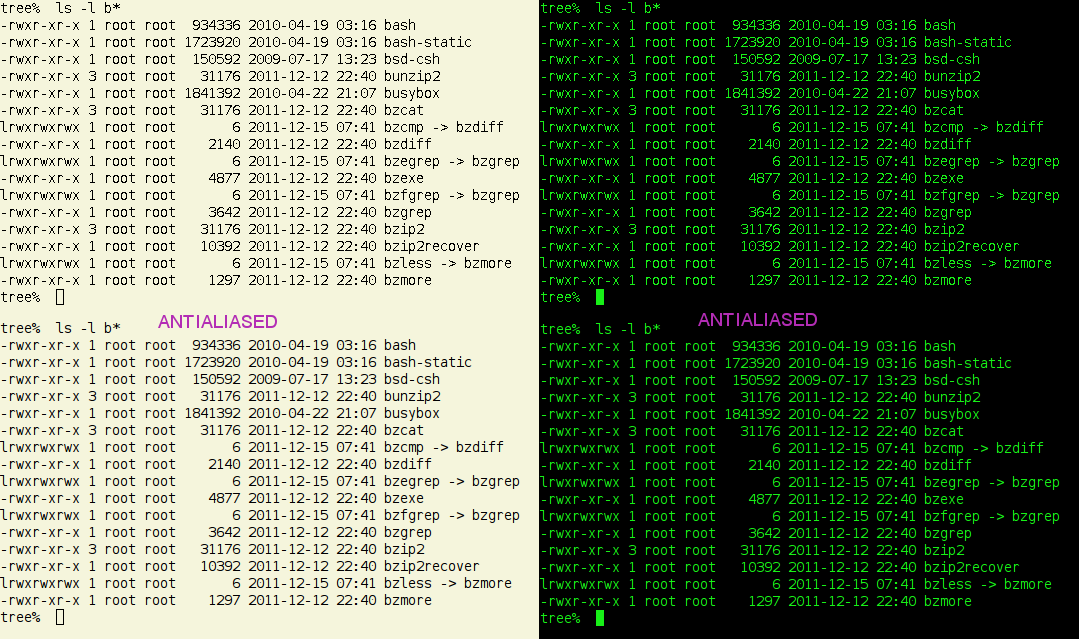
and in particular by this side-by-side comparison image:

  http://www.sabi.co.uk/Misc/snapFontAliasingDarkLight.png

that anti-aliased text looks very different on dark backgrounds
(thinner, not so fuzzy) than on light ones (thicker, fuzzier).
This is all without subpixel anti-aliasing (gray-level only).

My guess is that this happens because at around 100DPI most 10
point fonts render with 1-pixel wide features, and ''graying''
around that makes it look thicker, but how dark the gray is
matters a lot: if it is lighter, on light backgrounds the
apparent extra thickness will be less apparent, and viceversa on
dark backgrounds.

Therefore it would be nice to be able to control how dark is the
anti-aliased "fuzz", so it can be rather lighter than the default
on light backgrounds and a little darker on dark backgrounds.

Is there a runtime tweakable already?

_______________________________________________
Freetype mailing list
[email protected]
https://lists.nongnu.org/mailman/listinfo/freetype


_______________________________________________
Freetype mailing list
[email protected]
https://lists.nongnu.org/mailman/listinfo/freetype