What will happen is the scale lecture courses that are cheap, one teacher
and hundreds of students, will be skimmed off by the internet because they
really are educationally replaceable.      (That is what recordings did to
live performances.)    What you were left for education, as for complex
culture, is one of a kind products that develop creativity and the future
through individual training.   Those are the most expensive products.
Compare the cost of a rock band in a stadium to the cost of a one of kind
opera product at the Metropolitan.    With no external income the Met
operates at a 40% loss on all productions.     For the universities, those
lecture classes with one teacher and hundreds of students paying high
tuition amount to a rock concert with four or five members and thousands of
people in the audience.    They make a big profit.     It seems sometimes
that the economists never ran a business and certainly do not understand how
to sustain a complex product that is expensive to produce.   At the best
they are automobile dealers in sophistication.     Thousands of Willie
Lomans.     But try to sell a great science project or a great work of art
or the training of your child in the sophistication of cultural traditions,
professional expertise and the development of a future.
 America will need an education Czar and a council to sort this all out.
The market can't do it.  The market tends to reduce services until only the
wealthy can afford them or the workers die from low pay and too many hours.
Free markets don't work for culture and public goods.   Hell, most
economists don't seem to really know the meaning of "public goods" either.
Productivity lag and negative externalities are some exotic virus that
doesn't interest them until they are broken or given cancer by them.


Monolithic central planning doesn't work for the distribution of mass
produced products.    However, Monolithic Central planning created the
greatest schools in the world in the Soviet Union.  They trained more people
across classes.   Accessed more talent for the society and once the wall
came down, swept across the world like Genghis taking jobs in their path and
putting the locals on unemployment.    They now run our space station while
the market destroys our space program.     But they couldn't manufacture
toilet paper and get it distributed.    Humm!   That is SOME metaphor.
The market forces, like the internet, put pressure on the cultural
activities and in the last century  reduced complex culture by 98% in the
West once the Cold War was over and they didn't have to worry about keeping
up with the Russians.


The West is obviously in decline and the internet won't solve the problem
but it will kill the universities because it will leave them with the most
expensive needs and no students that can afford it.    I don't agree with
Keith and the others about the reasons for this decline.   I believe Marx is
perfectly adequate to describe what is happening without invoking asteroids
(which are real) or the collapse of paper money, which is a "story" solved
by mass murder and armies.


Thanks Mike.   Or should I say Cassie?


REH


From: [email protected]
[mailto:[email protected]] On Behalf Of Michael Gurstein
Sent: Wednesday, September 01, 2010 2:22 AM
To: 'RE-DESIGNING WORK, INCOME DISTRIBUTION, EDUCATION';
[email protected]
Subject: [Futurework] FW: [TriumphOfContent] Charts: College Tuition vs.
Housing Bubble vs. Medical Costs


-----Original Message-----
From: [email protected]
[mailto:[email protected]] On Behalf Of gary
Sent: Tuesday, August 31, 2010 11:11 PM
To: Triumph of Content
Subject: [TriumphOfContent] Charts: College Tuition vs. Housing Bubble vs.
Medical Costs


Sent to you by gary via Google Reader:


Charts:
<http://feedproxy.google.com/~r/Mymoneyblog/~3/H64SaWzyWb8/charts-college-tu
ition-vs-housing-bubble-vs-medical-costs.html>  College Tuition vs. Housing
Bubble vs. Medical Costs


via My Money Blog <http://www.mymoneyblog.com>  by Jonathan on 8/31/10


<http://api.tweetmeme.com/share?url=http%3A%2F%2Fwww.mymoneyblog.com%2Fchart
s-college-tuition-vs-housing-bubble-vs-medical-costs.html>


  <http://www.mymoneyblog.com/images/1007/tuition.gif>

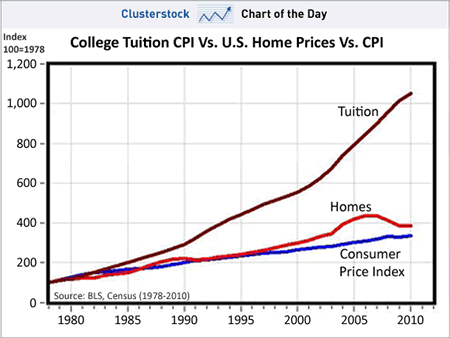
This chart from Clusterstock
<http://www.businessinsider.com/chart-of-the-day-tuition-home-prices-cpi-201
0-7>  (via Carpe
<http://mjperry.blogspot.com/2010/06/higher-education-bubble-its-about-to.ht
ml>  Diem) shows the cost of college tuition comparison to historical
housing prices and the Consumer Price Index (CPI) over the same period. The
CPI is designed to track our cost of living by estimating the average price
of consumer goods and services purchased by households. Everything was
normalized to 100 starting in 1978.

While housing went up 4x at its peak (~400), college tuition has gone up
over 10x. Instapundit Glenn Reynolds says the higher
<http://www.washingtonexaminer.com/opinion/columns/Sunday_Reflections/Higher
-education_s-bubble-is-about-to-burst-95639354.html>  education bubble is
about to burst:

It's a story of an industry that may sound familiar. The buyers think what
they're buying will appreciate in value, making them rich in the future. The
product grows more and more elaborate, and more and more expensive, but the
expense is offset by cheap credit provided by sellers eager to encourage
buyers to buy.

Buyers see that everyone else is taking on mounds of debt, and so are more
comfortable when they do so themselves; besides, for a generation, the value
of what they're buying has gone up steadily. What could go wrong? Everything
continues smoothly until, at some point, it doesn't.

Yes, this sounds like the housing bubble, but I'm afraid it's also sounding
a lot like a still-inflating higher education bubble. And despite (or
because of) the fact that my day job involves higher education, I think it's
better for us to face up to what's going on before the bubble bursts
messily.

The college tuition prices being tracked in the chart was done by the CPI
for US cities for "College Tuition and Fees". According to this BLS.gov link
<http://www.bls.gov/cpi/cpifacct.htm> , this tracks actual expenditures by
households, and not some measure of median college tuition, which is often
just the "retail price" before various forms of financial aid and/or
scholarships.

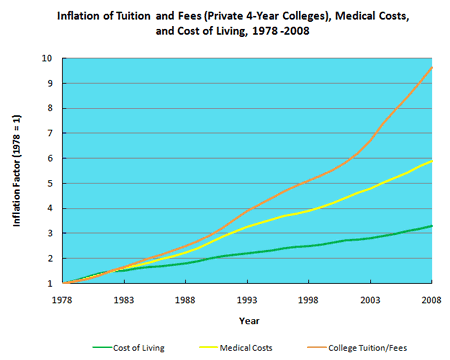
Another hot topic is the rapidly rising cost of health care. Well, college
tuition CPI beats that too, from this Wikipedia chart
<http://en.wikipedia.org/wiki/College_tuition> :

  <http://www.mymoneyblog.com/images/1007/tuition2.gif>

I know that I'm scared to imagine what college will cost in another 20
years. Dealing with this issue will be tricky, with huge amounts of easy
government credit being given to 18-year-olds that are being told by
everyone (including parents) that it is totally worth it. For many people,
it will indeed be worth it. For others, not so much.

In my humble opinion, it also seems obvious that this trend can't survive
forever. But will it burst like a bubble? Perhaps if the government turns
off the loans suddenly, but that seems unlikely. I like Reynold's idea that
there may be an educational revolution with the internet, online coursework,
and changing educational standards.


<http://feeds.feedburner.com/~ff/Mymoneyblog?a=H64SaWzyWb8:YPuKDCLXQuo:D7DqB
2pKExk>
<http://feeds.feedburner.com/~ff/Mymoneyblog?a=H64SaWzyWb8:YPuKDCLXQuo:F7zBn
Myn0Lo>
<http://feeds.feedburner.com/~ff/Mymoneyblog?a=H64SaWzyWb8:YPuKDCLXQuo:gIN9v
FwOqvQ>
<http://feeds.feedburner.com/~ff/Mymoneyblog?a=H64SaWzyWb8:YPuKDCLXQuo:yIl2A
UoC8zA>
<http://feeds.feedburner.com/~ff/Mymoneyblog?a=H64SaWzyWb8:YPuKDCLXQuo:qj6ID
K7rITs>

  <http://feeds.feedburner.com/~r/Mymoneyblog/~4/H64SaWzyWb8>


Things you can do from here:


*       Subscribe
<http://www.google.com/reader/view/feed%2Fhttp%3A%2F%2Ffeeds.feedburner.com%
2FMymoneyblog?source=email>  to My Money Blog using Google Reader
*       Get started using Google
<http://www.google.com/reader/?source=email>  Reader to easily keep up with
all your favorite sites


__._,_.___

Reply
<mailto:[email protected]?subject=charts:%20College%20Tuition%20vs.%20Housing
%20Bubble%20vs.%20Medical%20Costs>  to sender | Reply
<mailto:[email protected]?subject=charts:%20College%20Tuition
%20vs.%20Housing%20Bubble%20vs.%20Medical%20Costs>  to group | Reply
<http://groups.yahoo.com/group/TriumphOfContent/post;_ylc=X3oDMTJyZzg5MWhwBF
9TAzk3MzU5NzE0BGdycElkAzE3OTM4NjM5BGdycHNwSWQDMTcwNTA2Mzk4NQRtc2dJZAMyMTE1OQ
RzZWMDZnRyBHNsawNycGx5BHN0aW1lAzEyODMzMjE0NjA-?act=reply&messageNum=21159>
via web post |
<http://groups.yahoo.com/group/TriumphOfContent/post;_ylc=X3oDMTJmMjlza3BvBF
9TAzk3MzU5NzE0BGdycElkAzE3OTM4NjM5BGdycHNwSWQDMTcwNTA2Mzk4NQRzZWMDZnRyBHNsaw
NudHBjBHN0aW1lAzEyODMzMjE0NjA-> Start a New Topic

Messages
<http://groups.yahoo.com/group/TriumphOfContent/message/21159;_ylc=X3oDMTM3c
WR1Z2JpBF9TAzk3MzU5NzE0BGdycElkAzE3OTM4NjM5BGdycHNwSWQDMTcwNTA2Mzk4NQRtc2dJZ
AMyMTE1OQRzZWMDZnRyBHNsawN2dHBjBHN0aW1lAzEyODMzMjE0NjAEdHBjSWQDMjExNTk->  in
this topic (1)

Recent Activity:


<http://groups.yahoo.com/group/TriumphOfContent;_ylc=X3oDMTJmNjA4Z3NtBF9TAzk
3MzU5NzE0BGdycElkAzE3OTM4NjM5BGdycHNwSWQDMTcwNTA2Mzk4NQRzZWMDdnRsBHNsawN2Z2h
wBHN0aW1lAzEyODMzMjE0NjA-> Visit Your Group


<http://groups.yahoo.com/;_ylc=X3oDMTJlczJwOHAyBF9TAzk3NDc2NTkwBGdycElkAzE3O
TM4NjM5BGdycHNwSWQDMTcwNTA2Mzk4NQRzZWMDZnRyBHNsawNnZnAEc3RpbWUDMTI4MzMyMTQ2M
A--> Yahoo! Groups

Switch to:
<mailto:[email protected]?subject=change%20delive
ry%20Format:%20Traditional> Text-Only,
<mailto:[email protected]?subject=email%20delivery:%20
Digest> Daily Digest .
<mailto:[email protected]?subject=unsubscribe>
Unsubscribe .  <http://docs.yahoo.com/info/terms/> Terms of Use

.


<http://geo.yahoo.com/serv?s=97359714/grpId=17938639/grpspId=1705063985/msgI
d=21159/stime=1283321460/nc1=1/nc2=2/nc3=3>

__,_._,___

!DSPAM:2676,4c7dee78177551325751732!
_______________________________________________
Futurework mailing list
[email protected]
https://lists.uwaterloo.ca/mailman/listinfo/futurework