https://asiapacificreport.nz/2018/12/11/human-rights-watchdog-calls-for-police-probe-into-unclear-papua-killings/
Human rights watchdog calls for police probe into ‘unclear’ Papua killings
By *PMC Editor* <https://asiapacificreport.nz/author/pmc-editor/> -

December 11, 2018

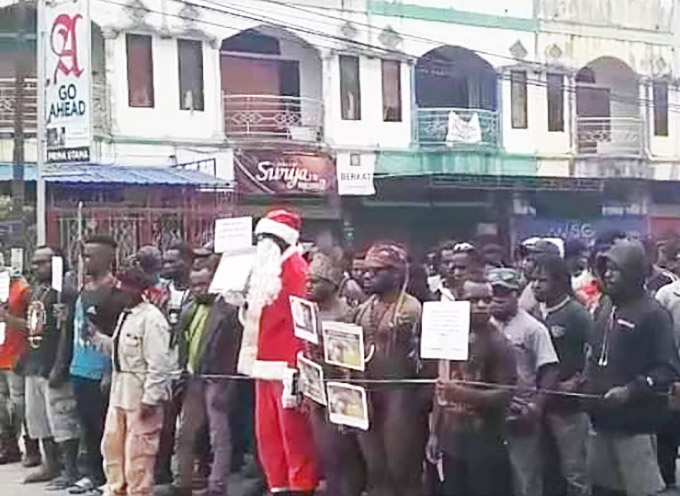
<https://asiapacificreport.nz/wp-content/uploads/2018/12/Christmas-rally-in-Papua-680wide.jpg>Christmas
spirit at a Human Rights Day rally in the Papuan capital of Jayapura this
week. Image: Voice Westpapua

*Pacific Media Centre <http://www.pmc.aut.ac.nz/>** Newsdesk*

Indonesian police should investigate a Papuan armed group’s killing of at
least 17 people
<https://www.radionz.co.nz/international/pacific-news/377702/sixteen-bodies-recovered-in-aftermath-of-papua-massacre>,
including a soldier, at a construction area in Nduga in Papua’s densely
forested Central Highlands earlier this month, Human Rights Watch said today
<https://www.hrw.org/news/2018/12/09/indonesia-papuan-militants-kill-17>.

The circumstances of the killings on December 2 remained unclear, said the
watchdog.

Papuan militants should cease unlawful killings, and the Indonesian
government should ensure that its security forces act in accordance with
international standards and not commit abuses in response to the attack,
said the watchdog.

*READ MORE:* Indonesia’s Papua media blacklist
<https://www.hrw.org/news/2018/08/06/indonesias-papua-media-blacklist-0#>

“A Papua militant group’s attack on a worksite raises grave concerns that
require a full investigation,” said Elaine Pearson
<https://www.hrw.org/about/people/elaine-pearson> of Human Rights Watch.

“Militants and responding security forces should not inflict harm on
ordinary Papuans.”

The West Papua National Liberation Army (Tentara Pembebasan Nasional Papua
Barat), the military wing of the Free Merdeka Movement (Organisasi Papua
Merdeka), claimed responsibility for the killings
<http://www.thejakartapost.com/news/2018/12/06/west-papua-liberation-army-claims-responsibility-for-mass-killing.html>,
saying those killed were military personnel from the Indonesian Army Corps
of Engineers.

An army colonel said that three of the survivors of the attack
<https://nasional.tempo.co/read/1152773/tni-polri-temukan-16-korban-tewas-insiden-pembunuhan-di-papua>
were
military personnel working as engineers.

Indonesian police prepare to face peaceful Papuan protesters in the capital
of Jayapura this week. Image: Voice Westpapua

*‘*
*Military engineers’*Sebby Sambom <https://www.facebook.com/Mmonggarap>, a
spokesman for the Papuan armed group, told the media that the attacks were
organised by the militant’s group’s third Ndugama Command
<https://suarapapua.com/2018/12/06/panglima-kodap-iii-ndugama-bertanggungjawab-atas-kasus-nduga/>
..

He said they had monitored the workers for three months
<http://www.thejakartapost.com/news/2018/12/06/west-papua-liberation-army-claims-responsibility-for-mass-killing.html>
and
concluded that they were engineering corps personnel wearing civilian
clothes.

However, Indonesia’s public works minister, Basuki Hadimuljono, said that
those killed were workers from state-owned companies
<http://www.thejakartapost.com/news/2018/12/04/trans-papua-road-project-suspended-amid-worsening-security.html>
PT
Istaka Karya and PT Brantas Abipraya, sent from Sulawesi to work on the
4300 km Trans-Papua highway.

He said that only the soldiers protecting the workers were armed, including
the one killed in the attack.

Indonesian President Joko Widodo said in reaction to the attacks
<https://news.detik.com/berita/4331141/jokowi-doakan-arwah-para-pahlawan-trans-papua-diterima-di-sisi-nya>
he
had “ordered the armed forces commander and the police chief to pursue and
capture all the perpetrators of such rude and violent acts”.

Priests, seminarians and students take part in a peaceful Human Rights Day
march in the capital Jayapura this week. Image: Voice Westpapua

In West Papua, December 1 is widely commemorated as the day West Papua
declared nationhood. In 1961, under Dutch rule, an elected council
consisting mostly of indigenous Papuans commissioned the creation of a
national anthem and flag.

On December 1, 1961, the West Papuan Morning Star flag was flown beside the
Dutch tricolor for the first time.

Indonesia took control over Papua with United Nations recognition in 1969.

*500 plus arrested*
Over the last five decades, some Papuans have resisted Indonesian rule. On
December 1, 2018, more than 500 students were arrested
<https://www.newsweek.com/hundreds-have-been-arrested-just-raising-flag-heres-why-1241476>
in
more than 10 Indonesian cities after peacefully raising the *Morning Star* flag
and demanding a referendum on independence.

Indonesia’s National Police initially announced that the killings in Nduga
were in retribution for a worker taking photographs of Papuan militants
organising a flag-raising ceremony near a road and bridge construction.

More than 100 military and police officers were evacuating the dead and
injured, and engaged in a military operation against the militants.

Human Rights Watch has long documented human rights abuses in Papua’s
Central Highlands
<https://www.hrw.org/news/2007/07/05/indonesia-police-abuse-endemic-closed-area-papua>,
where the military and police have frequently engaged in deadly
confrontation with armed groups.

Indonesian security forces have often committed abuses against the Papuan
population, including arbitrary detention and torture. A lack of internal
accountability within the security forces and a poorly functioning justice
system mean that impunity for rights violators is the norm in Papua.

“The Indonesian security forces should exercise care when operating in
Nduga, directing all security personnel to treat Papuans in accordance with
international standards,” said the watchdog.

“They should transparently investigate and hold accountable anyone
implicated in a criminal offence. Both the military and the police should
allow journalists to operate independently in the area.”


A cartoonist’s depiction of Indonesian government restrictions on media
freedom and rights monitoring in Papua. Cartoon: © 2015 Toni Malakian/Human
Rights Watch

*Remote access*
Nduga is an extremely remote area where no journalists have had access
since the attacks.

A decades-long official restriction on foreign media
<https://www.hrw.org/report/2015/11/10/something-hide/indonesias-restrictions-media-freedom-and-rights-monitoring-papua>
access
to Papua and controls on Indonesian journalists there have fostered that
lack of justice for serious abuses by Indonesian security forces and fueled
resentment among Papuans.

“The situation in Nduga is muddled in large part because no journalists can
independently go into the area to interview witnesses and verify what
happened,” Pearson said.

“Having independent monitors on the ground will help deter abuses by both
the militants and security forces, which would benefit all Papuans.