https://asiapacificreport.nz/2020/02/11/elaine-pearson-five-urgent-issues-for-indonesias-president-to-address/
West Papua: Five urgent issues for Indonesia’s president to address

By *Pacific Media Watch*
<https://asiapacificreport.nz/author/pacific-media-watch/> -

 February 11, 2020

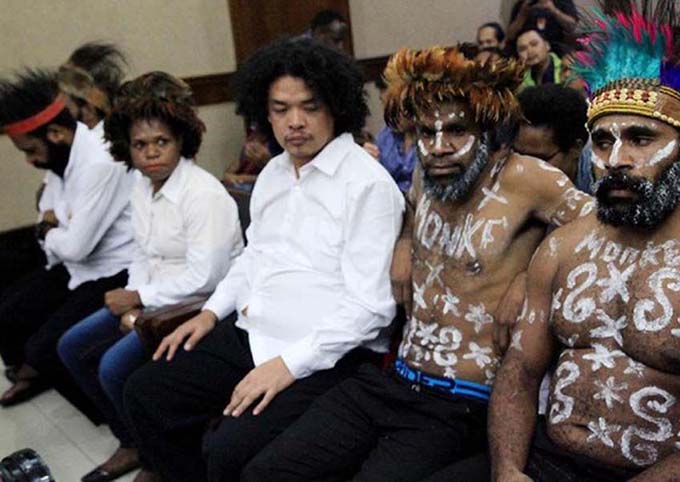
<https://asiapacificreport.nz/wp-content/uploads/2020/02/Papuan-political-prisoners-Jakarta-2019-Detik-680wide.jpg>Papuan
political prisoners on trial in Jakarta, December 16, 2019. Image: Detik

*By Elaine Pearson*

Indonesian President Joko Widodo (known as Jokowi) addressed Australia’s
Parliament yesterda
<https://www.abc.net.au/news/2020-02-10/joko-widodo-indonesian-president-addresses-australian-parliament/11948604>
y.

Indonesia is often referred to as the democratic success story of Southeast
Asia and a model of Muslim democracy, yet it has been responsible for
significant backsliding on human rights in recent years.

This backsliding is serious enough that Australian leaders should ask
Jokowi some hard questions during his Canberra visit.

*READ MORE:* Joko Widodo uses historic speech to call for greater action to
tackle climate change
<https://www.abc.net.au/news/2020-02-10/joko-widodo-indonesian-president-addresses-australian-parliament/11948604>

Here are five current human rights concerns:


*1. Indonesia’s draconian new Criminal Code*Indonesia has been working on
updating its colonial-era Criminal Code for decades. Now Indonesia’s
Parliament is discussing a new draft code with a raft of problematic
provisions
<https://www.hrw.org/news/2019/09/18/indonesia-draft-criminal-code-disastrous-rights>
that
would be disastrous for women and minorities, and for many Indonesians in
general.

The new code proposes to punish extramarital sex with up to one year in
jail and unmarried couples who live together with six months. Consensual
sex between adults should never be a crime, and this law would
disproportionately affect lesbian, gay, bisexual and transgender (LGBT)
people.

While it does not mention same-sex conduct, same-sex relationships are not
legally recognised in Indonesia, so it would effectively criminalise all
same-sex conduct.

The code also would criminalise
<https://www.hrw.org/news/2019/09/18/indonesia-draft-criminal-code-disastrous-rights>
disseminating
information about contraception as well as criminalising some abortions. It
would expand the toxic blasphemy law, which has been used to target
religious minorities.

While Jokowi delayed the vote following mass protests against the proposed
code last year, he should show leadership in ensuring that abusive
provisions are removed. These provisions not only violate Indonesia’s human
rights obligations but will help foment hatred and discrimination against
certain groups.


*2. Rising discrimination and attacks against LGBT people*While some gay
and lesbian Australians might not think twice about visiting Bali for a
holiday, they should be concerned about the rise in hateful rhetoric
<https://www.hrw.org/news/2018/07/01/indonesia-anti-lgbt-crackdown-fuels-health-crisis>,
discrimination and violence against LGBT people in Indonesia.

Since early 2016, Indonesian politicians, government officials, and state
offices have issued anti-LGBT statements – calling for everything from
criminalisation to “cures” for homosexuality, to censorship of information
about LGBT people and of positive reporting on their activities.

The government’s failure to halt arbitrary and unlawful raids by police and
militant Islamists on private LGBT gatherings has effectively derailed
public health outreach efforts to vulnerable populations. Last November,
Indonesia’s ombudsman revealed that a number of ministries openly
discriminate
<https://www.sbs.com.au/news/indonesian-ministries-slammed-after-banning-lgbtiq-pregnant-job-seekers>
against
LGBT people in job postings, saying that applicants “must not be mentally
disabled and not show sexual orientation or behavioral deviations.”


*3. No UN access for West Papua*The 2019 Pacific Island Forum Leaders’
statement
<https://www.forumsec.org/wp-content/uploads/2019/08/50th-Pacific-Islands-Forum-Communique.pdf>,
signed by all Pacific nations including Australia, expressed concern about
“reported escalation in violence and continued allegations of human rights
abuses in West Papua (Papua)” and urged the Indonesian government to honour
Jokowi’s 2018 promise
<https://www.ohchr.org/EN/NewsEvents/Pages/DisplayNews.aspx?NewsID=22637&LangID=E>
to
allow the UN Human Rights Office to visit the two provinces and report on
the situation before the next Pacific Island Forum’s leaders meeting this
year.

But the UN Human Rights Office has still had no access to West Papua. And
last year’s protests and violence, in which at least 53 people
<https://www.hrw.org/news/2020/01/14/indonesia-backsliding-rights> – both
Papuans and migrants from other parts of Indonesia – were killed and
hundreds more wounded, make the visit even more urgent. Precise estimates
on deaths are difficult because access to Papua is limited.

Indonesian authorities have detained and charged
<https://www.hrw.org/news/2019/11/28/indonesia-free-peaceful-papua-activists>
at
least 22 people for peaceful acts of free expression – mainly for raising
the pro-Papuan independence *Morning Star* flag or speaking about “West
Papua independence” in public. They are charged with  treason (*makar*) and
face up to 20 years in prison.


*4. Rising religious intolerance*Indonesia’s blasphemy law punishes
deviations from the central tenets of Indonesia’s six officially recognised
religions – Islam, Protestantism, Catholicism, Hinduism, Buddhism and
Confucianism – with up to five years in prison. The blasphemy law is
alarmingly used for political purposes and to target religious minorities.

The highest-profile victim of the law was the former Jakarta governor,
Basuki Purnama (Ahok), sentenced
<https://www.smh.com.au/world/asia/ahok-release-a-reminder-of-weaponised-blasphemy-law-in-indonesia-20190123-p50t3b.html>
in
2017 to two years in prison for allegedly defaming Islam in a speech to
fishermen on Seribu Islands, near Jakarta. More recently, a woman was
sentenced
<https://www.abc.net.au/news/2019-04-09/indonesia-supreme-court-upholds-blasphemy-conviction/10984958>
to
18 months in prison for complaining about the level of a mosque’s
loudspeaker.

These are among a number of worrying signs of growing efforts by the
government to impose religious conservatism.

Local and provincial-level governments in at least five provinces have
introduced decrees mandating that women and girls must wear the hijab in
civic buildings, universities and schools. Schools have enforced
<https://www.thejakartapost.com/news/2018/07/29/mandatory-hijab-at-state-schools-stirs-debate.html>
these
regulations in more than a dozen provinces, even on non-Muslim students.


*5. Defence Minister implicated in abuses*Imagine what would happen if an
Australian soldier discharged from the military for human rights abuses and
disobeying orders became our Defence Minister. That is exactly what has
happened in Indonesia, when last year Jokowi appointed his presidential
opponent, Prabowo Subianto, to the post.

The Indonesian army dismissed Prabowo in 1998 over allegations of kidnapping
of more than two dozen activists in 1997-98
<https://www.nytimes.com/1998/08/25/world/suharto-s-son-in-law-a-much-feared-general-is-ousted.html>
during
the fall of Suharto. He has also been accused of abuses
<https://www.thejakartapost.com/news/2013/12/20/what-ever-happened-kraras-timor-leste-pak-prabowo.html>
in
East Timor during his time there as a Kopassus commander.

Indonesia’s military has a long  record of impunity for killings and
enforced disappearances. That is sadly unlikely to improve under Prabowo’s
leadership of one of Indonesia’s most powerful institutions.

President Jokowi has another four years to take concrete steps to protect
the human rights and freedoms for  all Indonesians. But unless he takes
steps to stop the backsliding, Indonesia may face much bigger social and
political crises.

*Elaine Pearson is Australia director of Human Rights Watch. This article
has been republished from HRW.*