Hi Durai,

Ad 1. There will always be a top-level fragment. Fragment root elements and
their contents will be recorded as separate fragments. This works recursively,
so a Citation in a Citation would get its own fragment, and the contents of the
inner Citation would not be considered part of the same fragment.
Ad 2. To my knowledge fragmentation changes are normally applied automatically
by triggering a reindexation. Unless you have disabled that of course.
Ad 3. There is a cts query that allows crossing fragment boundaries, but I
don’t think you’d normally need that.
Kind regards,
Geert

From:
<[email protected]<mailto:[email protected]>>
 on behalf of Pavadaidurai A
<[email protected]<mailto:[email protected]>>
Reply-To: MarkLogic Developer Discussion
<[email protected]<mailto:[email protected]>>
Date: Wednesday, September 16, 2015 at 12:30 PM
To: MarkLogic Developer Discussion
<[email protected]<mailto:[email protected]>>
Subject: [MarkLogic Dev General] Query on Fragmentation

Dear All,

I have taken the below example from Marklogic documentation. I have couple of
questions reg Fragmentation. I understand from below example that “Citation”,
will need to defined as the fragement root


1)      Assuming that we few other elements under CitationSet besides Citation
element, what happens to the Misc elemens? In other words, if I am using
Fragment root, what happens to the left over elements in the document?

2)      I understand that after setting Fragmentation rule, existing documents
will remain unfragmented unless re-indexed (or re-loaded). Does
xdmp:document-set-collection API, takes care of fragmenting the document. I am
asking this question because xdmp:document-set-collection API internally
rewrites the document into the database.

3)      Is there anyway to find out if a given document is fragmented or not?

<CitationSet>
<Citation>citation1</Citation>
<Citation>citation2</Citation>
<Citation>citation3</Citation>
<Citation>citation4</Citation>
<Citation>citation5</Citation>
<Misc>misc1</ Misc>
<Misc>misc2</ Misc>
<Misc>misc3</ Misc>
<CitationSet/>


Fragment Roots<https://docs.marklogic.com/guide/admin/fragments#id_34807>

If a document contains many instances of an XML structure that share a common
element name, then these structures make sensible fragments. With MarkLogic
Server, you can use this common element name as a fragment root.

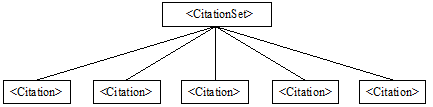
The following diagram shows an XML document rooted at <CitationSet> that
contains many instances of a <Citation> node. Each <Citation> node contains
further XML and averages between 15K and 20K in size. Based on this
information, <Citation> is a sensible element to use as a fragment root:

[https://docs.marklogic.com/media/apidoc/8.0/guide/admin/fragments/fragments-1.gif]


Thanks,
Durai.


**************** CAUTION - Disclaimer *****************
This e-mail contains PRIVILEGED AND CONFIDENTIAL INFORMATION intended solely
for the use of the addressee(s). If you are not the intended recipient, please
notify the sender by e-mail and delete the original message. Further, you are
not
to copy, disclose, or distribute this e-mail or its contents to any other
person and
any such actions are unlawful. This e-mail may contain viruses. Infosys has
taken
every reasonable precaution to minimize this risk, but is not liable for any
damage
you may sustain as a result of any virus in this e-mail. You should carry out
your
own virus checks before opening the e-mail or attachment. Infosys reserves the
right to monitor and review the content of all messages sent to or from this
e-mail
address. Messages sent to or from this e-mail address may be stored on the
Infosys e-mail system.
***INFOSYS******** End of Disclaimer ********INFOSYS***
_______________________________________________
General mailing list
[email protected]
Manage your subscription at:
http://developer.marklogic.com/mailman/listinfo/general