HI.

You can always test the items in question in a small controlled experiment:
- new database, document without fragmenting
- look at the document count vs the fragment count in admin interface for
that document
- then do the collection step
- then look again. If the add collection step does what you expect, the
number of fragments would have increased.


Kind Regards,
David Ennis


David Ennis
*Content Engineer*

[image: HintTech]  <http://www.hinttech.com/>
Mastering the value of content
creative | technology | content

Delftechpark 37i
2628 XJ Delft
The Netherlands
T: +31 88 268 25 00
M: +31 63 091 72 80

[image: http://www.hinttech.com] <http://www.hinttech.com>
<https://twitter.com/HintTech>  <http://www.facebook.com/HintTech>
<http://www.linkedin.com/company/HintTech>

On 16 September 2015 at 13:51, Pavadaidurai A <[email protected]>
wrote:

> Hi Geert,
>
>
>
> Thanks for responding! For the questions No.2 , yes the re-indexer is
> disabled. We do fire xdmp:document-set-collection on these documents on a
> regular basis. So, I am just curious if this API will take care of
> fragmentation for existing documents, since it internally rewrites the
> whole document.
>
>
>
> Thanks,
>
> Durai.
>
>
>
> *From:* [email protected] [mailto:
> [email protected]] *On Behalf Of *Geert Josten
> *Sent:* Wednesday, September 16, 2015 4:19 PM
> *To:* MarkLogic Developer Discussion
> *Subject:* Re: [MarkLogic Dev General] Query on Fragmentation
>
>
>
> Hi Durai,
>
>
>
> Ad 1. There will always be a top-level fragment. Fragment root elements
> and their contents will be recorded as separate fragments. This works
> recursively, so a Citation in a Citation would get its own fragment, and
> the contents of the inner Citation would not be considered part of the same
> fragment.
>
> Ad 2. To my knowledge fragmentation changes are normally applied
> automatically by triggering a reindexation. Unless you have disabled that
> of course.
>
> Ad 3. There is a cts query that allows crossing fragment boundaries, but I
> don’t think you’d normally need that.
>
>
>
> Kind regards,
>
> Geert
>
>
>
> *From: *<[email protected]> on behalf of
> Pavadaidurai A <[email protected]>
> *Reply-To: *MarkLogic Developer Discussion <
> [email protected]>
> *Date: *Wednesday, September 16, 2015 at 12:30 PM
> *To: *MarkLogic Developer Discussion <[email protected]>
> *Subject: *[MarkLogic Dev General] Query on Fragmentation
>
>
>
> Dear All,
>
>
>
> I have taken the below example from Marklogic documentation. I have couple
> of questions reg Fragmentation. I understand from below example that
> “Citation”, will need to defined as the fragement root
>
>
>
> 1)      Assuming that we few other elements under CitationSet besides
> Citation element, what happens to the Misc elemens? In other words, if I am
> using Fragment root, what happens to the left over elements in the document?
>
> 2)      I understand that after setting Fragmentation rule, existing
> documents will remain unfragmented unless re-indexed (or re-loaded). Does
> xdmp:document-set-collection API, takes care of fragmenting the document. I
> am asking this question because xdmp:document-set-collection API internally
> rewrites the document into the database.
>
> 3)      Is there anyway to find out if a given document is fragmented or
> not?
>
>
>
> <CitationSet>
>
> <Citation>citation1</Citation>
>
> <Citation>citation2</Citation>
>
> <Citation>citation3</Citation>
>
> <Citation>citation4</Citation>
>
> <Citation>citation5</Citation>
>
> <Misc>misc1</ Misc>
>
> <Misc>misc2</ Misc>
>
> <Misc>misc3</ Misc>
>
> <CitationSet/>
>
>
>
>
> Fragment Roots <https://docs.marklogic.com/guide/admin/fragments#id_34807>
>
> If a document contains many instances of an XML structure that share a
> common element name, then these structures make sensible fragments. With
> MarkLogic Server, you can use this common element name as a fragment root.
>
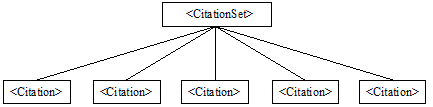
> The following diagram shows an XML document rooted at <CitationSet> that
> contains many instances of a <Citation> node. Each <Citation> node
> contains further XML and averages between 15K and 20K in size. Based on
> this information, <Citation> is a sensible element to use as a fragment
> root:
>
> [image:
> https://docs.marklogic.com/media/apidoc/8.0/guide/admin/fragments/fragments-1.gif]
>
>
>
>
>
> Thanks,
>
> Durai.
>
>
>
> **************** CAUTION - Disclaimer *****************
>
> This e-mail contains PRIVILEGED AND CONFIDENTIAL INFORMATION intended solely
>
> for the use of the addressee(s). If you are not the intended recipient, please
>
> notify the sender by e-mail and delete the original message. Further, you are
> not
>
> to copy, disclose, or distribute this e-mail or its contents to any other
> person and
>
> any such actions are unlawful. This e-mail may contain viruses. Infosys has
> taken
>
> every reasonable precaution to minimize this risk, but is not liable for any
> damage
>
> you may sustain as a result of any virus in this e-mail. You should carry out
> your
>
> own virus checks before opening the e-mail or attachment. Infosys reserves the
>
> right to monitor and review the content of all messages sent to or from this
> e-mail
>
> address. Messages sent to or from this e-mail address may be stored on the
>
> Infosys e-mail system.
>
> ***INFOSYS******** End of Disclaimer ********INFOSYS***
>
>
>
> _______________________________________________
> General mailing list
> [email protected]
> Manage your subscription at:
> http://developer.marklogic.com/mailman/listinfo/general
>
>
_______________________________________________
General mailing list
[email protected]
Manage your subscription at:
http://developer.marklogic.com/mailman/listinfo/general