Andrew,

Perhaps instead of trying to rank technologies, which involves coming up
with a scalar value for a multivariate phenomenon amid uncertainty, it would
be more useful to list the characteristics of each approach that someone
could use to do a ranking.
This would be especially useful if uncertainty ranges could be specified
instead off simple numbers, and there were suggestions on how uncertainties
might be diminished.

Best,

Ken

PS. It would be interesting to try to get some specificity on claims of
environmental risk. For example, is there anybody who really believes there
is significant direct risk associated with the fertilization activity
proposed by Climos? If the real concern is the slippery slope and not the
possible effects of the proposed activity itself, it would be useful for
that to be out in the open. If people really do think there could be lasting
bad effects from their proposed activity, it would be useful for someone to
try to provide evidence of this risk.

___________________________________________________
Ken Caldeira

Carnegie Institution Dept of Global Ecology
260 Panama Street, Stanford, CA 94305 USA

[email protected]; [email protected]
http://dge.stanford.edu/DGE/CIWDGE/labs/caldeiralab
+1 650 704 7212; fax: +1 650 462 5968


On Tue, Dec 23, 2008 at 6:18 PM, Alvia Gaskill <[email protected]> wrote:

>
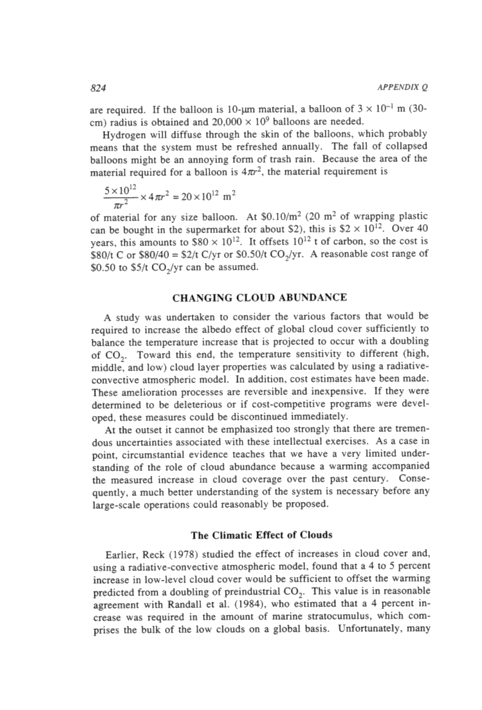
> NAS-92 considered burning of high sulfur coal on  islands in the ocean or
> sulfur alone on ships to increase CCN (cloud condensation nuclei) of low
> level marine stratocumulus clouds by 30% and the overall cloudiness
> (brightness) by 4%, arriving at a figure of 6Mt S/yr to balance a doubling
> of CO2.  They also considered how best to minimize land impacts.
>
> http://books.nap.edu/openbook/0309043867/gifmid/824.gif
>
> http://books.nap.edu/openbook.php?record_id=1605&page=824
>
> http://books.nap.edu/openbook.php?record_id=1605&page=830
>
> The objective in that analysis was to increase CCN, but increasing the
> sulfate aerosol concentration so that it scatters sunlight back into space
> would require a great deal more, with many of the same concerns as in the
> CCN enhancement strategy.  I would be opposed to the burning of coal on the
> scale required, not just because of the CO2 emissions, but also because of
> mercury emissions.  I also do not support any plan to allow Chinese power
> plants to continue to burn high sulfur coal without FGD systems and am
> unaware of locations where acid rain from such plants does not present an
> environmental hazard as the emissions can be transported thousands of
> miles.
> Thus, the best place to do this would be an island in the Pacific Ocean,
> although again one would have to be concerned about transported aerosol
> reaching land areas.  Placing the sulfur combustor on a mountain would
> facilitate getting the SO2 into the upper level winds, but since the goal
> was to keep it in a confined area over the ocean, I'm not sure that would
> be
> a good idea either.
>
> The scale necessary to achieve the desired cooling is also problematic.  If
> one assumes that the 60Mt/yr or so of S emitted globally today goes to zero
> by 2050 and that the sulfate aerosol from these emissions account for a
> negative 1.3W/m-2 forcing, then to replace this negative forcing would
> require an additional 60Mt/yr be found and burned.  The reason 60Mt would
> be
> needed for tropospheric aerosols and only a few Mt for stratospheric to
> achieve the same or even greater scattering of sunlight is the much shorter
> residence time for the tropospheric aerosols.  While 6Mt S may be available
> for this use by 2011 due to surplus production stimulated by demand from
> China for fertilizer, I see no easy source of 60Mt.  The link below
> presents
> a summary of the present market for sulfur and its future demand.
>
> http://www.pr-inside.com/china-sulfur-market-report-r641237.htm
>
> Sulfur prices have ranged from $5-50/tonne for most of the last 10 years,
> but spiked to nearly $800/tonne in 08 and has now collapsed again, along
> with many other commodities like crude oil.  At $1000/tonne, 60Mt costs $60
> billion, but back down at $200, a more realistic long term price, $12
> billion.  So availability and not cost would be the more important
> obstacle.
> This is why stratospheric and not tropospheric aerosols are the better
> alternative, all other impacts aside.
>
> http://www.ictulsa.com/sulphur_history.pdf
>
> ----- Original Message -----
> From: "Mike MacCracken" <[email protected]>
> To: "Andrew Lockley" <[email protected]>
> Cc: "Geoengineering" <[email protected]>
> Sent: Tuesday, December 23, 2008 9:35 AM
> Subject: [geo] Re: ranking the ideas
>
>
> >
> > I cannot imagine how adding soot to the atmosphere would lead to cooling
> > instead of warming.
> >
> > On the use of sulfates, indeed there were problems as a result of
> > deposition. The worst problems occurred when the sulfate was not lofted
> > and
> > so dispersed, as opposed to local, concentrated deposition. Sometimes
> this
> > occurred well down some particular trajectories (such as UK to
> > Scandinavia).
> > The question is whether there might be a way, by selectively determining
> > locations and the particular weather, to build up sulfate concentrations
> > over dark oceans rather than over land and forests. Certainly there would
> > still be (and likely are now) some adverse consequences, but one would
> > seek
> > to minimize those. Then the question is how these impacts would compare
> > with
> > the effects of the warming that is being alleviated--and how this would
> > compare with the balance for other approaches and the costs and
> challenges
> > of implementing the various approaches.
> >
> > Mike MacCracken
> >
> >
> > On 12/23/08 4:31 AM, "Andrew Lockley" <[email protected]> wrote:
> >
> >> Thanks, I hope others with opinions about this and other categories
> >> will put their views forward.
> >>
> >> I'm concerned by the use of sulphur in this way.  It caused terrible
> >> damage to the forests of Europe in the 70s and 80s.  At this time it
> >> was apparently difficult to establish exactly which sources were
> >> causing the problem.  How can we ensure that this does not happen
> >> again?
> >>
> >> Furthermore, I understand that tropospheric soot is also very
> >> significant, and that some have proposed using 'dirty burn' in ships
> >> and aircraft to promote cooling.  Smoke from rainforest fires in SE
> >> Asia is apparently sufficient to promote regional cooling.  Should
> >> this go on the IN list?
> >>
> >> A
> >>
> >> 2008/12/23 Mike MacCracken <[email protected]>:
> >>> Dear Andrew--
> >>>
> >>> Although not done intentionally (well, in many cases we have chosen not
> >>> to
> >>> use the technology that would maximally limit emissions), we are
> >>> already,
> >>> quite fortunately, creating a significant cooling influence with
> >>> tropospheric sulfate aerosols. While there are negative side effects,
> >>> comparing those against the impacts this cooling presently alleviates
> >>> (resulting from about the 0.5 C cooling influence) has not been done,
> >>> but
> >>> might not be clear-cut.
> >>>
> >>> In that there is no overwhelming negative influence of the tropospheric
> >>> sulfate aerosols, one could well imagine increasing their amount, at
> >>> least
> >>> to generate additional sulfate aerosols in regions where ecological
> >>> impacts
> >>> are likely to be minimal. So, increasing tropospheric sulfur dioxide
> >>> emissions from the elevated stacks of coal-fired power plants or by
> some
> >>> other means of lofting the sulfur dioxide to above the boundary layer
> >>> (where
> >>> its lifetime is long enough to allow conversion to sulfate aerosol)
> >>> would
> >>> seem to be an option to be included in the IN category. Indeed, there
> >>> may be
> >>> adverse impacts in terms of deposition and human health, but it may
> well
> >>> be
> >>> possible to manage the emissions to that they occur only for
> >>> trajectories
> >>> that take the sulfates out over the oceans or to other locations where
> >>> deposition would not be problematic.
> >>>
> >>> In fact, given the apparently increasing SO2 emissions from the new
> >>> coal-fired power plants in China (as evidenced by the high sulfate
> >>> levels
> >>> shown in the figure in the IPCC WG I report), this approach to limiting
> >>> warming may already be having some effect--indeed, maybe, as in the mid
> >>> 20th
> >>> century, sulfates may be what seems to be somewhat slowing the warming
> >>> over
> >>> the past decade.
> >>>
> >>> Mike MacCracken
> >>>
> >>>
> >>> On 12/22/08 8:37 PM, "Andrew Lockley" <[email protected]>
> wrote:
> >>>
> >>>>
> >>>> Can anyone else help me 'rank' the technologies?  Just because people
> >>>> talk about a tech lots doesn't mean it's actually any good!  I'm
> >>>> getting the impression that the following are basically in/out
> >>>>
> >>>> IN
> >>>> Sea water spraying
> >>>> Sulphur stratospheric seeding
> >>>> Ocean fertilisation with iron/urea
> >>>> White roofs (nice but not very effective)
> >>>>
> >>>> DON'T KNOW
> >>>> Limestone powder into the sea
> >>>> Fake plastic trees
> >>>> Biochar
> >>>> Removing HCl from oceans
> >>>>
> >>>> OUT
> >>>> Nuclear bombs
> >>>> Space mirrors
> >>>> Shiny balloons
> >>>> Sea albedo from litter/pykrete
> >>>> Low level soot and sulphur burning
> >>>>
> >>>> This is obviously just a  list based on my bar stool expertise.  If
> >>>> anyone with more knowledge could help that would be appreciated.  Any
> >>>> references to an objective ranking system that I can put in the wiki
> >>>> would be appreciated.
> >>>>
> >>>> A
> >>>>
> >>>> >>>
> >>>
> >>>
> >>>
> >
> >
> >
> > >
>
>
> >
>

--~--~---------~--~----~------------~-------~--~----~
You received this message because you are subscribed to the Google Groups
"geoengineering" group.
To post to this group, send email to [email protected]
To unsubscribe from this group, send email to
[email protected]
For more options, visit this group at
http://groups.google.com/group/geoengineering?hl=en
-~----------~----~----~----~------~----~------~--~---