Some critique of Copenhagen Consensus Centre
http://www.realclimate.org/index.php/archives/2009/08/a-biased-economic-analysis-of-geoengineering

"With respect to cloud brightening, Bickel and Lane ignore the Jones
et al. (2009) results that cloud brightening would mainly cool the
oceans and not affect land temperature much, so that it is an
imperfect method at best to counter global warming."

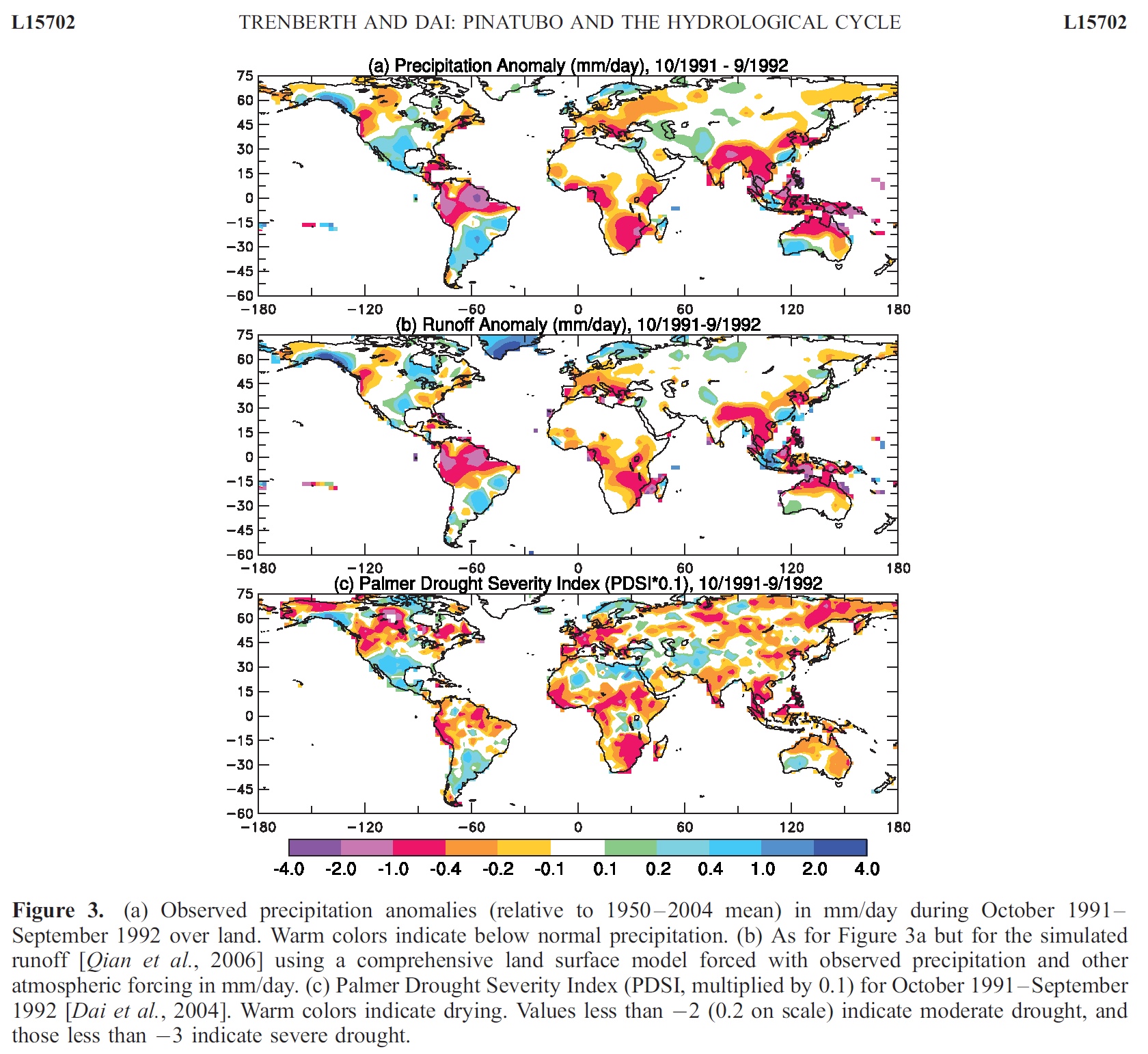
Also there some good graphics about sulfur aerosols and monsoons:
http://www.realclimate.org/images/trenberthdai07_fig3.jpg
"such a deployment strategy would affect the summer Asian monsoon,
reducing precipitation over China and India. And Robock et al. (2008)
give examples from past volcanic eruptions that illustrate this
effect, such as the pattern of precipitation reduction after the 1991
Pinatubo eruption (Trenberth and Dai, 2007)"

Aleksey
globalfrozing.com

full text
--------------------------

A biased economic analysis of geoengineering
Filed under: Aerosols Climate Science Geoengineering Greenhouse gases—
group @ 11 August 2009
Guest commentary by Alan Robock – Rutgers University

Bjorn Lomborg’s Climate Consensus Center just released an un-refereed
report on geoengineering, An Analysis of Climate Engineering as a
Response to Global Warming, by J Eric Bickel and Lee Lane. The
“consensus” in the title of Lomborg’s center is based on a meeting of
50 economists last year. The problem with allowing economists to
decide the proper response of society to global warming is that they
base their analysis only on their own quantifications of the costs and
benefits of different strategies. In this report, discussed below,
they simply omit the costs of many of the potential negative aspects
of producing a stratospheric cloud to block out sunlight or cloud
brightening, and come to the conclusion that these strategies have a
25-5000 to 1 benefit/cost ratio. That the second author works for the
American Enterprise Institute, a lobbying group that has been a
leading global warming denier, is not surprising, except that now they
are in favor of a solution to a problem they have claimed for years
does not exist.


Geoengineering has come a long way since first discussed here three
years ago. [Here I use the term “geoengineering” to refer to “solar
radiation management” (SRM) and not to carbon capture and
sequestration (called “air capture” in the report), a related topic
with quite different issues.] In a New Scientist interview, John
Holdren, President Obama’s science adviser, says geoengineering has to
be examined as a possible response to global warming, but that we can
make no such determination now. A two-day conference on geoengineering
organized by the U.S. National Academy of Sciences was held in June,
2009, with an opening talk by the President, Ralph Cicerone. The
American Meteorological Society (AMS) has just issued a policy
statement on geoengineering, which urges cautious consideration, more
research, and appropriate restrictions. But all this attention comes
with the message that we know little about the efficacy, costs, and
problems associated with geoengineering suggestions, and that much
more study is needed.

Bickel and Lane, however, do not hesitate to write a report that is
rather biased in favor of geoengineering using SRM, by emphasizing the
low cost and dismissing the many possible negative aspects. They use
calculations with the Dynamic Integrated model of Climate and the
Economy (DICE) economic model to make the paper seem scientific, but
there are many inherent assumptions, and they up-front refuse to
present their results in terms of ranges or error bars. Specific
numbers in their conclusions make the results seem much more certain
than they are. While they give lip service to possible negative
consequences of geoengineering, they refuse to quantify them. Indeed,
the purpose of new research is to do just that, but the tone of this
report is to claim that cooling the planet will have overall benefits,
which CAN be quantified. The conclusions and summary of the report
imply much more certainty as to the net benefits of SRM than is really
the case.

My main areas of agreement with this report are that global warming is
an important, serious problem, that SRM with stratospheric aerosols or
cloud brightening would not be expensive, and that we indeed need more
research into geoengineering. The authors provide a balanced
introduction to the issues of global warming and the possible types of
geoengineering.

But Bickel and Lane ignore the effects of ocean acidification from
continued CO2 emissions, dismissing this as a lost cause. Even without
global warming, reducing CO2 emissions is needed to do the best we can
to save the ocean. The costs of this continuing damage to the planet,
which geoengineering will do nothing to address, are ignored in the
analysis in this report. And without mitigation, SRM would need to be
continued for hundreds of years. If it were stopped, by the loss of
interest or means by society, the resulting rapid warming would be
much more dangerous than the gradual warming we are now experiencing.

Bickel and Lane do not even mention several potential negative effects
of SRM, including getting rid of blue skies, huge reductions in solar
power from systems using direct solar radiation, or ruining
terrestrial optical astronomy. They imply that SRM technologies will
work perfectly, and ignore unknown unknowns. Not one cloud has ever
been artificially brightened by injection of sea salt aerosols, yet
this report claims to be able to quantify the benefits and the costs
to society of cloud brightening.

They also imply that stratospheric geoengineering can be tested at a
small scale, but this is not true. Small injections of SO2 into the
stratosphere would actually produce small radiative forcing, and we
would not be able to separate the effects from weather noise. The
small volcanic eruptions of the past year (1.5 Tg SO2 from Kasatochi
in 2008 and 1 Tg SO2 from Sarychev in 2009, as compared to 7 Tg SO2
from El Chichón in 1982 and 20 Tg SO2 from Pinatubo in 1991) have
produced stratospheric clouds that can be well-observed, but we cannot
detect any climate impacts. Only a large-scale stratospheric injection
could produce measurable impacts. This means that the path they
propose would lead directly to geoengineering, even just to test it,
and then it would be much harder to stop, what with commercial
interests in continuing (e.g., Star Wars, which has not even ever
worked).

Bickel and Lane also ignore several seminal papers on geoengineering
that present much more advanced scientific results than the older
papers they cite. In particular, they ignore Tilmes et al. (2008),
Robock et al. (2008), Rasch et al. (2008), and Jones et al. (2009).

With respect to ozone, they dismiss concerns about ozone depletion and
enhanced UV by citing Wigley (2006) and Crutzen (2006), but ignore the
results of Tilmes et al. (2008), who showed that the effects would
prolong the ozone hole for decades and that deployment of
stratospheric aerosols in a couple decades would not be safe as
claimed here. Bickel and Lane assert, completely incorrectly, “On its
face, though, it does not appear that the ozone issue would be likely
to invalidate the concept of stratospheric aerosols.”

With respect to an Arctic-only scheme, they suggest in several places
that it would be possible to control Arctic climate based on the
results of Caldeira and Wood (2008) who artificially reduce sunlight
in a polar cap in their model (the “yarmulke method”), whereas Robock
et al. (2008) showed with a more realistic model that explicitly
treats the distribution and transport of stratospheric aerosols, that
the aerosols could not be confined to just the Arctic, and such a
deployment strategy would affect the summer Asian monsoon, reducing
precipitation over China and India. And Robock et al. (2008) give
examples from past volcanic eruptions that illustrate this effect,
such as the pattern of precipitation reduction after the 1991 Pinatubo
eruption (Trenberth and Dai, 2007):


With respect to cloud brightening, Bickel and Lane ignore the Jones et
al. (2009) results that cloud brightening would mainly cool the oceans
and not affect land temperature much, so that it is an imperfect
method at best to counter global warming. Furthermore Jones et al.
(2009) found that cloud brightening over the South Atlantic would
produce severe drought over the Amazon, destroying the tropical
forest.

They also ignore a huge class of ethical and world governance issues.
Whose hand would be on the global thermostat? Who would trust military
aircraft or a multi-national geoengineering company to have the
interests of the people of the planet foremost?

They do not seem to realize that volcanic eruptions affect climate
change because of sulfate aerosols produced from sulfur dioxide gas
injections into the stratosphere, the same that is proposed for SRM,
and not by larger ash particles that fall out quickly after and
eruption and do not cause climate change.

They dismiss air capture (“air capture technologies do not appear as
promising as solar radiation management from a technical or a cost
perspective”) but ignore the important point that it would have few of
the potential side effects of SRM. Air capture would just remove the
cause of global warming in the first place, and the only side effects
would be in the locations where the CO2 would be sequestered.

For some reason, they insist on using the wrong units for energy flux
(W) instead of the correct units of W/m^2, and then mix them in the
paper. I cannot understand why they choose to make it so confusing.

The potential negative consequences of stratospheric SRM were clearly
laid out by Robock (2008) and updated by Robock et al. (2009), which
still lists 17 reasons why geoengineering may be a bad idea. One of
those important possible consequences, the threat to the water supply
for agriculture and other human uses, has been emphasized in a recent
Science article by Gabi Hegerl and Susan Solomon.

Robock et al. (2009) also lists some benefits from SRM, including
increased plant productivity and an enhanced CO2 sink from vegetation
that grows more when subject to diffuse radiation, as has been
observed after every recent large volcanic eruption. But the
quantification of these and other geoengineering benefits, as well as
the negative aspects, awaits more research.

It may be that the benefits of geoengineering will outweigh the
negative aspects, and that most of the problems can be dealt with, but
the paper from Lomborg’s center ignores the real consensus among all
responsible geoengineering researchers. The real consensus, as
expressed at the National Academy conference and in the AMS statement,
is that mitigation needs to be our first and overwhelming response to
global warming, and that whether geoengineering can even be considered
as an emergency measure in the future should climate change become too
dangerous is not now known. Policymakers will only be able to make
such decisions after they see results from an intensive research
program. Lomborg’s report should have stopped at the need for a
research program, and not issued its flawed and premature conclusions.

References:

Jones, A., J. Haywood, and O. Boucher 2009: Climate impacts of
geoengineering marine stratocumulus clouds, J. Geophys. Res., 114,
D10106, doi:10.1029/2008JD011450.

Rasch, Philip J., Simone Tilmes, Richard P. Turco, Alan Robock, Luke
Oman, Chih-Chieh (Jack) Chen, Georgiy L. Stenchikov, and Rolando R.
Garcia, 2008: An overview of geoengineering of climate using
stratospheric sulphate aerosols. Phil. Trans. Royal Soc. A., 366,
4007-4037, doi:10.1098/rsta.2008.0131.

Robock, Alan, 2008: 20 reasons why geoengineering may be a bad idea.
Bull. Atomic Scientists, 64, No. 2, 14-18, 59, doi:10.2968/064002006.
PDF file Roundtable discussion of paper

Robock, Alan, Luke Oman, and Georgiy Stenchikov, 2008: Regional
climate responses to geoengineering with tropical and Arctic SO2
injections. J. Geophys. Res., 113, D16101, doi:10.1029/2008JD010050.
PDF file

Robock, Alan, Allison B. Marquardt, Ben Kravitz, and Georgiy
Stenchikov, 2009: The benefits, risks, and costs of stratospheric
geoengineering. Submitted to Geophys. Res. Lett., doi:
10.1029/2009GL039209. PDF file

Tilmes, S., R. Müller, and R. Salawitch, 2008: The sensitivity of
polar ozone depletion to proposed geoengineering schemes, Science, 320
(5880), 1201-1204, doi:10.1126/science.1153966.

Trenberth, K. E., and A. Dai (2007), Effects of Mount Pinatubo
volcanic eruption on the hydrological cycle as an analog of
geoengineering, Geophys. Res. Lett., 34, L15702, doi:
10.1029/2007GL030524.

------------------------


--~--~---------~--~----~------------~-------~--~----~
You received this message because you are subscribed to the Google Groups
"geoengineering" group.
To post to this group, send email to [email protected]
To unsubscribe from this group, send email to
[email protected]
For more options, visit this group at
http://groups.google.com/group/geoengineering?hl=en
-~----------~----~----~----~------~----~------~--~---