We are posting our response to Alan Robock's RealClimate commentary
regarding our Copenhagen Consensus paper, since his response has been
posted here.
Note: this version corrects a few minor typographical errors that we
noticed since our posting.

Regards,

Eric Bickel and Lee Lane

Full Text (http://www.realclimate.org/index.php/archives/2009/08/a-
biased-economic-analysis-of-geoengineering/comment-page-2/#comments)

We thank Alan Robock and the various respondents for their comments on
our paper. Since many of these comments seem to have been made without
the benefit of reading our work, we thought it prudent to emphasize a
few points here.

First, Robock speculates on our motives stating that we “refuse to
present ranges or error bars”, that we “refuse to quantify [possible
negative consequences]” and that we “ignore” various issues such a
negative side effects. These accusations imply a willful intent to
deceive. We find comments such as these from members of the scientific
community concerning, as they are not based on science, but rather on
an attempt to divine author’s intentions. We also find the willingness
to take arguments out of context and to selectively cite analyses to
support one’s point disturbing. It is just this type activity that has
caused the public to distrust the science of climate change, with
potentially tragic consequences.

Second, Robock asserts, “That the second author works for the American
Enterprise Institute, a lobbying group that has been a leading global
warming denier, is not surprising, except that now they are in favor
of a solution to a problem they have claimed for years does not
exist.” The facts are quite otherwise. AEI is not a lobbying
organization. Indeed, it does not even take organizational positions
on public policy issues, and it is quite common for AEI scholars to
hold differing positions on major policy controversies.  Robock could
have checked these facts simply by perusing AEI’s website. (http://
www.aei.org/about) As to the co-author of our paper, Lane has spent
most of the last decade on research aimed at finding more efficient
and affordable responses to climate change. He has advocated, as is
clear from both his congressional testimony and his other writings,
the use of a coordinated strategy including GHG controls, R&D on new
energy sources, adaptation, as well as R&D to explore the option of
solar radiation management. (http://www.aei.org/speech/100040)  In
imputing views and objectives to organizations and individuals,
minimal standards of scholarly and personal integrity on the part of
RealClimate would seem to require some prior effort to check the
accuracy of the claims. Better yet would be a policy of not allowing
ad hominem attacks.

Third, as we note throughout the paper, we argue for RESERACH funding
for climate engineering, not deployment. For example, the first
sentence of the abstract notes that “This paper offers a preliminary
and exploratory assessment of the potential benefits of and costs of
climate engineering.” The second paragraph of the abstract states, “We
estimate that the DIRECT [emphasis added] benefit-cost ratios are…Yet
large uncertainties remain about the science and engineering of SRM.
Only a substantial research program can resolve these uncertainties,
but the very large potential net benefits of SRM offer strong prima
facie evidence for including R&D on SRM as part of any portfolio of
climate policies during the next decade.” Finally, as we conclude
“These inputs to our analysis are admittedly speculative; many
questions surround their validity, and many gaps exist in them…This
analysis, then, can claim to be only an early and partial look at the
potential benefits and costs of [climate engineering]…the question is
whether or not the indirect costs [negative side effects] will change
the calculus. Only research can answer this question.”

Fourth, our primary argument is that the DIRECT benefits of solar
radiation management appear large, while the DIRECT costs appear to be
small. This logic is straightforward. If warming will cause large
damages the preventing warming may provide large benefits. The
argument that the direct costs appear relatively small is based on
existing cost studies; including Alan Robock’s (Robock et al. 2009)
which carefully analyzes the cost of using military aircraft (the F15-
C Eagle) to carry H2S to the stratosphere to “counteract” global
warming. Robock states that the capital cost of this scheme would be
$6,363,000,000 and would cost $4,175,000,000 per year to operate. We
note that this paper does not quantify possible negative side effects,
but do not accuse Robock of “refusing” to do so or “ignoring” it. The
paper also does not include error bars around the cost estimates and
instead purports to provide “quantitative starting points.” This is
quite similar to the approach we take in our “preliminary and
exploratory assessment.” Again, we do not take this omission to be
willful and instead give the authors the benefit of the doubt. We
understand that these estimates are highly uncertain, as are any
analyses of climate change.

Fifth, Robock avers that the real consensus on climate “… is that
mitigation needs to be our first and overwhelming response to global
warming…” No consensus in favor of mitigation is in evidence, though,
in the global political arena, and without a consensus there, the
feasibility of mitigation remains in grave doubt. Moreover, if we do
not yet know the indirect costs of geoengineering, how could we know
that mitigation needs to be the “first and overwhelming response.” How
have Robock, and the authors of the many similar comments posted on
this blog, managed to reduce their error bars to reach such a certain
conclusion?

Sixth, Robock states, “…Bickel and Lane ignore the effects of ocean
acidification from continued CO2 emissions, dismissing this as a lost
cause. Even without global warming, reducing CO2 emissions is needed
to do the best we can to save the ocean. The costs of this continuing
damage to the planet, which geoengineering will do nothing to address,
are ignored in the analysis in this report.” Actually our paper does
discuss ocean acidification as a harmful effect of CO2 emissions and
cites two other studies about the uncertainties concerning both its
consequences and the prospects for remediation. Our paper, does not,
as Robock notes, discuss acidification further for the same reason
that it also omits discussion of possible defects in the regulation of
the global banking system. SRM neither reduces the costs of these
problems nor raises them. Other measures are called for, and the
analysis that we were invited to do centered on SRM.  Our paper no
more claims to evaluate all options for dealing with CO2 that it
pretends to address responses to all the rest of the world’s ills. The
reader should also note that, contrary to the impression conveyed by
Robock’s comments, and with only a single exception, every scenario
reported in our paper envisions the use of SRM in conjunction with a
GHG control regime.

Seventh, Robock claims “They [Bickel and Lane] dismiss air capture
(“air capture technologies do not appear as promising as solar
radiation management from a technical or a cost perspective”) but
ignore the important point that it would have few of the potential
side effects of SRM. In fact, our paper points to several
institutional advantages of AC and goes on to state: “Thus, the high
costs of AC and the long time scales required for it to become
effective are serious drawbacks relative to several kinds of SRM. On
the other hand, AC, by seeking to remove CO2 from the atmosphere,
reduces some of the risks that remain with SRM.” We go on to note that
another Copenhagen Consensus paper will be addressing AC at greater
length.

Eighth, Robock claims: “They also ignore a huge class of ethical and
world governance issues. Whose hand would be on the global thermostat?
Who would trust military aircraft or a multi-national geoengineering
company to have the interests of the people of the planet foremost?”
We are unsure whence comes the idea of a multinational geoengineering
company. If, however, Robock’s “huge class of world governance issues”
coincides with the questions about how conflicting political interests
might be resolved, pages 24-26 of the paper are devoted solely to
these matters. Later, on page 34, the paper returns to an analysis of
the issue of possible discontinuity in an SRM regime.  The next sub-
section on page 34 begins our analysis of the option of deferring SRM
deployment in part to minimize global governance problems. At least
four of the seven bullet points in the paper’s conclusion stress the
importance of policy market failures and political transaction costs.
Robock may, of course, dislike the way in which our paper handles
these issues. To say, though, that our paper ignores these questions
is simply false.

Ninth, Robock writes "they [Bickel andLane] insist on using the wrong
units for energy flux (W) instead of the correct units of W/m^2, and
then mix them in the paper. I cannot understand why they choose to
make it so confusing.” We assume Robock means the power flux, since
watts are a measure of power, not energy. This issue is quite simple.
As we write in the paper "As a short hand, we will sometimes refer to
SRM in terms of watts. The reader should not forget however, that by
this we always mean watts per square meter." We are sorry that some
find this confusing. [Note since RealClimate posting: we understand
Robock's point and usage of energy flux. Our only point is that we do
not think our shorthand is confusing within the body of the paper. We
realize that we use this shorthand in the abstract, which is
potentially confusing and we will correct this.]

Finally, when it comes to the health and safety of human beings we do
not think any alternatives should be removed from the table. This
includes research into the potential benefits of geoengineering. We
hope that members of scientific community will not adopt a dogmatic
stance, but will instead freely welcome an exploration of
geoengineering’s potential benefits and costs.

References
Robock, A., A. Marquardt, B. Kravitz, and G. Stenchikov. 2009. The
Benefits, Risk, and Costs of Stratospheric Geoengineering. Forthcoming
in Geophysical Review Letters.


On Aug 16, 7:45 am, Stephen Salter <[email protected]> wrote:
> Hi All
>
> Jones, Haywood and Boucher 2009 studied the effects of quite a large and
> continuous increase in the concentration of condensation nuclei over a
> very small fraction of the earth’s surface, only 3.3%, and found that it
> produced a cooling of 0.97 watts/m2, about 60% of the total thermal
> change since pre-industrial times. It would not have been possible to
> confine the treatment to such a small area and you get better value for
> the spraying effort by giving a lower dose over a wider area. While the
> result was scientifically interesting it would have been even more so if
> they could have compared it with diffuse treatment in other areas.
>
> They reported reductions in precipitation over the Amazon basin, which
> at present has plenty of rain, and increases in precipitation in
> sub-Saharan Africa, Australia and Northern India which could benefit
> from more. People reporting their work make no mention of the beneficial
> effects or the possibility that the judicious choice of other treatment
> sites at other seasons could allow us to avoid the bad results and
> encourage the good ones.  They do not compare it with the changes in
> precipitation which would result from the failure of emissions reduction.
>
> We know that putting full right hand lock on the steering wheel gets us
> into the ditch on the right of the road while full left hand lock gets
> us into a ditch on the left.  This is an argument for learning how to
> steer, not a reason for removing all steering wheels.
>
> People living in Norway and the west coast of South Africa will confirm
> that sea temperatures have a powerful effect on land temperatures.
>
> Stephen
>
> Emeritus Professor of Engineering Design
> School of Engineering and Electronics
> University of Edinburgh
> Mayfield Road
> Edinburgh EH9 3JL
> Scotland
> tel               +44 131 650 5704
> fax +44 131 650 5702
> Mobile  07795 203 195
> [email protected]http://www.see.ed.ac.uk/~shs
>
> global_frozing wrote:
> > Some critique of Copenhagen Consensus Centre
>
> >http://www.realclimate.org/index.php/archives/2009/08/a-biased-econom...
>
> > "With respect to cloud brightening, Bickel and Lane ignore the Jones
> > et al. (2009) results that cloud brightening would mainly cool the
> > oceans and not affect land temperature much, so that it is an
> > imperfect method at best to counter global warming."
>
> > Also there some good graphics about sulfur aerosols and monsoons:
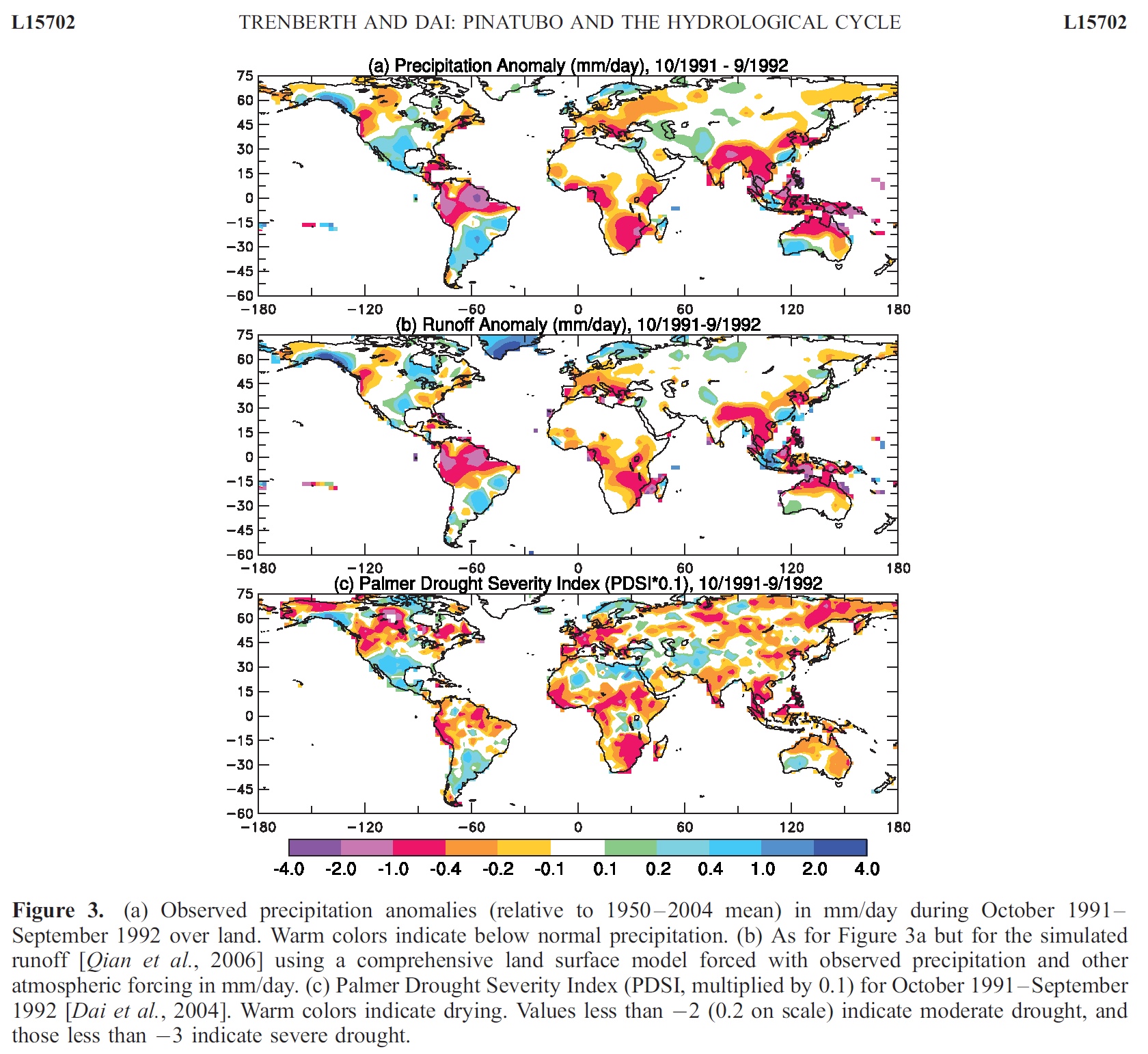
> >http://www.realclimate.org/images/trenberthdai07_fig3.jpg
> > "such a deployment strategy would affect the summer Asian monsoon,
> > reducing precipitation over China and India. And Robock et al. (2008)
> > give examples from past volcanic eruptions that illustrate this
> > effect, such as the pattern of precipitation reduction after the 1991
> > Pinatubo eruption (Trenberth and Dai, 2007)"
>
> > Aleksey
> > globalfrozing.com
>
> > full text
> > --------------------------
>
> > A biased economic analysis of geoengineering
> > Filed under: Aerosols Climate Science Geoengineering Greenhouse gases—
> > group @ 11 August 2009
> > Guest commentary by Alan Robock – Rutgers University
>
> > Bjorn Lomborg’s Climate Consensus Center just released an un-refereed
> > report on geoengineering, An Analysis of Climate Engineering as a
> > Response to Global Warming, by J Eric Bickel and Lee Lane. The
> > “consensus” in the title of Lomborg’s center is based on a meeting of
> > 50 economists last year. The problem with allowing economists to
> > decide the proper response of society to global warming is that they
> > base their analysis only on their own quantifications of the costs and
> > benefits of different strategies. In this report, discussed below,
> > they simply omit the costs of many of the potential negative aspects
> > of producing a stratospheric cloud to block out sunlight or cloud
> > brightening, and come to the conclusion that these strategies have a
> > 25-5000 to 1 benefit/cost ratio. That the second author works for the
> > American Enterprise Institute, a lobbying group that has been a
> > leading global warming denier, is not surprising, except that now they
> > are in favor of a solution to a problem they have claimed for years
> > does not exist.
>
> > Geoengineering has come a long way since first discussed here three
> > years ago. [Here I use the term “geoengineering” to refer to “solar
> > radiation management” (SRM) and not to carbon capture and
> > sequestration (called “air capture” in the report), a related topic
> > with quite different issues.] In a New Scientist interview, John
> > Holdren, President Obama’s science adviser, says geoengineering has to
> > be examined as a possible response to global warming, but that we can
> > make no such determination now. A two-day conference on geoengineering
> > organized by the U.S. National Academy of Sciences was held in June,
> > 2009, with an opening talk by the President, Ralph Cicerone. The
> > American Meteorological Society (AMS) has just issued a policy
> > statement on geoengineering, which urges cautious consideration, more
> > research, and appropriate restrictions. But all this attention comes
> > with the message that we know little about the efficacy, costs, and
> > problems associated with geoengineering suggestions, and that much
> > more study is needed.
>
> > Bickel and Lane, however, do not hesitate to write a report that is
> > rather biased in favor of geoengineering using SRM, by emphasizing the
> > low cost and dismissing the many possible negative aspects. They use
> > calculations with the Dynamic Integrated model of Climate and the
> > Economy (DICE) economic model to make the paper seem scientific, but
> > there are many inherent assumptions, and they up-front refuse to
> > present their results in terms of ranges or error bars. Specific
> > numbers in their conclusions make the results seem much more certain
> > than they are. While they give lip service to possible negative
> > consequences of geoengineering, they refuse to quantify them. Indeed,
> > the purpose of new research is to do just that, but the tone of this
> > report is to claim that cooling the planet will have overall benefits,
> > which CAN be quantified. The conclusions and summary of the report
> > imply much more certainty as to the net benefits of SRM than is really
> > the case.
>
> > My main areas of agreement with this report are that global warming is
> > an important, serious problem, that SRM with stratospheric aerosols or
> > cloud brightening would not be expensive, and that we indeed need more
> > research into geoengineering. The authors provide a balanced
> > introduction to the issues of global warming and the possible types of
> > geoengineering.
>
> > But Bickel and Lane ignore the effects of ocean acidification from
> > continued CO2 emissions, dismissing this as a lost cause. Even without
> > global warming, reducing CO2 emissions is needed to do the best we can
> > to save the ocean. The costs of this continuing damage to the planet,
> > which geoengineering will do nothing to address, are ignored in the
> > analysis in this report. And without mitigation, SRM would need to be
> > continued for hundreds of years. If it were stopped, by the loss of
> > interest or means by society, the resulting rapid warming would be
> > much more dangerous than the gradual warming we are now experiencing.
>
> > Bickel and Lane do not even mention several potential negative effects
> > of SRM, including getting rid of blue skies, huge reductions in solar
> > power from systems using direct solar radiation, or ruining
> > terrestrial optical astronomy. They imply that SRM technologies will
> > work perfectly, and ignore unknown unknowns. Not one cloud has ever
> > been artificially brightened by injection of sea salt aerosols, yet
> > this report claims to be able to quantify the benefits and the costs
> > to society of cloud brightening.
>
> > They also imply that stratospheric geoengineering can be tested at a
> > small scale, but this is not true. Small injections of SO2 into the
> > stratosphere would actually produce small radiative forcing, and we
> > would not be able to separate the effects from weather noise. The
> > small volcanic eruptions of the past year (1.5 Tg SO2 from Kasatochi
> > in 2008 and 1 Tg SO2 from Sarychev in 2009, as compared to 7 Tg SO2
> > from El Chichón in 1982 and 20 Tg SO2 from Pinatubo in 1991) have
> > produced stratospheric clouds that can be well-observed, but we cannot
> > detect any climate impacts. Only a large-scale stratospheric injection
> > could produce measurable impacts. This means that the path they
> > propose would lead directly to geoengineering, even just to test it,
> > and then it would be much harder to stop, what with commercial
> > interests in continuing (e.g., Star Wars, which has not even ever
> > worked).
>
> > Bickel and Lane also ignore several seminal papers on geoengineering
> > that present much more advanced scientific results than the older
> > papers they cite. In particular, they ignore Tilmes et al. (2008),
> > Robock et al. (2008), Rasch et al. (2008), and Jones et al. (2009).
>
> > With respect to ozone, they dismiss concerns about ozone depletion and
> > enhanced UV by citing Wigley (2006) and Crutzen (2006), but ignore the
> > results of Tilmes et al. (2008), who showed that the effects would
> > prolong the ozone hole for decades and that deployment of
> > stratospheric aerosols in a couple decades would not be safe as
> > claimed here. Bickel and Lane assert, completely incorrectly, “On its
> > face, though, it does not appear that the ozone issue would be likely
> > to invalidate the concept of stratospheric aerosols.”
>
> > With respect to an Arctic-only scheme, they suggest in several places
> > that it would be possible to control Arctic climate based on the
> > results of Caldeira and Wood (2008) who artificially reduce sunlight
> > in a polar cap in their model (the “yarmulke method”), whereas Robock
> > et al. (2008) showed with a more realistic model that explicitly
> > treats the distribution and transport of stratospheric aerosols, that
> > the aerosols could not be confined to just the Arctic, and such a
> > deployment strategy would affect the summer Asian monsoon, reducing
> > precipitation over China and India. And Robock et al. (2008) give
> > examples from past volcanic eruptions that illustrate this effect,
> > such as the pattern of precipitation reduction after the 1991 Pinatubo
> > eruption (Trenberth and Dai, 2007):
>
> > With respect to cloud brightening, Bickel and Lane ignore the Jones et
> > al. (2009) results that cloud brightening would mainly cool the oceans
> > and not affect land temperature much, so that it is an imperfect
> > method at best to counter global warming. Furthermore Jones et al.
> > (2009) found that cloud brightening over the South Atlantic would
> > produce severe drought over the Amazon, destroying the tropical
> > forest.
>
> > They also ignore a huge class of ethical and world governance issues.
> > Whose hand would be on the global thermostat? Who would trust military
> > aircraft or a multi-national geoengineering company to have the
> > interests of the people of the planet foremost?
>
> > They do not seem to realize that volcanic eruptions affect climate
> > change because of sulfate aerosols produced from sulfur dioxide gas
> > injections into the stratosphere, the same that is proposed for SRM,
> > and not by larger ash particles that fall out quickly after and
> > eruption and do not cause climate change.
>
> > They dismiss air capture (“air capture technologies do not appear as
> > promising as solar radiation management from a technical or a cost
> > perspective”) but ignore the important point that it would have few of
> > the potential side effects of SRM. Air capture would just remove the
> > cause of global warming in the first place, and the only side effects
> > would be in the locations where the CO2 would be sequestered.
>
> > For some reason, they insist on using the wrong units for energy flux
> > (W) instead of the correct units of W/m^2, and then mix them in the
> > paper. I cannot understand why they choose to make it so confusing.
>
> > The potential negative consequences of stratospheric SRM were clearly
> > laid out by Robock (2008) and updated by Robock et al. (2009), which
> > still lists 17 reasons why geoengineering may be a bad idea. One of
> > those important possible consequences, the threat to the water supply
> > for agriculture and other human uses, has been emphasized in a recent
> > Science article by Gabi Hegerl and Susan Solomon.
>
> > Robock et al. (2009) also lists some benefits from SRM, including
> > increased plant productivity and an enhanced CO2 sink from vegetation
> > that grows more when subject to diffuse radiation, as has been
> > observed after every recent large volcanic eruption. But the
> > quantification of these and other geoengineering benefits, as well as
> > the negative aspects, awaits more research.
>
> > It may be that the benefits of geoengineering will outweigh the
> > negative aspects, and that most of the problems can be dealt with, but
> > the paper from Lomborg’s center ignores the real consensus among all
> > responsible geoengineering researchers. The real consensus, as
> > expressed at the National Academy conference and in the AMS statement,
> > is that mitigation needs to be our first and overwhelming response to
> > global warming, and that whether geoengineering can even be considered
> > as an emergency measure in the future should climate change become too
> > dangerous is not now known. Policymakers will only be able to make
> > such decisions after they see results from an intensive research
> > program. Lomborg’s report should have stopped at the need for a
> > research program, and not issued its flawed and premature conclusions.
>
> > References:
>
> > Jones, A., J. Haywood, and O. Boucher 2009: Climate impacts of
> > geoengineering marine stratocumulus clouds, J. Geophys. Res., 114,
> > D10106, doi:10.1029/2008JD011450.
>
> > Rasch, Philip J., Simone Tilmes, Richard P. Turco, Alan Robock, Luke
> > Oman, Chih-Chieh (Jack) Chen, Georgiy L. Stenchikov, and Rolando R.
> > Garcia, 2008: An overview of geoengineering of climate using
> > stratospheric sulphate aerosols. Phil. Trans. Royal Soc. A., 366,
> > 4007-4037, doi:10.1098/rsta.2008.0131.
>
> > Robock, Alan, 2008: 20 reasons why geoengineering may be a bad idea.
> > Bull. Atomic Scientists, 64, No. 2, 14-18, 59, doi:10.2968/064002006.
> > PDF file Roundtable discussion of paper
>
> > Robock, Alan, Luke Oman, and Georgiy Stenchikov, 2008: Regional
> > climate responses to geoengineering with tropical and Arctic SO2
> > injections. J. Geophys. Res., 113, D16101, doi:10.1029/2008JD010050.
> > PDF file
>
> > Robock, Alan, Allison B. Marquardt, Ben Kravitz, and Georgiy
> > Stenchikov, 2009: The benefits, risks, and costs of stratospheric
> > geoengineering. Submitted to Geophys. Res. Lett., doi:
> > 10.1029/2009GL039209. PDF file
>
> > Tilmes, S., R. Müller, and R. Salawitch, 2008: The sensitivity of
> > polar ozone depletion to proposed geoengineering schemes, Science, 320
> > (5880), 1201-1204, doi:10.1126/science.1153966.
>
> > Trenberth, K. E., and A. Dai (2007), Effects of Mount Pinatubo
> > volcanic eruption on the hydrological cycle as an analog of
> > geoengineering, Geophys. Res. Lett., 34, L15702, doi:
> > 10.1029/2007GL030524.
>
> > ------------------------
>
> --
> The University of Edinburgh is a charitable body, registered in
> Scotland, with registration number SC005336.

--~--~---------~--~----~------------~-------~--~----~
You received this message because you are subscribed to the Google Groups
"geoengineering" group.
To post to this group, send email to [email protected]
To unsubscribe from this group, send email to
[email protected]
For more options, visit this group at
http://groups.google.com/group/geoengineering?hl=en
-~----------~----~----~----~------~----~------~--~---