https://peteirvine.substack.com/p/srm-would-likely-prevent-the-only
<https://peteirvine.substack.com/p/srm-would-likely-prevent-the-only?utm_source=twitter&sd=pf>
*By Pete Irvine (Plan A+)*

*14 July 2023*

Marine stratocumulus clouds keep the Earth cool and may break-up at very
high CO2 concentrations, SRM would likely push this tipping point far
beyond reach.

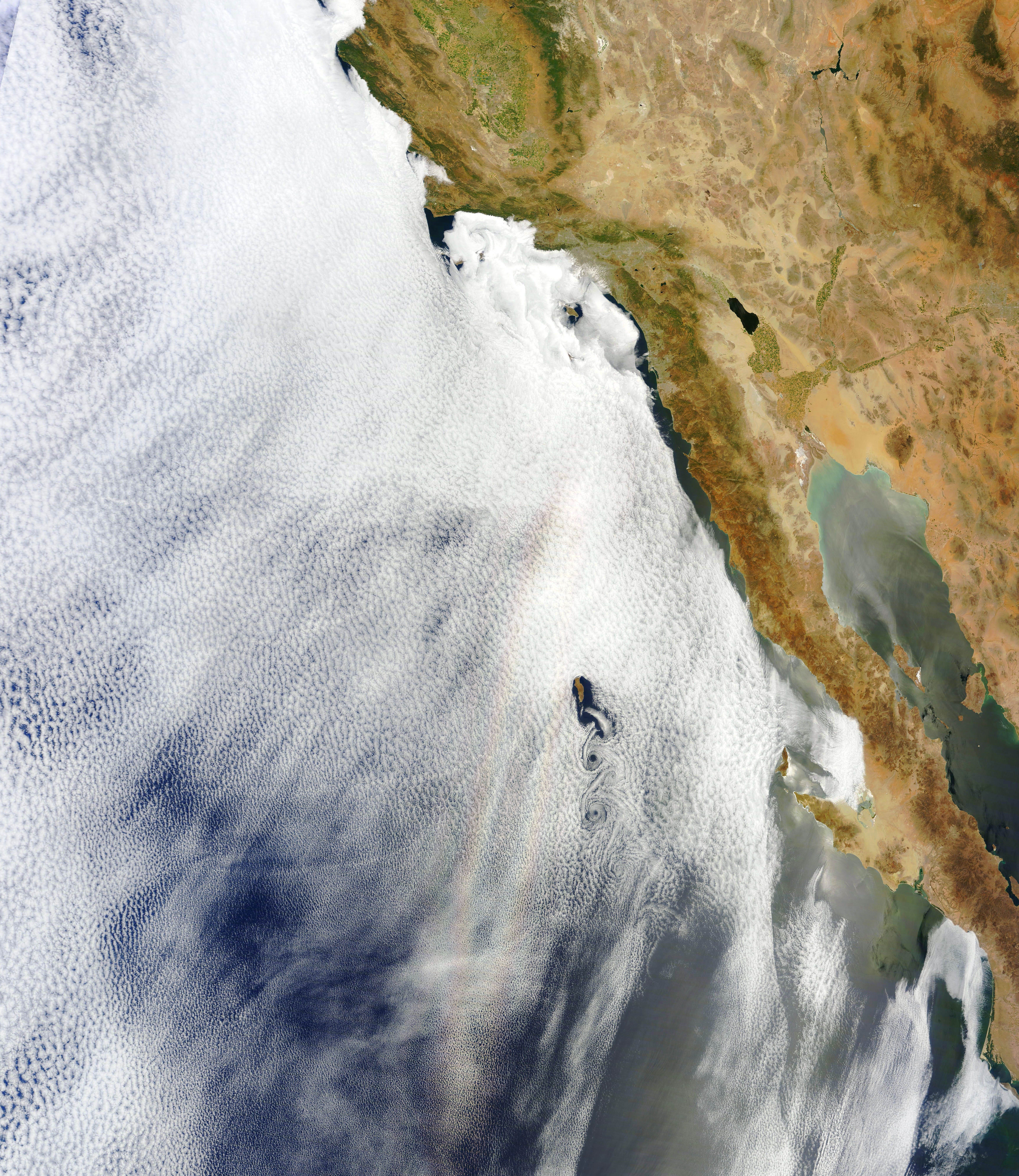
Marine Stratocumulus Clouds (MSCs) are low-lying clouds that cover around
20% of the low-latitude ocean, or 6.5% of the world's surface (Figure 1).
They are highly reflective and sit over the dark oceans, and so keep the
Earth much cooler than it would otherwise be.

Worringly, Schneider et al. (2019)
<https://www.nature.com/articles/s41561-019-0310-1> found that if CO2
concentrations rose above some critical threshold there could be a sudden
transition where these Marine Stratocumulus decks break up, leading to a
jump in global temperatures of as much as 8 °C. They also found that after
this warming, CO2 concentrations would need to be brought much below the
original threshold to restore these cloud decks.

As Greenhouse Gas (GHG) forcing is a key driver of the collapse of the
clouds in their simulations, Schneider and colleagues followed up this
original paper with a study
<https://www.pnas.org/doi/abs/10.1073/pnas.2003730117> testing whether
Solar Radiation Management (SRM) could prevent this. They conclude that SRM
“is not a fail-safe option to prevent global warming because it does not
mitigate risks to the climate system that arise from direct effects of
greenhouse gases on cloud cover.”

As I pointed out in my last post
<https://peteirvine.substack.com/publish/post/128960895> they focus
strongly on the fact that it fails to prevent this tipping point while
neglecting to note that it substantially raises the threshold CO2 level
where it occurs. Here, I want to dig a bit deeper and explain how their
study also substantially under-estimates the potential of SRM to prevent
this potentially catastrophic tipping point.
[image: Marine stratocumulus - Wikipedia]
<https://substackcdn.com/image/fetch/f_auto,q_auto:good,fl_progressive:steep/https%3A%2F%2Fsubstack-post-media.s3.amazonaws.com%2Fpublic%2Fimages%2F2e5f095f-2f82-4936-9669-2e7fde0191a7_5200x6000.jpeg>

*Figure 1. Marine Stratocumulus clouds off the coast of Baja California.
Source: Wiki <https://en.wikipedia.org/wiki/Marine_stratocumulus>*
How Marine Stratocumulus Clouds work

Most clouds form when surface warming produces warm, moist, buoyant air
parcels which rise high enough that the water vapour condenses to form
water droplets. For Marine stratocumulus clouds this convection process is
driven instead from the top-down, rather than the bottom-up.

Marine stratocumulus clouds are low clouds that form in the sub-tropics,
i.e., desert-like regions where there are no high clouds and warm, dry air
descends from above. Dry air isn’t good at absorbing thermal radiation and
keeping the surface warm, which is why deserts can see temperatures drop
from scorching in the day time to frigid at night.

This means that the top of marine stratocumulus clouds lose lots of energy
by emitting thermal radiation to space (radiative cooling). This cloud-top
radiative cooling leads to cool, dense air parcels dropping to the surface,
driving up warm, moist air from the surface in return. Rather than the
surface warming that drives convection in most other clouds, radiative
cooling drives the convection that sustains marine stratocumulus clouds
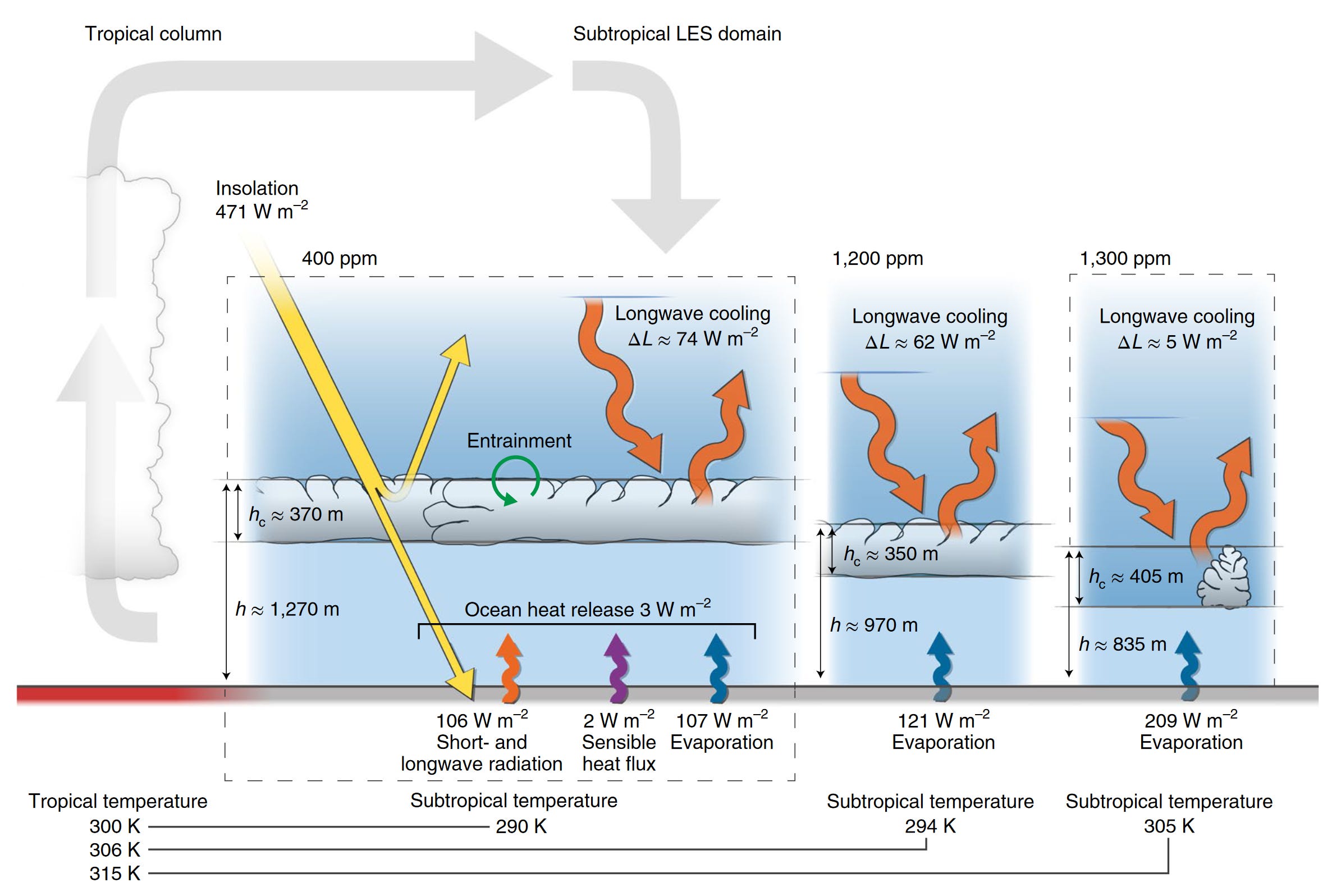
(See Figure 2, left).

Marine Stratocumulus Clouds break up when either the radiative cooling
becomes too weak to drive air parcels all the way to the surface, breaking
their connection with their moisture source (the ocean), or when too much
warm, dry air is mixed in from above the cloud-top as this dries out the
clouds making them less good at radiatively cooling themselves.
<https://substackcdn.com/image/fetch/f_auto,q_auto:good,fl_progressive:steep/https%3A%2F%2Fsubstack-post-media.s3.amazonaws.com%2Fpublic%2Fimages%2F248144e6-d3b6-4edc-842d-18b16aa5872f_2389x1596.png>

*Figure 2. Figure 1 from Schneider et al. (2019)
<https://www.nature.com/articles/s41561-019-0310-1>, full caption in
footnote*
*1*
*. Shows the energy budget of marine stratocumulus clouds at different CO2
concentrations, for today’s conditions (400 ppm), and just before (1200
ppm) and just after (1300 ppm) the break-up of the cloud-deck.*

Modeling Marine Stratocumulus Clouds (is hard)

The processes which drive cloud formation occur at a scale of 10s of
metres, far below the scales captured in global climate models (~10 km in
the latest, most expensive models, and more like ~100 km in more standard
climate models). This means that key cloud processes are “parameterized” in
climate models, i.e., they are not directly simulated and instead
relatively simple equations are used which aim to capture the larger-scale
behaviour of clouds seen in observations or other types of models.

Schneider et al. use what’s known as a Large Eddy Simulation (LES) Model,
or Cloud-Resolving Model in their study which simulates a patch of clouds a
few km across but at a very high resolution of 50m horizontally and 10m
vertically. This allows them to directly simulate the processes involved in
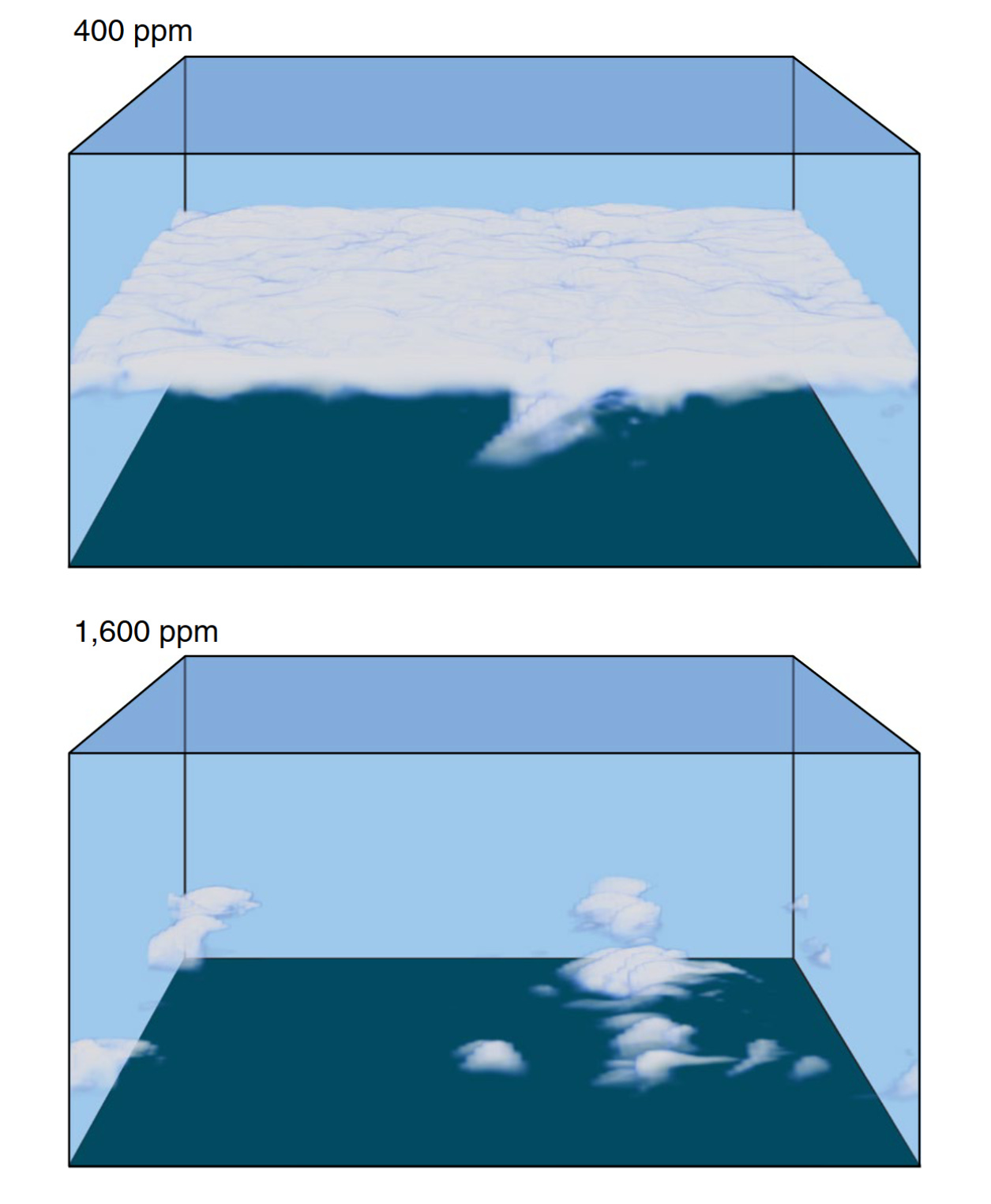
the formation and break-up of clouds (see Figure 2).

Normally these models fix sea-surface temperatures and so cannot simulate
global warming or local feedbacks from ocean warming, but Schneider et al.
apply a trick to get around this. They couple their cloud-resolving model,
which represents the marine stratocumulus decks, to a simple 1-D model of
the Tropical atmosphere, which can estimate the global temperature response
and changes to the atmospheric column.

This approach lets them estimate the effects of changes in the marine
stratocumulus decks on tropical and global temperatures, and to feed back
these changes onto their patch of marine stratocumulus clouds. It’s crude,
but it allows them to demonstrate this potential novel tipping point in
cloud dynamics and its global implications.
<https://substackcdn.com/image/fetch/f_auto,q_auto:good,fl_progressive:steep/https%3A%2F%2Fsubstack-post-media.s3.amazonaws.com%2Fpublic%2Fimages%2F812e1897-48a8-4b52-9843-1462460eba28_1255x1525.png>

*Figure 3. Figure 2 from Schneider et al. (2019), showing the stratocumulus
decks at 400 ppm and at 1600 ppm, i.e., after they have broken down.*
A major, new tipping point

A “tipping point” is a metaphor for the phenomenon that beyond a certain
threshold, a runaway process, or positive feedback, pushes a system into
some new state. Think of pushing your coffee cup along the table. Things
proceed smoothly up to a point, but once it goes over the edge, pushing it
the other way will not get it back where it started.

Several tipping points have been identified in the Earth System, such as
the collapse of the Greenland Ice Sheet and the shut down of the Atlantic
Meridional Overturning Circulation (partly responsible for the gulf stream
that brings warm waters to Europe). These examples both exhibit
“hysteresis”: Once the system is pushed beyond a certain point, pushing it
back the other way might not bring it back and you may need to push it much
further to let it recover.

Schneider et al. (2019)
<https://www.nature.com/articles/s41561-019-0310-1> find
for the first time an atmospheric process that might lead to a global
tipping point with hysteresis (Figure 3). They show that as the CO2
concentration increases (red) things warm (c, d) and the clouds thin (b) up
to a point and then there’s a sudden collapse of cloud cover (d) at 1300
parts per million (ppm, >3x today’s CO2 concentration) and an enormous jump
in temperatures of ~8 °C. Then when they dial back the CO2 concentrations
in this warmer world cloud cover stays low, only returning to their
original levels when CO2 gets to 200 ppm (0.5x today’s CO2 concentration).
<https://substackcdn.com/image/fetch/f_auto,q_auto:good,fl_progressive:steep/https%3A%2F%2Fsubstack-post-media.s3.amazonaws.com%2Fpublic%2Fimages%2F357434e9-948e-4a02-a0df-63ea93fbefb0_409x894.png>

*Figure 4. Figure 3 from Schneider et al. (2019), showing stratocumulus
instability and hysteresis with fixed large-scale subsidence. Subtropical
cloud fraction (a). Cloud liquid water path (LWP, b). Subtropical sea
surface temperature (SST, c) and Tropical SST (d). Full caption in footnote*
*2*
*.*

While other tipping points in the Earth system can have substantial
regional impacts and modest impacts on global temperatures, Schneider et
al. find that their tipping point *more than doubled global temperature
change* in their simulations!

Now this would be truly catastrophic, but its worth noting that even if
they are right 1300 ppm is a long way away from where we are today and
where we’re likely to go in the future. And, as I’ll explain SRM would
likely push this threshold far beyond reach.
Mechanisms behind marine stratocumulus break-up

Let’s dig in a bit deeper and understand why this happens (sorry, it’s
going to get a little technical here). Schneider et al. identify 2
interacting mechanisms that are responsible for the break-up of marine
stratocumulus decks under high-CO2 conditions.

   1.

   The elevated CO2 concentrations make the atmosphere more opaque to
   thermal radiation, leading it to emit more thermal radiation down towards
   the cloud top and reducing their ability to cool by radiating heat. As the
   convection in these clouds is driven by radiative cooling, this weakens the
   convection that couples the clouds to the ocean surface, eventually
   decoupling them from their moisture source and leading them to break up.
   2.

   Warmer sea-surface temperatures lead to more evaporation at the surface.
   This leads to a greater transport of moist heat energy to the cloud top
   which leads to more intense mixing when this moisture condenses. This
   intensified mixing draws in more warm, dry subtropical air from above which
   dries the cloud making it less effective at radiating heat, contributing to
   the weakening of convection.

They combine these meachanisms and cloud adjustments in a simple conceptual
model to define an instability parameter (*S*) to predict the break-up of
stratocumulus decks. Their equation is:

*Equation 1. S = (LHF/ΔL) × (hc/h)*

Where *LHF* is the latent heat flux from the surface, *ΔL* is the radiative
cooling of the cloud tops, *hc* is the thickness of the cloud layer and *h* is
the cloud-top height (See Figure 2). They find that when the instability
parameter, S, exceeds a critical threshold of ~0.6 the cloud layer breaks
up.
SRM fails to be perfect, but greatly reduces the risk

In their follow-up paper, Schneider et al. (2020)
<https://www.pnas.org/doi/abs/10.1073/pnas.2003730117>, the authors
demonstrate that SRM fails to eliminate this risk. This seems reasonable as
the insulating effects of CO2 suppress the radiative cooling which is
essential to these clouds. However, issues with their experimental design
leads them to grossly underestimate the potential of SRM to reduce the
threat from this tipping point.

They represent SRM as a simple reduction in incoming sunlight and find that
SRM fails to eliminte the risk of marine stratocumulus break-up, but it
pushes the critical CO2 level up from >1200 ppm (>3x today’s CO2) to >1700
ppm (>4.25x today’s CO2), and reduces the magnitude of the increase in
global temperatures from ~8 to ~5 °C. They also find that the hysteresis
(the stickiness of this new cloudless state) is still present and CO2
concentrations still need to be brought way down for the marine
stratocumulus clouds to recover.

In their write-up, the authors focus on the failure of SRM to eliminate the
risk, while neglecting to make obvious comparisons to their original study
which show that SRM raises this critical threshold. Here’s their claim from
the plain language summary:

*“we demonstrate that solar geoengineering is not a fail-safe option to
prevent global warming because it does not mitigate risks to the climate
system that arise from direct effects of greenhouse gases on cloud cover.”*

The dictionary definition of “Mitigate” is “to reduce the severity of
something”, and they found that it both reduced the magnitude of the
additional warming and raised the threshold CO2 level needed to cause this
tipping point. This plain language summary therefore gives a clearly
misleading impression that SRM fails as noted in Reynolds (2022)
<https://journals.sagepub.com/doi/full/10.1177/20530196221095569> and my
last post
<https://peteirvine.substack.com/p/are-srm-scientists-boosters-or-blockers>.

*Underestimating the potential of SRM*

Not only did Schneider et al.
<https://www.pnas.org/doi/abs/10.1073/pnas.2003730117> mischaracterize
their own findings, they also badly misrepresented SRM in their experiments
and so substantially underestimated its potential to reduce the risk of
this tipping point. Let me explain.

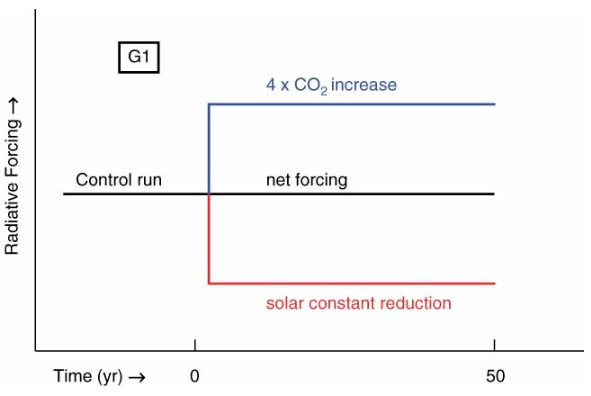
It seems that they were trying to replicate the kind of experimental design
seen in the Geoengineering Model Intercomparison Project’s (GeoMIP)
idealized G1 experiment (Figure 5) where a large increase in CO2 is offset
by an equivalent reduction in incoming sunlight to keep temperatures
constant. Here, they apply a 3.7 Wm-2 reduction in incoming sunlight for
every doubling of CO2 which seems reasonable at first glance, as it’s equal
to the global radiative forcing from a doubling of CO2. However, this
substantially underestimates the reduction in sunlight needed for a number
of reasons. First, ~30% of all incoming light is reflected to space,
second, the tropics and subtropics (which they simulate) receive more
sunlight than the global average, and third, reducing incoming sunlight
produces cloud feedbacks that can partially offset the reduction.
<https://substackcdn.com/image/fetch/f_auto,q_auto:good,fl_progressive:steep/https%3A%2F%2Fsubstack-post-media.s3.amazonaws.com%2Fpublic%2Fimages%2Fbbee37d4-41af-4486-be0c-1da90dcead47_591x396.png>

*Figure 5.* Schematic of experiment G1. The experiment is started from a
control run. The instantaneous quadrupling of CO2 concentration from
pre-industrial levels is balanced by a reduction in the solar constant
until year 50. Figure 1 from Kravitz et al. (2011)
<https://rmets.onlinelibrary.wiley.com/doi/full/10.1002/asl.316>.

In the GeoMIP G1 experiment
<https://agupubs.onlinelibrary.wiley.com/doi/full/10.1002/jgrd.50646> the
models needed to reduce incoming sunlight by between 1.75% and 2.5% for
every doubling of CO2 to offset all warming. If we take the middle of that
range, 2.25%, and multiply it by the insolation in their cloud resolving
model (471 Wm-2) we find that they should have reduced incoming sunlight by
10.6 Wm-2 for every doubling of CO2 rather than 3.7 Wm-2 if they wanted to
represent SRM deployed to keep temperatures constant. Unsurprisingly, they
fail to keep temperatures constant as they ramp up their CO2
concentrations, only offsetting roughly half of the warming as compared to
their CO2-only runs.

At the point just before the break-up of the marine stratocumulus clouds in
their standard simulations (1200 ppm CO2), ~50% of the reduction in
radiative cooling comes not from CO2 forcing but from the elevated water
vapour content that comes from warming. As SRM has offset half of the
warming in their new runs, they reason that it has therefore halved this
water vapour contribution, and they suggest this means that it only
contributes ~25%, but this is incorrect. If CO2 contributed 2 units and
warming contributed a further 2 units, halving the warming would mean that
it contributed 1/3 of the new total. This means that by failing to
eliminate the warming they have overestimated the reduction in radiative
cooling that would be seen in a fully-offsetting deployment of SRM by ~50%.
In their SRM simulations radiative cooling has been reduced by 22%, which
suggests that if warming had been eliminated it would only have fallen by
~14.5%.

This residual warming also contributes to the increased evaporation and
latent heat flux from the surface, another source of instability (Equation
1). They find that the latent heat flux is ~17% stronger in their SRM
simulations just before the break-up due to this warming. However, if
they’d been successful in offsetting all warming with SRM then we might
instead expect a reduction, or at most no change, in evaporation and latent
heat flux as seen in the GeoMIP G1 simulations (Kravitz et al. 2013
<https://agupubs.onlinelibrary.wiley.com/doi/full/10.1002/jgrd.50646>,
Figure 3).

According to my very rough calculations
3
, if they had eliminated the warming in their SRM simulations, rather than
only halving it, they would have found that they needed to *double CO2
concentrations again* to produce marine stratocumulus break-up in their SRM
simulations. If I’m right, then rather than SRM increasing the critical
threshold by 500 pppm from >1200 to >1700 ppm as they suggest, it would
have increased it by 2200 ppm, from >1200 to something more like >3400 ppm.More
research needed

Schneider et al.’s 2019 paper
<https://www.nature.com/articles/s41561-019-0310-1> was a groundbreaking
piece of work, highlighting a novel potential mechanism that could lead to
a tipping point in marine stratocumulus and dramatic warming under high CO2
conditions. While another idealized study
<https://journals.ametsoc.org/view/journals/clim/36/8/JCLI-D-22-0528.1.xml> has
reproduced their findings, much more work is needed on this issue.

Their 2020 paper <https://www.pnas.org/doi/abs/10.1073/pnas.2003730117> was
a neat extension of their work, but it misrepresented SRM in such a way
that they grossly underestimated the potential of SRM to address this
potential tipping point. They also mischaracterised their own findings to
promote a message that SRM “fails to mitigate” when in fact they showed
that it would greatly increased the CO2 threshold from extremely high
(>1200 ppm) to implausibly high concentrations (>1700 ppm) and reduce the
temperature increase substantially. If they’d simulated SRM correctly (and
my rough calculations are correct), they’d likely have shown that it would
have raised the threshold from implausibly high to impossibly high levels
(>3400 ppm)
4
.

If the marine stratocumulus collapse theory is borne out in future
simulations, and Schneider et al.’s simple conceptual model holds up, then
I’m confident that future studies of SRM’s potential to address this threat
will show that it is far more effective than Schneider et al. 2020
<https://www.pnas.org/doi/abs/10.1073/pnas.2003730117> suggest.

*FIN*


1
<https://peteirvine.substack.com/p/srm-would-likely-prevent-the-only?utm_source=twitter&sd=pf#footnote-anchor-1-134568089>

*Fig. 1 | Simulated subtropical clouds in the present climate (400 ppm
Co2), at higher Co2 (1,200 ppm) and after stratocumulus breakup (1,300
ppm).* In stratocumulus clouds, longwave radiative cooling of the cloud
tops propels air parcels downward, which convectively connects the clouds
to their moisture supply at the surface. Turbulence entrains warm and dry
air across the inversion, which counteracts the radiative cooling and
convective moistening of the cloud layer. When the atmospheric
concentration of greenhouse gases (for example, CO2 and H2O) increases
(1,200 ppm), the longwave cooling of the cloud tops weakens, because the
downwelling longwave radiation that reaches the cloud tops from above
emanates at lower levels with higher temperatures relative to the cloud-top
temperatures. Eventually, at sufficiently high greenhouse gas
concentrations (1,300 ppm in our simulation without subsidence changes),
stratocumulus decks break up into cumulus clouds, which leads to dramatic
surface warming. Evaporation then strengthens, and the average longwave
cooling at the level of the cloud tops drops to less than 10% of its value
in the presence of stratocumulus decks.
2
<https://peteirvine.substack.com/p/srm-would-likely-prevent-the-only?utm_source=twitter&sd=pf#footnote-anchor-2-134568089>

*Fig. 3 | Stratocumulus instability and hysteresis with fixed large-scale
subsidence.* a, Subtropical cloud fraction. b, Cloud liquid water path
(LWP). c, Subtropical SST. d, Tropical SST. Red upward arrows indicate the
simulations that started from the baseline simulation with 400 ppm CO2;
blue downward arrows indicate the simulations that started from 1,600 ppm.
The CO2 axis is logarithmic (ticks every 200 ppm) because the radiative
forcing of CO2 is logarithmic in concentration. Departures of the SST
changes from straight lines indicate the degree to which the climate
sensitivity is state dependent. Higher climate sensitivities at high CO2,
after stratocumulus breakup, occur because the tropical column is
approaching a local runaway greenhouse state25.
3
<https://peteirvine.substack.com/p/srm-would-likely-prevent-the-only?utm_source=twitter&sd=pf#footnote-anchor-3-134568089>

Looking back to Equation 1, we can make a rough estimate of how much higher
CO2 concentrations would need to rise to reach the critical threshold if
the full warming had been offset by SRM. The key term is *(LHF/ΔL) *and at
the critical threshold (1700 ppm) in their simulations, LHF is 17% higher
and *ΔL* is 22% lower than in the baseline simulation (400 ppm), meaning
that we have a 33% increase in this term, (1.17/0.78)**(LHF_400/ΔL_400). *As
the radiative forcing from CO2 increases is logarithmic, a little over 2
doublings of the CO2 concentration had produced a 33% increase in this
term. If we recalculate the change in that term for a no warming case where
we assume there is no change in latent heat flux, and a radiative cooling
that is only 2/3 of the original, we get a change in this term of only 17%.
To get this back up to ~33% we would need to double the CO2 forcing again,
from >4 times today’s level to >8 times today’s level, i.e. >3200 ppm.
4
<https://peteirvine.substack.com/p/srm-would-likely-prevent-the-only?utm_source=twitter&sd=pf#footnote-anchor-4-134568089>

The most extreme emissions scenario considered by the IPCC, the implausible
SSP5-8.5 scenario which sees global coal consumption in 2100 that is *5x
higher than today’s
<https://www.carbonbrief.org/explainer-the-high-emissions-rcp8-5-global-warming-scenario/>*,
doesn’t reach 1200 ppm until around the end of the 21st century, 1700 ppm
in the 2nd half of the 22nd century, and never gets close to 3200 ppm.


*Source: Substack*

--
You received this message because you are subscribed to the Google Groups
"geoengineering" group.
To unsubscribe from this group and stop receiving emails from it, send an email
to [email protected].
To view this discussion on the web visit
https://groups.google.com/d/msgid/geoengineering/CAHJsh9-LHjspCzD1RxCiObehkJCpqAnhii_KvLoATcnGL13g8g%40mail.gmail.com.