*This item and others will be in the monthly “Solar Geoengineering Updates
Substack” newsletter:* https://solargeoengineeringupdates.substack.com/
-----------------------------------------------------------------
https://acp.copernicus.org/articles/23/15305/2023/

*Authors*
Jim M. Haywood <[email protected]>, Andy Jones, Anthony C. Jones, Paul
Halloran, and Philip J. Rasch
*How to cite*: Haywood, J. M., Jones, A., Jones, A. C., Halloran, P., and
Rasch, P. J.: Climate intervention using marine cloud brightening (MCB)
compared with stratospheric aerosol injection (SAI) in the UKESM1 climate
model, Atmos. Chem. Phys., 23, 15305–15324,
https://doi.org/10.5194/acp-23-15305-2023, 2023.
*Published: 14 Dec 2023*
*Abstract*

The difficulties in using conventional mitigation techniques to maintain
global-mean temperatures well below 2 ∘C compared with pre-industrial
levels have been well documented, leading to so-called “climate
intervention” or “geoengineering” research whereby the planetary albedo is
increased to counterbalance global warming and ameliorate some impacts of
climate change. In the scientific literature, the most prominent climate
intervention proposal is that of stratospheric aerosol injection (SAI),
although proposals for marine cloud brightening (MCB) have also received
considerable attention. In this study, we design a new MCB experiment
(G6MCB) for the UKESM1 Earth-system model which follows the same baseline
and cooling scenarios as the well-documented G6sulfur SAI scenario
developed by the Geoengineering Model Intercomparison Project (GeoMIP), and
we compare the results from G6MCB with those from G6sulfur. The deployment
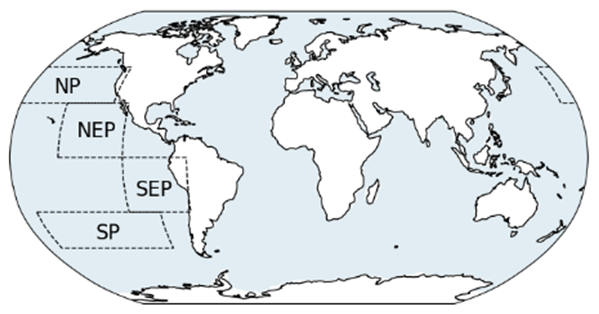
strategy used in G6MCB injects sea-salt aerosol into four cloudy areas of
the eastern Pacific. This deployment strategy appears capable of delivering
a radiative forcing of up to −1 W m−2 from MCB, but at higher injection
rates, much of the radiative effect in G6MCB is found to derive from the
direct interaction of the injected sea-salt aerosols with solar radiation,
i.e. marine sky brightening (MSB). The results show that while G6MCB can
achieve its target in terms of reducing high-end global warming to moderate
levels, there are several side effects. Some are common to SAI, including
overcooling of the tropics and residual warming of middle and high
latitudes. Other side effects specific to the choice of the targeted MCB
regions include changes in monsoon precipitation, year-round increases in
precipitation over Australia and the maritime continent, and increased
sea-level rise around western Australia and the maritime continent; these
results are all consistent with a permanent and very strong La Niña-like
response being induced in G6MCB. The results emphasize that considerable
attention needs to be given to oceanic feedbacks for spatially
inhomogeneous MCB radiative forcings. It should be stressed that the
results are extremely dependent upon the strategy chosen for MCB
deployment. As demonstrated by the development of SAI strategies which can
achieve multiple temperature targets and ameliorate some of the residual
impacts of climate change, much further work is required in multiple models
to obtain a robust understanding of the practical scope, limitations, and
pitfalls of any proposed MCB deployment.
[image:
https://acp.copernicus.org/articles/23/15305/2023/acp-23-15305-2023-f02]
<https://acp.copernicus.org/articles/23/15305/2023/acp-23-15305-2023-f02-web.png>

Figure 2The regions used for sea-salt injection in G6MCB; only ocean points
within each region were used
*Source: EGU*

--
You received this message because you are subscribed to the Google Groups
"geoengineering" group.
To unsubscribe from this group and stop receiving emails from it, send an email
to [email protected].
To view this discussion on the web visit
https://groups.google.com/d/msgid/geoengineering/CAHJsh994dKg5ThD-wJ6Oq5jQqO2QSGjpddRWcVCfwZ25GH1cZA%40mail.gmail.com.