*This item and others will be in the monthly “Solar Geoengineering Updates
Substack” newsletter:* https://solargeoengineeringupdates.substack.com/
---------------------------------------------------------------
https://www.eenews.net/articles/noaa-gets-dire-warning-about-solar-geoengineering/


*By Robin Bravender | 03/25/2024*

The agency is being asked to strengthen a toothless rule that requires only
a heads-up before experiments to modify the weather.

As a Phoenix heat wave is killing hundreds of people, an entrepreneur
approaches the city’s mayor with an extraordinary offer.

The company will spray enough aerosols into the sky to reduce temperatures
near Phoenix for a week, until the heat wave passes. It’s a tempting offer
that could save lives, although the science surrounding what happens next
isn’t clear.

Such a scenario might once have been the stuff of science fiction novels,
but it’s no longer far-fetched, said David Bookbinder, a longtime climate
attorney who previously served as Sierra Club’s chief climate counsel.

He and other climate experts fear that regulators aren’t ready for what’s
coming.

“I am more concerned about this than anything else,” Bookbinder said in a
recent interview. Climate solutions “are not going to get deployed in time,
which is only going to create more of a demand for something like this.”

As the climate continues to heat up and humanity feels the scorching,
sometimes deadly, consequences, environmentalists, scientists and business
executives are increasingly interested in exploring solar geoengineering
technologies that could blunt some of those effects. That includes
injecting aerosols into the stratosphere to reflect sunlight away from the
planet, also known as solar radiation modification.

But meddling with the climate is contentious, and efforts to regulate — or
even study — geoengineering on a large scale have proven difficult both
domestically and internationally.

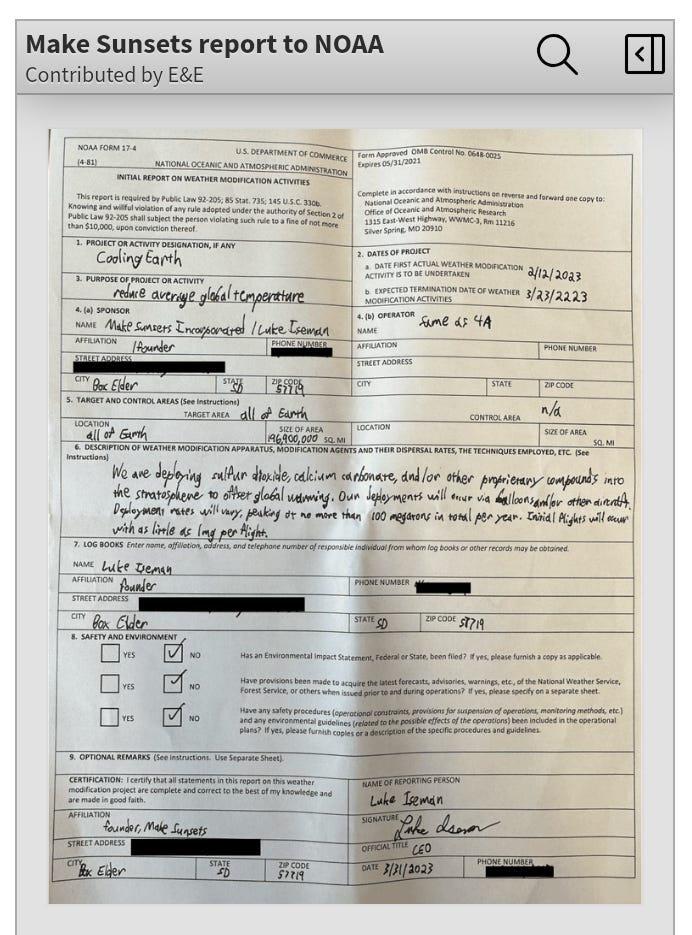
Currently, a U.S. company or citizen with plans to inject aerosols into the
atmosphere is required to fill out a one-page form
<https://library.oarcloud.noaa.gov/noaa_documents.lib/OAR/OWAQ/Weather_Modification_Project/Administrative/WxMod_Form17-4.pdf>
with
the Commerce Department 10 days before they do so, thanks to a law from the
1970s that requires reporting of efforts to modify the weather.

That’s not enough, say academics and researchers who are urging the
government to expand their rules governing private firms’ solar radiation
modification efforts. It’s part of a broader push to regulate small-scale
geoengineering experiments that are already happening.

“There’s no governance on the international level, national governance,
there’s no state governance, there’s nothing,” said Bookbinder.

Bookbinder represented environmental groups during his tenure at Sierra
Club in the landmark climate case *Massachusetts* *v. EPA, *which confirmed
the agency’s authority to regulate greenhouse gases as pollutants under the
Clean Air Act. He went on to work for the Niskanen Center, a libertarian
think tank. He’s now self-employed.

Bookbinder is agnostic on whether geoengineering technologies should be
deployed, he said, but he’s worried it could be done without proper
oversight and that the United States and international governments aren’t
prepared to keep it in check.

It’s been on his mind for a few years, Bookbinder said, since he started
wondering about “the next big problem that we’re not thinking about yet.”

“I said, ‘Holy shit, it’s not the climate change.’ We know what that is. We
know how it’s proceeding,” Bookbinder said. “It’s going to be the solutions
that people start offering up.”
Fodder for science fiction

Scientists know that aerosol particles can cool the Earth’s surface because
they temporarily reflect sunlight. The 1991 eruption of Mount Pinatubo in
the Philippines, for example, lowered the average global temperature
<https://earthobservatory.nasa.gov/images/1510/global-effects-of-mount-pinatubo>
by
about 1 degree Fahrenheit for roughly a year.

But widespread questions remain about the scientific and geopolitical
implications of injecting aerosols into the upper atmosphere to modify the
climate. Potential risks could include damage to the ozone or changes to
weather patterns — possibly impacting other countries. Geoengineering also
doesn’t address other harms associated with producing and burning fossil
fuels, such as local pollution and ocean acidification.

And if a country or company were to implement a major geoengineering
scheme, it would have to continue until carbon concentrations in the
atmosphere fell to a safe level or risk triggering a catastrophic spike in
global warming — a risk known as termination shock.

A proposal to study solar geoengineering was withdrawn from consideration
<https://subscriber.politicopro.com/article/eenews/2024/03/01/solar-geoengineering-proposal-withdrawn-at-un-summit-00144175>
at
a U.N. Environment Assembly earlier this year after nations failed to reach
agreement over how to approach the contentious issue.

Bookbinder pointed to a scenario laid out in the 2020 climate fiction novel
“Ministry for the Future” by Kim Stanley Robinson. Geoengineering is
central in the novel
<https://www.bbc.com/future/article/20231010-sun-solar-geoengineering-ministry-for-the-future-kim-stanley-robinson>,
which depicts India suffering from a deadly heat wave and spraying aerosols
into the stratosphere.

If something like that were to happen in the real world, “suppose then the
monsoon fails over India and China has a disastrous drought or heat wave,”
Bookbinder said. “Who do you think they’re gonna blame? The geopolitical
problems that can come if people start doing this on a national scale are
beyond imagining.”
‘Gaps’ in government rules?

International doomsday scenarios are Bookbinder’s biggest worry, he said.

On a smaller scale, he’s hoping to get the regulatory ball rolling by
prodding the U.S. government to update 1970s-era rules that track efforts
to modify the weather.

“As climate change accelerates and its damages mount, the investigation and
testing of some forms of climate intervention technologies” including solar
radiation modification, “appear imminent and inevitable,” Bookbinder and
others wrote in a March petition
<https://subscriber.politicopro.com/eenews/f/eenews/?id=0000018e-6702-d098-ad8f-e71ad7980002>
filed
with NOAA.

“While some of these activities will likely take place with federal
oversight and funding, the field overall lacks transparency and oversight,”
the petition says.

Signatories include Bookbinder; Tracy Hester of the Environment, Energy,
and Natural Resource Center at the University of Houston Law Center; Shuchi
Talati, founder of the Alliance for Just Deliberation on Solar
Geoengineering
<https://subscriber.politicopro.com/article/eenews/2023/04/17/former-doe-official-launches-solar-geoengineering-group-00091913>;
and other professors.

Make Sunsets later submitted the required form after NOAA communicated with
the company, Stein told E&E News Friday in an email. Anyone who knowingly
and willfully violates the rule may be subject to a fine. Outside of the
reporting requirements, NOAA has no role in approving such activities,
Stein said.
<https://substackcdn.com/image/fetch/f_auto,q_auto:good,fl_progressive:steep/https%3A%2F%2Fsubstack-post-media.s3.amazonaws.com%2Fpublic%2Fimages%2F9f614d98-f0ad-4a3d-96b1-f514aa974ab6_692x935.png>

Amid the broader controversy surrounding geoengineering, Harvard
University announced
last week
<https://subscriber.politicopro.com/article/eenews/2024/03/19/harvard-shuts-down-geoengineering-experiment-00147652>
that
it ended a solar radiation modification research project after years of
setbacks and opposition from critics.

But the idea still has plenty of interest — and experts say it’s gaining in
traction as the world appears on pace to exceed its climate targets.
Earlier this year, the Environmental Defense Fund hosted a meeting of
climate scientists, activists and philanthropists to discuss solar
geoengineering.

Many of the attendees would prefer that guidelines for solar geoengineering
research be established by a federal scientific coordinating body like the
U.S. Global Change Research Program, E&E News reported
<https://subscriber.politicopro.com/article/eenews/2024/02/14/inside-edfs-private-meeting-on-geoengineering-00141329>
.

The White House Office of Science and Technology Policy released a report
last June
<https://www.whitehouse.gov/wp-content/uploads/2023/06/Congressionally-Mandated-Report-on-Solar-Radiation-Modification.pdf>
laying
out a research plan for solar radiation modification. The Biden
administration stressed that the report came in response to a directive
from Congress and that the administration “remains focused on reducing
emissions, increasing resilience, advancing environmental justice, and
achieving true energy security.”

There are “no plans underway to establish a comprehensive research program
focused on solar radiation modification,” the White House wrote last year.

*Reporter Corbin Hiar contributed. *

*Source: E&E News*

--
You received this message because you are subscribed to the Google Groups
"geoengineering" group.
To unsubscribe from this group and stop receiving emails from it, send an email
to [email protected].
To view this discussion on the web visit
https://groups.google.com/d/msgid/geoengineering/CAHJsh99XpubVvdu5md_y4ELWFTXmhc_OAdAwRQ3Ft5WTXeH6aw%40mail.gmail.com.