WEEKLY SUMMARY (25 MARCH - 31 MARCH 2024)

*Subscribe to our newsletter to receive monthly updates on Solar
Geoengineering:*
Solar Geoengineering Updates
<https://solargeoengineeringupdates.substack.com?utm_source=substack&utm_campaign=publication_embed&utm_medium=email>
Monthly news summaries about solar geoengineering. Links to scientific
papers, news articles, jobs, podcasts, and videos.
<https://solargeoengineeringupdates.substack.com?utm_source=substack&utm_campaign=publication_embed&utm_medium=email>
By Andrew Lockley
<https://solargeoengineeringupdates.substack.com?utm_source=substack&utm_campaign=publication_embed&utm_medium=email>
------------------------------
RESEARCH PAPERSStratospheric circulation response to stratospheric aerosol
injections remains uncertain <https://europepmc.org/article/ppr/ppr823532>
Diallo, M., Dunker, N., Eichinger, R., Ploeger, F., Garny, H., Ern, M., ...
& Hegglin, M. (2024). Stratospheric circulation response to stratospheric
aerosol injections remains uncertain.

*Abstract*

Mitigating global warming through stratospheric aerosol injection (SAI),
which aims to reproduce the cooling effects of tropical volcanoes on
surface climate, is emerging as a potential strategy for limiting
near–surface global warming to around 1.5–2◦C above pre–industrial levels.
However, knowledge of how the stratospheric circulation will respond to
SAI, and the resulting feedback on surface climate and weather, remain
highly uncertain. Here, we quantify the stratospheric circulation response
to the 1991 Mount Pinatubo eruption and compare its response to a future
global warming scenario with and without tropical SAI. We show that the
shallow branch of the stratospheric circulation slows down in climate
models and observations following tropical aerosol perturbations due to
reduced lower stratospheric planetary and gravity wave breaking. However,
the depth and strength of the deep branch response is highly uncertain.
Climate models show a strengthening of the deep branch due to enhanced
middle/upper stratospheric planetary and gravity wave breaking, contrasting
with the observed weakening of the deep branch induced by reduced planetary
and gravity wave forcing. As interest in SAI continues to grow, our results
demonstrate the urgent need to study the impact of gravity/planetary wave
uncertainty on ozone recovery, surface climate and weather.

Solar Geoengineering: Assessing Whether Lack of Scientific Evidence
Justifies Halting Solar Geoengineering Research
<https://thesciencebrigade.com/jst/article/view/52>

Lonkar, A. (2024). Solar Geoengineering: Assessing Whether Lack of
Scientific Evidence Justifies Halting Solar Geoengineering Research. *Journal
of Science & Technology*, *5*(2), 57-68.

*Abstract*

This article examines the relevance of the research on solar
geo-engineering, which has become the new buzz-word in climate change
mitigation. With current climate mitigation policies becoming evidently
inadequate, one needs to look at science for the panacea. Solar
geoengineering is a double-edged sword, capable of giving desirable results
in the near future but equally capable of multiplying the complexities of
the problem in long term future. There continue to exist certain
deep-rooted concerns about the necessity and end-use consequences of this
technology. The article attempts to examine both these facets. It also
throws light on the concerns of indigenous communities and the principle of
intergenerational justice with respect to the conduct of solar
geoengineering research. The article ends with a conclusion which aims at
giving a balanced solution to the research question.

Trends in integrated assessments of solar radiation modification
considering its side-effects
<https://www.researchgate.net/profile/Takanobu-Kosugi/publication/374002715_Trends_in_integrated_assessments_of_solar_radiation_modification_considering_its_side-effects/links/65e137d4c3b52a117001d584/Trends-in-integrated-assessments-of-solar-radiation-modification-considering-its-side-effects.pdf>

Kosugi, T. Trends in integrated assessments of solar radiation modification
considering its side-effects.

*Abstract*

The implementation of SRM is expected to reduce the global average
temperature rise at a relatively low cost. However, there are concerns that
it will have considerable side effects. Therefore, to address SRM in
integrated assessment models, the models have been expanded to introduce
climate variables other than temperature, such as precipitation, as well as
variables related to the environment other than climate. Environmental
effects associated with measures against climate change extend beyond those
caused by SRM. Similar concerns apply to mitigation measures such as
biomass energy use, despite the differing nature of these measures.
Refinement of integrated assessment models to allow for a variety of
effects could be useful in assessing not only SRM but also mitigation
measures [29]. SRM research from a natural science perspective based on
Earth system models is also progressing. This research is expected to
comprehensively clarify the environmental impacts of SRM and devise SRM
implementation techniques that can reduce environmental damage [30-32].
However, the social effects of SRM, as represented by international
conflicts, are difficult to resolve only through scientific and
technological innovations. The role of governance is crucial [33]. Future
challenges will include determining ways to utilize integrated assessment
models to contribute to the discussion of SRM research and development and
implementation policies (including bans).

A Proposal of Geoengineering Method as Global Warming Countermeasure:
Stratospheric O3 Increase to Reduce Earth's Surface Temperature
<https://www.preprints.org/manuscript/202403.0854/v1>

Ohmori, T. (2024). A Proposal of Geoengineering Method as Global Warming
Countermeasure: Stratospheric O3 Increase to Reduce Earth's Surface
Temperature.

*Abstract*

A method of geoengineering/solar radiation management is proposed as global
warming countermeasure. The idea is to decrease surface temperature by
increasing stratospheric ozone. One-dimensional (vertical)
radiative-convective equilibrium temperature calculations show that surface
temperature can be lowered by increasing the amount of ozone in the
stratosphere. It was the increase in altitude above about 25 km that
reduced surface temperatures. The method of increasing the amount of ozone
(O3 injection), the rate of decrease of surface temperature after the ozone
increase, and the rate of decrease of ozone concentration by photochemical
reaction and diffusion/transport after the ozone increase are discussed.

A survey of interventions to actively conserve the frozen North
<https://link.springer.com/article/10.1007/s10584-024-03705-6>

van Wijngaarden, A., Moore, J. C., Alfthan, B., Kurvits, T., & Kullerud, L.
(2024). A survey of interventions to actively conserve the frozen
North. *Climatic
Change*, *177*(4), 58.

*Abstract*

The frozen elements of the high North are thawing as the region warms much
faster than the global mean. The dangers of sea level rise due to melting
glacier ice, increased concentrations of greenhouse gases from thawing
permafrost, and alterations in the key high latitude physical systems
spurred many authors, and more recently international agencies and
supra-state actors, to investigate “emergency measures” that might help
conserve the frozen North. However, the efficacy and feasibility of many of
these ideas remains highly uncertain, and some might come with significant
risks, or could be even outright dangerous to the ecosystems and people of
the North. To date, no review has evaluated all suggested schemes. *The
objectives of this first phase literature survey (which can be found in a
separate compendium* (https://doi.org/10.5281/zenodo.10602506), are to
consider all proposed interventions in a common evaluation space, and
identify knowledge gaps in active conservation proposals. We found 61
interventions with a high latitude focus, across atmosphere, land, oceans,
ice and industry domains. We grade them on a simple three-point evaluation
system across 12 different categories. From this initial review we can
identify which ideas scored low marks on most categories and are therefore
likely not worthwhile pursuing; some groups of interventions, like
traditional land-based mitigation efforts, score relatively highly while
ocean-based and sea ice measures, score lower and have higher uncertainties
overall. This review will provide the basis for a further in-depth expert
assessment that will form phase two of the project over the next few years
sponsored by University of the Arctic.

------------------------------
*CONFERENCE PAPERS*Multi-model simulation of solar geoengineering indicates
avoidable destabilization of the West Antarctic ice sheet
<https://meetingorganizer.copernicus.org/EGU24/EGU24-7071.html>

Moore, J., Chen, Y., Yue, C., Jevrejeva, S., Visioni, D., Uotilla, P., &
Zhao, L. (2024). *Multi-model simulation of solar geoengineering indicates
avoidable destabilization of the West Antarctic ice sheet* (No.
EGU24-7071). Copernicus Meetings.

*Abstract*

Heat transported in Circumpolar Deep Water is driving the break-up of ice
shelves in the Amundsen Sea sector of Antarctica, that has been simulated
to be unavoidable under all plausible greenhouse gas scenarios. However,
climate intervention scenarios have not been considered. Solar
geoengineering changes global thermal radiative balance, and atmospheric
and oceanic transportation pathways. We simulate stratospheric aerosol
injection (SAI) designed to reduce global mean temperatures from those
under the unmitigated SSP5-8.5 scenario to those under the SSP2-4.5
scenario with six CMIP6-class Earth System Models. These consistently show
intensified Antarctic polar vortex and sub-polar westerlies, which
mitigates changes to easterly winds along the Amundsen Sea continental
shelf compared with greenhouse gas scenarios. The models show significantly
cooler Amundsen Sea waters and lower heat content at 300-600 m under SAI
than with either solar dimming or the SSP5-8.5 unmitigated greenhouse gas
scenarios. However, the heat content increases under all scenarios compared
with present day suggesting that although vulnerable ice shelves would
continue to thin, the rate would be lower for SAI even with SSP5-8.5
specified greenhouse gases, than for the moderate (SSP2-4.5) scenario. The
simulations here use climate interventions designed for global temperature
targets; interventions targeted at preserving the frozen high latitudes
have also been proposed that might be expected to produce bigger local
effects, but potentially deleterious impacts elsewhere. Considering the
huge disruptions to society of ice sheet collapse, more research on
avoiding them by intervention technology is a moral imperative.

Exploring the impacts of changes in solar radiation on ecohydrological
variables <https://meetingorganizer.copernicus.org/EGU24/EGU24-7258.html>

Wang, Y., Meili, N., & Fatichi, S. (2024). *Exploring the impacts of
changes in solar radiation on ecohydrological variables* (No. EGU24-7258).
Copernicus Meetings.

*Abstract*

Several geoengineering projects are designed to modify solar radiation to
limit global warming. These changes in solar radiation can have impacts on
ecohydrological systems which are poorly quantified. In this study, CMIP6
outputs were used to calculate sensitivities of global and local
near-surface meteorological variables to solar radiation changes. These
sensitivities were applied to the currently observed climate to perturb
meteorological variables in response to changes in solar radiation. These
new conditions were used as inputs to a mechanistic ecohydrological model
(T&C) to analyze the partitioning and changes in energy and water fluxes
and the response of vegetation productivity in different biomes and
climates. Specifically, we run two simulation scenarios to understand the
solar radiation impacts on ecohydrological systems. The first scenario
focuses only on changes in solar radiation, while the second scenario
considers the combined effects of solar radiation changes and its climate
feedback. The results show that, in the absence of climate feedback,
changes in solar radiation are mainly reflected in changes in sensible
heat, with less impact on the hydrological cycle, and vegetation
productivity is positively and linearly correlated with changes in solar
radiation. When climate feedback is included, the effects on latent heat
and hydrologic variables are more pronounced, and the response of
vegetation productivity to negative and positive solar radiation changes
tend to be asymmetric. These results provide a basis for how land-surface
processes could respond to regional brightening and dimming and future
solar geoengineering programs.

------------------------------
WEB POSTSPermitting for mCDR and mSRM
<https://www.epa.gov/ocean-dumping/permitting-mcdr-and-msrm> (US EPA)When
is ignorance the best strategy? (Plan A+)
Plan A+
When is ignorance the best strategy?
<https://peteirvine.substack.com/p/when-is-ignorance-the-best-strategy?utm_source=substack&utm_campaign=post_embed&utm_medium=email>
Researchers, and the societies they serve, generally believe that it is
better to know something than to not know it. There are exceptions, though.
Some knowledge is dangerous because it unlocks dangerous capabilities. The
secrets of the nuclear bomb were closely, if unsuccessfully, guarded by the
USA for obvious reasons. Similarly, there is great conce…
Read more
<https://peteirvine.substack.com/p/when-is-ignorance-the-best-strategy?utm_source=substack&utm_campaign=post_embed&utm_medium=email>
12 days ago · 2 likes · Pete Irvine
Divisive Sun-dimming study at Harvard cancelled: what’s next?
<https://www.nature.com/articles/d41586-024-00876-1> (Nature)Thinking fast
and slow about SRM (Plan A+)
Plan A+
Thinking fast and slow about SRM
<https://peteirvine.substack.com/p/thinking-fast-and-slow-about-srm?utm_source=substack&utm_campaign=post_embed&utm_medium=email>
Humans are not naturally neutral and objective truth seekers. We're capable
of complex, rational thought, but it seems this capability evolved to solve
problems and persuade others, rather than to pursue the truth. How will our
tendency towards reactive and motivated reasoning play out when it comes to
thinking about Solar Radiation Management…
Read more
<https://peteirvine.substack.com/p/thinking-fast-and-slow-about-srm?utm_source=substack&utm_campaign=post_embed&utm_medium=email>
6 days ago · 1 like · 1 comment · Pete Irvine
Brief Reflections On The SCOPEX Advisory Committee And Implications For
Research Governance
<https://sgdeliberation.org/brief-reflections-on-the-scopex-advisory-committee-and-implications-for-research-governance/>
(DSG)Roll The Dice To Save The Arctic?
<https://globalclimaterisks.org/insights/beyond-quick-fixes/roll-the-dice-to-save-the-arctic/>
(Global Climate Risks)
------------------------------
PODCASTWarm pool & SAI - Günther | Reviewer 2 does geoengineering

Warm pool & SAI - Günther

Reviewer 2 does geoengineering

1:27:19
<https://podcasts.apple.com/us/podcast/warm-pool-sai-g%C3%BCnther/id1529459393?i=1000650436323&uo=4>

"Moritz Günther tries valiantly to get @geoengineering1 to understand the
atmospheric dynamics of SAI's impacts on the warm pool, but it's rather
like watching him trying to train a baboon to use Photoshop - there's some
engagement, and the occasional flash of comprehension before it all gets
too much for him.

Günther, M., Schmidt, H., Timmreck, C., and Toohey, M.: Why does
stratospheric aerosol forcing strongly cool the warm pool?, EGUsphere
[preprint], https://doi.org/10.5194/egusphere-2024-429, 2024."

------------------------------
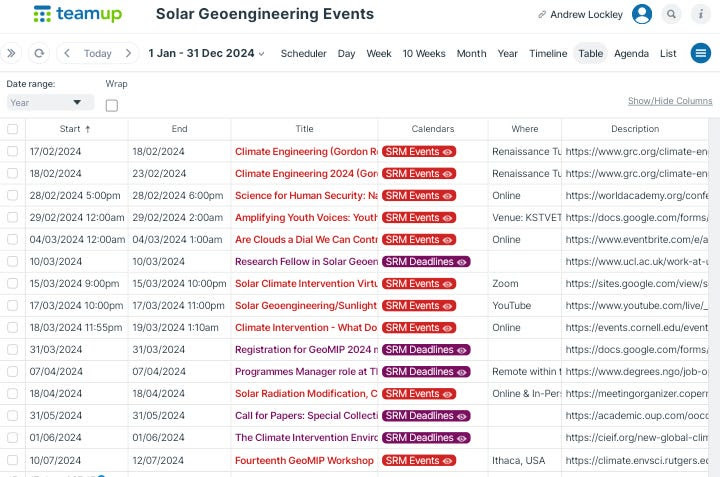
*UPCOMING EVENTS**Solar Radiation Modification, Clouds, Aerosols, and their
Impacts on the Biosphere and Earth System | EGU General Assembly
<https://meetingorganizer.copernicus.org/EGU24/session/49142> | 18 April
2024**Fourteenth GeoMIP Workshop | Ithaca, USA
<https://climate.envsci.rutgers.edu/GeoMIP/2024.html> | 10-12 July 2024*

Solar Geoengineering Events Calendar <https://teamup.com/ks64mmvtit583eitxx>

*GUIDELINES:**Sync selected events to your default calendar in these simple
steps:**1) Click on the event you want to sync.**2) Tap the menu icon
(three vertical lines) at the top left.**3) Choose 'Share.'**4) Pick your
default calendar.**5) Save the event.*

*Sync the entire Teamup Calendar to your default calendar with these simple
steps:**1) Tap the menu icon (three vertical lines) at the top right.**2)
Choose 'Preferences.'**3) Click 'iCalendar Feeds.'**4) Copy the URL shown
for 'Solar Geoengineering Events / SRM Deadlines.'’**5) Paste the URL into
your default calendar settings.**6) Click 'Subscribe' or 'Add Calendar.'**For
more detailed instructions,
visit: https://calendar.teamup.com/kb/subscribe-to-teamup-icalendar-feeds/
<https://calendar.teamup.com/kb/subscribe-to-teamup-icalendar-feeds/>*

*You can directly sync all Solar Geoengineering events to your default
calendars by pressing the link below:*

Sync SG Events to your Default Calendars
<https://ics.teamup.com/feed/ks64mmvtit583eitxx/0.ics>
<https://substackcdn.com/image/fetch/f_auto,q_auto:good,fl_progressive:steep/https%3A%2F%2Fsubstack-post-media.s3.amazonaws.com%2Fpublic%2Fimages%2F9179304a-0442-40cd-b8ed-974bcdacfa51_720x477.jpeg>
------------------------------

--
You received this message because you are subscribed to the Google Groups
"geoengineering" group.
To unsubscribe from this group and stop receiving emails from it, send an email
to [email protected].
To view this discussion on the web visit
https://groups.google.com/d/msgid/geoengineering/CAHJsh99JQpntZVbj_%3DenZr4L5SAUcpU%2BAVxbuBL1T%2BjPzvuwyQ%40mail.gmail.com.