*This item and others will be in the monthly “Solar Geoengineering Updates
Substack” newsletter:* https://solargeoengineeringupdates.substack.com/
---------------------------------------------------------------
https://www.nytimes.com/2024/04/02/climate/global-warming-clouds-solar-geoengineering.html

   -
   -

By Christopher Flavelle <https://www.nytimes.com/by/christopher-flavelle>


Photographs by Ian C. Bates

Christopher Flavelle reported from a decommissioned aircraft carrier in
Alameda, Calif. He spoke with scientists, environmentalists and government
officials.

   - *April 2, 2024*

A little before 9 a.m. on Tuesday, an engineer named Matthew Gallelli
crouched on the deck of a decommissioned aircraft carrier in San Francisco
Bay, pulled on a pair of ear protectors, and flipped a switch.

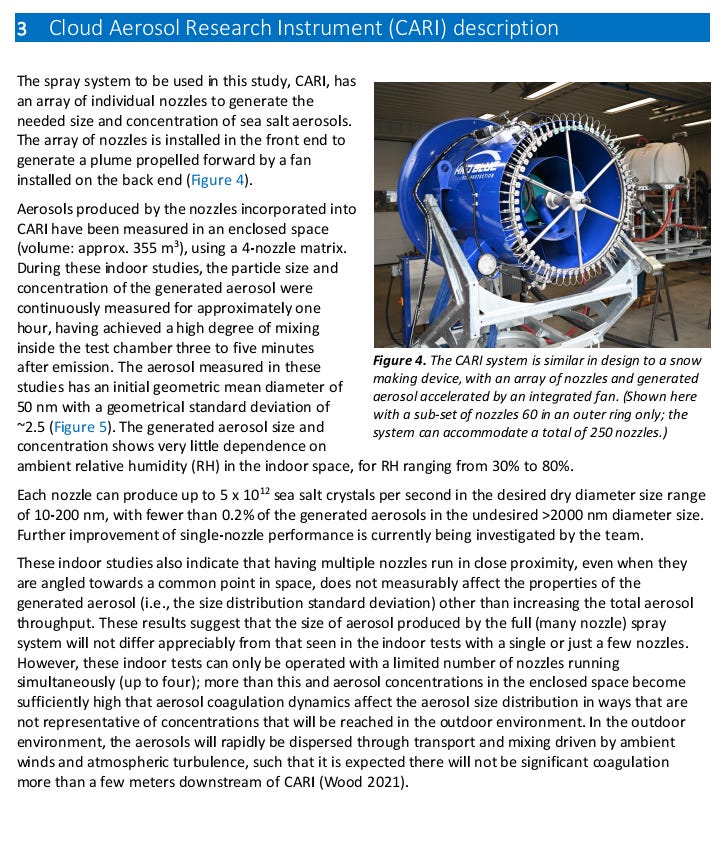
A few seconds later, a device resembling a snow maker began to rumble, then
produced a great and deafening hiss. A fine mist of tiny aerosol particles
shot from its mouth, traveling hundreds of feet through the air.

It was the first outdoor test in the United States of technology designed
to brighten clouds and bounce some of the sun’s rays back into space, a way
of temporarily cooling a planet that is now dangerously overheating. The
scientists wanted to see whether the machine that took years to create
could consistently spray the right size salt aerosols through the open air,
outside of a lab.

If it works, the next stage would be to aim at the heavens and try to
change the composition of clouds above the Earth’s oceans.

As humans continue to burn fossil fuels and pump increasing amounts of
carbon dioxide into the atmosphere, the goal of holding global warming to a
relatively safe level, 1.5 degrees Celsius compared with preindustrial
times, is slipping away. That has pushed the idea of deliberately
intervening in climate systems closer to reality.
[image: A view of the spraying machine, looking something like a short
cannon. The barrel is royal blue. A United States flag waves on a short
mast just behind, at the edge of the carrier’s flight deck.]
The sprayer on the deck of the Hornet.
[image: A close-up photo of a hand dumping salt from a pitcher into a
small, white tank.]
A researcher added salt to the solution for the machine.

Universities, foundations, private investors and the federal government
have started to fund a variety of efforts, from sucking carbon dioxide out
of the atmosphere
<https://www.nytimes.com/2024/03/31/climate/climate-change-carbon-capture-ccs.html?searchResultPosition=1>
to
adding iron to the ocean in an effort to store carbon dioxide on the sea
floor.

“Every year that we have new records of climate change, and record
temperatures, heat waves, it’s driving the field to look at more
alternatives,” said Robert Wood, the lead scientist for the team from the
University of Washington that is running the marine cloud brightening
project. “Even ones that may have once been relatively extreme.”

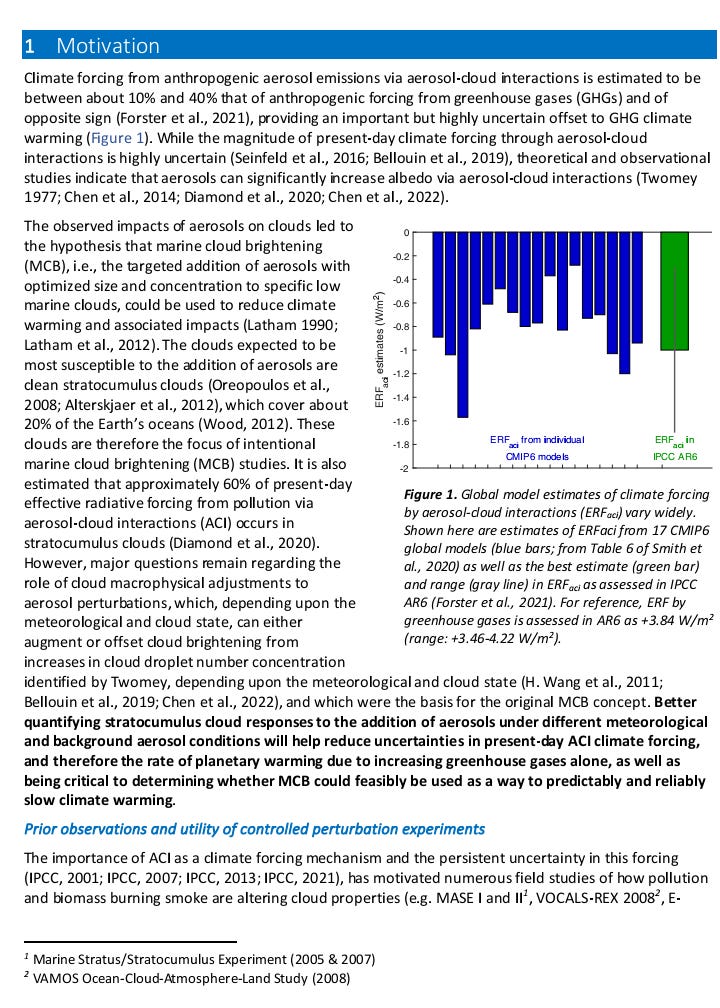
Brightening clouds is one of several ideas to push solar energy back into
space — sometimes called solar radiation modification, solar
geoengineering, or climate intervention. Compared with other options, such
as injecting aerosols into the stratosphere, marine cloud brightening would
be localized and use relatively benign sea salt aerosols as opposed to
other chemicals.
BUYING TIME
A series on the risky ways humans are starting to manipulate nature to
fight climate change.
Can We Engineer Our Way Out of the Climate Crisis?
Blocking solar rays. Sucking carbon dioxide from the atmosphere. Ideas that
sound like science fiction are now starting to become reality, raising
concerns about safety.
March 31, 2024
<https://www.nytimes.com/2024/03/31/climate/climate-change-carbon-capture-ccs.html?pgtype=Article&action=click&module=RelatedLinks>

And yet, the idea of interfering with nature is so contentious, organizers
of Tuesday’s test kept the details tightly held, concerned that critics
would try to stop them. Although the Biden administration is funding
research into different climate interventions, including marine cloud
brightening, the White House distanced itself from the California study,
sending a statement to The New York Times that read: “The U.S. government
is not involved in the Solar Radiation Modification (SRM) experiment taking
place in Alameda, CA, or anywhere else.”

David Santillo, a senior scientist at Greenpeace International, is deeply
skeptical of proposals to modify solar radiation. If marine cloud
brightening were used at a scale that could cool the planet, the
consequences would be hard to predict, or even to measure, he said.

“You could well be changing climactic patterns, not just over the sea, but
over land as well,” he said. “This is a scary vision of the future that we
should try and avoid at all costs.”
[image: Karen Orenstein, wearing a blue, long sleeve top, sitting on a
grassy clearing with a light brown fence and a brick building in the
background.]
Karen Orenstein, director of the Climate and Energy Justice Program at
Friends of the Earth U.S., said the focus should be on burning less fossil
fuel.Credit...Shuran Huang for The New York Times

Karen Orenstein, director of the Climate and Energy Justice Program at
Friends of the Earth U.S., a nonprofit environmental group, called solar
radiation modification “an extraordinarily dangerous distraction.” She said
the best way to address climate change would be to quickly pivot away from
burning fossil fuels.

On that last point, the cloud researchers themselves agree.

“I hope, and I think all my colleagues hope, that we never use these
things, that we never have to,” said Sarah Doherty, an atmospheric
scientist at the University of Washington and the manager of its marine
cloud brightening program.

She said there were potential side effects that still needed to be studied,
including changing ocean circulation patterns and temperatures, which might
hurt fisheries. Cloud brightening could also alter precipitation patterns,
reducing rainfall in one place while increasing it elsewhere.

But it’s vital to find out whether and how such technologies could work,
Dr. Doherty said, in case society needs them. And no one can say when the
world might reach that point.
[image: A man in a grey pullover and black pants and shoes is squinting
into the sun as he sits on the base of a lift on the deck of an aircraft
carrier.]
Robert Wood, the lead scientist for the team from the University of
Washington that is running the marine cloud brightening project.
[image: A woman is smiling into the sunshine, her dark hair blowing in the
breeze.]
Sarah Doherty, the manager of the university’s marine cloud brightening
program.
∴

In 1990, a British physicist named John Latham published a letter
<https://www.nature.com/articles/347339b0> in the journal Nature, under the
heading “Control of Global Warming?,” in which he introduced the idea that
injecting tiny particles into clouds could offset rising temperatures.

Dr. Latham later attributed his idea to a hike with his son in Wales, where
they paused to look at clouds over the Irish Sea.

“He asked why clouds were shiny at the top but dark at the bottom,” Dr.
Latham told the BBC in 2007
<http://news.bbc.co.uk/2/hi/programmes/6354759.stm>. “I explained how they
were mirrors for incoming sunlight.”

Dr. Latham had a proposal that may have seemed bizarre: create a fleet of
1,000 unmanned, sail-powered vessels to traverse the world’s oceans and
continuously spray tiny droplets of seawater into the air to deflect solar
heat away from Earth.

The idea is built on a scientific concept called the Twomey effect: Large
numbers of small droplets reflect more sunlight than small numbers of large
droplets. Injecting vast quantities of minuscule aerosols, in turn forming
many small droplets, could change the composition of clouds.

“If we can increase the reflectivity by about 3 percent, the cooling will
balance the global warming caused by increased C02 in the atmosphere,” Dr.
Latham, who died in 2021
<https://www.theguardian.com/science/2021/may/30/john-latham-obituay>, told
the BBC. “Our scheme offers the possibility that we could buy time.”

A version of marine cloud brightening already happens every day, according
to Dr. Doherty.

As ships travel the seas, particles from their exhaust can brighten clouds,
creating “ship tracks,” behind them. In fact, until recently, the cloud
brightening associated with ship tracks offset about 5 percent of climate
warming from greenhouse gases, Dr. Doherty said.

Ironically, as better technology and environmental regulations have reduced
the pollution emitted by ships, that inadvertent cloud brightening is
fading, as well as the cooling that goes along with it.
A deliberate program of marine cloud brightening could be done with sea
salts, rather than pollution, Dr. Doherty said.

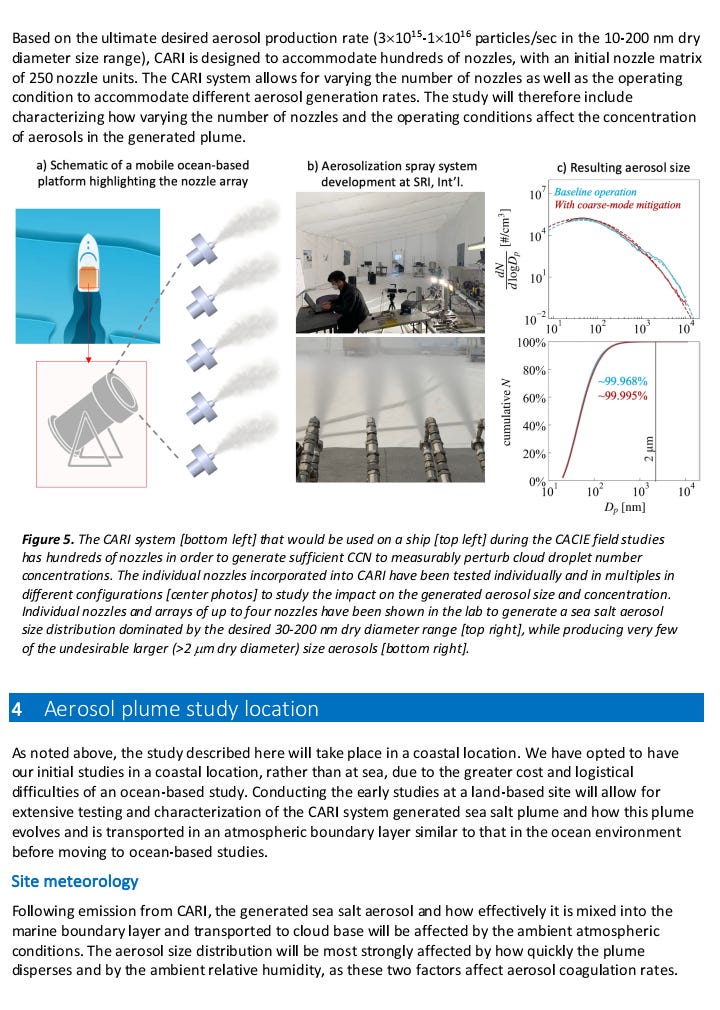
Brightening clouds is no easy task. Success requires getting the size of
the aerosols just right: Particles that are too small would have no effect,
said Jessica Medrado, a research scientist working on the project. Too big
and they could backfire, making clouds less reflective than before. The
ideal size are submicron particles about 1/700th the thickness of a human
hair, she said.

Next, you need to be able to expel a lot of those correctly sized aerosols
into the air: A quadrillion particles, give or take, every second. “You
cannot find any off-the-shelf solution,” Dr. Medrado said.

The answer to that problem came from some of the most prominent figures in
America’s technology industry.

In 2006, the Microsoft founder, Bill Gates, got a briefing from David
Keith, one of the leading researchers in solar geoengineering, which is the
idea of trying to reflect more of the sun’s rays. Mr. Gates began funding
Dr. Keith and Ken Caldeira, another climate scientist and a former software
developer, to further their research.


The pair considered the idea of marine cloud brightening but wondered if it
was feasible.

[image: Armand Neukermans, wearing beige pants and a grayish top, standing
at a trolley with what appears to be a tank, a compressor and a web of
wires and hoses.]
Armand Neukermans, an engineer and inventor, at the lab in Sunnyvale,
Calif., where his team began work on a spraying device.
[image: An office bathed in an eerie green light. On the left, a
concentrated beam of brighter green is focused on the wall.]
Using lasers to detect particles in the air at Dr. Neukermans’s lab.

So they turned to Armand Neukermans, a Silicon Valley engineer with a
doctorate in applied physics from Stanford and 74 patents. One of his early
jobs was at Xerox, where he devised a system to produce and spray ink
particles for copiers. Dr. Caldeira asked if he could develop a nozzle that
would spray not ink, but sea salt aerosols.

Intrigued, Dr. Neukermans, who is now 83, lured some of his old colleagues
out of retirement and began research in a borrowed lab in 2009, with
$300,000 from Mr. Gates. They called themselves the Old Salts.

The team worked on the problem for years, eventually landing on a solution:
By pushing air at extremely high pressure through a series of nozzles, they
could create enough force to smash salt crystals into exceedingly small
particles of just the right size.

Their work moved to a larger laboratory at the Palo Alto Research Center, a
former Xerox research facility now owned by SRI International, a
independent nonprofit research institute. Dr. Medrado became the lead
engineer for the project two years ago. By the end of last year, the
sprayer had been assembled and was waiting in a warehouse near San
Francisco.

The machine was ready. The team needed somewhere to test it.
[image: Jessica Medrado standing in a doorway. She is wearing a black
padded jacket and she has sunglasses perched on the top of her head. The
door and the wall around are gray and appear to be steel. She is holding
the door half-open with her right hand.]
Jessica Medrado of SRI International.
Weather instruments, for use in the study, on the deck of the Hornet.

As the researchers were perfecting the sprayer, a profound transformation
was happening outside their laboratory.

Since Dr. Latham first proposed the idea of marine cloud brightening, the
concentration of heat-trapping gases in the atmosphere has increased by
about
<https://www.climate.gov/news-features/understanding-climate/climate-change-atmospheric-carbon-dioxide>
20
percent. Last year was the hottest in recorded history
<https://www.nytimes.com/2024/01/09/climate/a-new-era-in-global-heat.html#:~:text=It's%20confirmed%3A%202023%20was%20the,the%20European%20Union's%20climate%20monitor.>
and
the World Meteorological Organization projects that 2024 will be another
record year <https://time.com/6554830/2023-hottest-year-ever/>. Global
ocean temperatures have been at record highs for the past year.
<https://www.washingtonpost.com/weather/2024/03/20/record-ocean-heat-climate/>

As the effects of climate change continue to grow, so has interest in some
sort of backup plan. In 2020, Congress directed the National Oceanic and
Atmospheric Administration to study solar radiation modification. In 2021,
the National Academies of Sciences, Engineering and Medicine published a
report saying the United States should “cautiously pursue” research
<https://www.nationalacademies.org/news/2021/03/new-report-says-u-s-should-cautiously-pursue-solar-geoengineering-research-to-better-understand-options-for-responding-to-climate-change-risks>
into
the idea. Last month, scientists from NOAA and other federal agencies proposed
a road map
<https://research.noaa.gov/2024/03/20/scientists-detail-research-to-assess-viability-and-risks-of-marine-cloud-brightening/>
for
researching marine cloud brightening.


Interest is growing overseas, as well. In February, an Australian team of
researchers at Southern Cross University, which was advised by Dr.
Neukermans, conducted a monthlong experiment off the country’s northeast
coast, spraying aerosols from a ship and measuring the response of clouds.

Daniel P. Harrison, the lead researcher, called the tests “the smallest of
baby steps aimed at confirming and refining the underpinning theory in the
real world.” He said it was too early to discuss any findings.

Private funding is also growing. Kelly Wanser is a former technology
executive who helped establish the marine cloud brightening project at the
University of Washington. In 2018 she created SilverLining
<https://www.nytimes.com/2020/10/28/climate/climate-change-geoengineering.html>,
a nonprofit organization to advance research into what she calls “near-term
climate interventions” like cloud brightening.

Ms. Wanser’s group is contributing part of the funding for the research at
the University of Washington and SRI, which is budgeted at about $10
million over three years, she said. That includes the study aboard the
Hornet, which is expected to cost about $1 million a year.

[image: A decommissioned aircraft carrier, seen from ground level, looking
up at the bow, on a gray day. In the far distance, a city skyline is
visible.]
The Hornet, now a floating museum, docked at Alameda, Calif.

Finding money for that work has gotten easier as record heat has “really
shifted attitudes” among funders, Ms. Wanser said. Donors include the
Quadrature Climate Foundation, the Pritzker Innovation Fund and the Cohler
Charitable Fund, established by the former Facebook executive Matt Cohler,
according to Ms. Wanser.

Last year, Ms. Wanser spoke with a member of the board that runs the
Hornet, which now operates as a museum affiliated with the Smithsonian.
Would they host a first-of-its-kind study?

The museum agreed. The test was a go.

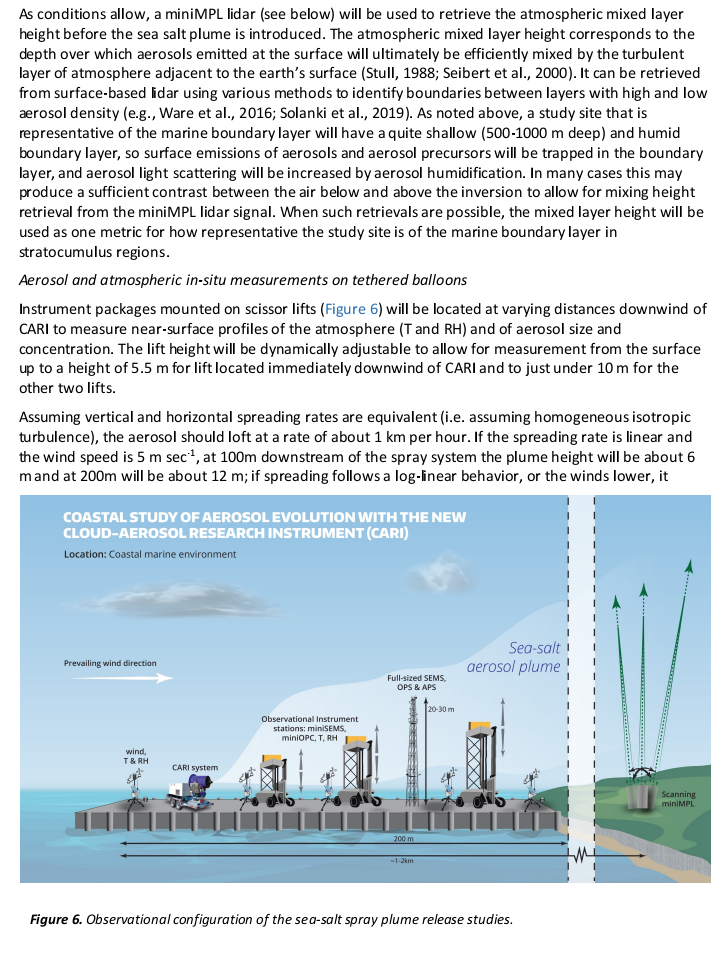
The flight deck of the Hornet rises 50 feet above the shore of Alameda, a
small town on the east side of San Francisco Bay. On Tuesday, it held a
series of finely calibrated sensors, perched atop a row of scissor lifts
reaching into the air.

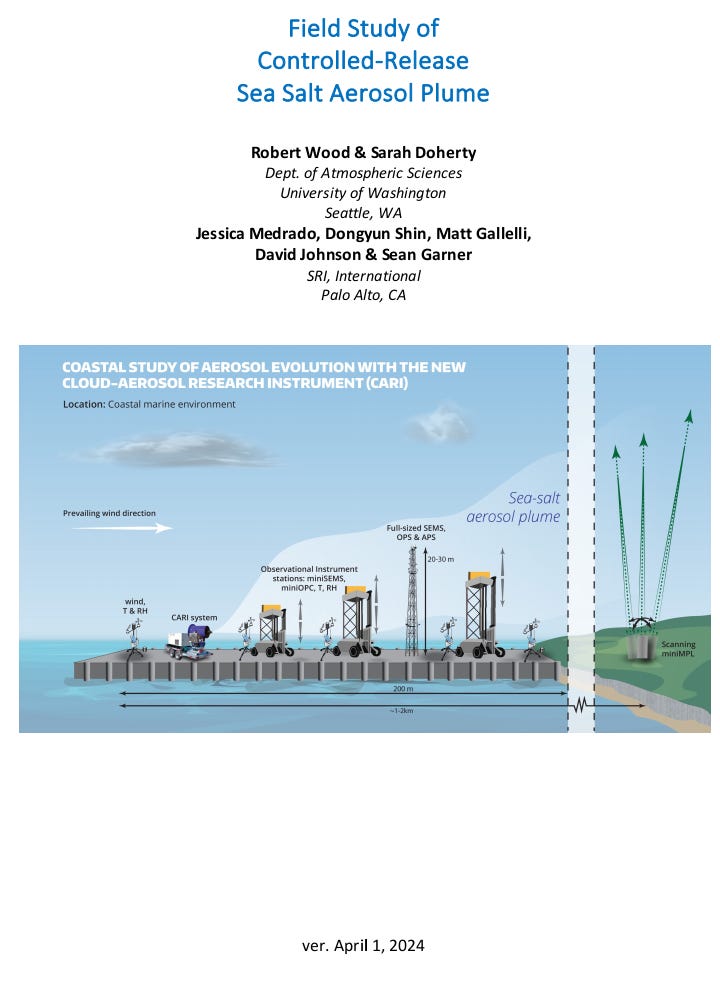
Underneath a United States flag at the far end of the flight deck was the
sprayer: Shiny blue, roughly the shape and size of a spotlight, with a ring
of tiny steel nozzles around its three-foot-wide mouth. The researchers
call it CARI, for Cloud Aerosol Research Instrument.

On one side of the sprayer was a box the size of a shipping container that
housed a pair of compressors, which fed highly pressurized air to the
sprayer through a thick, black hose. On the other side was a tank of water.
A series of switches, turned in careful sequence, fed the water and air
into the device, which then shot a fine mist toward the sensors.
[image: A portrait of Kelly Wanser, with her face half cast in shadow.]
Kelly Wanser, executive director of SilverLining.
[image: A cloud of mist hangs over scissor lifts placed around the carrier
deck.]
Scissor lifts held sensors to measure the spray during testing.

The goal was to determine whether the aerosols leaving the sprayer, which
had been carefully manipulated to reach a specific size, remained that size
as they rushed through the air in different wind and humidity conditions.
It will take months to analyze the results. But the answers could determine
whether marine cloud brightening would work, and how, according to Dr. Wood.

Ms. Wanser said she hoped the testing, which could continue for months or
longer, will demystify the concept of climate intervention technologies.
Toward that aim, the equipment will remain on the Hornet and be on display
during hours when the ship is open to the public. Even if the equipment is
not ultimately used to cool the planet, the data it generates can add to
the understanding of how pollution and other aerosols interact with clouds,
the researchers said.

Dr. Wood estimated that scientists could need another decade of tests
before they were in a position to potentially use marine cloud brightening
at the scale required to cool the Earth.

Ms. Wanser is already looking ahead to the next phase of that research.
“The next step is go out to the ocean,” she said, “aim up the spray a
little higher, and touch clouds.”


*Source: The New York Times*


*—————————————————*


*For more details on MCB Project visit: *

https://faculty.washington.edu/robwood2/wordpress/?page_id=1578


—————————————————


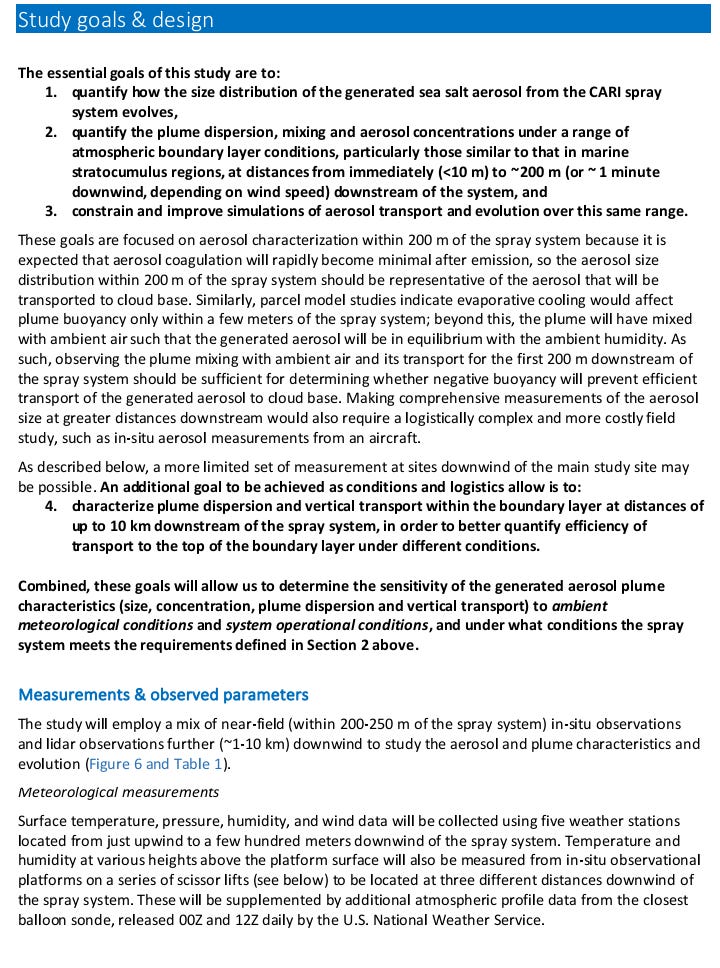
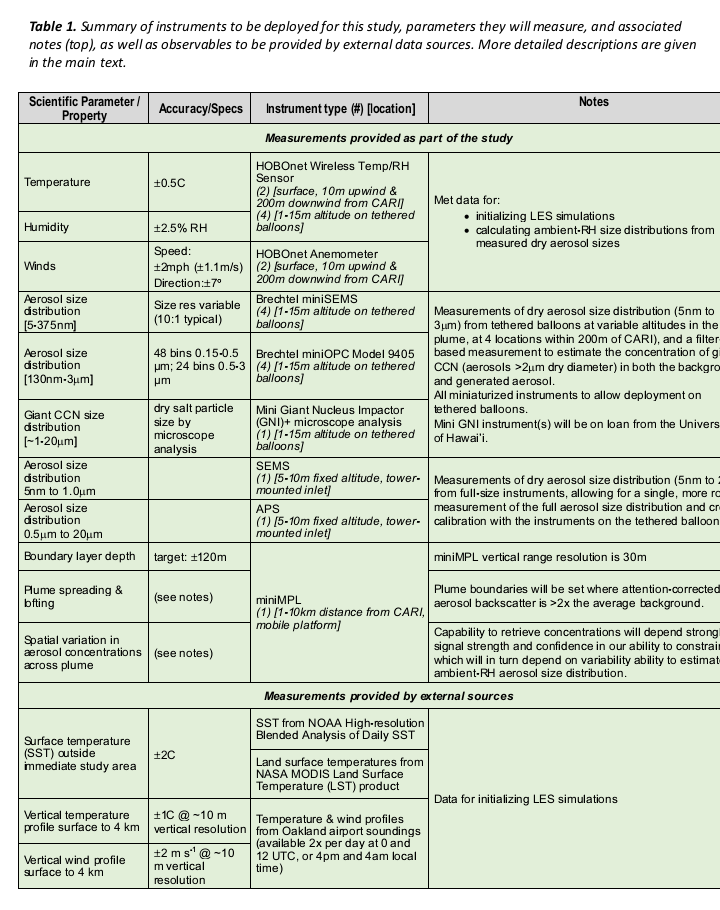
*A detailed description (study design) of this outdoor experiment using a
novel instrument (CARI) is available here:*

https://drive.google.com/file/d/1iJWCk5wGhAWbFPFcVftBojoO3_kqBA-o/view?usp=sharing


*Field Study of Controlled-Release Sea Salt Aerosol Plume*
<https://substackcdn.com/image/fetch/f_auto,q_auto:good,fl_progressive:steep/https%3A%2F%2Fsubstack-post-media.s3.amazonaws.com%2Fpublic%2Fimages%2F00a4d950-817d-4a98-8829-f99c20d79038_720x988.png>
<https://substackcdn.com/image/fetch/f_auto,q_auto:good,fl_progressive:steep/https%3A%2F%2Fsubstack-post-media.s3.amazonaws.com%2Fpublic%2Fimages%2Fa6fd8e4b-ee74-46cc-92cc-dd503a2361f4_720x1008.png>
<https://substackcdn.com/image/fetch/f_auto,q_auto:good,fl_progressive:steep/https%3A%2F%2Fsubstack-post-media.s3.amazonaws.com%2Fpublic%2Fimages%2F26cc9aad-87a5-4839-a6d5-4e072b7e9308_720x841.png>
<https://substackcdn.com/image/fetch/f_auto,q_auto:good,fl_progressive:steep/https%3A%2F%2Fsubstack-post-media.s3.amazonaws.com%2Fpublic%2Fimages%2F3738a325-e04c-4f87-a467-f1b1099cf376_720x1010.png>
<https://substackcdn.com/image/fetch/f_auto,q_auto:good,fl_progressive:steep/https%3A%2F%2Fsubstack-post-media.s3.amazonaws.com%2Fpublic%2Fimages%2F8e36df78-1808-4fc8-8a29-57802394b491_720x968.png>
<https://substackcdn.com/image/fetch/f_auto,q_auto:good,fl_progressive:steep/https%3A%2F%2Fsubstack-post-media.s3.amazonaws.com%2Fpublic%2Fimages%2F79d59304-5fb1-425c-83bc-274ab3d2bf52_720x954.png>
<https://substackcdn.com/image/fetch/f_auto,q_auto:good,fl_progressive:steep/https%3A%2F%2Fsubstack-post-media.s3.amazonaws.com%2Fpublic%2Fimages%2F9dbdd19a-1ac6-45a1-a917-7914a3949b76_720x910.png>

*Source: University of Washington, Department of Atmospheric Sciences*

--
You received this message because you are subscribed to the Google Groups
"geoengineering" group.
To unsubscribe from this group and stop receiving emails from it, send an email
to [email protected].
To view this discussion on the web visit
https://groups.google.com/d/msgid/geoengineering/CAHJsh9-14mDh6%2B95FY-yqGF9H_%2BCKRWED9_NTqQptpR7BPnhNg%40mail.gmail.com.